

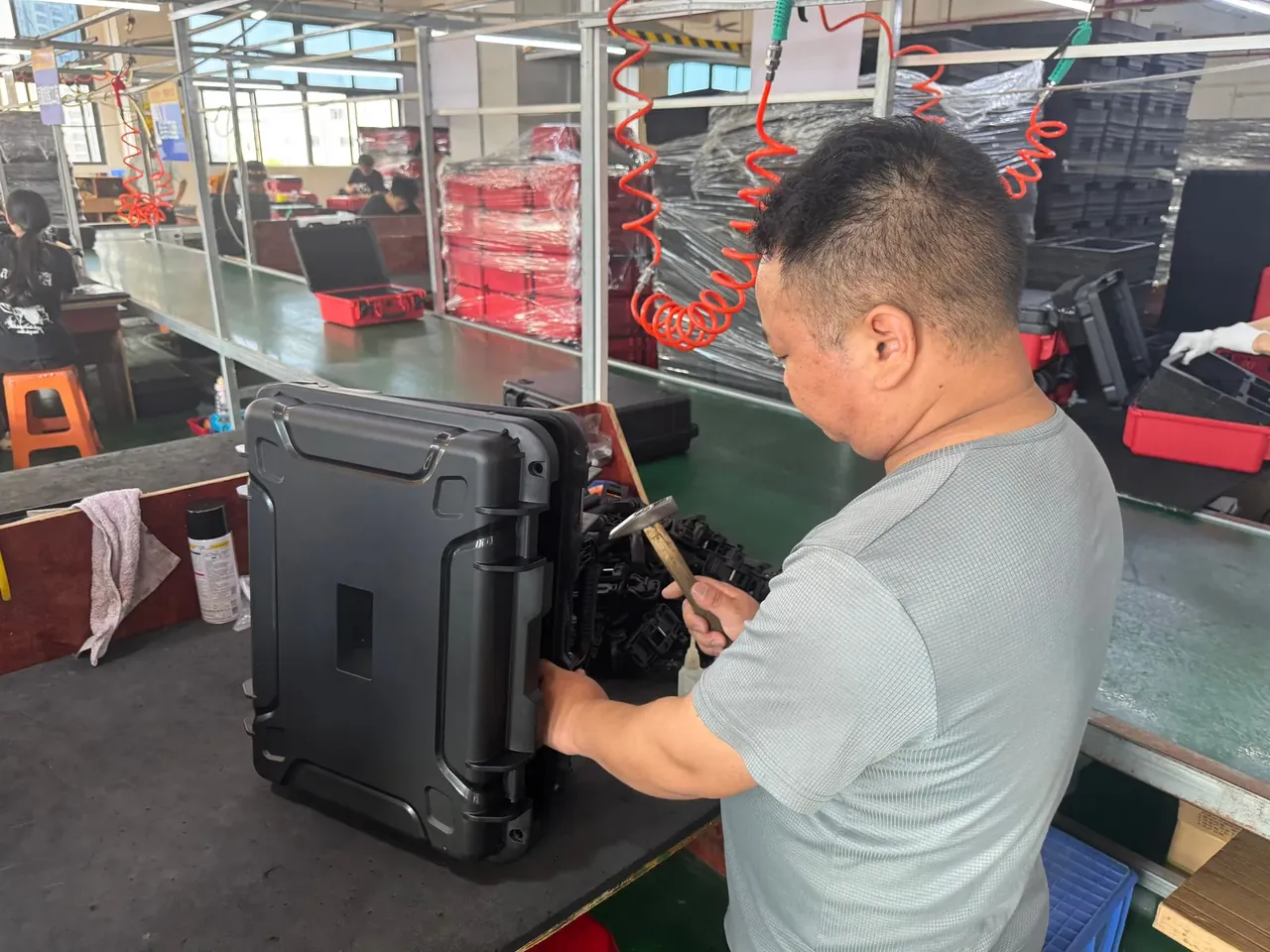
Quick answer: Case Hardware Assembly is bounded by three numbers: 1.6 kN rivet pull-out, an M5 window of 3.8–5.2 N·m, and under 12% decay after 480 h of spray.
Table of contents
- Rivet Pull-Out in Case Hardware Assembly
- The Torque Window for M5 Screws
- Torque Decay After Salt Spray
- Interchangeability and Rework
- Torque Setting for the Assembly Batch
- FAQ
1. Rivet Pull-Out in Case Hardware Assembly
Start with the rivet. In case hardware assembly, pull-out usually means the plastic wall tears before the rivet breaks. A φ4 blind rivet is rated 1600 N in shear and 2200 N in tension, but it clamps a 4.4 mm shell, so the weak side is the polymer. The 1.6 kN read on the bench marks the bore yielding, not the rivet snapping.
Pull speed is held down, because fast and slow pulls differ by around ten percent. Displacement control at 20 mm/min logs peak force and peak displacement separately, which keeps strength and ductility apart.
Rivet spacing governs the same failure. Centre-to-centre below 30 mm stacks the two bearing zones, so the second rivet seats while the first is already loosening. Pilot holes run half a size over nominal: oversized and the rivet shifts before it carries load, undersized and it raises radial craze at the rim.
2. The Torque Window for M5 Screws
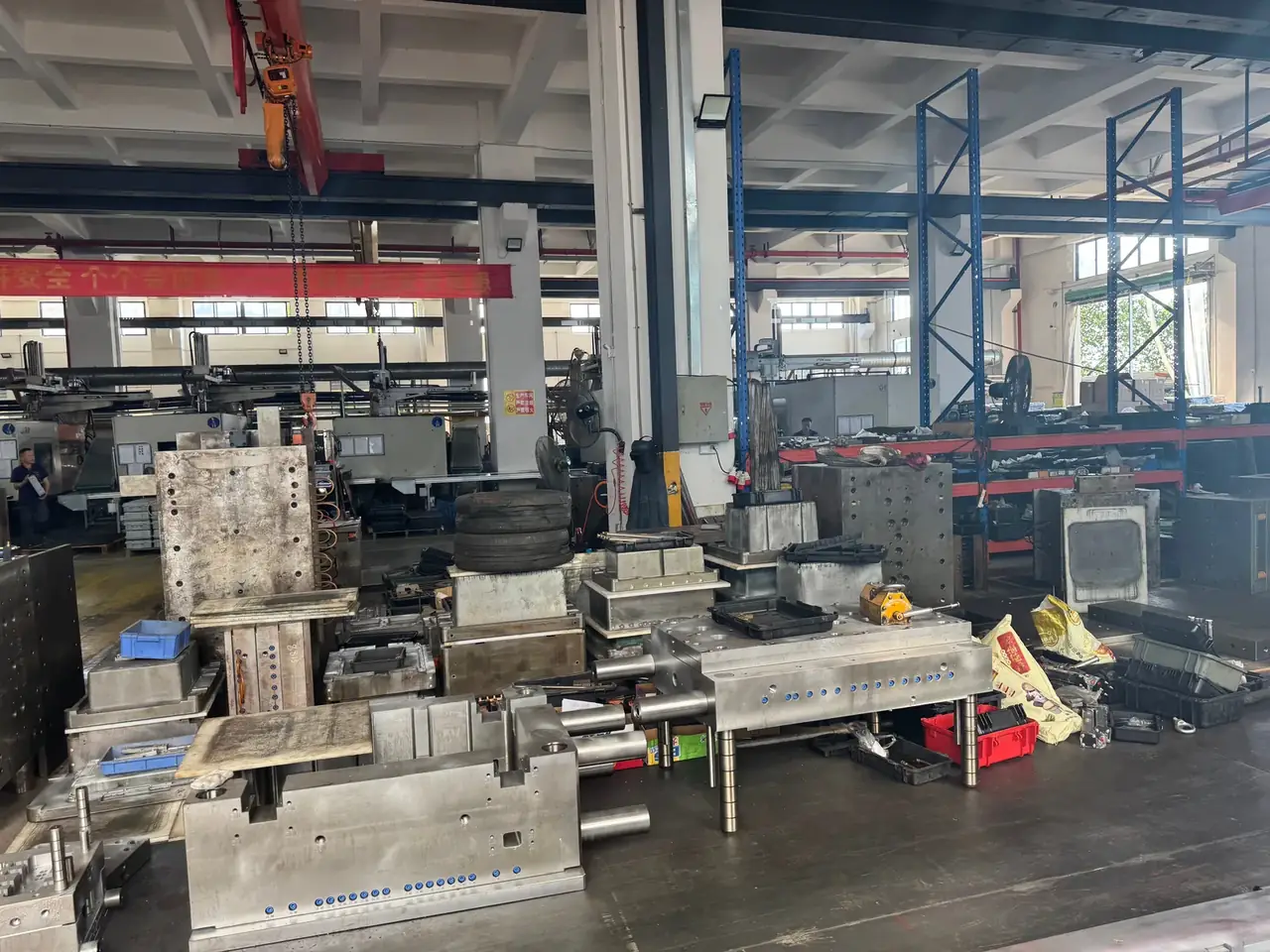
The window in case hardware assembly is pinched from both ends. The ceiling belongs to the boss root, which blushes past 5.2 N·m on an M5; the floor belongs to sealing, since under 3.8 N·m the gasket never compresses enough for IP66.
| Torque step | Setting | Clamp load | Boss condition |
|---|---|---|---|
| Low | 3.8 N·m | about 2.2 kN | Gasket seated with margin |
| Mid | 4.5 N·m | about 2.6 kN | Insert loaded evenly |
| High | 5.2 N·m | about 3.0 kN | Root blushing |
Clamp load is back-calculated from the nut factor. A dry steel screw in polymer runs near 0.35, so torque equals factor times clamp load times diameter; 4.5 N·m lands around 2.6 kN, which over the 14.2 mm² stress area of an M5 is a little above 180 MPa — fine in a glass-filled boss, too much for unfilled nylon.
Drivers are torque-controlled in case hardware assembly. Two units at one station, calibrated three months apart, can read 0.2 N·m differently, so a three-fastener check at shift start goes on the station card.
Screw length counts too. Under 8 mm of engagement the thread grips two or three pitches and the reading is fiction; driven through the wall, the inner face bulges and lifts the sealing surface.
3. Torque Decay After Salt Spray
Salt spray in case hardware assembly follows the neutral recipe: 5% sodium chloride, chamber at 35 °C, pH 6.5–7.2, fallout 1–2 mL per 80 cm² per hour. The 48, 96, 240, 480 and 720 h rungs each answer to a service environment, and 480 h is the one used for coastal work.
| Salt-spray stage | Solution and heat | What to look at | Use |
|---|---|---|---|
| 48 h | 5% NaCl, 35 °C | White rust on plating | Shipping spot check |
| 240 h | 5% NaCl, 35 °C | Thread galling tendency | Coastal batches |
| 480 h | 5% NaCl, 35 °C | Torque decay | Pass-line value |
Decay arrives by two routes. Plating loss raises thread friction, so the same setting delivers less clamp load; corrosion product packs the clearance, and a re-torque must crush that layer first, which inflates the reading.
Teardown in case hardware assembly happens within 24 h of the door opening: rinse, dry, let the sample settle. Leave it three or five days and the thread galls, so the number recorded is galling torque rather than decay. Re-torque backs off half a turn at the original position and drives back to setting; loading straight away measures static friction.
4. Interchangeability and Rework
A case hardware assembly kit holds 12 pieces: four latches, two hinge sets, two handle mounts, two foot pads, two valve seats. Fixed counts let rework be tracked by part number instead of by stripping a case.
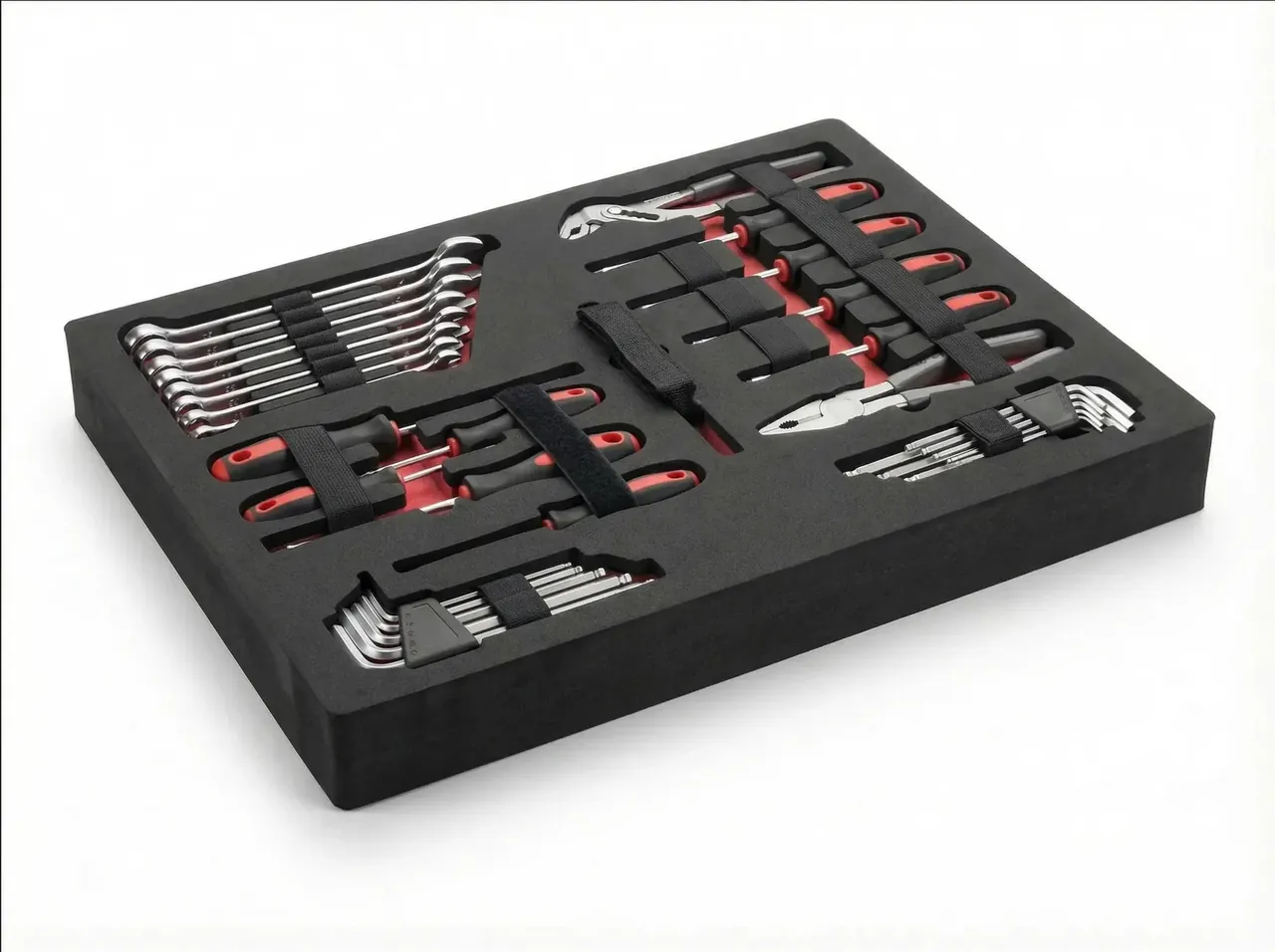
Interchangeability hangs on rivet hole diameter, which governs pull-out, and countersink depth, which governs appearance. A 0.2 mm change in latch tongue thickness moves closing force by about thirty newtons.
Rework in case hardware assembly is not extra torque. A case still leaking at 5.2 N·m has an under-compressed gasket or a lid flange out of flat, and more force only whitens the boss. Inspect the bore, relocate and re-rivet if cracked, replace the gasket if not.
Rework rate is held at 0.8%. Above it, check driver calibration, then hardware lot, then the shell; the reverse order condemns sound cases. Reworked units ship separately, with pull-out re-run to 1.6 kN because their bores have already carried a rivet.
5. Torque Setting for the Assembly Batch
The setting is the middle torque step in case hardware assembly — the one still showing under 12% decay after 480 h; the steps above and below serve as rework references only.
| Decay reading | Re-torque value | Verdict | Action |
|---|---|---|---|
| 8% | 4.14 N·m | Keep | Normal assembly |
| 11% | 4.01 N·m | Keep | Add a mark |
| 15% | 3.83 N·m | Over line | Strip and inspect |
The middle step sits at 4.5 N·m and re-torques to 4.14 N·m, an 8% loss with room before 12%. The 5.2 N·m step looks safer and is not: it parks the boss at the blush point and loosens sooner after spray. The 3.8 N·m step never compresses the gasket, so IP66 fails first.
The batch card carries four lines: initial 4.5 N·m, re-torque no lower than 4.01 N·m, spray 480 h, decay at or under 12%. Three boundaries follow — 580×410×230 mm outside, 515×350×170 mm cavity, 4300 open-close cycles. Switch supplier and boundaries stay while the values are re-measured.
Settings are versioned, and a change bumps the card one revision. A rework is traced by revision number rather than memory.
Conclusion
Case hardware assembly is fenced in by pull-out, torque and decay at once: 1.6 kN at the φ4 rivet protects the bore, 4.5 N·m at the M5 protects boss and gasket, and 12% after 480 h protects the calendar. Relax one and the other two stop meaning much. With the batch card versioned, a 95 s takt keeps running. JUNZHIJIA records IP66 as a benchmark rather than a certificate held.
Related Reading
- Export Packing: Plastic Case or Wooden Crate
- Torque, Latch Force and Gasket Imprint
- Assembly Inspection Intervals and Criteria
Related Products
- 8 Series — Gun Cases; Military Equipment Cases; Camera Equipment Cases; Drone Cases; Watch Cases; Knife Cases; First Aid Cases; Electronics Equipment Cases
- WL8-2812 PP Gun Case — model WL8-2812
- All protective cases and toolboxes: 7 series, 158 models