

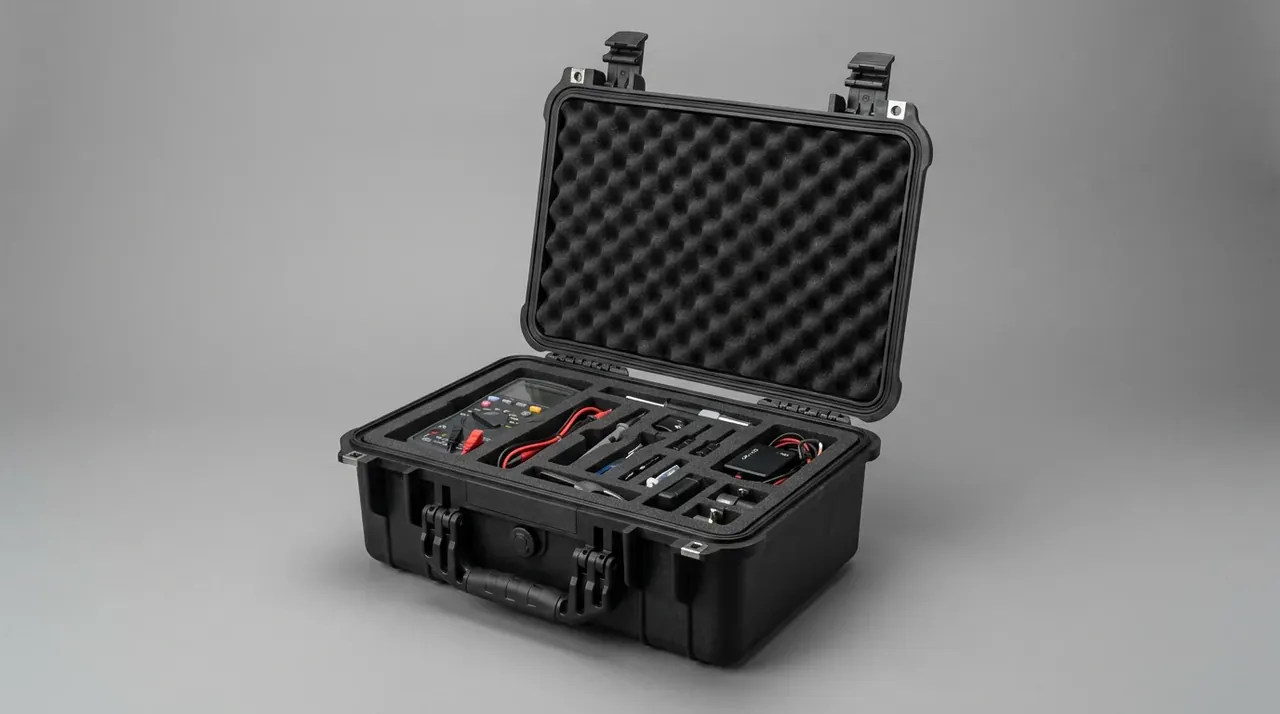
Quick answer: A case harness is chosen on three numbers: weight, strap width and belt share. Above 18 kg use twin shoulder and belt; one shoulder stops at 12 kg.
Table of contents
- A harness spreads 18 kg across support points
- One shoulder: the load lands on one collarbone
- Two shoulders and a belt: 30 % off here
- The sternum strap carries nothing
- Three numbers that set the sizes
- FAQ
1. A harness spreads 18 kg across support points
Carry 18 kg on a strap and the shoulder does not feel 18 kg. It feels 18 kg divided by contact area, which is why widening a case harness strap from 25 mm to 50 mm halves the pressure at the same load.
Pressure is the easy half. The centre of gravity is the hard half. A case is a rigid box, and once it hangs on the back its mass sits 120 mm to 180 mm from the spine, generating a moment the body answers by leaning forward.
So the first question about a case harness is how close the load can sit to the back; the second is how wide the straps are.
One strap gives one support point. Two points spread the moment, and a third hands part of the load to the hips.
The moment can be estimated with two numbers. At 18 kg with the centre 150 mm from the back, the waist sees 26 N·m; a panel that pulls the centre 6 mm closer drops it to 25 N·m, and that single newton-metre decides whether the ache arrives at 20 minutes or 40.
2. One shoulder: the load lands on one collarbone
A single-strap case harness runs from the right shoulder to the left hip. The whole load passes through one point above the right shoulder, and at 18 kg that point sits on skin with bone underneath; after 10 minutes the fingers tingle.
The practical ceiling for one shoulder is 12 kg. Past that the shoulder rises on its own, the trapezius takes over from the collarbone, and the neck aches within 20 minutes.
What one shoulder does well is speed: on the body in under 2 seconds, which still suits inspection work with frequent opening. The condition is a case under 12 kg and a strap at least 38 mm wide.
3. Two shoulders and a belt: 30 % off here
Two straps split the load in half, spaced 380 mm apart so each lands on the middle of a collarbone. Below 340 mm the straps crowd the base of the neck; past 420 mm they slide off the shoulder and the wearer keeps hitching them up.
The belt is the third support point and the one most often skipped. Cinched on the iliac crest it pulls the weight down, so the straps carry only the remainder. Belt webbing runs 40 mm wide: under 30 mm it cuts into the crest, over 60 mm it jams against the hip when the wearer bends. Let the belt slip below the hip and its share falls from 30 % to under 10 %, which makes a twin-shoulder case harness pointless.
| Configuration | Strap width mm | Case weight band | Load path |
|---|---|---|---|
| Single shoulder | 38 | Under 12 kg | One collarbone and trapezius |
| Twin shoulder | 50 | 12–18 kg | Both collarbones |
| Twin shoulder with belt | 50 | 18–25 kg | 70 % shoulder, 30 % hip |
| Twin, belt and sternum | 50 | Above 25 kg | 70 % shoulder, 30 % hip, closed across |
4. The sternum strap carries nothing
The sternum strap does one job: it pulls the two shoulder straps together at the breastbone so they cannot slide outward while walking. It carries a lateral force of 20 N to 40 N, an order of magnitude below the 176 N that 18 kg produces.
Its height is 180 mm below the shoulder line, which puts it across the middle of the sternum, where the closing lever is shortest and the strap does not cut into the armpit. Adjustment travel is 120 mm, enough for wearers from 155 cm to 190 cm; the right position is level with the elbow when the arm hangs relaxed.
Treating it as a load-bearing part is the usual mistake. Tighten it and both straps pull into a V, the inner edge digs into the trapezius, and pressure rises instead of falling. Inside a case harness the belt takes the weight and the sternum strap takes the stability.
5. Three numbers that set the sizes
Strap padding is 50 mm wide and 8 mm thick in EVA, with a 2 mm edge radius so it does not cut. Under 6 mm thick, pressure on the collarbone rises sharply; over 12 mm the padding stands off the shoulder and the contact area shrinks again.
The back panel of a case harness is 6 mm EVA, as wide as the 380 mm strap spacing. It separates the hard edge of the case from the spine and brings the centre of gravity 6 mm closer.
Set-up follows a fixed order: loosen everything, put the case on, tighten the belt, then the shoulder straps, then close the sternum buckle. Reverse it and the belt never gets tight, so the 30 % share is never collected.
| Strap width mm | Thickness mm | Contact pressure kPa | Case weight |
|---|---|---|---|
| 25 | 6 | 26 | Under 8 kg |
| 38 | 8 | 17 | Under 12 kg |
| 50 | 8 | 11 | Above 18 kg |
| Case weight band | Configuration | Strap spacing mm | Belt share |
|---|---|---|---|
| Under 12 kg | Single shoulder | Not applicable | 0 |
| 12–18 kg | Twin shoulder | 380 | 0 |
| 18–25 kg | Twin shoulder with belt | 380 | 30 % |
| Above 25 kg | Twin, belt, sternum | 380 | 30 % |
Conclusion
The difference between harness types is the number of support points, not the finish of the webbing. One point puts 18 kg on a single collarbone and caps the load at 12 kg; two points spread it across 380 mm; a belt adds the third and removes 30 %, so the shoulders carry 12.6 kg. The sternum strap stays a closure part and never joins the load path.
Related Reading
- Measured handle load ratings
- Handle position for a two-person lift
- Matching wheels to a trolley handle
- Handle dimensions for ergonomics
Related Products
- 8 Series — Gun Cases; Military Equipment Cases; Camera Equipment Cases; Drone Cases; Watch Cases; Knife Cases; First Aid Cases; Electronics Equipment Cases
- WL8-2812 PP Gun Case — model WL8-2812
- All protective cases and toolboxes: 7 series, 158 models