

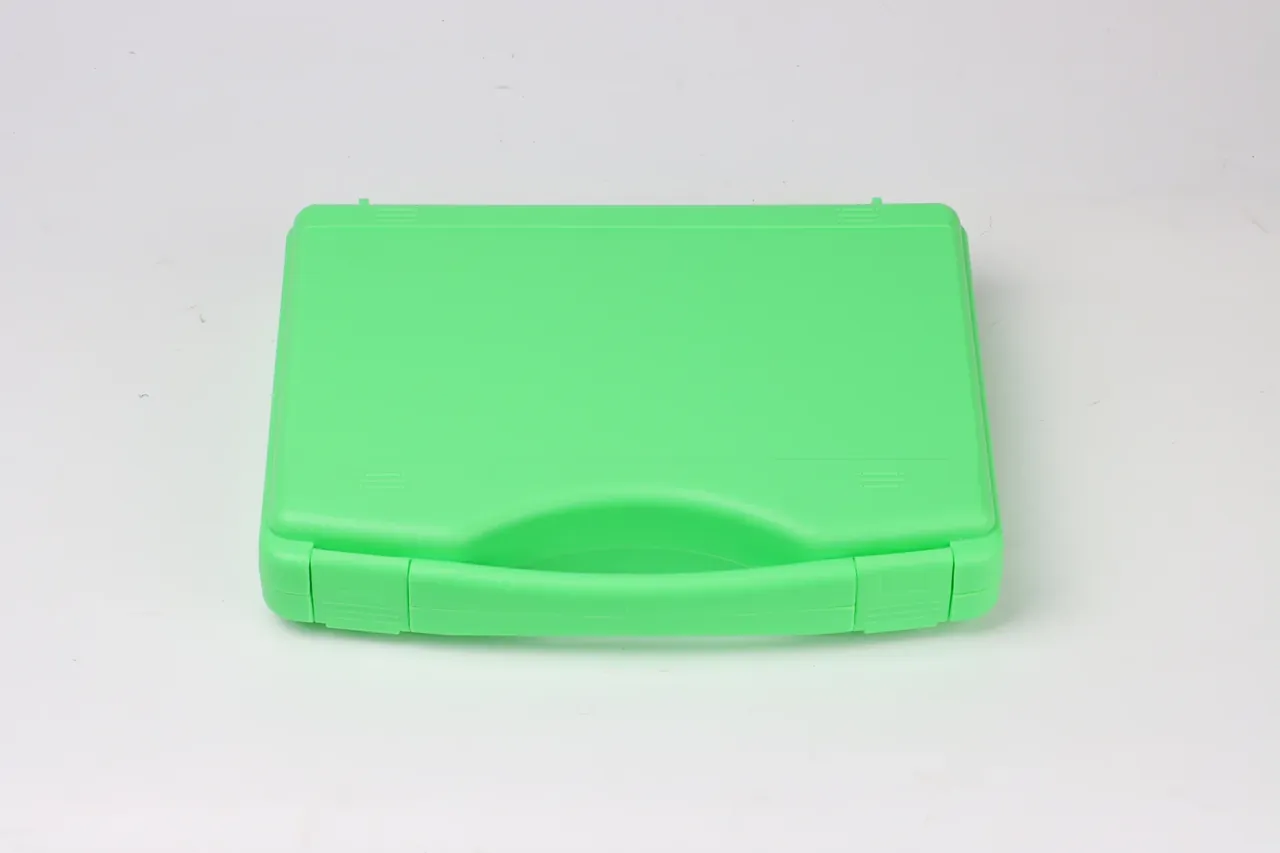
Quick answer: Case handle load is the total weight times a dynamic factor of 1.3, so a 20 kg load means 26 kg static and 255 N while walking. Three limits decide pass or fail: no more than 1.5 mm of set after 24 hours loaded, no more than 0.4 mm of pin clearance after 7200 sway cycles, and no clip release in a 0.9 m handle-down drop.
Table of contents
- Three Numbers Before Any Design
- Grip Test: Four Load Points at 20 kg
- From 196 N to 255 N: Wall and Pin
- 7200 Sway Cycles and a Handle-Down Drop
- What PP Has Left at -20 °C
- Putting the Load on the Drawing
- FAQ
1. Three Numbers Before Any Design
Twenty kilos is five numbers added up: 4.3 kg of case, 6.2 kg of instrument, 3.4 kg of probes and cable, 2.1 kg of batteries, 4.0 kg of spares. The handle carries that total, not the volume on the label.
The dynamic factor comes next: a static lift is 196 N, a walking carrier peaks at 1.3 times or 255 N, stairs at 1.8 times or 355 N. Quote all three separately. Sway runs on top, ±150 mm at 1 Hz, which is 7200 cycles in two hours and sets how far the pin bore wears.
| Total load | Static | Dynamic (1.3×) | Span | Grip wall |
|---|---|---|---|---|
| 10 kg | 98 N | 127 N | 140 mm | 3.5 mm |
| 15 kg | 147 N | 191 N | 155 mm | 4.0 mm |
| 20 kg | 196 N | 255 N | 168 mm | 4.5 mm |
| 30 kg | 294 N | 382 N | 185 mm | 5.5 mm |
2. Grip Test: Four Load Points at 20 kg
Load lands on four points: palm face, fingers, clips, screw bosses. Whichever reaches its limit first decides the failure.
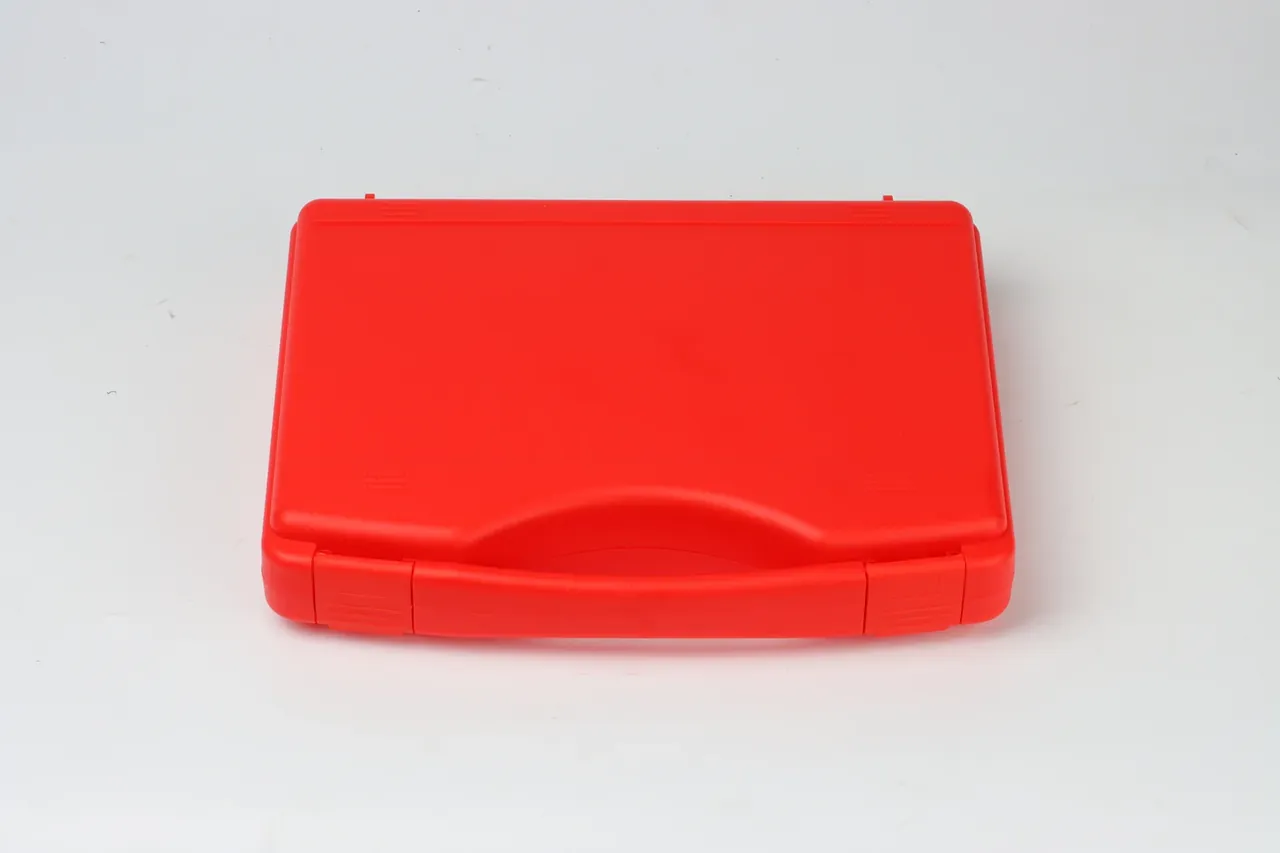
The palm is pressure: a 168 mm grip with a 26 × 16 mm oval section has 3700 mm² of perimeter, 40% of it touching the hand, so 1480 mm². At 196 N that is 0.13 MPa. Radius the edge at 2 mm only and contact falls to 630 mm², pressure rises to 0.31 MPa, and two kilometres of walking leaves a red line across the palm.
A TPE overmould settles that: 55 Shore A deflects 1.2 mm under 196 N, contact grows 1.6 times and pressure falls to 0.08 MPa.
The rear points are harder. Clip on pin is plastic on plastic and wears by cycle count; an M4 screw in PP pulls out at 300 N, 1200 N for four, derated 30% to 840 N, a factor of 3.3 on 255 N.
3. From 196 N to 255 N: Wall and Pin
Two arms 4.5 mm thick and 18 mm deep give 162 mm², and 255 N over that is 1.6 MPa against 25 MPa yield, so the handle fails at a hole rather than the section.
A 5 mm 304 pin in double shear has 39.3 mm² and sees 6.5 MPa against 205 MPa yield. The real limit is the plastic ear: 3.5 mm between bore and edge takes 8.1 MPa, and 7200 cycles chew that edge.
So wall follows the bore: an ear of 5 mm rather than 3.5 drops edge stress to 5.7 MPa for 0.6 per unit, and a 6 mm pin pulls clearance at 7200 cycles from 0.35 to 0.28 mm.
| Handle type | Set at 20 kg | Palm pressure | Clearance after 7200 | Cost |
|---|---|---|---|---|
| One-piece fold, 4.5 mm PP | 0.8 mm | 0.31 MPa | 0.35 mm | 0 |
| Overmoulded fold, TPE 55 A | 1.1 mm | 0.08 MPa | 0.35 mm | 6.8 |
| Metal bracket, plastic grip | 0.3 mm | 0.11 MPa | 0.12 mm | 12.0 |
4. 7200 Sway Cycles and a Handle-Down Drop
A sway rig clamps the case, hangs 20 kg on the handle and runs ±150 mm at 1 Hz for two hours. Clearance reads 0.05 mm new and 0.35 mm at 7200 cycles, the limit being 0.4 mm; past it the handle rocks in the hand.
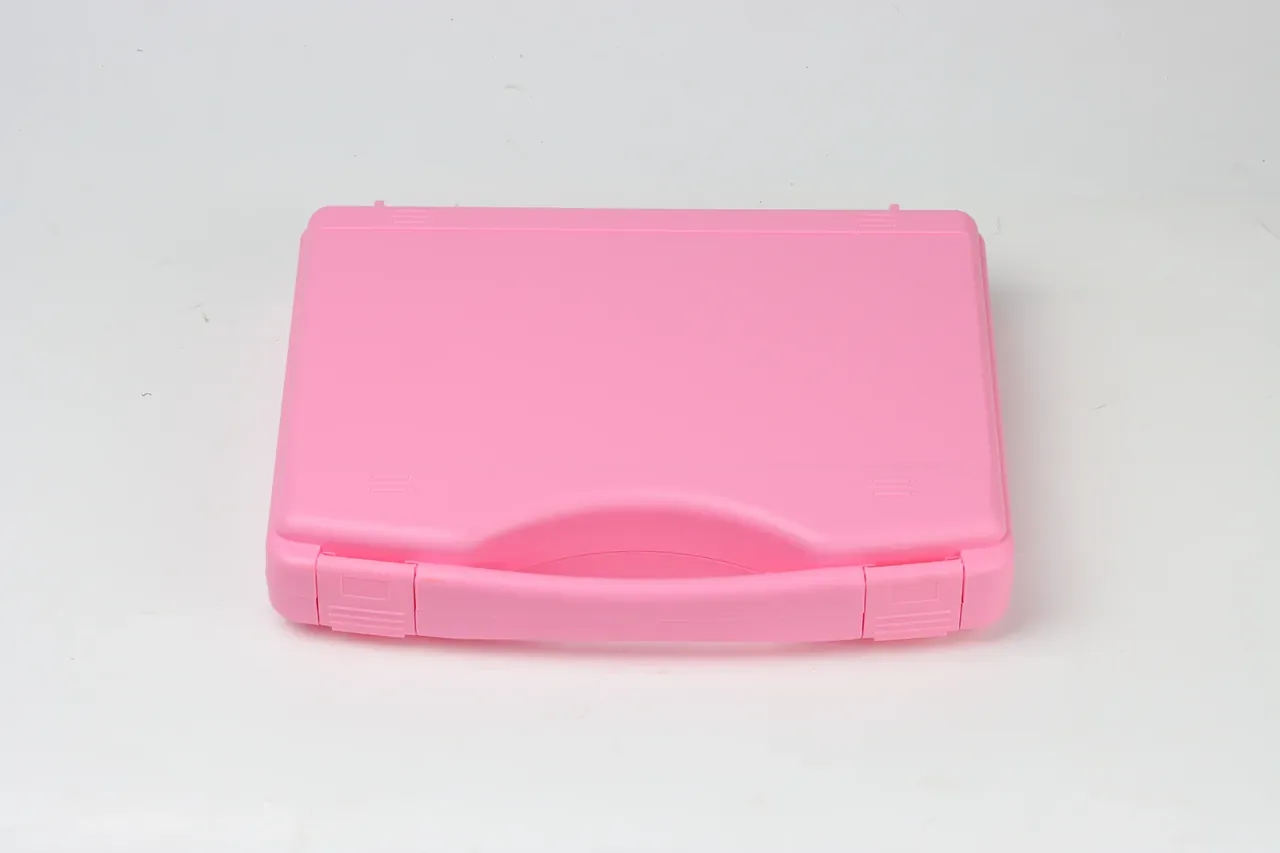
A handle-down drop is another test: 20 kg from 1.2 m peaks at 68 g, asking 13.3 kN, which no plastic does, so the six-face drop only requires the body to land and the handle to stay on. What qualifies a handle is the empty case from 0.9 m, 4.3 kg at 45 g or 1.9 kN, and clips are sized for 2.4 kN.
5. What PP Has Left at -20 °C
Notched Izod for PP reads 6 kJ/m² warm and 2.4 kJ/m² at -20 °C, so the knock that leaves a white mark in summer chips a corner at the ear in winter. TPE climbs from 55 to 72 Shore A in the same cold, the grip turns slick, and a glove with oil lets a 20 kg case slide; widen the grip from 26 to 30 mm for winter work.
Heat takes the other path: 24 hours at 70 °C under 20 kg sets a one-piece handle 2.4 mm against 0.8 mm cold, an overmoulded one 2.9 mm, against a 3.0 mm limit.
| Test | Condition | Limit |
|---|---|---|
| Static | 20 kg, 24 h, ambient | Set ≤1.5 mm |
| Sway | 20 kg, 1 Hz, ±150 mm, 7200 cycles | Pin clearance ≤0.4 mm |
| Empty drop | 0.9 m, handle down, 4.3 kg | No release, no crack |
| Cold hold | 20 kg, 4 h, -20 °C | No crack or whitening |
6. Putting the Load on the Drawing
Five numbers belong on the drawing; a missing one lets the supplier choose: 168 mm span, 26 × 16 mm oval grip, 4.5 mm arms, 5 mm pin, PP with 20% glass. Glass is swapped most often: plain PP looks identical warm, while cold impact falls from 2.4 to 1.6 kJ/m².
- Static: 20 kg for 24 h, mid-handle sag ≤1.5 mm
- Sway: pin out at 7200 cycles, clearance ≤0.4 mm, no white powder
- Drop: empty case from 0.9 m, handle down, clips intact
- Cold: 4 h at -20 °C, then 20 kg, no failure within the hour
- Torque: M4 at 1.2 N·m, five units rechecked, decay ≤0.2 N·m
Cost follows the same lines: a one-piece folding handle adds nothing and suits 20 kg and under, overmoulding adds 6.8 and buys palm pressure, a metal bracket adds 12 and buys creep resistance past 30 kg. Most 20 kg projects land in the middle, overmould plus a double pin, at 3.2.
Conclusion
Add the load into a total, multiply by 1.3 for 255 N, size the wall by the bore. A 20 kg case with a 168 mm span, 4.5 mm arms, a 5 mm pin and a 5 mm ear holds 0.35 mm of clearance after 7200 cycles and 0.8 mm of set after 24 hours.
This article discusses only the specification and design intent on the container (case) side, and does not cover any handling, loading or use of the contents.
Related Reading
- How a hand-carry hard case is built
- Quality checks on a case assembly line
- Sealing and immersion tests for hard cases
- Where hand-carry hard cases are used
Related Products
- 8 Series — Gun Cases; Military Equipment Cases; Camera Equipment Cases; Drone Cases; Watch Cases; Knife Cases; First Aid Cases; Electronics Equipment Cases
- WL8-2812 PP Gun Case — model WL8-2812
- All protective cases and toolboxes: 7 series, 158 models