

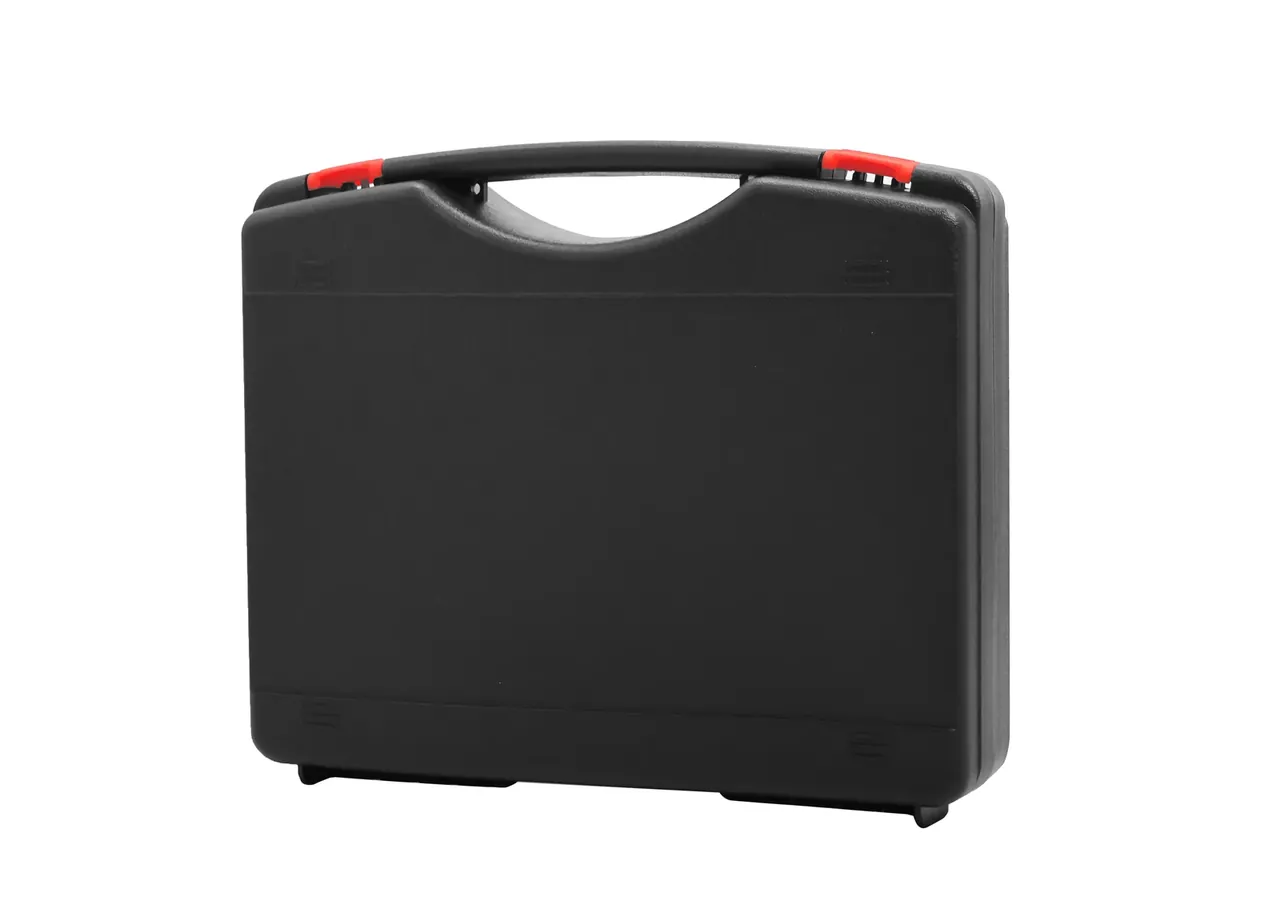
Quick answer: Cases for Middle East projects hinge on two lines, heat and dust: a sealed shell at 55 °C ambient holds 78 °C inside within 2 h. A PP wall parked at 70 °C ages faster than it deforms.
Table of contents
- Cases for Middle East: 55 °C Ambient to 78 °C
- Heat Ageing: 1000 h Tensile Retention
- UV Package: HALS Dose and Carbon Black
- Gaskets and Foam: EPDM or Silicone
- Dust Paths: 0.3 mm Gaps and IP6X
- FAQ
1. Cases for Middle East: 55 °C Ambient to 78 °C
Cases for Middle East projects begin with a temperature balance sheet, not a resin data sheet: dry-hot summer ground reads 70 °C, and a shell left lid-up for 2 h reaches 90% of its equilibrium air temperature.
A black lid runs 12–18 K above ambient: at 55 °C the surface measures 68–73 °C, trapped air 75–78 °C, the lid inner face another 2–3 K. Homopolymer PP holds to 100 °C at 0.45 MPa, so 78 °C leaves 22 K, and that margin is geometry rather than polymer — an unloaded wall, ribs sharing the lid load, a dished lid.
| Placement | Ambient | Trapped air | Lid inner face | Specification |
|---|---|---|---|---|
| Under shade net | 55 °C | 62 °C | 65 °C | Standard build |
| Partly sheltered | 55 °C | 70 °C | 73 °C | EPDM gasket |
| Open ground | 55 °C | 78 °C | 81 °C | Silicone gasket |
| Inside a vehicle | 58 °C | 80 °C | 83 °C | Add a heat liner |
A bonded thermocouple reads 2 °C above one hanging in air, which matters near 78 °C.
2. Heat Ageing: 1000 h Tensile Retention
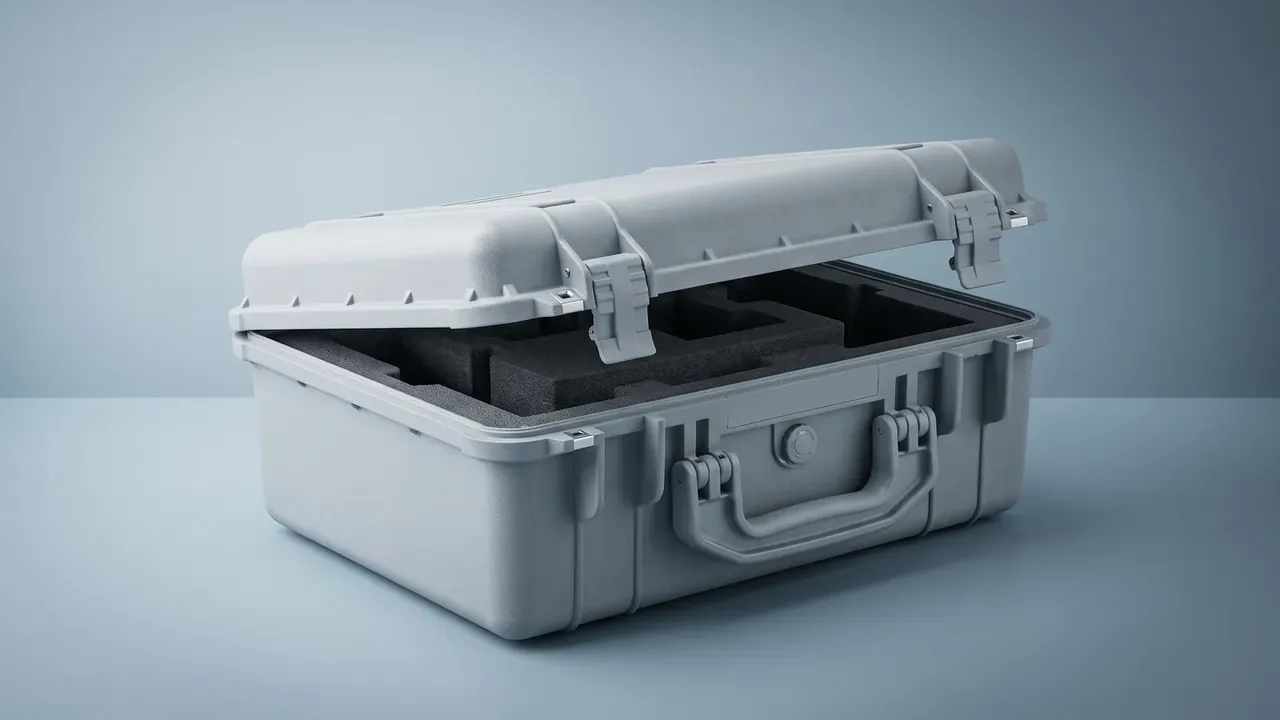
Above 70 °C, a shell fails not on the first hot afternoon but two years later at the latch boss, because antioxidant consumption doubles every 10 K.
Oven ageing at 70 °C for 1000 h leaves 85% of tensile strength and 40% of elongation at break; at 90 °C the same run gives 70% and 22%. Under 50% elongation, drop margin is gone.
Cases for Middle East programmes running 8 years have to hold the cavity under 65 °C: on the 10 K halving rule, five years of reserve at 70 °C equals ten at 60 °C. Shade and a light lid cost less than a thicker wall.
3. UV Package: HALS Dose and Carbon Black
Colour picks the additive package. Two per cent carbon black cuts UV penetration to tens of microns and charges 6–8 K of surface heat against a bone-white lid.
Hindered amine stabilisers run 0.3–0.5%; with 0.2% absorber, 1000 h of xenon-arc pulls ΔE from 8 to 2–3.5, and the gap between 0.3% and 0.5% becomes chalking by year five. Light shells reflect and run 8 K cooler but need 0.5% HALS plus 0.3% absorber to replace the black-out.
Cases for Middle East buyers should read a microtome slice rather than the recipe: carbon black at 20 nm, dispersed to grade 3, works at 2%, while agglomerates leave paths that bloom white before they crack.
4. Gaskets and Foam: EPDM or Silicone
The gasket on Cases for Middle East crosses both lines. EPDM runs -50–120 °C, silicone -60–200 °C, so both survive 78 °C; compression set after 22 h at 70 °C splits them, 25% against 15%.
After 2000 h at 70 °C, EPDM hardens 8 Shore A and seal load climbs from 60 N to 80 N, so the latch hook takes the load and breaks first. Silicone costs 2.5 times more and repays it in latches.
| Compound | Continuous range | Set, 22 h at 70 °C | Opening force | Where it fits |
|---|---|---|---|---|
| EPDM | -50–120 °C | 25% | Up 30% | Shade, part shelter |
| Silicone | -60–200 °C | 15% | Up 8% | Open ground, vehicle |
| Neoprene | -40–100 °C | 30% | Up 35% | Short rotation |
Foam completes the seal: PE at 33 kg/m³ holds set at 5% or below at 25–30% compression, and passes 8% beyond 40%.
5. Dust Paths: 0.3 mm Gaps and IP6X
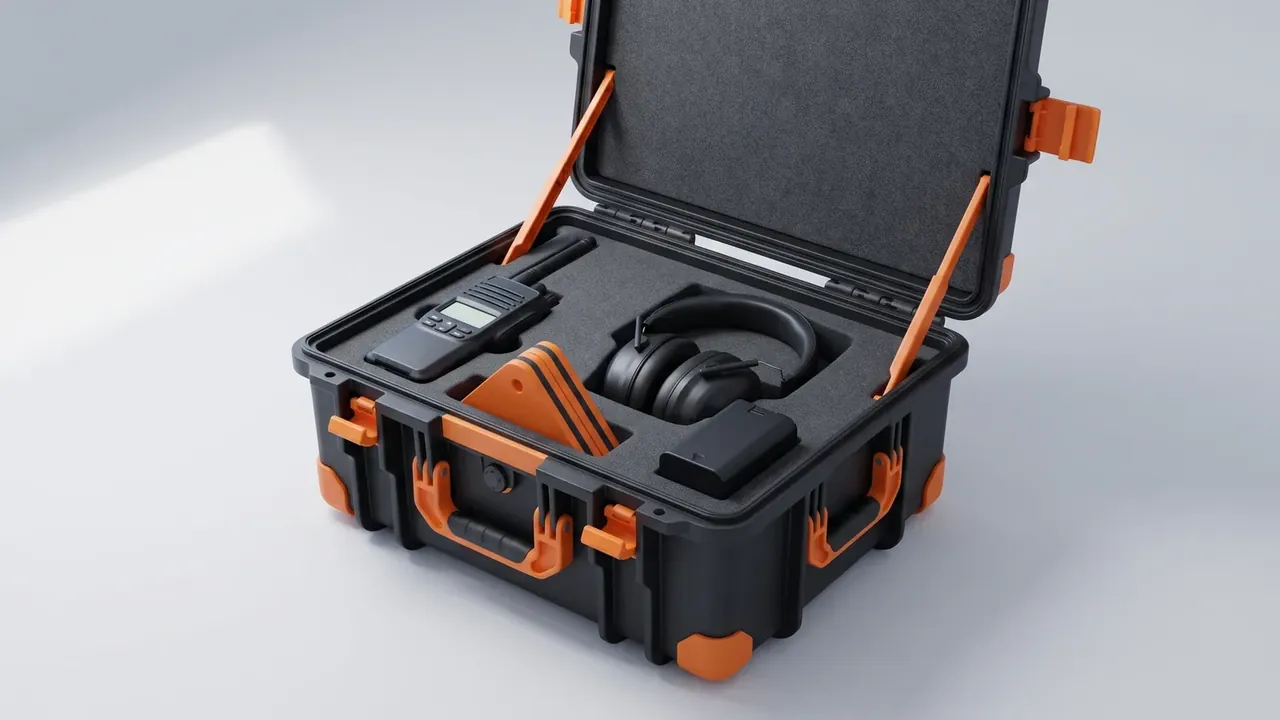
Dust on Cases for Middle East projects arrives through joints, not faces: 0.3 mm at the latch land, 0.15 mm at the hinge pin seat, 0.2 mm at the diaphragm edge, 0.4 mm along the trolley rail.
The IP6X chamber runs talc at 2 kg/m³ under 2 kPa of negative pressure for 8 h, and the criterion is no visible dust inside. Stripped afterwards, an unvalved shell shows 0.2 mg/cm² on the inner wall while an ePTFE unit shows none.
| Path | Gap | Deposit, 8 h | Countermeasure |
|---|---|---|---|
| Latch land | 0.3 mm | 0.1 mg/cm² | Double-lip seal |
| Hinge pin seat | 0.15 mm | 0.05 mg/cm² | Dry-film coating |
| Valve diaphragm | 0.2 mm | None | ePTFE membrane |
| Trolley rail | 0.4 mm | 0.3 mg/cm² | Wiper ring |
Grease is the quiet failure. Lithium bleeds base oil at 70 °C, binds dust into paste and lifts rail pull from 30 N to 55 N, where a PTFE film of 8–12 μm at 0.05–0.1 friction holds 30–45 N. A 2 h sweep at 10–500 Hz costs 15% of preload, taking gasket compression from 28% to 24%.
Conclusion
Cases for Middle East work out as one heat budget and one dust budget. Shade gives 62 °C inside and open ground 78 °C, a gap closed by a gasket grade and a reflective lid; 1000 h at 70 °C leaves 40% elongation; UV needs 0.3–0.5% HALS with 2% carbon black, and a black shell pays 3–5 K of heat for it; dust follows the 0.3 mm latch land and the 0.2 mm membrane edge, where 8 h in a chamber is only a floor.
This article discusses only the container (case body) side of specifications and design intent, and does not cover any handling, loading or use of the contents.
Related Reading
- Dustproof case selection and test items
- What a dustproof case is: structure and sealing
- Gasket and O-ring compounds compared
- Case requirements across industries
Related Products
- 8 Series — Gun Cases; Military Equipment Cases; Camera Equipment Cases; Drone Cases; Watch Cases; Knife Cases; First Aid Cases; Electronics Equipment Cases
- WL8-2812 PP Gun Case — model WL8-2812
- All protective cases and toolboxes: 7 series, 158 models