

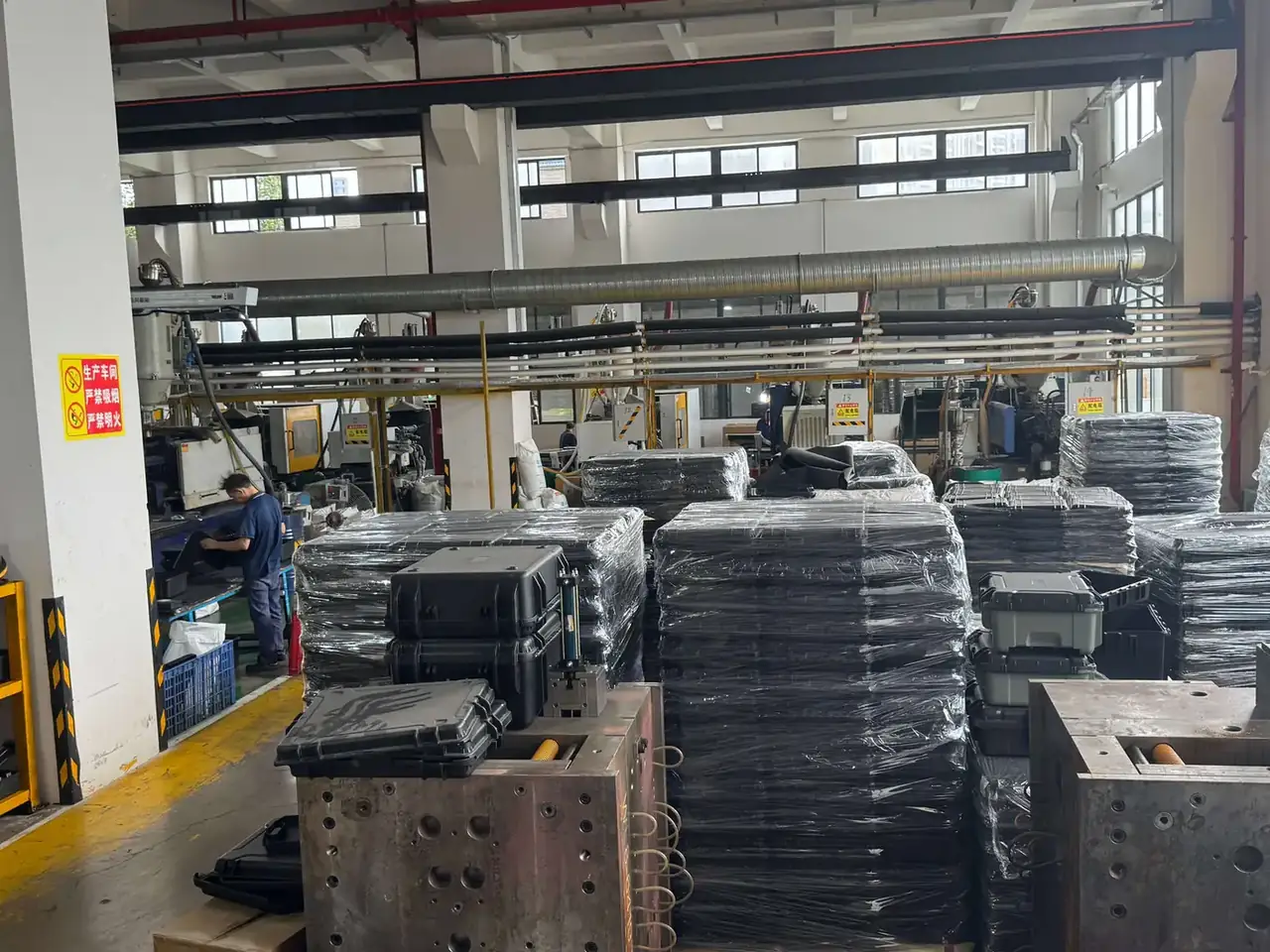
Quick answer: Mixed case order fulfilment holds on three steps: the pick list turns an order into location codes, three-colour labels carry status on the case, and a dual check with weighing stops errors before loading. Each step needs one hard rule: a unique code, a readable label, a check that measures.
Table of contents
- From Order to Location Code
- Three-Colour Labels and What the Label Says
- Dual Check and Weighing
- Three Error Hotspots
- Loading Order, Seal and Sign-off
- FAQ
1. From Order to Location Code
Mixed case order fulfilment starts on paper. An order splits into lines, each line lands on a location, and the code runs five segments: zone, row, column, level, slot, as in A-03-12-2-04, thirteen characters. Fixed lengths let a scanner read it in one pass.
One size per line is the split rule. Two locations holding one size merge, with a primary and a backup slot; two sizes 20 mm apart stay two lines. Six to eight lines per order runs smoothly; past twelve, errors climb.
| Segment | Meaning | Example |
|---|---|---|
| 1 | Zone | A |
| 2 | Row | 03 |
| 3 | Column | 12 |
| 4 | Level | 2 |
| 5 | Slot | 04 |
Route the pick one way in a snake, under 120 m per pick; beyond that, pickers jump slots from memory, the first sign of a miss.
2. Three-Colour Labels and What the Label Says
In mixed case order fulfilment a label carries status, not identity. Red means picked and unchecked, yellow short or pending, green checked. Place it upper right, 20 mm from the edge, 100 by 80 mm.
The printed part is five fixed lines: order, line, size, piece count, destination. Nothing is added by hand, because handwriting fails at the dock.
| Colour | Status | When it comes off |
|---|---|---|
| Red | Picked, unchecked | After the check |
| Yellow | Short or pending | After the gap is filled |
| Green | Checked by two | Archived with the order |
The swap rule is absolute: pass the check, tear red and apply green. Green is never applied in advance, because it means two people signed off with their hands.
3. Dual Check and Weighing
In mixed case order fulfilment the picker self-checks three things: label matches line, pieces match count, case body undamaged. Only then does the case enter the yellow zone, since a pallet counts as a release.
The checker scans every case against the list, then weighs at least 30 percent. A deviation beyond 0.4 kg or 1.5 percent, whichever is tighter, opens the order. Weighing is the cheapest trap: it catches a case that scans right and is one unit short.
Keep the bench within 15 m of the loading door; further away, checked goods get handled twice, and the second move breeds errors.
4. Three Error Hotspots
The first hotspot is one family, two sizes: models 20 mm apart look identical at arm's length. Store them on separate bays with an empty slot between, and print the last two size digits on the label.
The second is similar colours: dark grey and black read alike under warm light, so the model line plus code separates them; colour marks status only.
The third is the accessory bag, which travels in a side pocket, so a picker lifts the case and leaves it. Give it a line marked required and the count fails at once.
| Hotspot | How it shows | Interception |
|---|---|---|
| One family, two sizes | Right label, wrong case | Separate bays, size digits |
| Similar colours | Visual check passes | Model line plus code |
| Missing accessories | Case complete, parts absent | Required accessory line |
5. Loading Order, Seal and Sign-off
Mixed case order fulfilment loads by two rules: heavy low, one order one zone. Cases over 25 kg go on the bay floor, lighter cases ride above, and one order sits in one block so the receiver unloads instead of searching.
Stack to roof height minus 100 mm, usually three tiers, offset seams, 50 mm at the wall. On a truck with four to six orders, dividers carry the last four digits.
Close the doors, fit a 12-digit one-time seal, copy the number onto the delivery note, and shoot three frames: seal, door seam, full side. The receiver checks it at sign-off; a mismatch or cut seal goes in writing within 24 hours.
Conclusion
Errors in mixed case order fulfilment rarely come from lifting; they come from broken information: a code nobody reads, a label nobody swaps. Turn the code, the labels, the check and the zones into actions, and the tear-and-apply is what runs mixed case order fulfilment.
This article discusses only the container (case body) side of specifications and design intent, and does not cover any handling, loading or use of the contents.
Related Reading
- Batch incoming inspection for case bodies
- How case labels support asset tracking
- What pre-shipment inspection covers and records
- Setting AQL sampling for custom case acceptance
Related Products
- 8 Series — Gun Cases; Military Equipment Cases; Camera Equipment Cases; Drone Cases; Watch Cases; Knife Cases; First Aid Cases; Electronics Equipment Cases
- WL8-2812 PP Gun Case — model WL8-2812
- All protective cases and toolboxes: 7 series, 158 models