

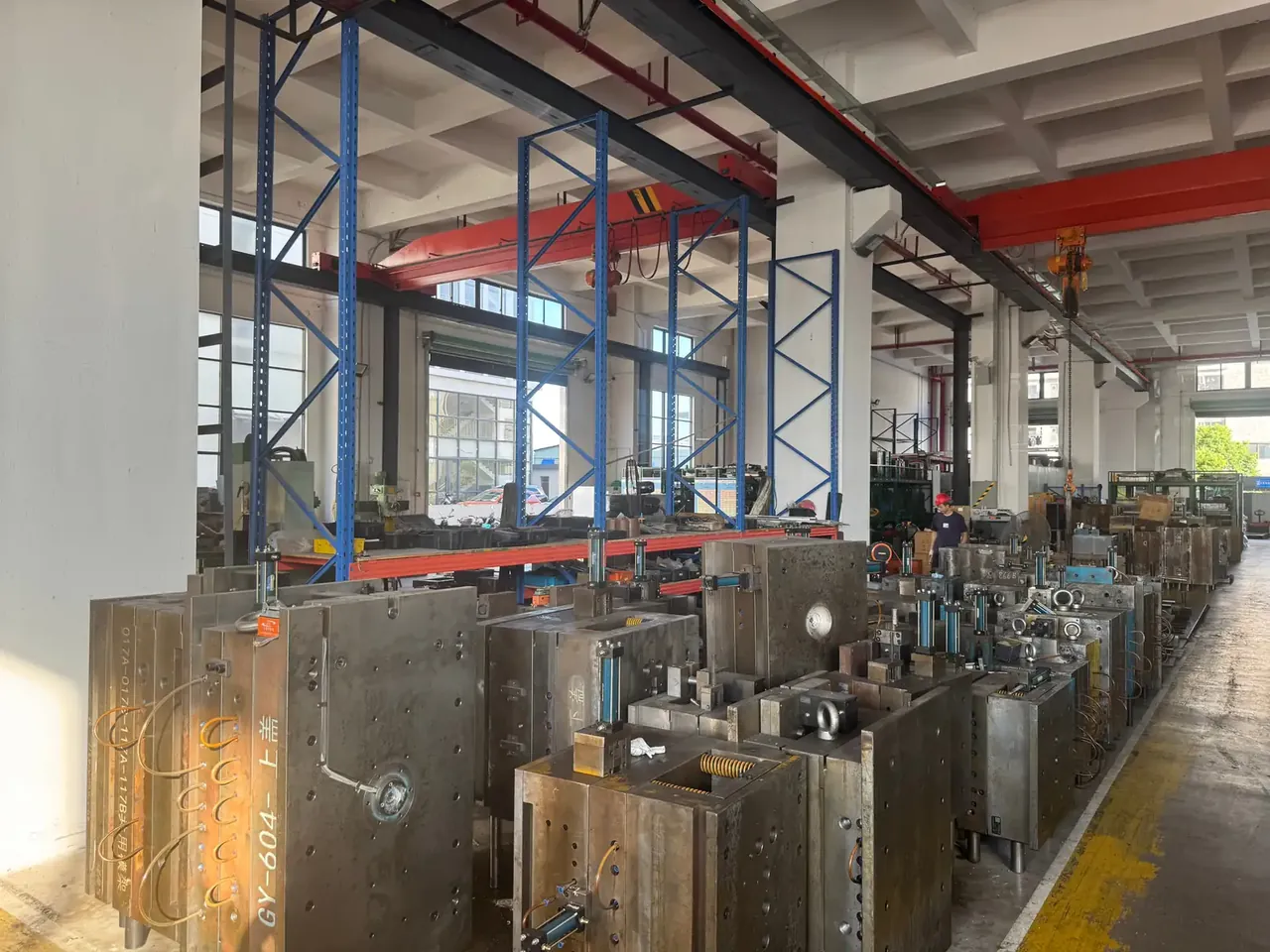
Quick answer: A case mould decides how even the box wall runs, how the lid meets the body, and how long one part takes. Five points carry that: plate stack, gate position, cooling, ejection with draft, and the trial run.
Table of contents
- How a Case Mould Is Stacked
- Gate Position and Runner Balance
- Cooling Channels and Cycle Time
- Ejection and Draft Angle
- Trial Runs and First Article
- FAQ
1. How a Case Mould Is Stacked
A case mould stacks seven to nine plates between the clamp plates. The top plate carries the sprue bush, the cavity plate cuts the lid, the core plate cuts the body, the support plate backs the core, and two spacer blocks open the ejection space.
| Plate | Material | Thickness | Job |
|---|---|---|---|
| Top clamp plate | 45 steel | 40 mm | Holds sprue bush |
| Cavity plate | 718H, 33 HRC | 90 mm | Lid cavity |
| Core plate | 718H, 33 HRC | 90 mm | Body core |
| Support plate | 45 steel, hardened | 60 mm | Backs the core |
| Spacer block | 45 steel | 120 mm | Ejection travel |
Plate thickness is not free. At a 280 mm body the support plate goes from 50 to 60 mm; leave it thin and the core sags 0.1 mm, giving one thick wall and one thin wall. Stacked this way a four-cavity mould weighs about 3.8 t and needs a 650 t press. An 800 mm plate also grows 0.28 mm from 25 °C to 60 °C, so guide clearance is set cold.
2. Gate Position and Runner Balance
The body is 3 mm thin-wall and deep, so a centre gate lets melt climb all four walls at once, while a side gate leaves a weld line where cracks start.
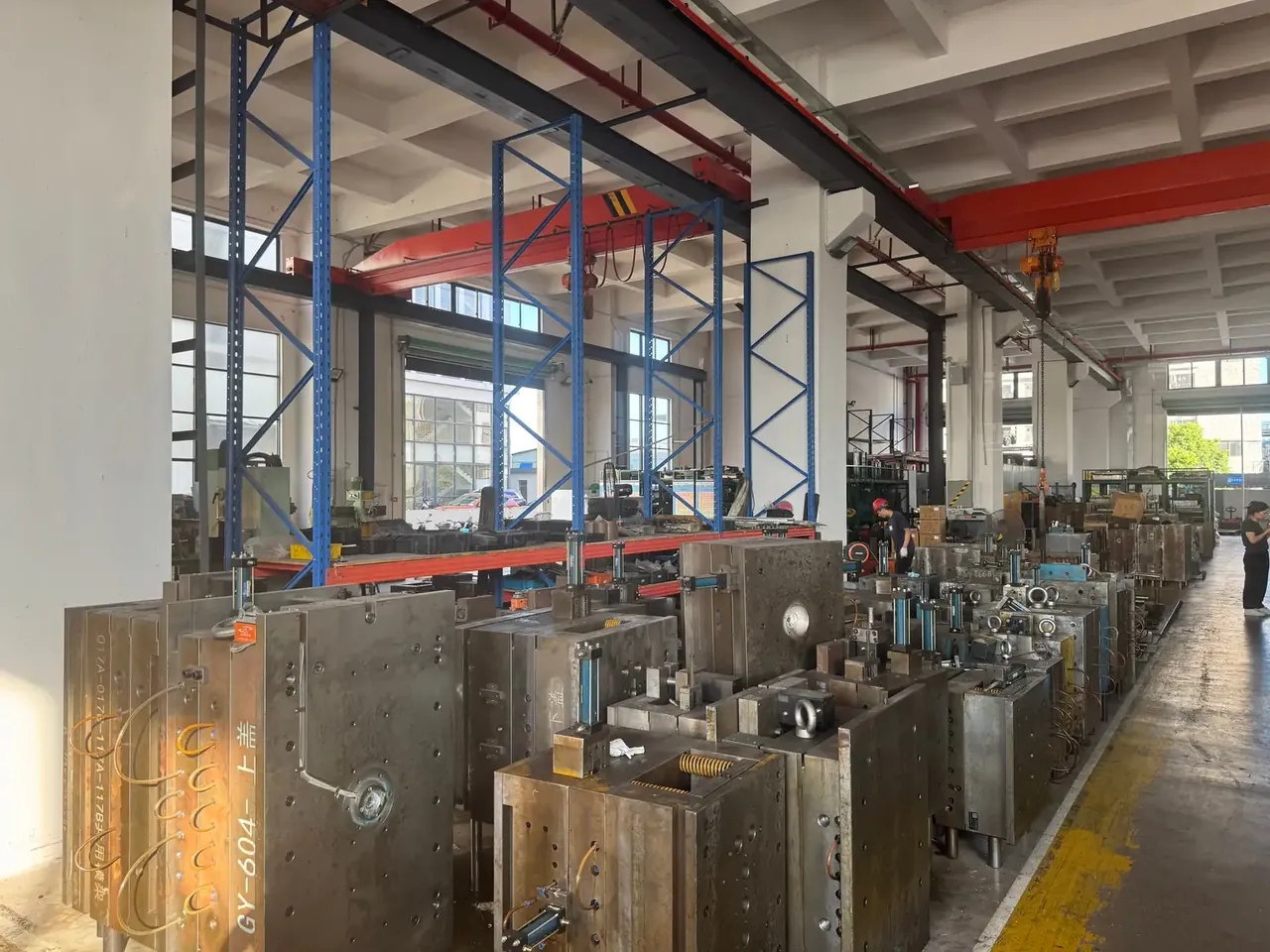
Runners run as an 8 mm trapezoid off a 6 mm sprue. Keep the four branches within 5 mm in length and 0.5 mm in section, or far cavities starve and the box warps. A 0.03 mm vent at the parting line, where the melt arrives last, keeps corners from scorching.
3. Cooling Channels and Cycle Time
Cooling sets about seventy percent of the cycle. Cavity and core each run a circuit of 12 mm holes on a 60 mm pitch, 15 mm from the moulding surface, water at 45 °C and 8 litres per minute.
| Cooling layout | Pitch | Cycle | Warpage |
|---|---|---|---|
| Straight drilled | 60 mm | 55 s | 0.6 mm |
| Baffle plus insert | 45 mm | 48 s | 0.4 mm |
| Conformal insert | Follows surface | 42 s | 0.2 mm |
Cost differs by an order of magnitude: a laser melted conformal insert can cost as much as half a mould base, so it pays only at high volume. Cooling also gates ejection: the timer must follow the thick section, or each pin leaves a white mark.
4. Ejection and Draft Angle
A deep body grips the core hard, so ejection is where white marks appear. Eight pins of 6 mm sit at the corners and long-side midpoints, on a 60 mm stroke, sized for 12 kN.
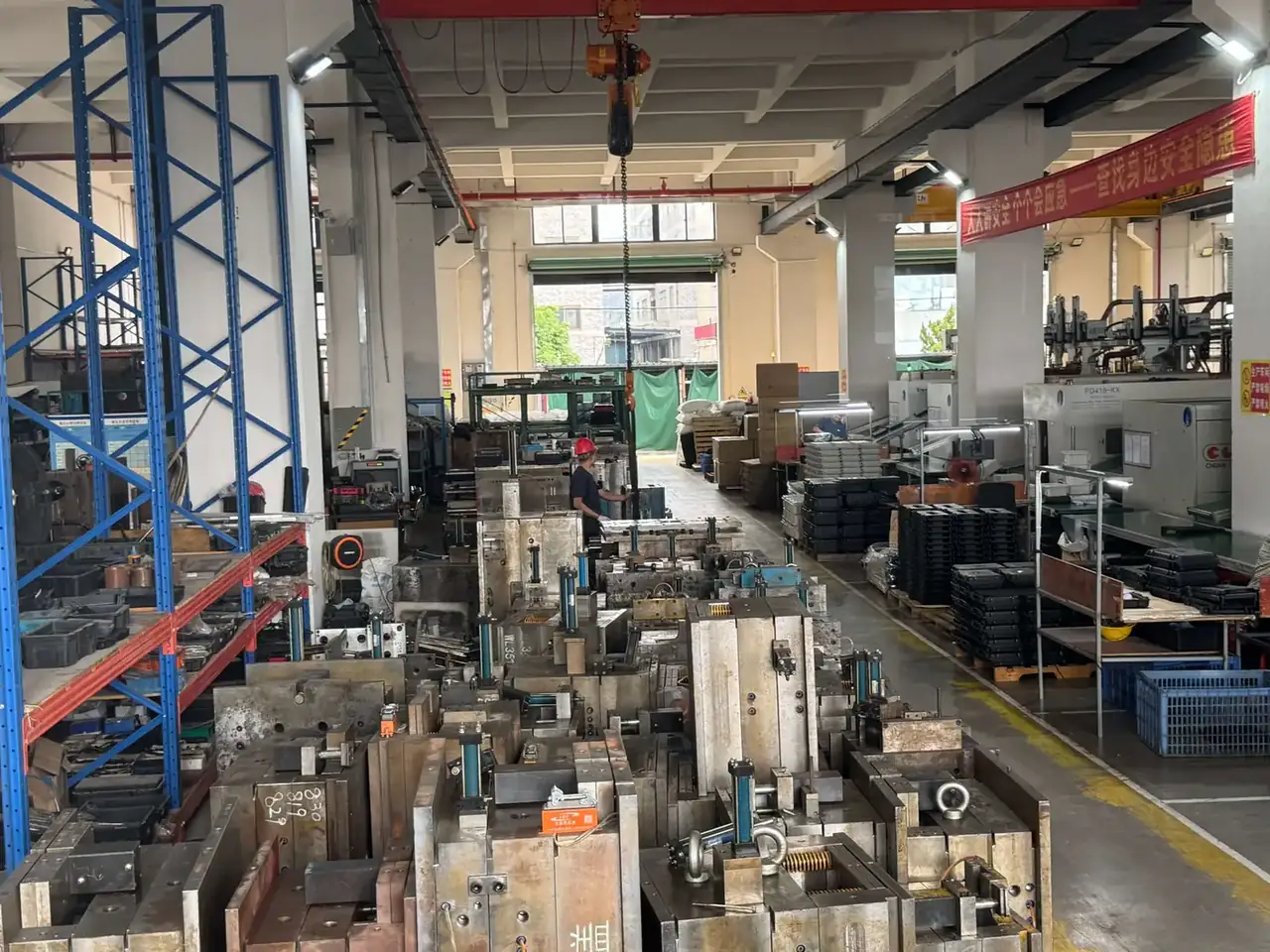
A deep body runs 1.5° of draft, which at 200 mm of depth opens 5.2 mm per side. Below 1° the wall scuffs at release. Hold all eight pins within 0.05 mm, or the first few take the whole load and bump the base.
5. Trial Runs and First Article
A case mould is tried three times: dry cycling for motion, short shots for fill order, and a full shot for size. At sixty percent fill the melt should reach the same point in all four cavities; if one fills first, the runner goes back for rework.
| Check | Method | Accept |
|---|---|---|
| Wall thickness | Ultrasonic, five points | 3 mm ±0.1 mm |
| Parting gap | Feeler gauge | 0.02 mm blocked |
| Lid fit | Hinged and cycled | No interference |
| Seal flatness | Plate and dial gauge | Within 0.05 mm |
| Latch alignment | Visual at closure | Tongue seated |
A passed first article is not the end. Run 300 parts: cavity temperature climbs over the first 50 shots, so dimensions drift, and the mould is signed off only if drift stays inside 0.15 mm.
Conclusion
The plate stack sets stiffness, gate and runner set fill, cooling sets cycle, ejection and draft set appearance, and the trial run decides whether it repeats. Skip one and the fault surfaces three months into production. Fix them in order and the sealing face and latch seats hold, which is how a case mould is judged.
This article discusses only the container (case body) side of specifications and design intent, and does not cover any handling, loading or use of the contents.
Related Reading
- Case mould maintenance explained
- How a case mould should be stored
- How a trial moulding run is organised
- Matching press tonnage to box size
Related Products
- 8 Series — Gun Cases; Military Equipment Cases; Camera Equipment Cases; Drone Cases; Watch Cases; Knife Cases; First Aid Cases; Electronics Equipment Cases
- WL8-2812 PP Gun Case — model WL8-2812
- All protective cases and toolboxes: 7 series, 158 models