

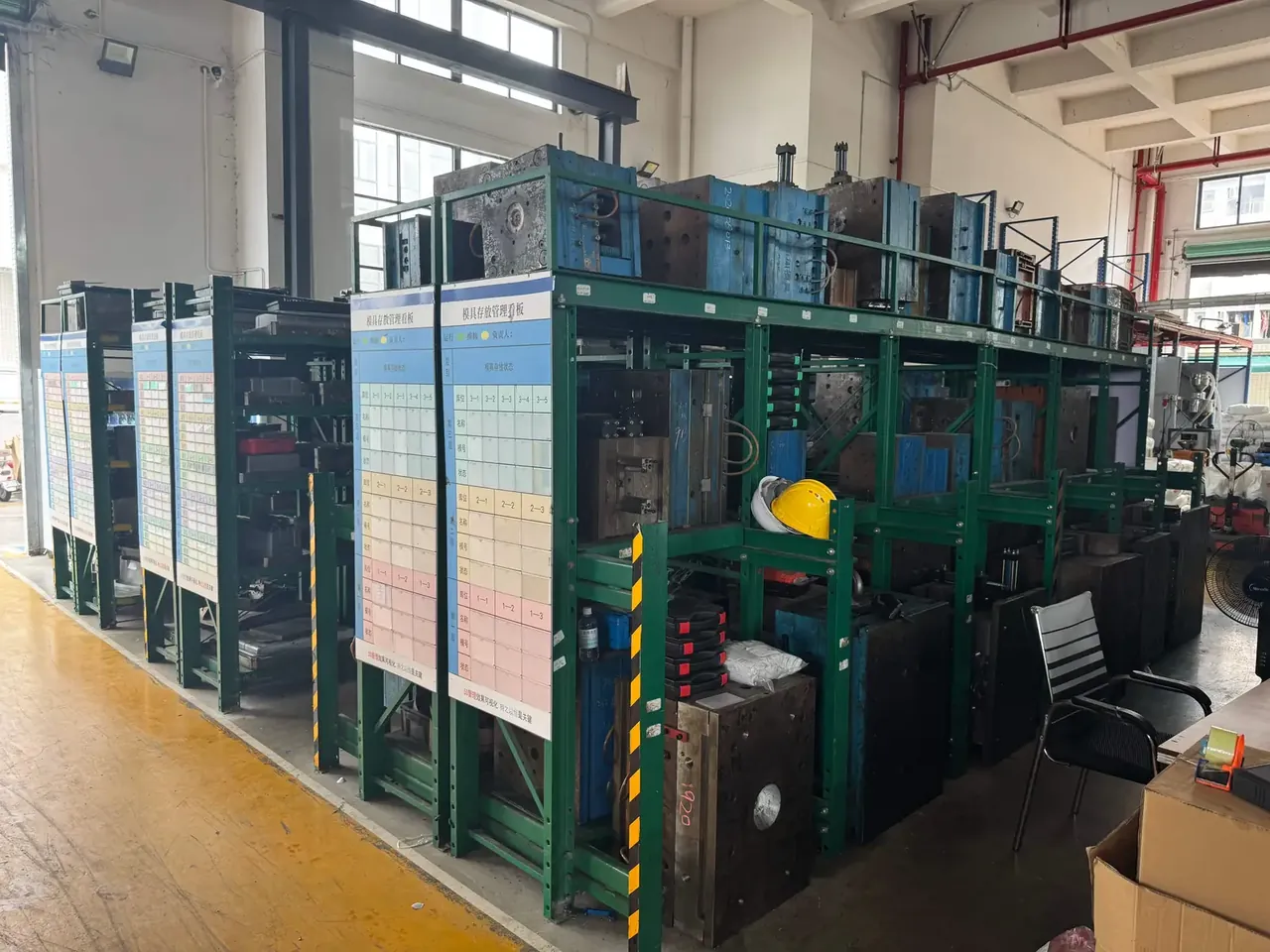
Quick answer: A Case Mould leaving the press needs a clean, dry condition check, a rust barrier and a fixed location. Drain the circuits, cool below 40 °C, coat with lithium grease, hold 60% RH, recoat every six months, lift on four rated eyebolts and log the next inspection.
Table of contents
- Condition Check Before a Case Mould Is Shelved
- Rust Prevention: Grease, Humidity, Recoating
- Lifting: Eyebolt Rating and Four-Point Slings
- Stacking Height, Skids and Aisles
- Ledger and Tag Fields
- FAQ
1. Condition Check Before a Case Mould Is Shelved
Storage starts at the press: purge the barrel, clear the sprue bush, shut the hot runner down, then blow the water circuits twice at 0.3 MPa until no mist leaves. A tool put away wet spots at the cavity corners within a month.
Let the mould fall below 40 °C before coating; grease applied hot runs off into patches that never cure. Use the wait to check the parting line for nicks, the pins for bends and the eyebolt threads for damage.
Zone by return frequency, not tool number. A sits beside the changeover bay within 30 days of the next run, B covers three to twelve months at 60% RH, C takes anything longer behind a separate dehumidifier, and floor loading is checked at 5 t per square metre.
2. Rust Prevention: Grease, Humidity, Recoating
Case moulds rust from the water circuits and the parting line outward. Coat the cavity with NLGI 2 lithium grease rated to 180 °C, 0.5 to 1 mm thick, brushed one way; fingers leave salt. Guides take 32-grade oil and ejector bores a soft film oil.
Humidity fails before grease does. Hold the store at 60% RH, 5 to 35 °C, with a night-to-day swing under 5 °C, because a moving temperature condenses moisture under the film.
| Measure | Material or setting | Interval | Failure sign |
|---|---|---|---|
| Cavity coating | NLGI 2 lithium, 0.5–1 mm | 6 months | Cracking, bare steel |
| Guide oil | 32-grade machine oil | 6 months | Dry to touch |
| Humidity | 60% RH or below | Daily log | Condensation on cavity |
Strip the old film with kerosene first; new grease over old traps water. On finding pinhead rust, cut the cycle to four months and read the humidity log, since the room is usually the cause.
3. Lifting: Eyebolt Rating and Four-Point Slings
Size each eyebolt for half the tool weight: a 1.2 t case mould takes four M16 rated 1.4 t each, a 3.5 t tool takes four M20 at 2.1 t. Engagement reaches 1.5 times the diameter with the shoulder seated flat; if it will not seat, use a longer thread.
Four-point lifting is the default above 0.8 t, with slings within 30 degrees of vertical, since a wider angle raises the horizontal force on the base. Lift 200 mm, hold 30 seconds, then travel; land on 100 by 100 mm skids under the feet.
4. Stacking Height, Skids and Aisles
Single layer is the default and two is the maximum. Stacking needs three conditions: a heavier lower tool with a larger footprint, skids aligned within 20 mm, and upper weight inside the shelf rating.
Ground contact is the quiet failure: a base on concrete draws moisture up through the feet, and rust surfaces only after it reaches the cavity. Skids lift 200 mm and span both feet. Leave 250 mm to the wall, 1.2 m in the aisle, and keep eyebolts fitted.
5. Ledger and Tag Fields
A ledger is a due-date system, not a history book: tool number, cavitation, steel grade, intake date, service record and next inspection date. The first four identify the tool; the last two say whether it can run today.
| Field | Rule | Example |
|---|---|---|
| Tool number | Match the stamp, no shorthand | XJ-2418 |
| Cavitation | State it plainly | 1 cavity |
| Steel grade | Cavity and base listed apart | 718H, 45 base |
| Intake date | Day the coating finished | 2026-03-12 |
| Next inspection | Intake date plus six months | 2026-09-12 |
Engrave the tag on 1 mm aluminium and hang it on the side of the base, never a sealing face: four lines plus a colour block, green in store, amber due, red awaiting repair.
Conclusion
Storage standards for a Case Mould rest on three fixed points: the drain and cooldown that start the rust clock, the grease, humidity and recoat cycle that decide whether the tool opens bright or pitted, and the eyebolt rating, four-point lift and skid height that keep the move uneventful. Fix those and the ledger has something worth recording.
This article discusses only the container (case body) side of specifications and design intent, and does not cover any handling, loading or use of the contents.
Related Reading
- What drives the cost of a custom case mould
- How wall thickness shapes an injection moulded case
- Trial runs before a case mould is released
- Judging the structure of a high-quality case
Related Products
- 8 Series — Gun Cases; Military Equipment Cases; Camera Equipment Cases; Drone Cases; Watch Cases; Knife Cases; First Aid Cases; Electronics Equipment Cases
- WL8-2812 PP Gun Case — model WL8-2812
- All protective cases and toolboxes: 7 series, 158 models