

Quick answer: A case mould is chosen by quantifying five criteria, not by comparing prices: cavity count against tonnage, steel against resin, cooling against wall thickness, life against the maintenance record, and delivery against the sign-off you can enforce.
Table of contents
- Five Criteria That Define a Case Mould
- Criterion One: Cavity Count Against Machine Tonnage
- Criterion Two: Frame Steel Paired With Cavity Steel
- Criterion Three: Cooling Layout and Ejection
- Criteria Four and Five: Life Records and Delivery Sign-Off
- FAQ
1. Five Criteria That Define a Case Mould
A case mould serves one shell: one outer profile, one wall thickness, one latch pattern. Quotations a few percent apart rarely differ by steel grade; they differ on cavity count, cooling, life target and delivery.
Each criterion must be measurable. "Two cavities" is not a criterion; "two cavities, 620 cm² projected each, on a 530 t machine or larger" is.
| Criterion | What to quantify | Typical range | What breaks first |
|---|---|---|---|
| Cavity count | Shots per cycle, projected area | 1 to 4 cavities | Short tonnage, flash |
| Steel | Frame and cavity grade | 45 steel with 718H or S136 | Walls collapse early |
| Cooling | Bore, pitch, depth from cavity | 10 mm bore, 60 mm pitch | Warp above 0.5 mm |
| Life | Design shots | 300,000 to 500,000 | Early rework |
| Delivery | Trial dates | T1 samples in 45 days | Window missed |
2. Criterion One: Cavity Count Against Machine Tonnage
Cavity count follows annual volume and shell size. A shell over 500 mm needs above 1,000 t for two cavities, and few plants own more than one such press, so scheduling bottlenecks before the mould does. Below 200 mm, four cavities on 250 t is cheapest per part.
Tonnage comes from projected area: multiply outer length by width, apply 0.45 to 0.55 t per cm², add 20 percent. A 560 by 380 mm lid projects 2,128 cm², giving 960 to 1,170 t, where an 800 t press flashes on the parting line opposite the gate. Oversizing costs frame steel and stroke: a 180 mm shell needs 290 mm of travel.
3. Criterion Two: Frame Steel Paired With Cavity Steel
Frames are 45 steel at 28 to 32 HRC, while cavity and core are selected separately. PP shells run 718H at 30 to 34 HRC, since inner walls need no mirror finish; PC windows or flame-retardant grades need S136 at 48 to 52 HRC, nitrided 0.05 to 0.08 mm.
Depth is the difficulty. A 120 to 200 mm pocket leaves 30 mm walls that injection pressure bows outward, so the case mould is built from four side inserts and a separate base, torqued to 80 N·m on M12 bolts, joints within 0.02 mm.
Harder is not better: a 52 HRC pocket takes three times the polishing hours, and one scratch means reworking the block.
4. Criterion Three: Cooling Layout and Ejection
Cooling takes more than 60 percent of a 2.5 to 3.5 mm wall cycle. The standard is a 10 mm bore on a 60 mm pitch, 25 to 30 mm from the cavity, and baffles cut the top-to-bottom spread from 6 °C to under 2 °C.
Ejection follows the undercuts. Latches take lifters at 3 to 5 degrees, the seal groove takes a stripper plate at 0.03 to 0.05 mm clearance, and pins run 3 to 5 mm with stroke at deepest cavity plus 5 to 8 mm.
5. Criteria Four and Five: Life Records and Delivery Sign-Off
Life is counted in shots: 718H reaches about 300,000 on PP, nitrided S136 reaches 500,000, and past that flash grows from 0.05 mm to 0.15 mm while rework frequency doubles. The record tracks accumulated shots and next due dates.
Delivery belongs in the contract: T1 at 45 days, a 300 shot run at T2, drop and stack tests, then the production schedule.
| Acceptance item | Method | Pass line |
|---|---|---|
| First-off key dimensions | CMM | Cpk at or above 1.33 |
| Parting-line flash | 0.05 mm feeler gauge | Gauge does not enter |
| Cavity temperature spread | Infrared meter | 2 °C or less |
| Cooling circuit seal | 6 bar held 10 minutes | Drop of 0.2 bar or less |
| Continuous run | 300 shots | No short shots, no warp |
Conclusion
Selecting a case mould turns requirements into numbers. Cavity count, steel, cooling, life and delivery constrain one another, and a loose one surfaces in the third month of production. Written into the enquiry, they give every quotation one baseline, and the case mould a payback period you can calculate.
This article discusses only the container (case body) side of specifications and design intent, and does not cover any handling, loading or use of the contents.
Related Reading
- Maintenance intervals for a case mould
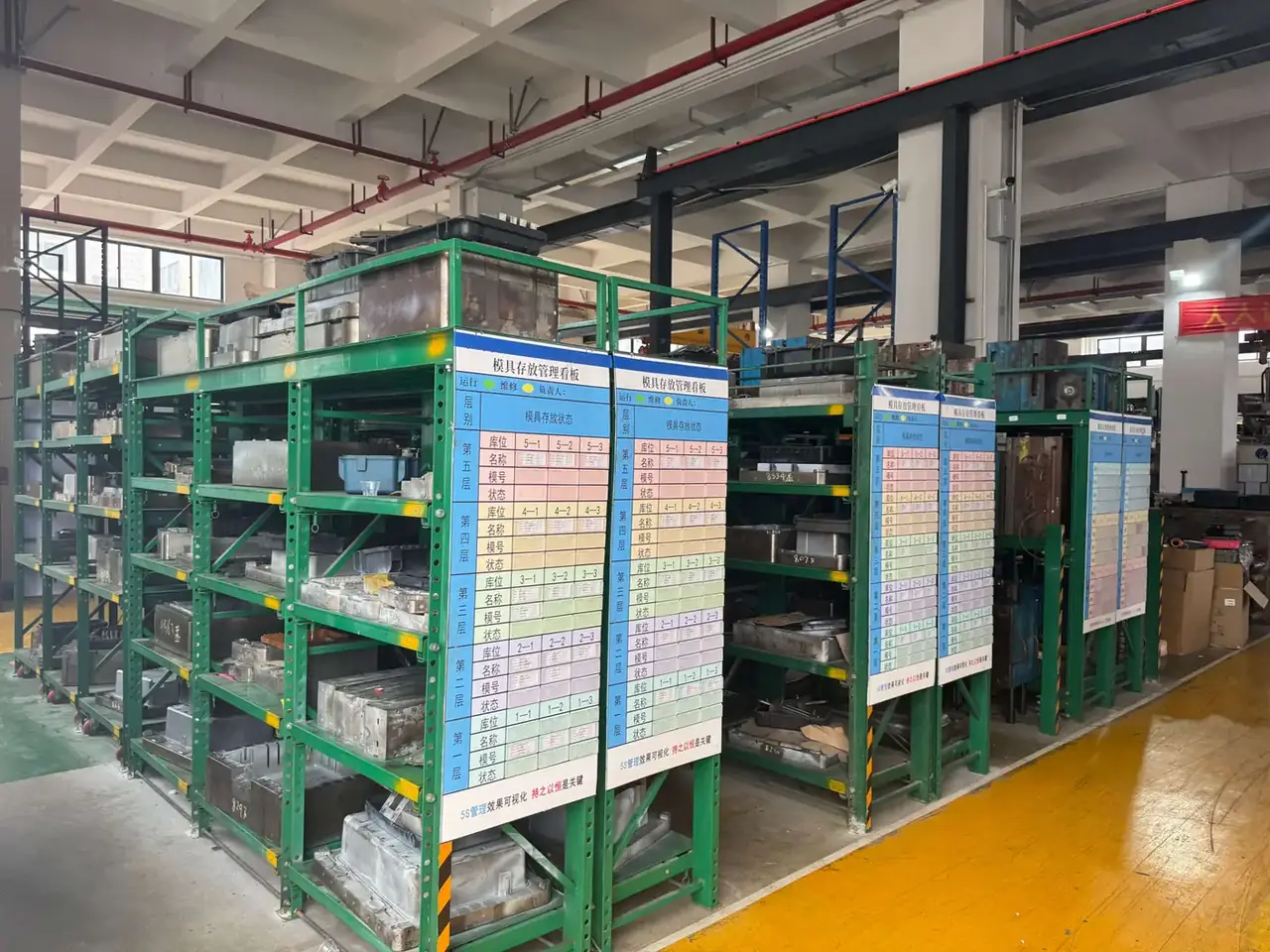
- Storage and rust protection for moulds
- Trial moulding before release
- Matching machine tonnage to case size
Related Products
- 8 Series — Gun Cases; Military Equipment Cases; Camera Equipment Cases; Drone Cases; Watch Cases; Knife Cases; First Aid Cases; Electronics Equipment Cases
- WL8-2812 PP Gun Case — model WL8-2812
- All protective cases and toolboxes: 7 series, 158 models