

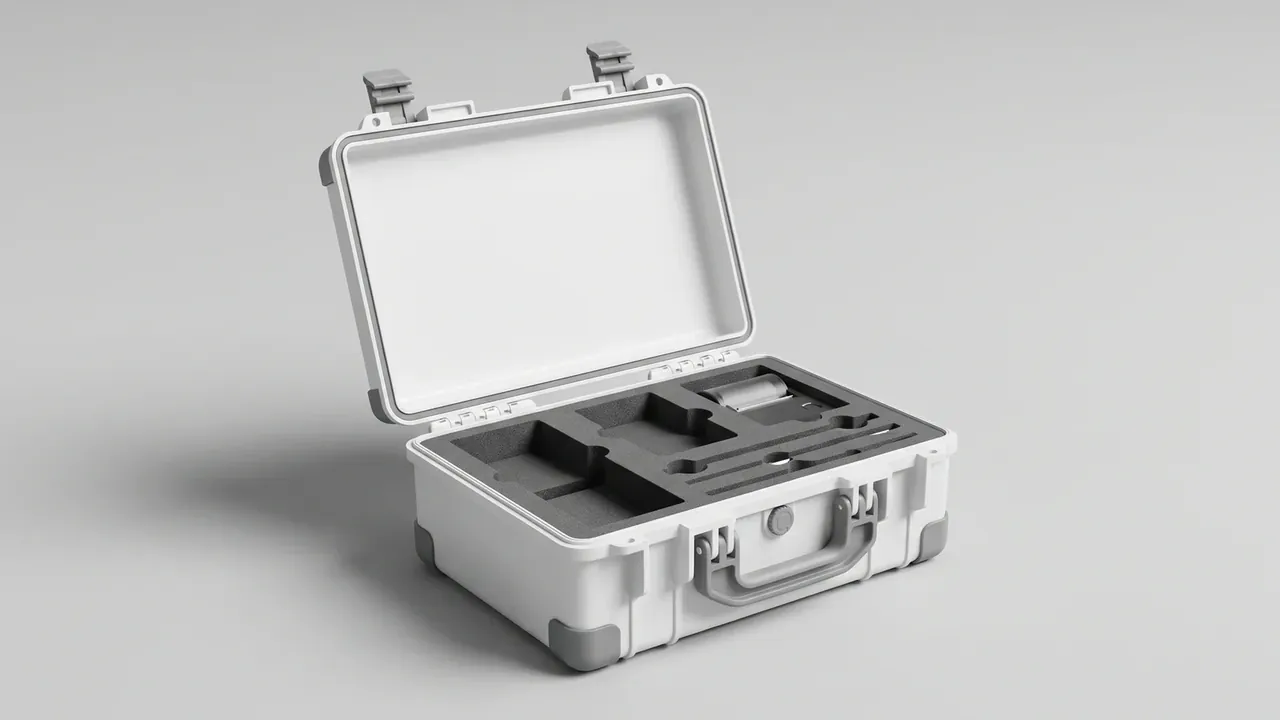
Quick answer: Cases for Nordic projects start at impact strength, not at a cold rating: homopolymer PP drops to 2 kJ/m² at -40 °C, a third of its 23 °C value. Then the latches and the grease go stiff.
Table of contents
- The Cold Budget: Impact Strength at -40 °C
- Drop at 1.2 m: Six Faces, Corners First
- Latch Material: PA66 or POM at -40 °C
- Gasket Tg: Silicone Sits 70 K Above EPDM
- Cold-Start Torque: Ribs for Handle and Wheels
- Frost, Condensation and the Warm-Up Rule
- FAQ
1. The Cold Budget: Impact Strength at -40 °C
Cases for Nordic projects open with impact strength, not with a quoted cold rating. Homopolymer PP reads 6 kJ/m² notched at 23 °C, 3 kJ/m² at -20 °C and 2 kJ/m² at -40 °C, one third of the warm value, and 2 kJ/m² means a 1 kg tup from 30 cm starts a crack.
Thickness does not buy that back: embrittlement freezes the chain segments and leaves stress no path to relax. Brittleness temperature is the second line: near -10 °C for homopolymer, -35 °C for copolymer, so -40 °C lands 5 K outside the boundary, and a Nordic build either switches resin or goes from 2.8 mm to 3.4 mm for 12% more weight.
| Compound | 23 °C | 0 °C | -20 °C | -40 °C |
|---|---|---|---|---|
| PP homopolymer | 6 kJ/m² | 5 kJ/m² | 3 kJ/m² | 2 kJ/m² |
| PP copolymer | 8 kJ/m² | 7 kJ/m² | 4.5 kJ/m² | 3.2 kJ/m² |
| PA66 toughened | 9 kJ/m² | 8 kJ/m² | 6 kJ/m² | 4.5 kJ/m² |
| POM homopolymer | 7 kJ/m² | 6 kJ/m² | 4 kJ/m² | 2.8 kJ/m² |
State the method with the number: ISO 179 Charpy notched, 80×10×4 mm, 4 h soak at -40 °C, break within 10 s.
2. Drop at 1.2 m: Six Faces, Corners First
A 1.2 m drop is the height Cases for Nordic shells fall from a hand, and it doubles as the flexibility test: six faces, three edges, one corner, one drop per sample, no through-crack, no latch release.
At room temperature the cycle leaves a 1.5 mm dent; after a 4 h soak at -40 °C the same shell splits 40 mm at a corner on the first impact, where three faces and the weld line meet at 30% of warm strength.
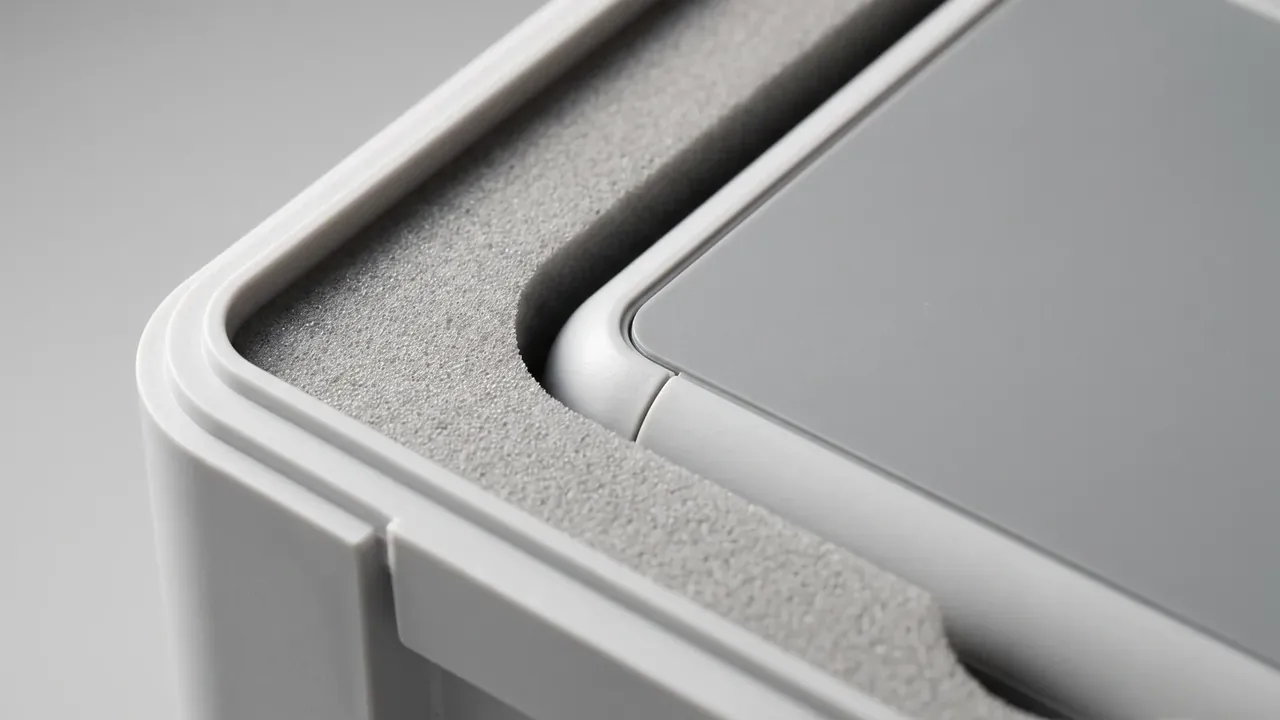
Three fixes: a corner radius from 1 mm to 3 mm cuts stress concentration 25% for almost no weight; moving the weld onto a flat needs a new gate; foam at 25 mm on six corners adds 0.4 kg and is cheapest.
3. Latch Material: PA66 or POM at -40 °C
The latch is the first plastic part to fail on Cases for Nordic shells. Toughened PA66 holds 4.5 kJ/m² notched at -40 °C against 2.8 kJ/m² for homopolymer POM, and the field gap is notch sensitivity: a 0.2 mm score at the hook root ends a POM latch outright.
Dry PA66 is its brittle state: 2.5% moisture restores toughness and swells the part 0.6%, while a dry Nordic winter takes an outdoor latch under 1% in three months for 15% of impact. Under 50 openings a year a toughened PA66 grade is enough; daily transit moves to die-cast stainless at 90 g and 40% more cost.
4. Gasket Tg: Silicone Sits 70 K Above EPDM
A gasket follows its glass transition. Silicone sits near -120 °C, EPDM near -50 °C, and at -40 °C silicone is still elastic while EPDM has entered the transition ahead of the glassy state, losing recovery from 60% to 35%.
Lost recovery is lost sealing: the lid closes short of design compression, a 0.4 mm gap opens at the corner, and opening force climbs from 60 N to 140 N.
| Compound | Tg | Recovery at -40 °C | Opening force | Verdict |
|---|---|---|---|---|
| Silicone | -120 °C | 55% | 100 N | Outdoor, long term |
| EPDM | -50 °C | 35% | 140 N | Indoor rotation |
| Neoprene | -45 °C | 30% | 150 N | Not advised |
A gasket frozen into its groove fails more often: overnight frost bonds the seal to the land, and forcing the lid pulls it out of the channel. Warm the rim with a palm.
5. Cold-Start Torque: Ribs for Handle and Wheels
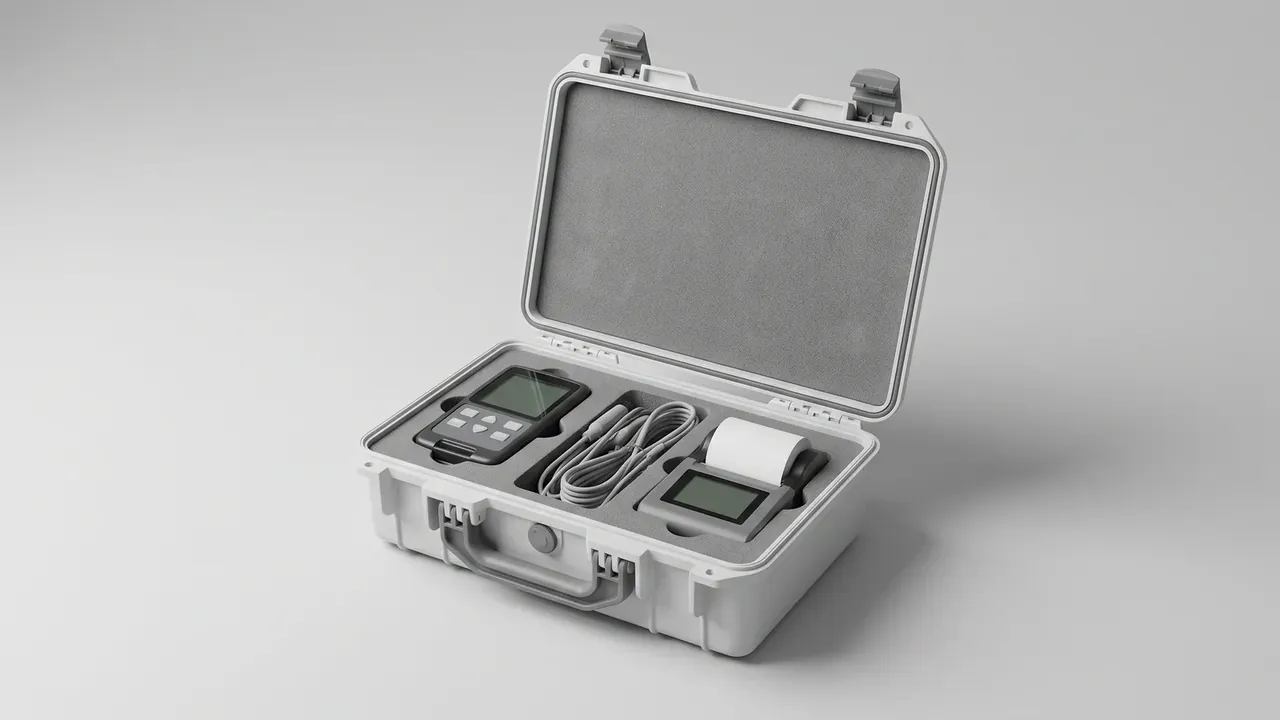
Drag on cold Cases for Nordic shells begins with grease: penetration falls from 265 to 180 and rail torque climbs to 2–3 times the warm figure. A 45 L trolley measures 1.8 N·m at 20 °C and 5.4 N·m at -40 °C.
Ribs are sized against that torque: handle seats from 2 ribs to 4 at a 1.5 mm root, rib thickness at 60% of wall, wheel housings from 4 mm to 6 mm with a steel insert in the axle bore, where the PP-to-steel gap at -40 °C reads 0.07 mm. An M6 self-tapper loses 20% of its grip in a PP boss, so Nordic builds add 0.8 mm of boss wall.
6. Frost, Condensation and the Warm-Up Rule
Carried from -40 °C into a 20 °C room, a shell frosts and then condenses. At 20 °C and 50% relative humidity the dew point is 9.3 °C, and the wall needs about 50 min to reach it at 1 K/min; open the lid sooner and moist air settles on wall and foam.
Warm up in two stages. Cases for Nordic shells leaving a -40 °C store go to a 0–5 °C ante-room for 24 h before the 20 °C room, cutting condensate from 0.8 to 0.1 g/dm². Past 72 h in the cold, a 45 L shell needs 24 h and a 90 L shell 30 h.
Conclusion
Cases for Nordic cold design compresses into four numbers: homopolymer PP keeps 2 kJ/m² at -40 °C where copolymer holds 3.2 kJ/m² on a -35 °C transition; the 1.2 m drop fails at the corner; the gasket is chosen on Tg, where 70 K decides whether recovery survives; cold-start torque reaches 2–3 times warm, so ribs are sized at 5.4 N·m. The last item is free: 72 h cold, 24 h warm-up, then open.
This article discusses only the container (case body) side of specifications and design intent, and does not cover any handling, loading or use of the contents.
Related Reading
- Low-temperature brittleness: where material choice ends
- Case specification for cold weather
- How a cold drop test is run
Related Products
- 8 Series — Gun Cases; Military Equipment Cases; Camera Equipment Cases; Drone Cases; Watch Cases; Knife Cases; First Aid Cases; Electronics Equipment Cases
- WL8-2812 PP Gun Case — model WL8-2812
- All protective cases and toolboxes: 7 series, 158 models