

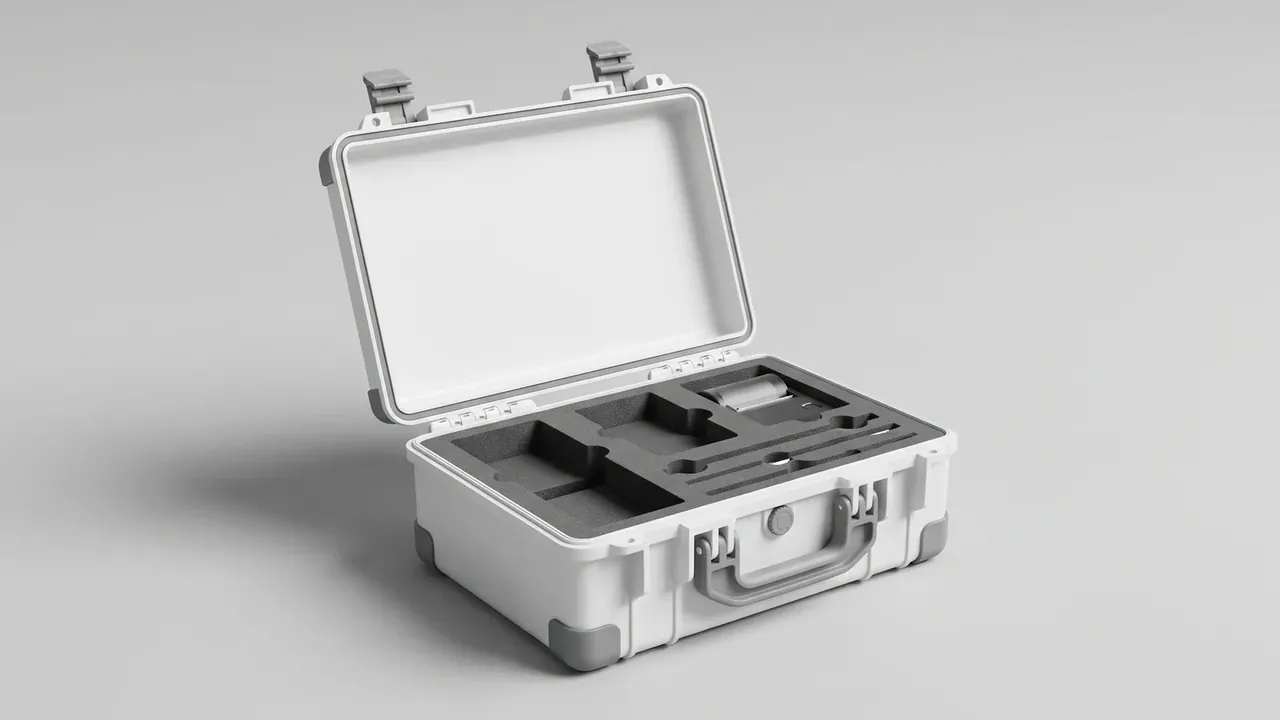
Quick answer: A Cold Drop starts after 4 h at -20 °C: of 12 samples, 4 cracked from 1.2 m while only 1 cracked from a reduced 0.9 m, and the fracture surfaces showed radial lines with a small mirror zone.
Table of contents
- Conditioning Before the Cold Drop
- 1.2 m versus a Reduced 0.9 m
- Reading the Fracture Surface
- Homopolymer versus Copolymer PP
- FAQ
1. Conditioning Before the Cold Drop
What separates a Cold Drop from an ambient drop test is the four hours before the case enters the drop zone. Samples sit at -20 °C ± 1 °C for 4 h with a 2.5 kg weight inside, latches closed, and a wall thermocouple confirming -18 °C before anything leaves the chamber.
Transfer stays under 15 s; beyond that the wall recovers 3–5 °C and the result stops being a cold number. The impact base is concrete at least 100 mm thick; a pallet reshapes the pulse.
Each face takes 3 drops in the order base, front, side, corner, and a cracked sample is replaced rather than reused. Keep chamber air under 2 m/s, since direct flow makes the thermocouple read 1–2 °C low, and leave 50 mm between samples.
| Stage | Parameter | Recorded |
|---|---|---|
| Conditioning | -20 °C ± 1 °C | Wall surface temperature |
| Duration | 4 h | Time out of chamber |
| Payload | 2.5 kg | How the weight is fixed |
| Transfer | under 15 s | Temperature at release |
2. 1.2 m versus a Reduced 0.9 m
1.2 m is the usual drop height for a portable case, and cold programmes often cut it to 0.9 m on the grounds that the resin has gone brittle. In one batch of 12 samples, 3 base drops from 1.2 m cracked 4 units, a 33% rate; the same sequence at 0.9 m cracked 1 unit, 8%.
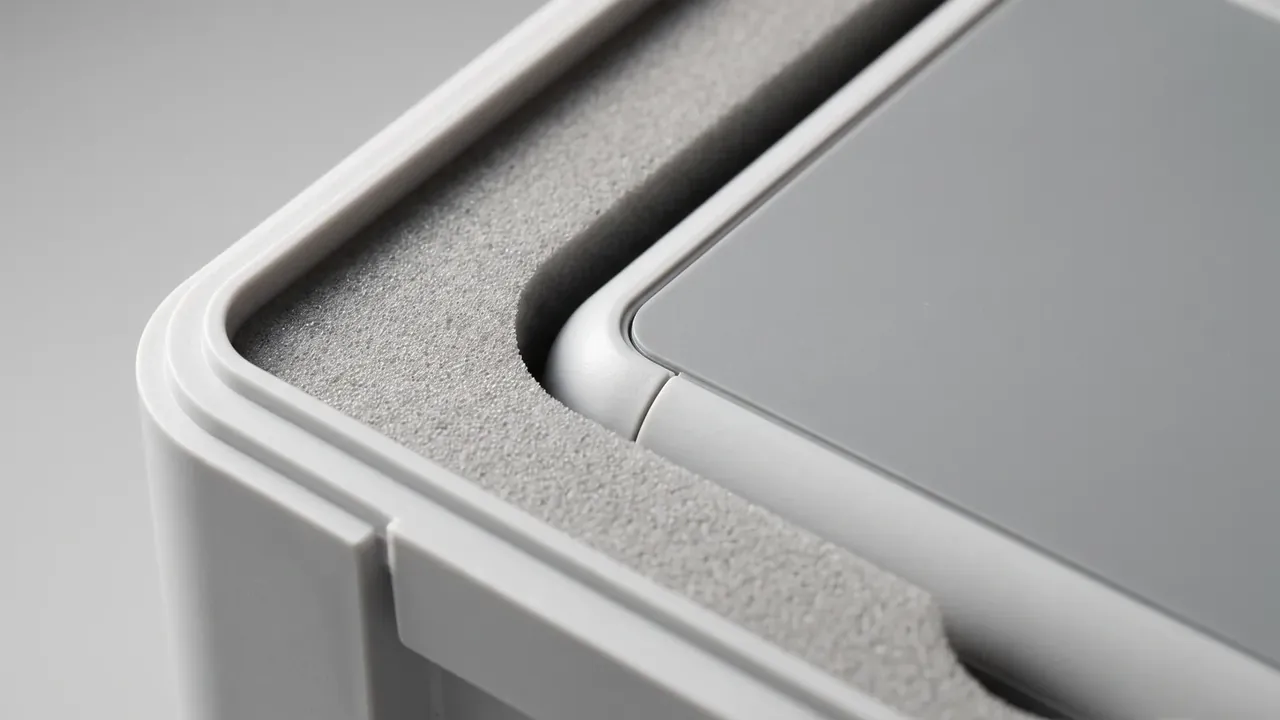
The gap is more than 25% of height. Potential energy falls linearly, so 0.9 m keeps 75% of it, but notched impact of PP at -20 °C is only 40%–50% of room temperature. Absorption drops faster than input, so 0.9 m is not equivalent severity.
A reduced height is usable if the report states the value and the crack rate at that value. Saying only that the case passed a 0.9 m cold drop hides the 8%.
The energy arithmetic runs backwards too. A 2.5 kg payload in a 4 kg case gives about 76 J from 1.2 m and 57 J from 0.9 m, while notched energy per unit area falls from 0.9 J/mm² to 0.4 J/mm² at -20 °C.
| Height | Face | Drops | Cracked | Rate | Longest crack |
|---|---|---|---|---|---|
| 1.2 m | Base | 3 | 4 of 12 | 33% | 46 mm |
| 0.9 m | Base | 3 | 1 of 12 | 8% | 18 mm |
3. Reading the Fracture Surface
The fracture surface is the only physical evidence that explains where a Cold Drop started. Initiation sits where the radial lines converge, so a magnifier aimed there shows whether the break began at the latch boss root or a corner radius. The mirror zone hugs that point; below 2 mm² it means low initiation stress and fast propagation, the signature of brittle failure. A whitened surface with drawn fibres is ductile tearing, evidence the resin choice was right at that height. Use a 10× loupe, not a phone camera.
Initiation concentrates in two places: the R2 radius at the latch boss root, and the step where wall thickness drops from 3.2 mm to 2.4 mm, both where the weld line ends and keeps only 60%–70% of bulk strength.
Pair the surface with the height. At the same 1.2 m, one sample cracked at the R2 with a 46 mm crack, another at the latch pin bore with 12 mm. Those are different faults: an undersized radius against thin material around the bore.
4. Homopolymer versus Copolymer PP
Homopolymer PP has a glass transition near 0 °C, so at -20 °C it is fully glassy and no energy dissipation mechanism is left. Copolymer PP disperses a rubber phase with a transition around -40 °C, still rubbery at -20 °C, which converts impact energy into deformation.
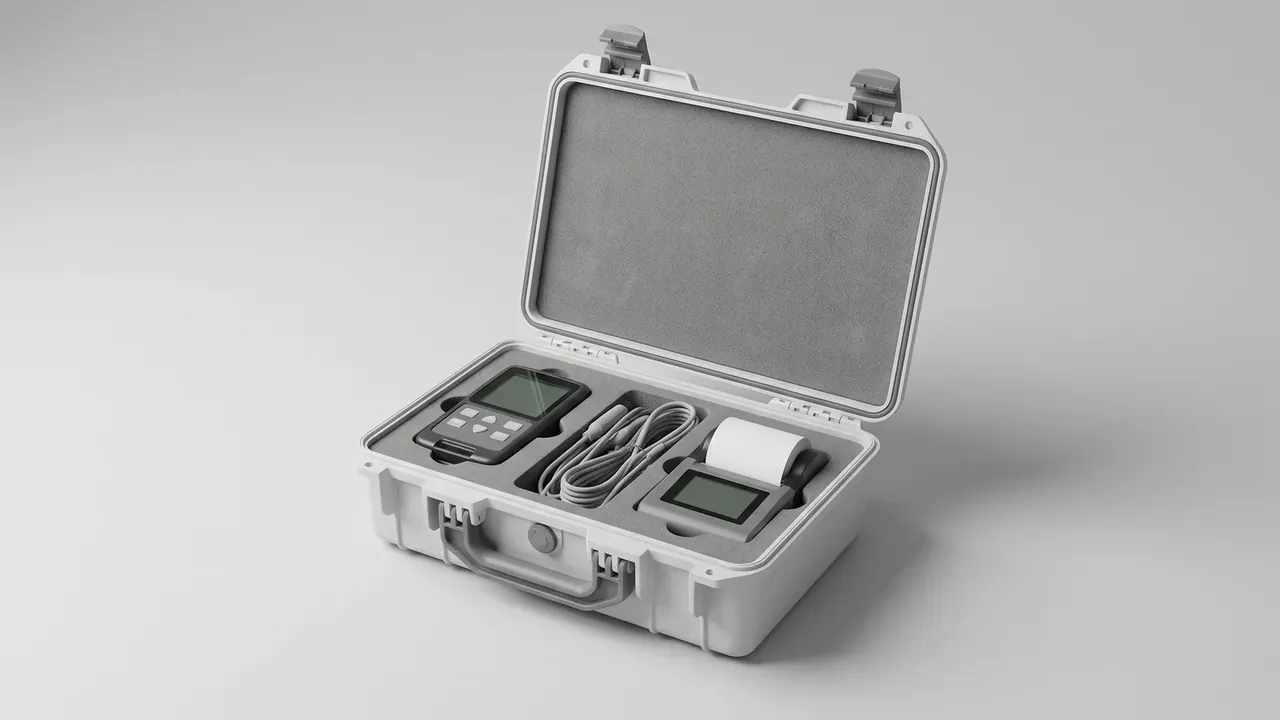
| Material | Notched impact at 23 °C | Notched impact at -20 °C | Drop | Fracture type |
|---|---|---|---|---|
| Homopolymer PP | 45 kJ/m² | 18 kJ/m² | 60% | Fully brittle, clear radial lines |
| Copolymer PP | 52 kJ/m² | 28 kJ/m² | 46% | Brittle with local drawing |
| Copolymer PP plus 15% POE | 60 kJ/m² | 41 kJ/m² | 32% | Mostly ductile tearing |
Adding 15% impact modifier lifts the -20 °C value to 41 kJ/m² at the cost of stiffness, larger deformation at 70 °C and a tacky surface. Cold and hot demands pull opposite ways, and one grade claiming both misses both.
Test bars and whole cases often disagree. A bar is gated at one end, so melt fills in one direction and the notch cuts the most oriented region; a case is gated at the base centre, flow splits and rejoins, and the latch boss root is a weld line. The same resin can pass 28 kJ/m² on bars and still split at 1.2 m in a full case.
Conclusion
A Cold Drop verdict should never rest on whether something broke. Read crack rate, drop height and fracture surface together. The checklist: 4 h at -20 °C, release within 15 s, 3 base drops, crack rate ≤10%, no large mirror zone. Where a line fails, move to copolymer PP or add 10%–15% impact modifier first, then open the latch boss radius, then thicken the wall. Cold stores and winter transport deserve these numbers in the acceptance clause, not the phrase cold resistant.
Related Reading
- Case histories of brittle fracture at low temperature
- Low temperature brittleness testing: temperature points and soak time
- Drop test height, faces and pass rules
- Cold chain case selection and insulation options
Related Products
- 8 Series — Gun Cases; Military Equipment Cases; Camera Equipment Cases; Drone Cases; Watch Cases; Knife Cases; First Aid Cases; Electronics Equipment Cases
- WL8-2812 PP Gun Case — model WL8-2812
- All protective cases and toolboxes: 7 series, 158 models