

Quick answer: Three hard lines settle scrapping: a crack at a corner or latch seat, lid flatness past 1.5 mm, a pin bore opened 0.5 mm. Add 40% of value.
Table of contents
- Three hard lines and one economic line
- A crack is judged by where it sits, then by length
- Distortion: 1.5 mm across the lid, 2 mm across the diagonals
- Hardware, the repair sum and three signatures
- FAQ
1. Three hard lines and one economic line
Whether a case still works should not wait for a leak to answer. Cracks, distortion and hardware failure are the three hard lines; hit any one and the case is scrapped without a debate about repair. Only when all three pass does the arithmetic start.
| Line | Evidence | Limit | Action |
|---|---|---|---|
| Crack | Over a third of wall width | >1/3 width | Scrap |
| Crack | At corner, rib root, latch seat | any length | Scrap |
| Wall | Left after wear | <2.0 mm | Scrap |
| Lid | Flatness over the top | >1.5 mm | Scrap |
| Lid | Two diagonals compared | >2 mm | Scrap |
| Hardware | Bore, latch force, rust | 0.5 mm / 30 N / 15% | Scrap |
The economic line comes after the hard ones. A repair quote above 40% of case value means replace, even when all three pass, since a repaired case carries about half the remaining life at close to half the price.
The real cost is judging wrong. Scrapping a repairable case wastes book value; keeping one that should go costs a leak. That asymmetry keeps the hard lines strict.
There is also a deadline. Nothing leaves the store while a verdict is pending, and the verdict is due in 5 working days; without a deadline, pending becomes permanent.
2. A crack is judged by where it sits, then by length
The wall leaves the mould at 3.0 mm and can wear below 2.0 mm, a loss over 30%, which is where cracks begin. So measure thickness before length: a case under 2.0 mm is not repaired even when the crack is only 8 mm.
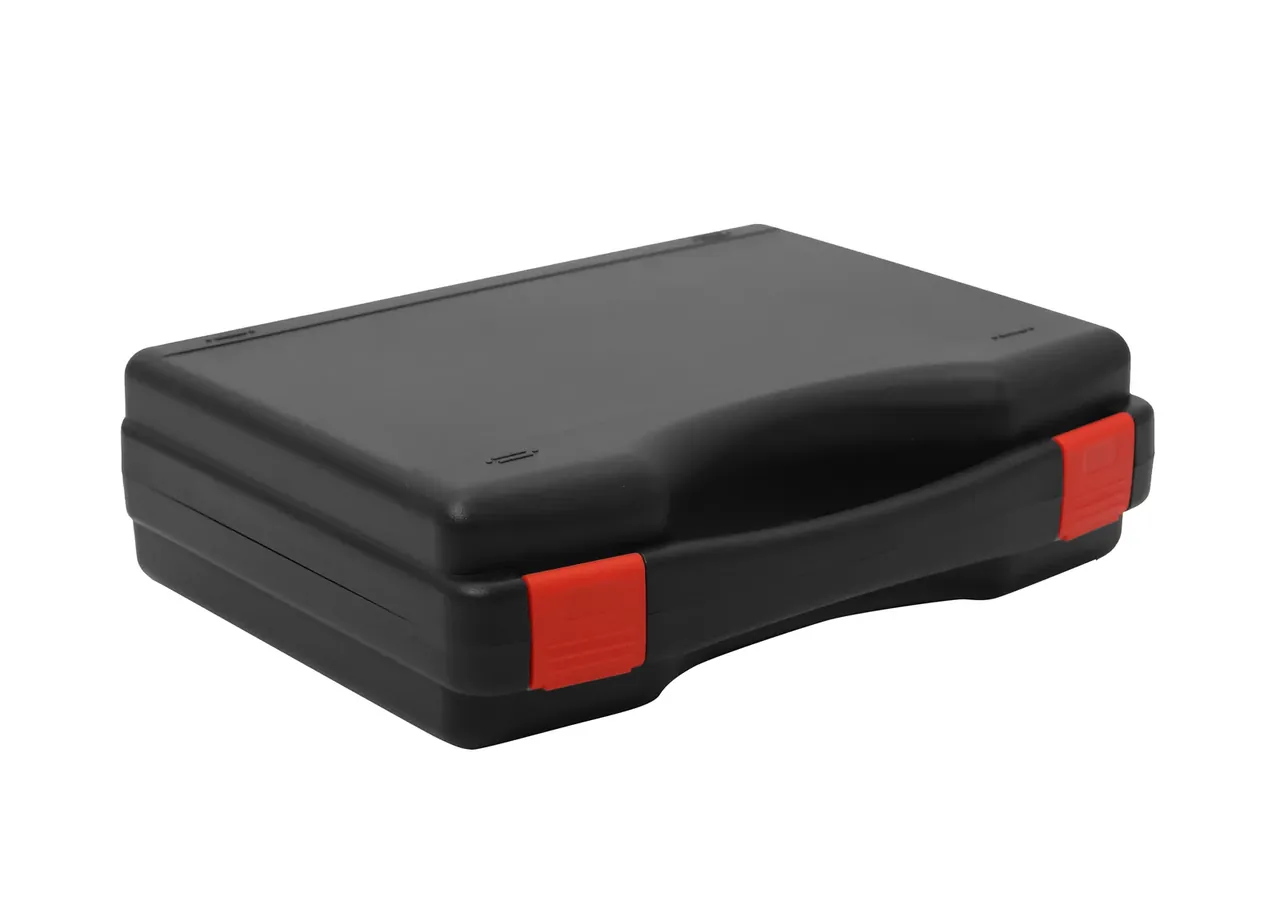
Position rules out earlier than length. A corner radius, a rib root or a latch seat carries a stress concentration factor above 2, and a repair leaves the load path where it was, so a second crack is close to certain; those spots are scrapped at any length. Only a flat panel crack shorter than a third of the wall width is open to discussion.
Read length with a 20x loupe and a 0.5 mm scale, measuring the visible crack ends rather than the edge of the whitened zone. Whitening is yield and comes first, so treating it as a crack writes off repairable cases.
Two cases make the point. One carries a 45 mm crack mid-panel with 2.4 mm of wall left and goes to repair. The other carries a 12 mm crack sitting 3 mm under a latch seat, and it is scrapped on position alone.
Photograph three frames before closing a case out: the whole body, the crack with the scale in frame, the caliper reading.
3. Distortion: 1.5 mm across the lid, 2 mm across the diagonals
Lay a 500 mm steel rule on edge along the middle of the lid and try a feeler gauge beneath it; 1.5 mm slipping in fails flatness. Take five points, centre plus four edge midpoints, and record the worst instead of the average, which hides a local collapse.
The second number is the diagonal. Past 2 mm of difference the opening has gone parallelogram, and a gasket in that shape never seats along its run.
Distortion splits into elastic and permanent. A case straight off a truck still carries load marks, so lay it flat for 24 h and measure again. What recovers was elastic; what stays past the limit is where a case is scrapped.
Heat lies. Linear expansion of PP runs about 1.5×10⁻⁴/K, so a 1 m case warmed 20 °C grows roughly 3 mm, and a diagonal read in a sunny yard doubles the error. Bring it into a 23 °C room for 2 h first.
Stacking is the usual source. A bottom case under load for 3 months sags 2.2 mm and still reads 1.7 mm after 24 h flat; the same batch on the top layer returns to 0.8 mm and keeps working.
4. Hardware, the repair sum and three signatures
Latches and hinges fail three ways: bore wear, lost latch force, rising rust area. The pin bore starts at 6 mm; opened to 6.5 mm, a wear of 0.5 mm, the latch rocks sideways and never pulls down. Latch force is pulled with a gauge at the middle of the latch: a new case reads 45 N to 70 N, and below 30 N people start slamming the lid.
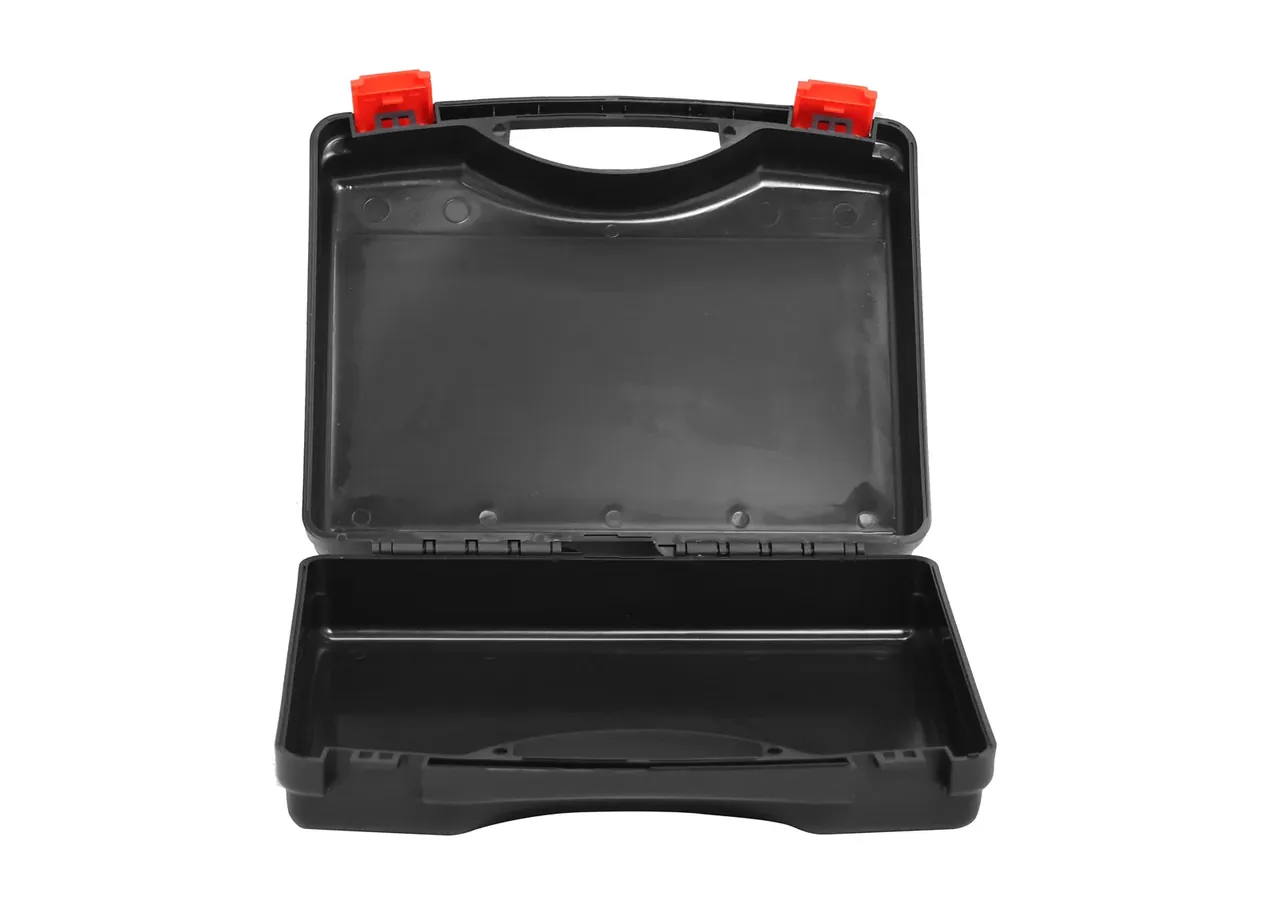
Rust is counted as area. Press a 10 mm grid sheet on the latch seat, hinge pin and vent, count squares, and fail the part above 15%; bloom does not count, pitting does.
| Route | Cost against value | Life left | Applies when |
|---|---|---|---|
| Latches only | 8%–12% | about 70% | Bore intact, no cracks |
| Latches and hinges | 18%–25% | about 50% | Two hardware failures, wall sound |
| Gasket plus hardware | 30%–38% | about 45% | Three light failures, lid flat |
| New case | 100% | 100% | Any hard line, or repair over 40% |
Sign-off needs three people: the user department confirms downtime, maintenance confirms the readings, EHS confirms the disposal route. The sheet carries 8 fixed fields, from case ID and commissioning date to criterion hit, measured value, photo number and signatories; a missing field sends it back, and two returns usually mean the readings were reconstructed afterwards.
Keep records for 3 years. The aim is batch recall: once one model passes 8% scrapped in a year, the question moves from a single case to the batch.
Conclusion
The order cannot be reversed: thickness and crack position first, then 1.5 mm of lid flatness and 2 mm across the diagonals, then a 0.5 mm bore, 30 N of latch force and 15% rust. Any hard line is where a case is scrapped, and only then does the 40% repair threshold get a hearing. Three signatures, 8 fields, 3 years of records and a 5-day deadline are what make every retirement traceable. Slow is survivable; vague is not.
This article discusses only the container (case body) side of specifications and design intent, and does not cover any handling, loading or use of the contents.
Related Reading
- Where repair stops on cracks and distortion
- Wear parts list and spare replacement
- Warranty verdicts and how to negotiate them
- Where retired cases go for recycling
Related Products
- 8 Series — Gun Cases; Military Equipment Cases; Camera Equipment Cases; Drone Cases; Watch Cases; Knife Cases; First Aid Cases; Electronics Equipment Cases
- WL8-2812 PP Gun Case — model WL8-2812
- All protective cases and toolboxes: 7 series, 158 models