

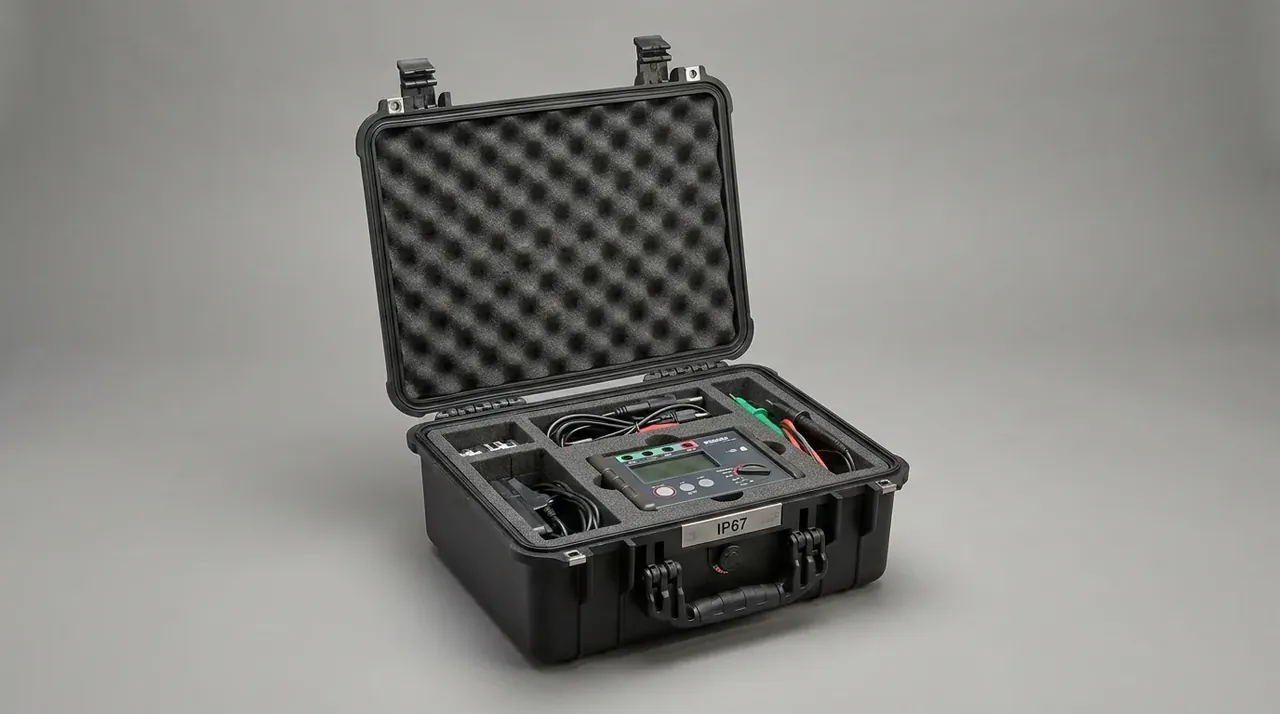
Quick answer: Case thermal cycling at -40 °C for two hours widens the lid-to-body gap from 0.05 to 0.45 mm, drops gasket squeeze from 25% to 14% and costs 38 N of latch preload.
Table of contents
- Four Parameters That Define Case Thermal Cycling
- The Gap After Two Hours at -40 °C
- Pressure, Lid Bulge and the Relief Valve
- Gasket Versus Plastic: Differential Shrinkage
- Condensation, Dew Point and the Pass List
- FAQ
1. Four Parameters That Define Case Thermal Cycling
A valid case thermal cycling run comes from four numbers: 3 °C/min ramp, two-hour dwell at each end, 100 cycles, ±2 °C uniformity inside the case. Change one and the failure moves to another corner.
Push the ramp to 5 °C/min and the through-wall gradient grows from 4 to 9 °C. The skin contracts while the core still expands, so cracks migrate to the body corners and the groove looks clean when it is not.
The dwell comes from equilibrium. A 3 mm wall carries a 12 minute time constant, so two hours is ten constants and the air-to-wall difference closes to 1 °C. Cut it to 30 minutes and the gasket sees 18 °C less range.
| Stage | Temperature (°C) | Ramp | Dwell | Tolerance |
|---|---|---|---|---|
| Cold | -40 | 3 °C/min | 2 h | ±2 °C |
| Hot | 70 | 3 °C/min | 2 h | ±2 °C |
| Transfer | 20 | within 5 min | none | — |
| Cycles | 100 | logged | — | — |
2. The Gap After Two Hours at -40 °C
ABS shrinks at 8×10⁻⁵/K, so a 520 mm body loses 2.5 mm across a 60 K swing. The silicone cord beside it runs at 2.5×10⁻⁴/K and loses 7.8 mm. The 5.3 mm difference leaves through the corners, because the groove is only 6 mm wide.
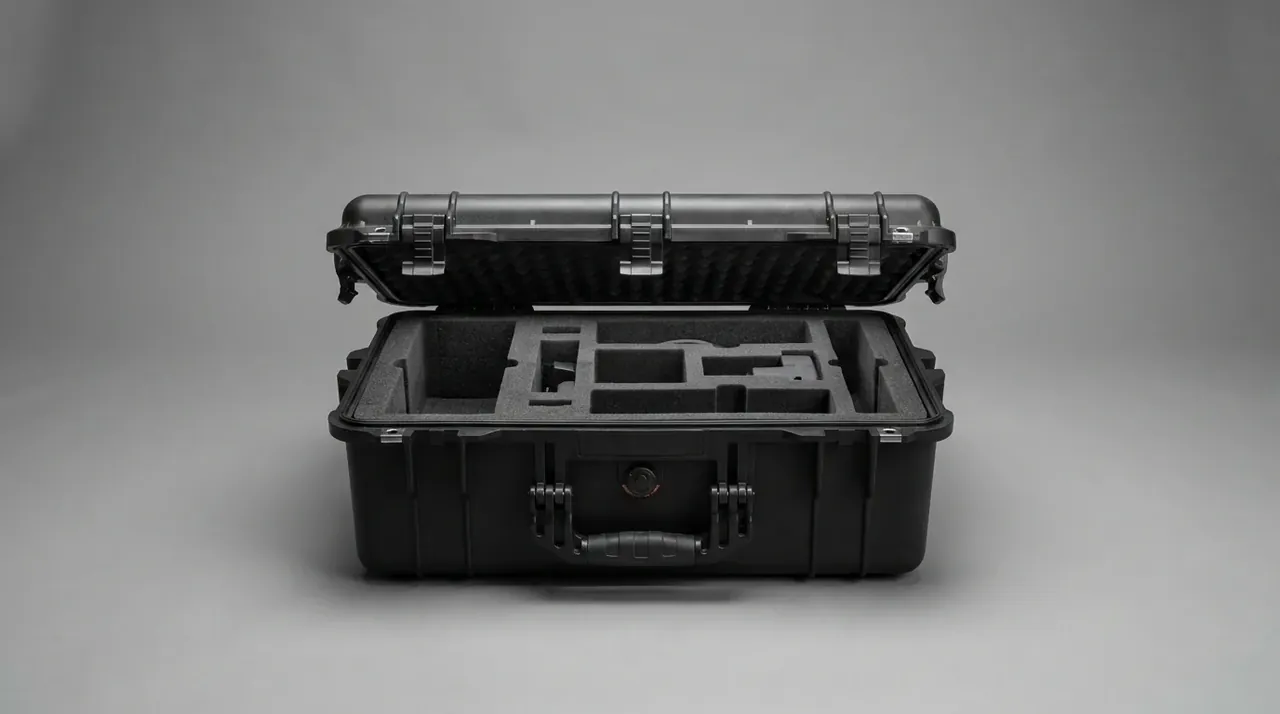
Measured gaps climb faster than arithmetic: 0.05 mm on the first assembly, 0.12 at 25 cycles, 0.45 at 100. Half arrives while elastic recovery lags, the rest is compression set with the cord dropping from 8.00 to 7.42 mm.
| Cycles | Gap (mm) | Squeeze | Latch force (N) | First failure |
|---|---|---|---|---|
| First part | 0.05 | 25% | 180 | none |
| 25 | 0.12 | 23% | 172 | none |
| 50 | 0.24 | 20% | 158 | groove corners |
| 100 | 0.45 | 14% | 142 | corners, latch bosses |
| 150 | 0.62 | 11% | 128 | hinge side |
The latch deforms second. A PA66-GF30 boss shrinks 0.6 mm less than the ABS body over 60 K, so preload falls from 180 to 142 N; below 120 N the lid lifts a 0.1 mm slit and the 60 s leak check jumps from 0.4 to 2.1 kPa.
3. Pressure, Lid Bulge and the Relief Valve
The hot half is the half people underestimate. A sealed 10 L cavity rising from 20 to 70 °C gains 17 kPa; falling to -40 °C turns it into -20.9 kPa of vacuum.
Without a valve, 17 kPa bows a 520 mm lid 0.6 mm at mid-span while the corners stay put. The vacuum side is worse to use: -20.9 kPa holds the lid shut and opening force climbs from 90 to 160 N.
A breather valve removes most of it. Membranes cracking at 3.5 to 5 kPa cap the differential near 5 kPa and bulge drops to 0.15 mm. Cold defeats them: silicone hardens from 50 to 62 Shore A at -40 °C, cracking pressure rises to 12 kPa, and 100 cycles leave 0.3 mm of set, so reverse flow starts only at -25 kPa.
4. Gasket Versus Plastic: Differential Shrinkage
Material choice is the hardness gain at -40 °C plus the set after 100 cycles, not a feel test at room temperature. At 70 Shore A, silicone stiffens 6 points, EPDM 14, and PVC enters crystalline hardening.
The pass line for set is 25%. Silicone lands at 18% and still holds 25% squeeze; EPDM reaches 26% and squeeze falls to 19%; PVC reaches 41%, the same as leaving the groove empty.
| Material | TR10 (°C) | Gain at -40 °C | Set, 100 cycles | Verdict |
|---|---|---|---|---|
| Silicone 70 Shore A | -55 | 6 points | 18% | usable |
| EPDM 70 Shore A | -45 | 14 points | 26% | stiff when cold |
| PVC 65 Shore A | -20 | crystalline | 41% | not suitable |
A 6 mm groove with an 8 mm cord gives 25% squeeze and 2 mm for growth. The silicone loses 1.9 mm more than ABS per 100 mm, and a square corner turns that into tension, thinning the cord 0.15 mm and dropping squeeze to 17%; an R8 corner holds 22%.
Metal follows none of it. A 6 mm stainless pin moves 0.007 mm across 60 K while the ABS moves 0.03 mm, so the bore opens from 6.02 to 6.05 mm and the lid rocks 3 degrees after 100 cycles.
5. Condensation, Dew Point and the Pass List
Condensation never shows in the gap, only in the water left inside. Air at 20 °C and 60% RH has a dew point of 12 °C, so one pass through 12 °C lasting over 8 minutes deposits a film; across 100 cycles the wall water in a 10 L cavity climbs from 0.2 to 3.1 g. The valve does not stop it, since the membrane passes vapour either way; holding 3 °C/min lets cavity air cool against the walls instead of the groove.
Fail the run when two of four items trip: gap above 0.3 mm, squeeze below 18%, latch force down 20%, or more than 1 kPa drop holding -20 kPa for 60 s. Measure within 24 hours of unloading, because reading straight out of the chamber understates the gap by 0.08 mm.
Conclusion
Read the results by cycle count. Inside 50 cycles the groove corners lead, 0.24 mm gap and 20% squeeze, and an R8 corner with 2 mm of allowance still saves it. At 100 cycles the latch bosses lead, 38 N gone and a 0.45 mm gap, and a new cord is too late because the preload travel needs redesign. At 150 the hinge side leads with 3 degrees of rock, which is structure, not sealing.
This article discusses container-side specifications and design implications only, and does not cover any handling, loading or use of the contents.
Related Reading
- Breather valve cracking pressure and placement
- Silicone, EPDM and PVC gasket comparison
- Gasket groove width and squeeze design
- Seal ageing and replacement criteria
Related Products
- 8 Series — Gun Cases; Military Equipment Cases; Camera Equipment Cases; Drone Cases; Watch Cases; Knife Cases; First Aid Cases; Electronics Equipment Cases
- WL8-2812 PP Gun Case — model WL8-2812
- All protective cases and toolboxes: 7 series, 158 models