

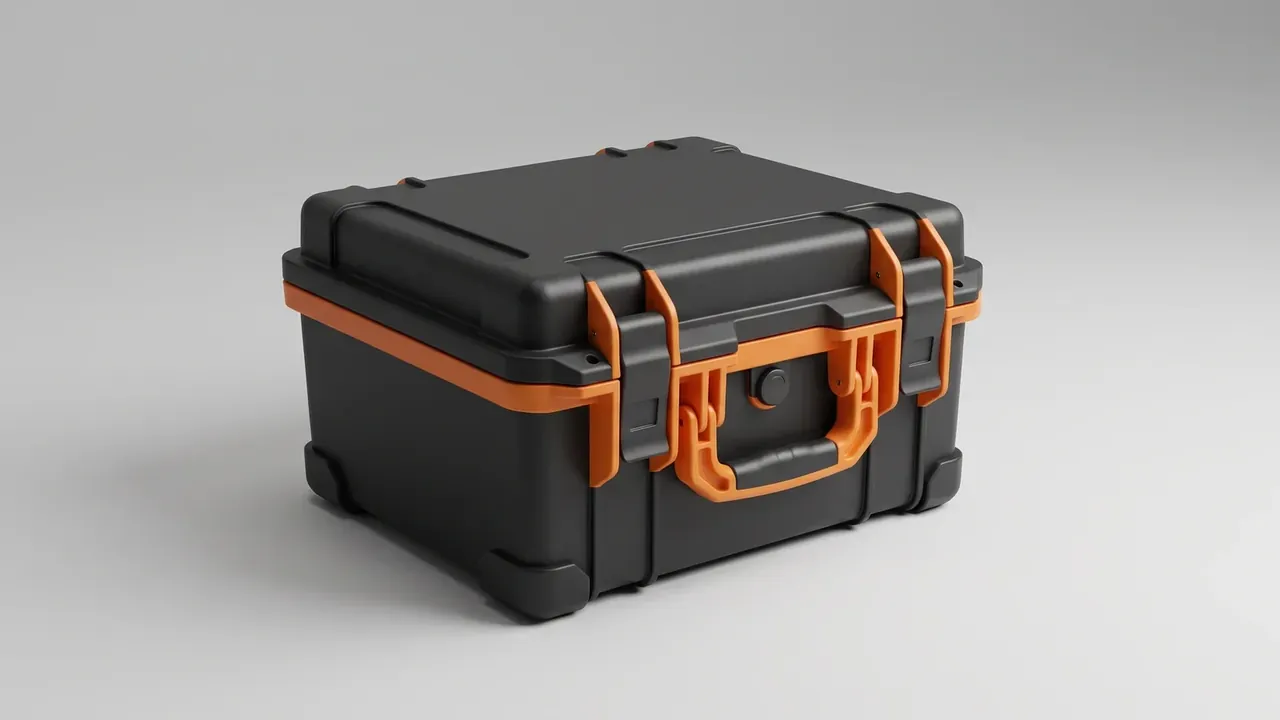
Quick answer: A pressure relief valve on a case opens at 3–5 kPa, so a 26 kPa cabin differential never reaches the gasket seals or the latches. Fit one when the cavity passes 20 L, the route crosses 1000 m of altitude, or the shipment flies; any one of those is enough.
Table of contents
- What the valve actually resists
- Where the differential comes from
- Diaphragm versus spring
- When to fit one, when not to
- FAQ
1. What the valve actually resists
Close the lid, latch it down, and the cavity becomes a sealed parcel of air. Change the outside pressure and the difference lands on the lid and the gasket, bowing the shell outward or sucking it in.
Take a 40 L case, 520 mm by 420 mm. The lid projects about 0.22 m², so 20 kPa of differential puts 4.4 kN on it, roughly the weight of 450 kg resting on the lid. Four latches share that load at 1.1 kN each, and the hook-to-rim contact stress runs straight into yield.
A pressure relief valve gives that load somewhere to go. At 3–5 kPa the disc lifts, air moves from cavity to atmosphere, and the differential stays pinned under the threshold while the gasket and latches remain inside their design envelope.
The part weighs 8–15 g, under 0.3 % of case weight, yet it is the only pressure relief valve in the assembly, and the only part that vents.
Bigger cavities feel more: an 80 L case with a 0.4 m² lid meets 8 kN at 20 kPa, twice what four latches rated at 1.1 kN can hold.
2. Where the differential comes from
Three sources matter, and a pressure relief valve has to cover all of them.
Altitude comes first. Sea level sits at 101 kPa, a site at 3000 m at roughly 70 kPa, and that 30 kPa gap presses on the shell for the whole drive from plain to plateau without ever equalising.
Air freight comes second. A cargo hold is pressurised to the equivalent of 2400 m, about 75 kPa in cruise against 101 kPa on the ground, a 26 kPa difference. Latch the case at the airport, fly, open it on arrival, and the audible inrush is that 26 kPa.
Temperature comes third. A sealed cavity warmed 30 °C gains roughly 10 kPa at constant volume; move the case from a 35 °C container into a 0 °C cold store and the cavity drops 8–12 kPa below ambient, pulling the lid down 1.5 mm.
| Source | Typical magnitude | Where it appears |
|---|---|---|
| 3000 m against sea level | 30 kPa | Plateau road transport |
| Cargo hold (2400 m equivalent) | 26 kPa | Air freight |
| 30 °C rise after sealing | 8–10 kPa | Summer truck, container |
| 40 °C drop in transit | 8–12 kPa vacuum | Warm warehouse to cold store |
The load is not even. At 20 kPa the centre of a 520 mm lid sags 2.5 mm while the corners barely move, stretching the gasket and dropping mid-span contact pressure to a third.
Sources stack. Load at noon into a 55 °C trailer, fly in the afternoon, land on a plateau, and the combined differential passes 35 kPa; apply a 1.5 safety factor and that figure sets the ceiling.
3. Diaphragm versus spring
A diaphragm valve uses a 0.2–0.3 mm silicone membrane as the disc. At 3 kPa the edge lifts 0.1 mm and air escapes around the perimeter; below 0.5 kPa the membrane reseats.
A spring valve holds the poppet with a 0.6 N/mm spring. Cracking pressure is set by preload, 1.8–3.0 N for the 3–5 kPa band, and repeatability reaches ±0.3 kPa. The cost is a guide bore for the poppet, which keeps the body above 12 mm.
Flow matters more than cracking point. A diaphragm unit takes about 90 seconds to bleed a 40 L cavity from 20 kPa to 5 kPa; a spring unit of the same bore takes 25 seconds, so for air freight read flow first.
Both types have to pass dust and water. Point the port downward and add a 0.05 mm hydrophobic membrane and IP67 is reachable; for IP68 at 1.5 m for 30 minutes the body needs two O-rings and a threaded compression ring, doubling cost.
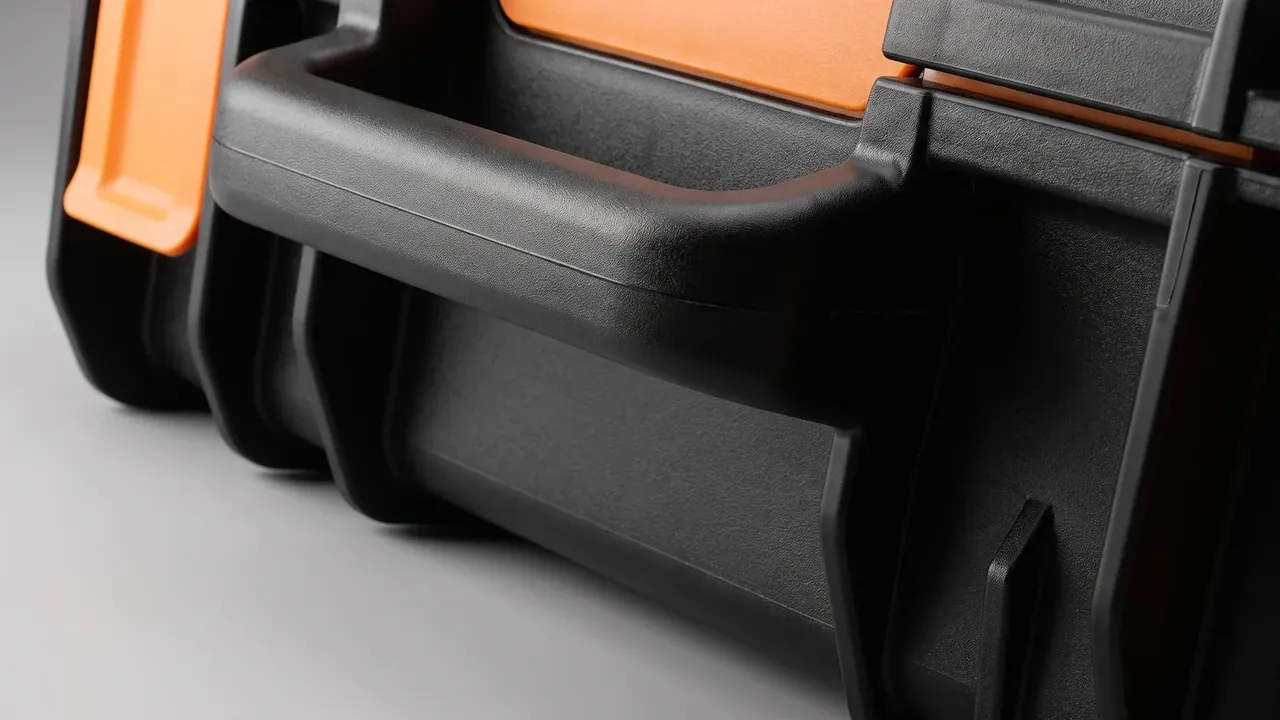
Placement matters. A lid-centre port vents fastest but sits where deflection peaks, so the boss needs 3 mm of wall; a low side port stays clear of standing water but blocks easily with foam.
| Item | Diaphragm | Spring |
|---|---|---|
| Cracking pressure | 2.5–3.5 kPa | 3–5 kPa, adjustable |
| Reseat pressure | 0.5 kPa | 0.8–1.2 kPa |
| Repeatability | ±0.6 kPa | ±0.3 kPa |
| Vent time, 40 L | about 90 s | about 25 s |
| Minimum body | 12 mm | 16 mm |
| Rating ceiling | IP67 | IP68 |
| Unit price | USD 1–2 | USD 3–5 |
4. When to fit one, when not to
Three tests decide it, and any single hit means fit one.
Cavity over 20 L with a route crossing 1000 m of altitude: fit. Ten kilopascals across 0.22 m² is 2.2 kN, more than four latches can absorb with margin.
Sealed for the whole shipment with an air leg: fit. The 26 kPa cabin differential does not fade, and the vacuum on arrival pulls the gasket 0.5 mm out of its seat, after which the lid no longer closes tight.
Short road runs with the case opened every 8 hours: skip it. Opening equalises the cavity, and measured differentials in that duty rarely pass 2 kPa.
Servicing follows duty. Press the poppet every 12 months in ordinary storage, inspect after 48 hours of salt fog on coastal sites, and replace the whole pressure relief valve once the poppet sticks or the membrane hardens.
A spring valve runs USD 3–5, some 3 %–5 % of case cost, while a latch bent by pressure means a repair starting at USD 18 plus freight.
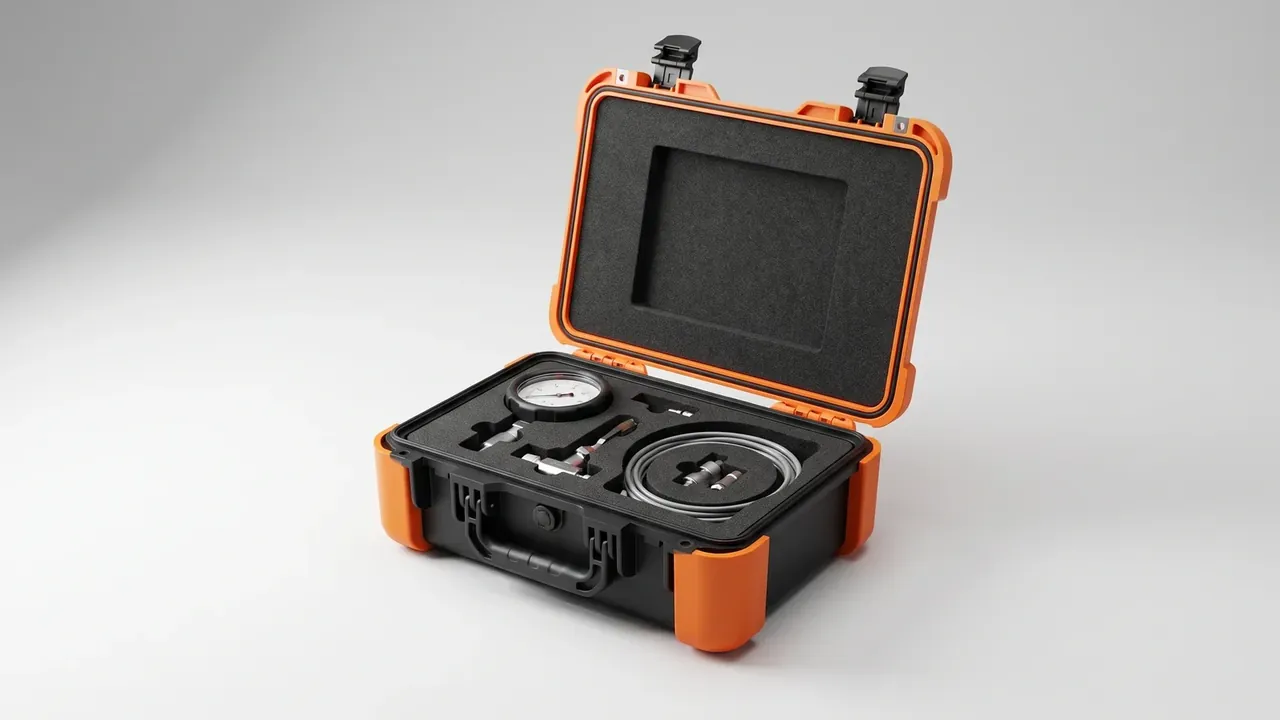
One failure mode gets overlooked: foam blocking the port. With cushion foam pressed against the vent, air has to cross a 0.05 mm membrane at roughly a third of rated flow, and the valve is effectively absent. Leave an 8 mm air gap in the insert.
Acceptance takes one rig. Feed 5 kPa of regulated air: the pressure relief valve should pass before 5 kPa, stop once pressure falls 1 kPa, and show no continuous bubbles within two minutes. Sample 5 % of each lot, all units of a first article, and record cracking and reseat pressure.
Conclusion
A pressure relief valve is not universal equipment, but the decision is measurable: cavity above 20 L, 1000 m of altitude, or an air leg, and the differential passes 10 kPa with more than 2 kN on the lid. A 3–5 kPa cracking point keeps the seal inside its envelope. Port down, 8 mm of foam clearance, replacement at 5000 cycles, and the part keeps working.
This article discusses only the container (case body) side of specifications and design intent, and does not cover any handling, loading or use of the contents.
Related Reading
- IP ratings and test methods for hard cases
- Standards for air transport cases
- How a waterproof hard case is built
- Injection moulding for protective cases
Related Products
- 8 Series — Gun Cases; Military Equipment Cases; Camera Equipment Cases; Drone Cases; Watch Cases; Knife Cases; First Aid Cases; Electronics Equipment Cases
- WL8-2812 PP Gun Case — model WL8-2812
- All protective cases and toolboxes: 7 series, 158 models