

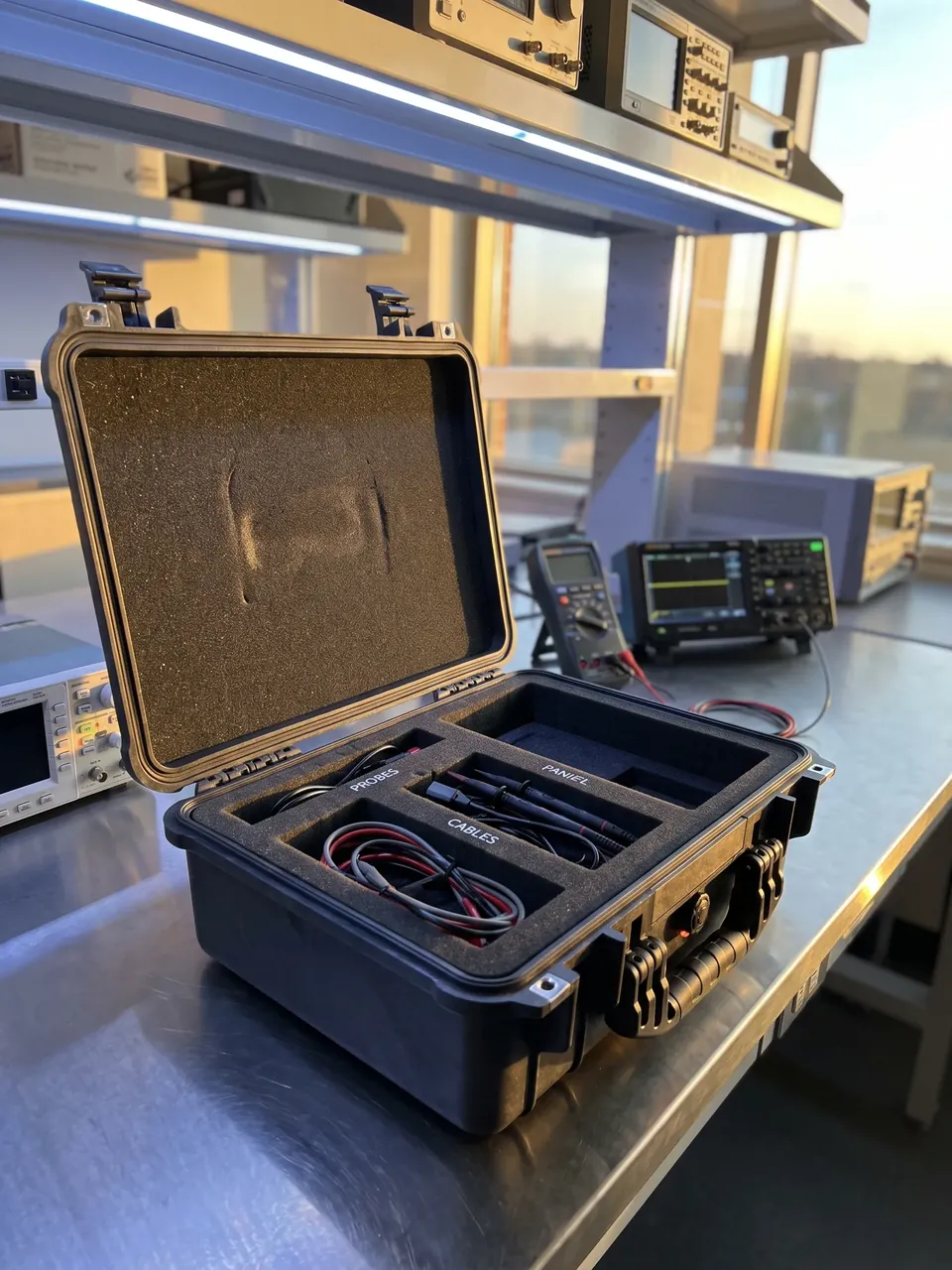
Quick answer: A case vibration test has two routes, random described by power spectral density and sine sweep described by peak acceleration.
Table of contents
- Where the two routes diverge
- PSD and acceleration spectra differ
- Finding resonance from 5 to 500 Hz
- Why dwell at resonance hurts more
- How test time converts
- Case and liner response on the table
- FAQ
1. Where the two routes diverge
One 12 kg case, 1 hour of random, 2 hours of sine sweep, both stamped pass, yet the damage carried differs by more than 3 times. The difference is spectral shape: random spreads energy across 10–500 Hz, sine works one frequency at a time.
Truck beds, cargo holds and rail consists deliver broadband acceleration logged as power spectral density; engines and compressors deliver narrowband excitation logged as peak acceleration.
Sine instead of random never excites modes above 200 Hz, so thin lids stay quiet; random instead of sine averages the peak into the band, so the gain cannot be read.
2. PSD and acceleration spectra differ
PSD carries g²/Hz and reports energy per 1 Hz slice, so the curve must be integrated and square-rooted to yield Grms. A sine spectrum carries g for one peak, which makes 1.6 Grms and 1.6 g incomparable.
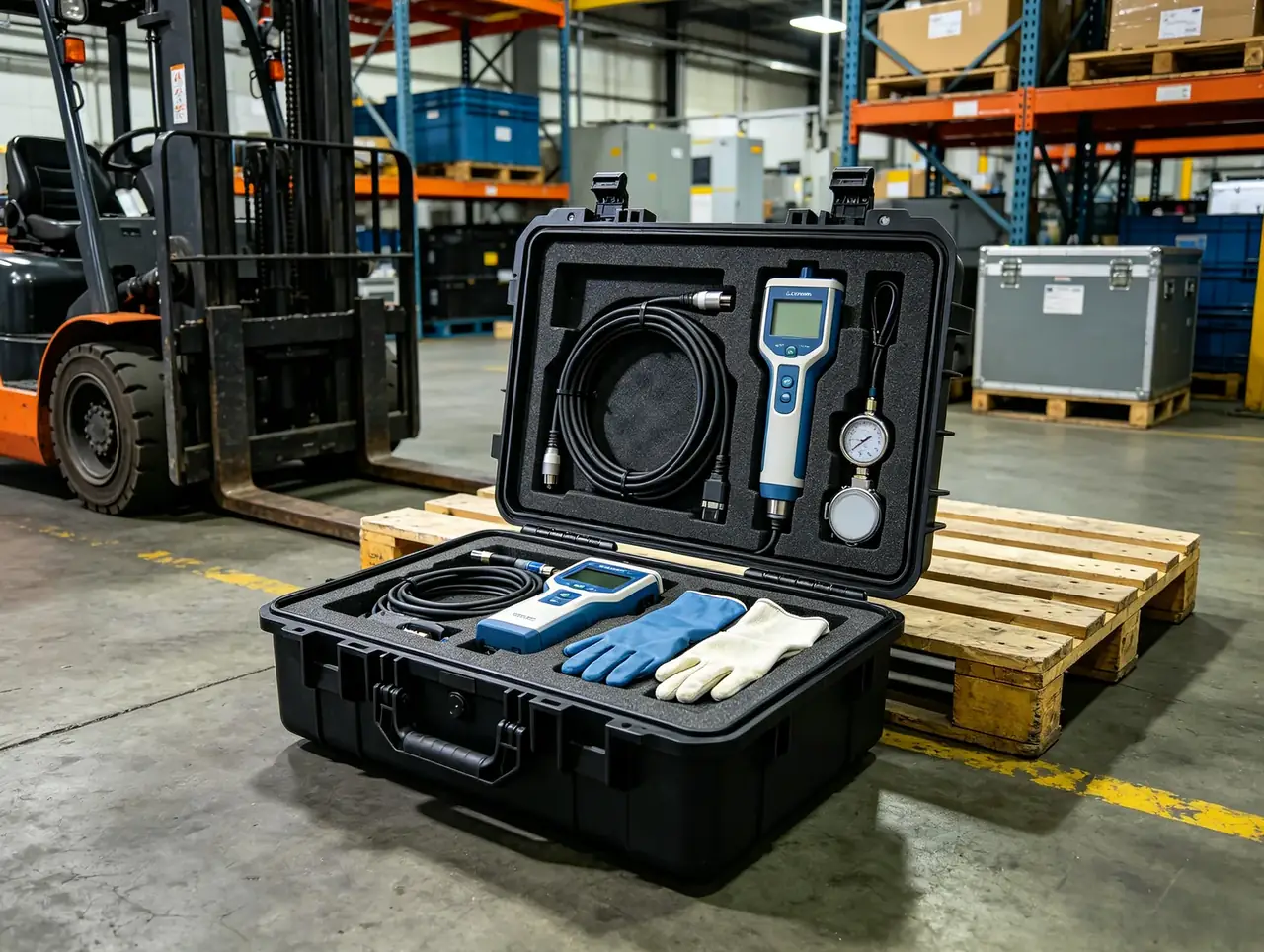
A transport profile reads in three segments: 0.01 g²/Hz flat from 20 to 200 Hz integrates to 1.8 g², a −6 dB/oct roll-off adds 0.9 g², and 2.7 g² roots to 1.64 Grms.
Three numbers set severity: start frequency, flat level, roll-off. Doubling the flat section raises Grms only 1.41 times but doubles energy above 200 Hz, so an 8th-power law cuts lid life to 1/16.
Sine is easier to read, and the trap is the peak: 0.5 g amplified 6 times puts 3 g on the lid while the report says 0.5 g.
| Item | Random | Sine |
|---|---|---|
| Descriptor | PSD, g²/Hz | Peak, g |
| Readout | Grms | g at one frequency |
| Band | 10–500 Hz continuous | 5–500 Hz stepped |
| Source | Truck, air, rail | Engine, compressor |
| Failure | Latch loosening | Lid cracking |
3. Finding resonance from 5 to 500 Hz
Sweep rate follows a log ramp, and 1 oct/min is the default. Covering 5 to 500 Hz means 6.6 octaves, so one sweep takes 6.6 minutes and 2 hours equals 18 sweeps; at 2 oct/min the measured gain drops about 30 percent.
Run a 0.2 g presweep to locate resonance zones, then sweep at 0.5 g; skip it and the first full-level sweep can crack a lid weld line.
Put the control accelerometer on the table centre, not the case floor, which is elastic and would turn response into input.
The criterion is transmissibility above 3. On a 520 mm case the lid measured Q of about 6 at 78 Hz, the handle root 4.5 at 145 Hz and the base corners 3 at 210 Hz.
| Location | Resonance | Q | Symptom |
|---|---|---|---|
| Lid centre | 78 Hz | 6.0 | Panel flutter, gasket lift |
| Handle root | 145 Hz | 4.5 | Whitening, micro-crack |
| Base corners | 210 Hz | 3.0 | Deepened foot wear |
4. Why dwell at resonance hurts more
Fixed-frequency dwell stacks cycles. Ten minutes at 78 Hz gives the lid 46800 reversals, while an hour of random spends only 3 percent of its energy near 78 Hz, about 8400 cycles, a 5.6 times gap.
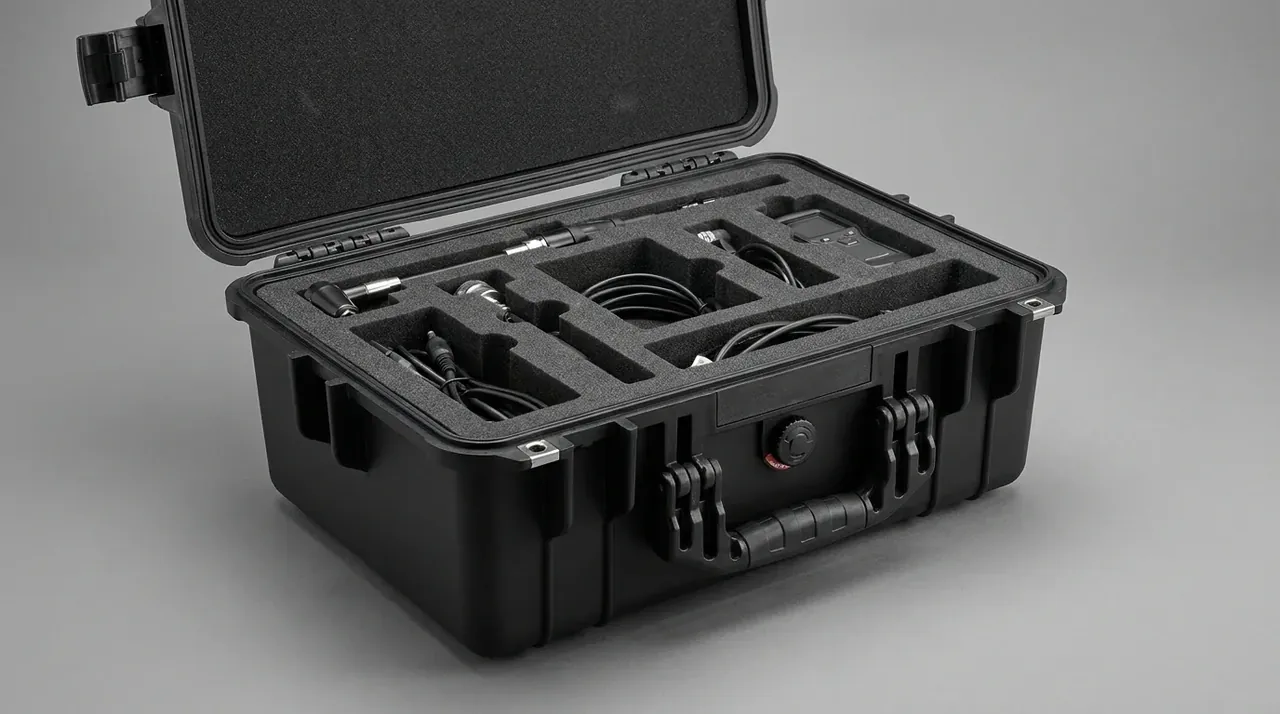
Amplified stress is the real driver. A 0.5 g input with Q of 6 puts 3 g on the lid, stress scales with that factor, and under an 8th-power law life falls to 1/6561, which is why a case back from a dwell shows a gasket pressed into permanent set.
Three fixes exist. Limit the input at resonance to 0.2 g so response stays under 1.2 g. Bond 2 mm of damping compound inside the lid to bring Q from 6 to 3.5. Add two ribs 1.5 mm high to push the first mode from 78 Hz to 118 Hz.
Only the structural change removes the problem at the root.
5. How test time converts
Conversion assumes equal damage under Miner accumulation, with damage scaling as duration times stress to the 4th power and m=4 for random. One hour at 1.64 Grms becomes 4 hours at 1.16 Grms or 16 hours at 0.82 Grms.
On the sine side it runs through sweep count. At 1 oct/min the rate near 78 Hz is about 0.9 Hz/s, so crossing the 13 Hz half-power bandwidth takes 14 seconds, and 18 sweeps give about 19700 cycles. Reaching 46800 needs 43 sweeps, or 4.7 hours.
Both reports say pass, one at 8400 cycles and one at 19700. Read the spectrum first, the duration second.
| Test | Input | Duration | Cycles near 78 Hz |
|---|---|---|---|
| Random | 1.64 Grms | 1 h | about 8400 |
| Sine sweep | 0.5 g, 1 oct/min | 2 h | about 19700 |
| Sine dwell | 0.5 g fixed | 10 min | 46800 |
6. Case and liner response on the table
The load path has three layers: fixture, case, liner. The fixture first mode should sit at 1.5 times the upper test frequency, so a 500 Hz test needs 750 Hz, or the data belongs to the fixture.
The case layer is about modes. The flat 10–200 Hz section covers the lid and handle zone, and a lid Q of 6 means a 1.64 Grms input reaches near 10 g rms on the panel.
The liner layer is about the isolation threshold. Foam natural frequency sits at 35–45 Hz and attenuation starts above 1.4 times that, from 50 to 63 Hz; above 80 Hz transmissibility falls to 0.4, while 78 Hz sits in the transition at 1.8.
Chain them: 1.64 Grms in, 9.8 g at the lid, times 1.8 through the foam, and the payload sees close to 18 g. Run it backwards: allow 25 g, divide by 1.8, get 13.9 g, divide by 6, and the ceiling is 2.3 Grms.
Case and liner belong in one run; split them and the middle layer disappears.
Conclusion
Pick the spectrum by payload weight. Under 3 kg the first mode usually sits above 150 Hz, so 1.0 Grms for 1 hour suffices and sine is a 0.5 g spot check. Between 3 and 15 kg the lid and handle resonance falls inside the flat section, so raise the level to 1.6 Grms and add a 2 hour sine sweep at 1 oct/min. Above 15 kg the centre of gravity rises and the base mode drops, so hold 1.6 Grms, extend to 3 hours and add a 10 minute dwell at the worst resonance. A case vibration test report should state spectrum type, Grms, sweep rate and dwell point rather than one word of pass, because whoever repeats the run needs all four numbers.
This article discusses container-side specifications and design implications only, and does not cover any handling, loading or use of the contents.
Related Reading
- ASTM D4169 distribution cycle testing
- Identifying and avoiding transport resonance
- How to lay out case reinforcement ribs
- Comparing foam materials for case liners
Related Products
- 8 Series — Gun Cases; Military Equipment Cases; Camera Equipment Cases; Drone Cases; Watch Cases; Knife Cases; First Aid Cases; Electronics Equipment Cases
- WL8-2812 PP Gun Case — model WL8-2812
- All protective cases and toolboxes: 7 series, 158 models