

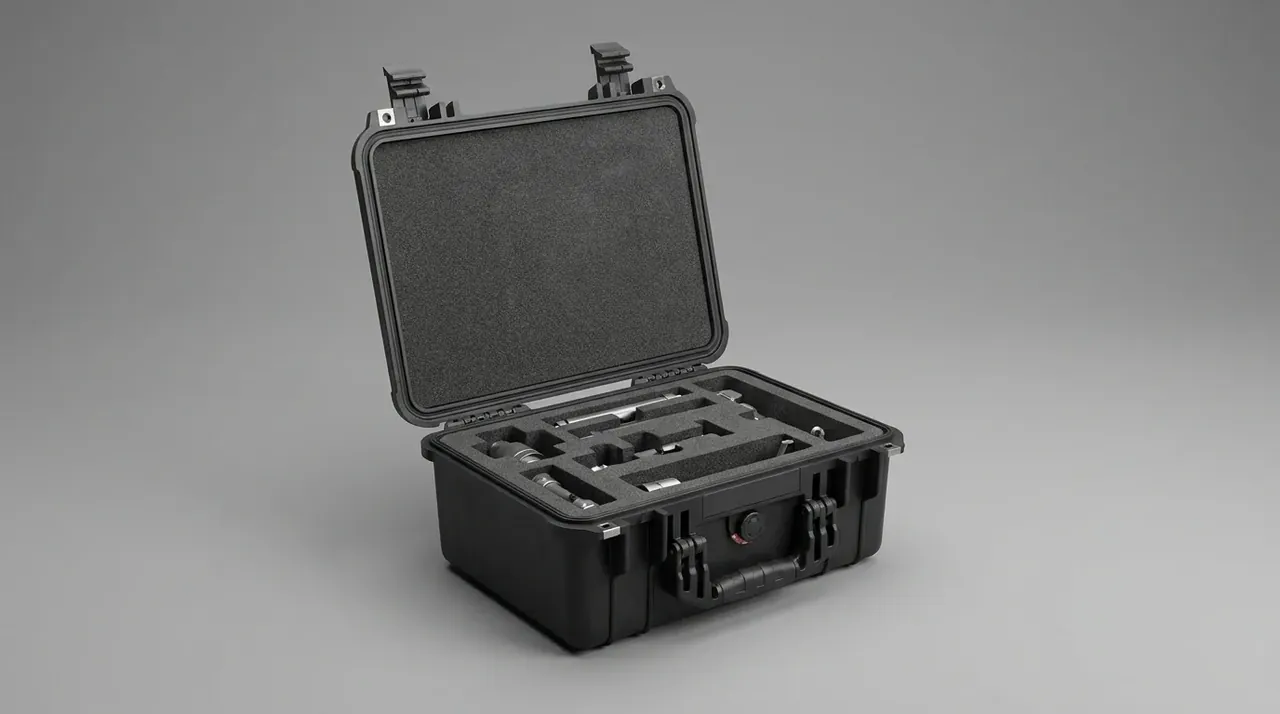
Quick answer: A 120 L case often allows only 40 kg, because the case load limit is set by the weakest of base stiffness, latch pull-out and lid stacking, not by volume.
Table of contents
- Case load limit and volume are two separate lines
- Pressure comes from footprint area
- Local point loads eat half the allowance
- Stacking and lifting are rated separately
- Four jobs where volume is large but load is light
- FAQ
1. Case load limit and volume are two separate lines
A 130 L case is rated 50 kg; mould the wall at 5 mm instead of 3 mm and the rating rises to 75 kg while the interior still measures 130 L. The case load limit follows the weakest of base stiffness, latch pull-out and lid stacking, while volume is interior length times width times depth. There is no factor linking the two, and filling a case with water proves sealing, not capacity.
Ratings grow slower than volume. A 22 L case is rated 25 kg and a 130 L case 50 kg: volume rises 5.9 times, rating only twice.
| Nominal volume | Interior base mm | Base area m² | Rated load | Distributed pressure |
|---|---|---|---|---|
| 22 L | 380×260 | 0.099 | 25 kg | 2.5 kPa |
| 55 L | 520×380 | 0.198 | 40 kg | 2.0 kPa |
| 95 L | 640×470 | 0.301 | 45 kg | 1.5 kPa |
| 130 L | 760×520 | 0.395 | 50 kg | 1.2 kPa |
Pressure is weight times 9.8 over base area, so volume rises six times while pressure falls from 2.5 kPa to 1.2 kPa. A large case is not troubled by total weight; it is troubled by weight arriving in one spot.
Pressed at 4.5 kPa, the 3 mm base sagged 1.8 mm at the centre and the 5 mm base 0.7 mm, which decides whether the base carries a concentrated mass for years.
2. Pressure comes from footprint area
Spread 25 kg over a 0.099 m² base and the reading is 2.5 kPa; stand the same 25 kg on four 50×50 mm feet, 0.01 m², and it jumps to 24.5 kPa. Labels assume full-base support, while transport loads only the feet.
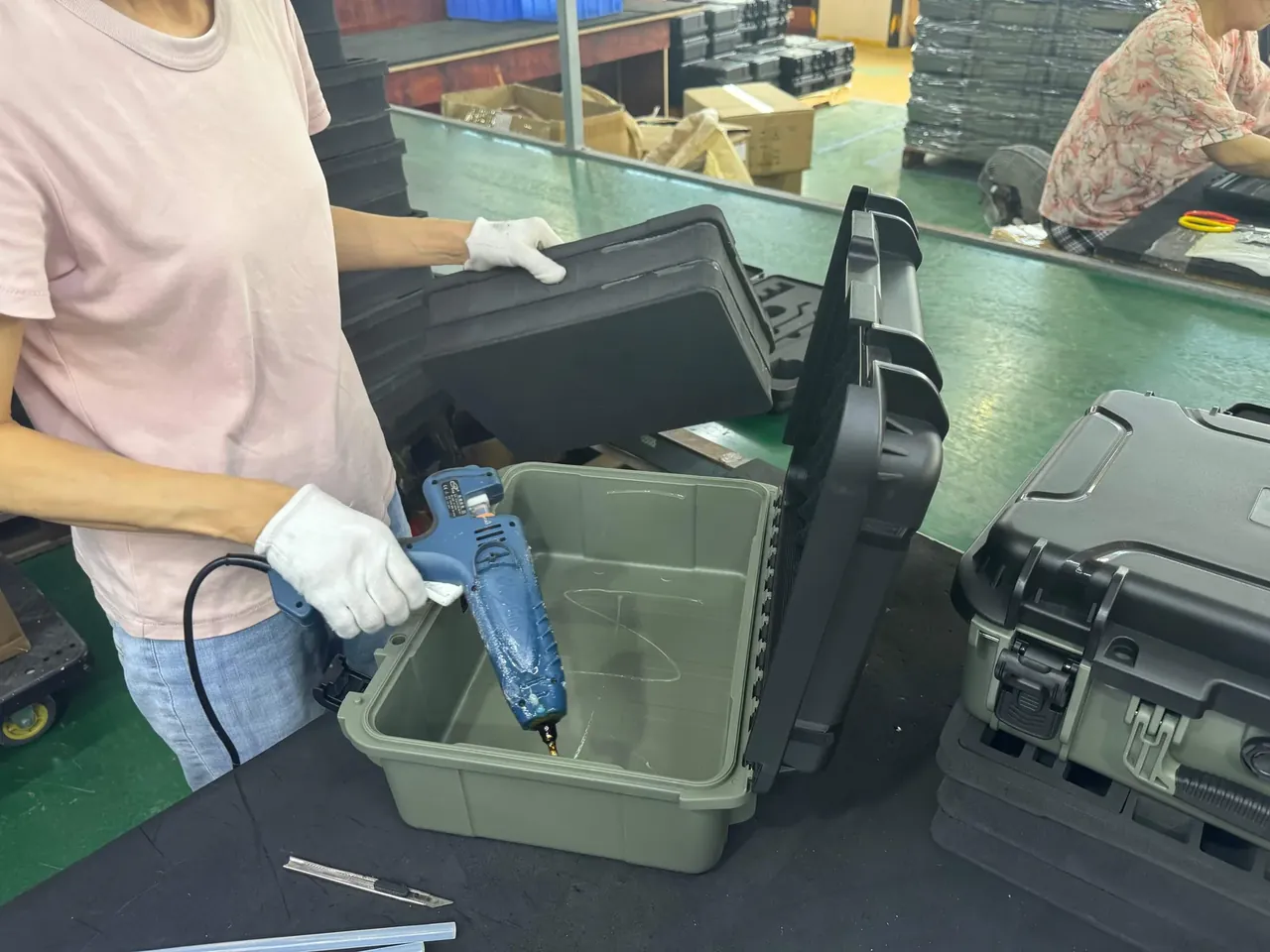
Footprint pressure is what you convert against a truck floor at 15 kPa or a cold-store shelf at 8 kPa. The case load limit on a packing list is one number; the number reaching the floor is another.
Van floors are corrugated, ribs 12 mm high at 80 mm centres, so bearing area falls to about 20% and real pressure approaches 12 kPa.
3. Local point loads eat half the allowance
A 30 kg pump on four 60×60 mm feet puts 7.5 kg on each: 20.4 kPa, eight times the distributed case. If it tips in transit, all 30 kg land on one foot at 81.7 kPa, near 33 times, and the case load limit has failed at 60% of the label.
| Support pattern | Contact area m² | Pressure under 30 kg |
|---|---|---|
| Full base | 0.301 | 1.0 kPa |
| 200×200 mm pad | 0.040 | 7.4 kPa |
| 100×100 mm hard foot | 0.010 | 29.4 kPa |
| Four 60×60 mm feet | 0.014 | 20.4 kPa |
| One 20×20 mm point | 0.0004 | 735 kPa |
Once the base sags 2 mm, the sealing face opens 0.3 mm to 0.5 mm and the immersion test fails. Overload shows at the gasket long before it shows as a crack.
Any contact patch under 2% of the interior base takes no share of the distributed allowance. On that rule a 20×20 mm foot reads 735 kPa, and PP at 40 ℃ creeps 1.2 mm in 1000 hours, deforming the rim with it.
Cold accelerates it: at -20 ℃ the same case cracks at the foot in a 0.8 m drop, where 23 ℃ needs 1.4 m.
4. Stacking and lifting are rated separately
Empty 6.5 kg plus 25 kg of load gives 31.5 kg per case on a 0.105 m² lid. Two high, the bottom lid carries 31.5 kg at 2.9 kPa; three high, 63 kg at 5.9 kPa; four high, 94.5 kg at 8.8 kPa. Against a 6 kPa design, four high exceeds it by 47%, and no chart shows that.
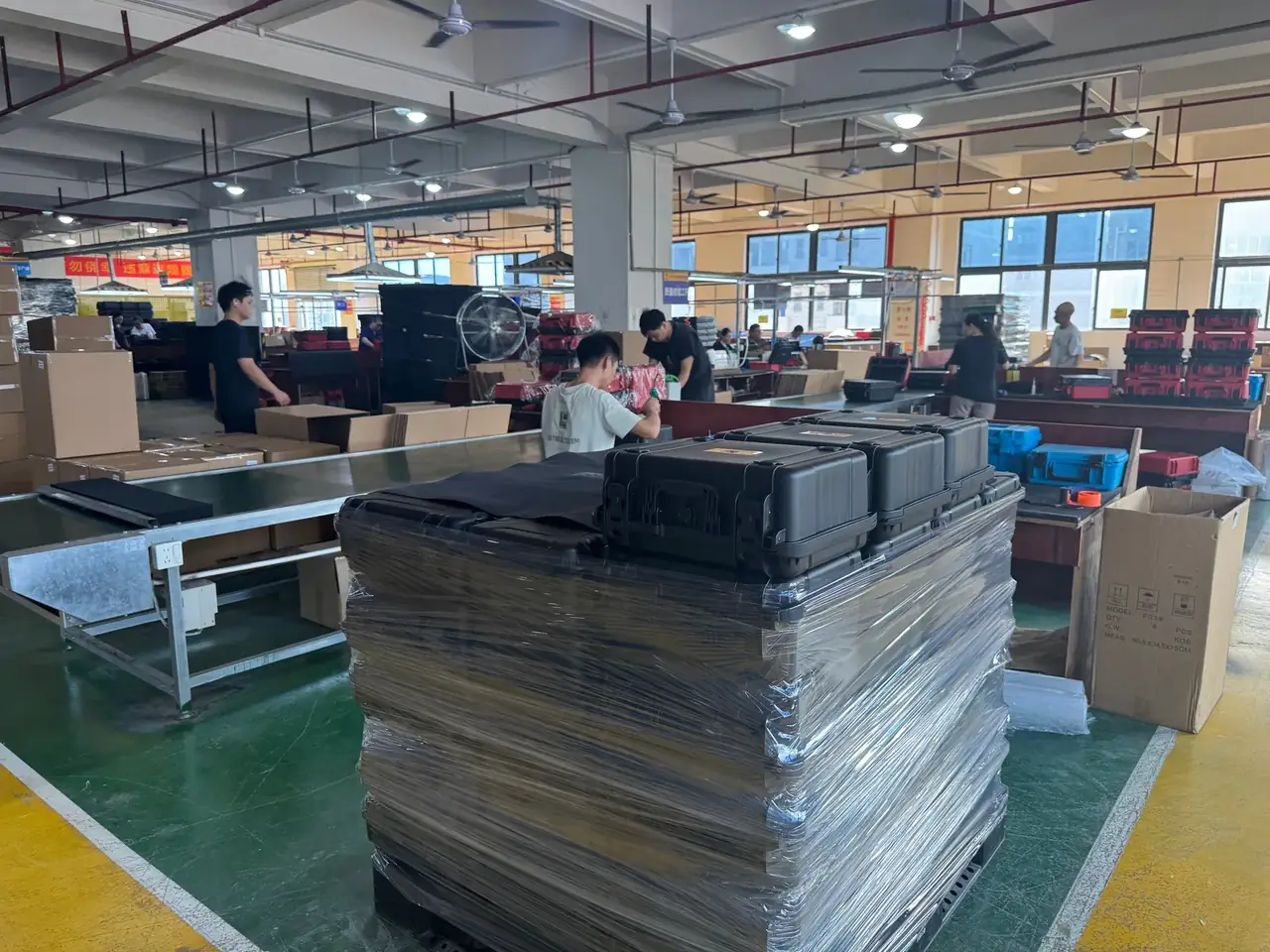
| Stack height | Load on bottom lid | Distributed pressure | Against the 6 kPa design value |
|---|---|---|---|
| 2 high | 31.5 kg | 2.9 kPa | 51% margin |
| 3 high | 63.0 kg | 5.9 kPa | 2% margin |
| 4 high | 94.5 kg | 8.8 kPa | 47% over |
Contact area needs a haircut: four 50×50 mm pads total 0.01 m², so 31.5 kg reads 30.9 kPa, ten times the distributed figure. Shift those pads 20 mm and the lid edge lifts 1.5 mm.
Lifting is a second line. Four rings rated 40 kg with a 1.3 dynamic factor pull 41 kg from a 31.5 kg case, 10.2 kg each. Off-centre, two rings take 60% each, or 24.6 kg.
The case load limit needs two statements on the drawing: distributed pressure for the lid, single-point pull for each ring, neither standing in for the other.
5. Four jobs where volume is large but load is light
Above 95 L, payload density usually falls below 0.2 kg/L, so space runs out before weight does:
- Lamp heads: 1.8 kg each in 0.09 m³, a density of 0.02 kg/L, six units at 10.8 kg
- Empty return trips: case weight 6.5 kg to 11 kg, zero payload
- Thin-walled housings and duct sections: 0.05 kg/L, carried by the full base
- Manual handling: 23 kg for one person on repeat lifts, 46 kg for two
In all four, a bigger case buys space and not allowance, and a denser pack only raises the local loads.
Three checks settle it on site: weigh the payload, measure the contact patch of the heaviest item, compare both with the rating moulded on the lid.
Conclusion
The case load limit and the volume deserve two independent judgements. Volume is interior length times width times depth times a loading factor of 0.6 to 0.7, which gives what fits; the rating is the smallest of base stiffness, latch pull-out and lid stacking times 0.8, which gives what can be lifted. Buy against whichever runs out first, and the argument over 40 kg or 50 kg in a 120 L case disappears. Three numbers make it operational: contact area on the base drawing, 6 kPa allowable on the lid, 40 kg per ring stated as a two-ring rating.
This article discusses container-side specifications and design implications only, and does not cover any handling, loading or use of the contents.
Related Reading
- How to measure interior case dimensions
- Stacking structure and inter-layer loads
- Static and dynamic load on case handles
- Sizing a protective case to the payload
Related Products
- 8 Series — Gun Cases; Military Equipment Cases; Camera Equipment Cases; Drone Cases; Watch Cases; Knife Cases; First Aid Cases; Electronics Equipment Cases
- WL8-2812 PP Gun Case — model WL8-2812
- All protective cases and toolboxes: 7 series, 158 models