

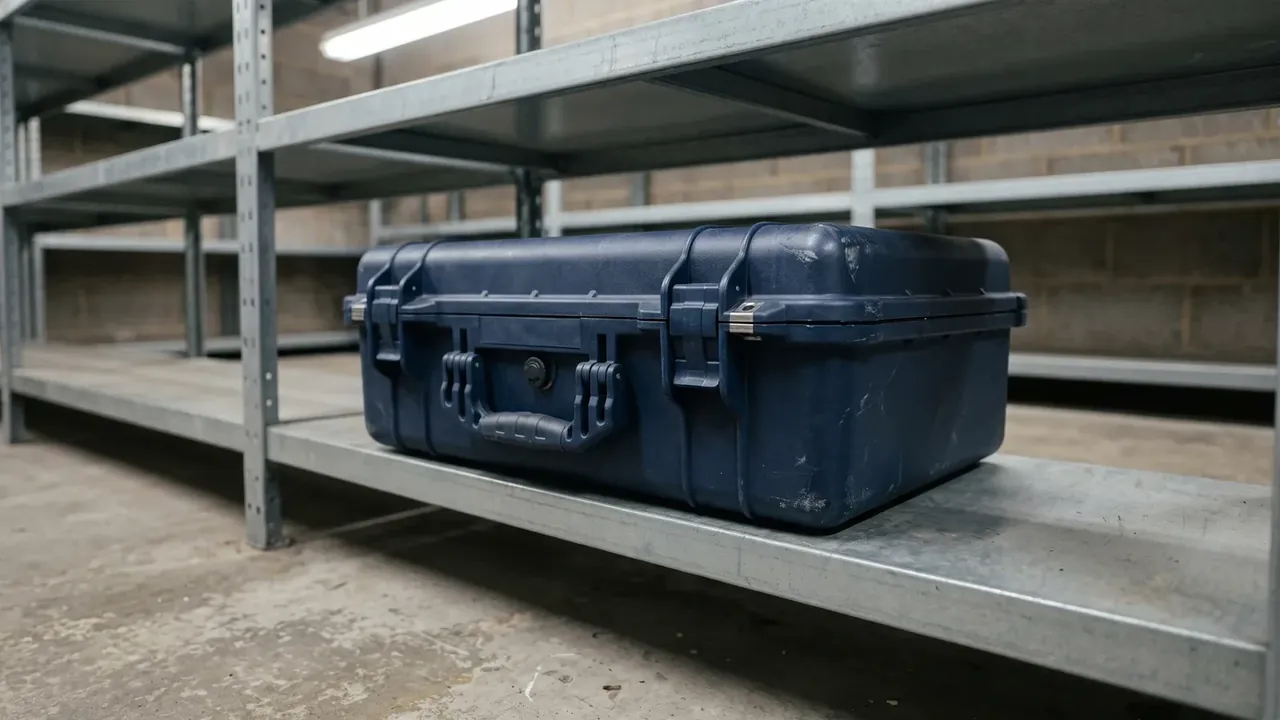
Quick answer: On the same 1.2 m drop one case peaks at 40 G and the other at 85 G, with 30 mm liners in both, so case vs flight case damping comes down to the four suspension points holding the inner frame.
Table of contents
- Same drop, different suspension
- How four points cut the shock
- Avoiding 8 to 15 Hz and measuring 12 dB
- Fixing force from a 25% liner squeeze
- When to suspend and when a liner is enough
- FAQ
1. Same drop, different suspension
Drop both cases 1.2 m onto six faces and the peak inside reads 40 G in one and 85 G in the other. Both carry a 30 mm liner, so the gap is not foam; it is the four elastic points that hold the inner frame off the shell.
The first difference is the path a shock takes. In a protective case the load runs from the wall through the liner into the equipment, and compression absorbs part of it. In a flight case the inner frame hangs on four points, so the shock first stretches them 8 mm before it reaches the liner.
That extra stage halves the peak without adding a millimetre of foam.
Readings compare only with the method fixed: vector sum of three axes, 10 kHz sampling, 500 Hz filter, worst of six faces.
| Structure | Peak at 1.2 m | Liner |
|---|---|---|
| Case with liner | 85 G | 30 mm |
| Flight case, 4 points | 40 G | 30 mm |
They also fail in different places. At 85 G the corner liner is crushed through and the shell cracks first; at 40 G a strap breaks, the frame bottoms out and the peak jumps above 90 G. A dented corner means the liner is thin, a whitened rubber point means the suspension is worn.
2. How four points cut the shock
The four points sit at the inner corners, 300 mm apart across and 220 mm along, each rated 30 kg static. They are not bumpers; their job is to hold the frame away from the wall.
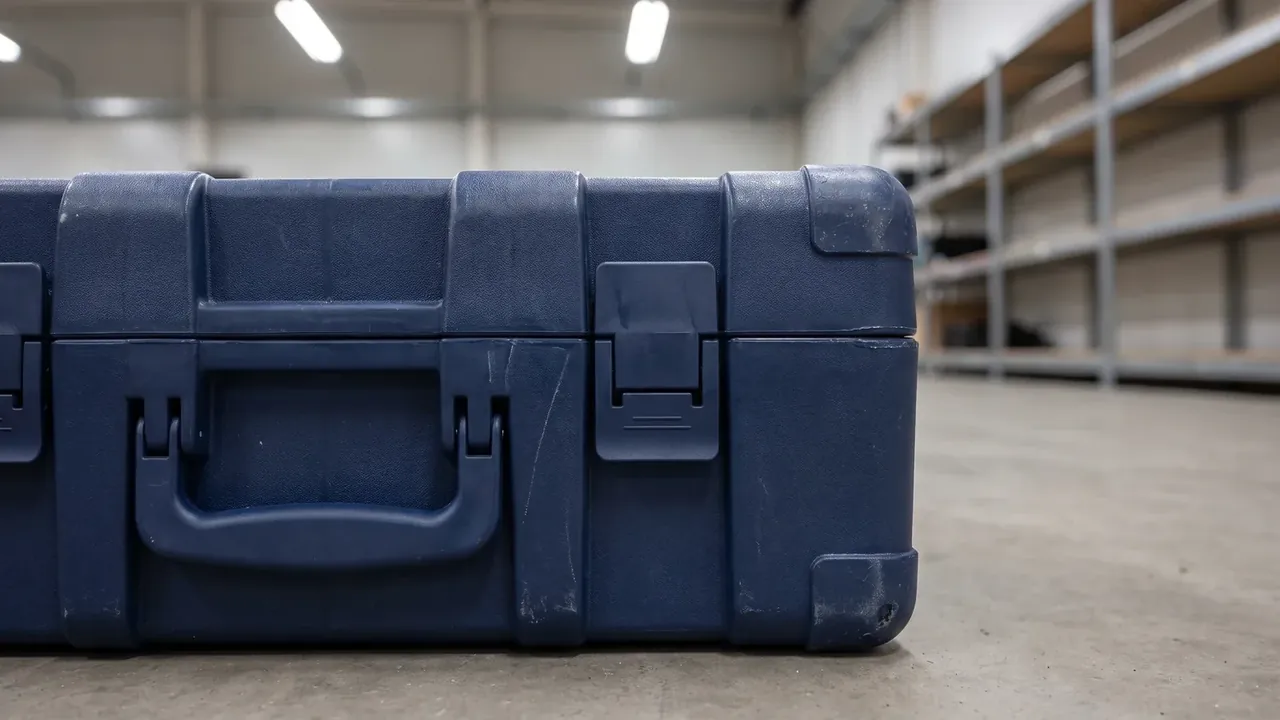
Energy is cut by travel: stretching 8 mm spends part of the kinetic energy and the rebound spends more, dropping transmissibility to 0.25, so 1.0 G in leaves 0.25 G at the frame.
Travel costs space: 10 mm clearance all round, and usable volume falls 6% at the same outside size.
Stiffness sets the band. A hard point isolates above 20 Hz but amplifies around 10 Hz by 1.8 times; a soft point is good at low frequency and moves 12 mm. Choosing a point is choosing which band to avoid.
Suspension ages too: an elastomer at 40 ℃ for 24 months loses 15% of its rebound, and the same case reads 8 G to 12 G higher in year two, so it needs an annual drop retest.
3. Avoiding 8 to 15 Hz and measuring 12 dB
A suspension system naturally sits between 8 Hz and 15 Hz, right on top of the transport vibration band. Below 1.4 times the natural frequency the input is amplified, above it the input is isolated, and that 1.4 line is the real dividing rule in case vs flight case damping.
The 12 dB figure is a ratio of two acceleration spectra: 20 log of input over output. Feed 1.0 G in and read 0.25 G out and the answer is 12 dB. A single-frequency 12 dB claim means nothing without band and bandwidth.
Three test conditions make it repeatable: sweep 5 Hz to 200 Hz, rate 1 oct/min, one sweep per axis.
| Ratio to natural frequency | Transmissibility |
|---|---|
| 0.5 | 1.6, amplified |
| 1.0 | 3.2, resonance |
| 1.4 | 1.0, neutral |
| 2.0 | 0.6, 4 dB |
| 3.0 | 0.25, 12 dB |
The equipment has its own natural frequency, and it must not land on the box. A device resonating at 12 Hz inside a suspension tuned to 12 Hz peaks 20% higher than with no suspension at all.
Two levers move it: point stiffness, which lifts 9 Hz to 16 Hz, and frame mass, where 2 kg drops 1.5 Hz. Both change travel, so both need a fresh drop test.
4. Fixing force from a 25% liner squeeze
A 30 mm EVA liner squeezed 25% is left with 22.5 mm. That margin generates clamping force: about 180 N around the perimeter holds an 8 kg device in place.
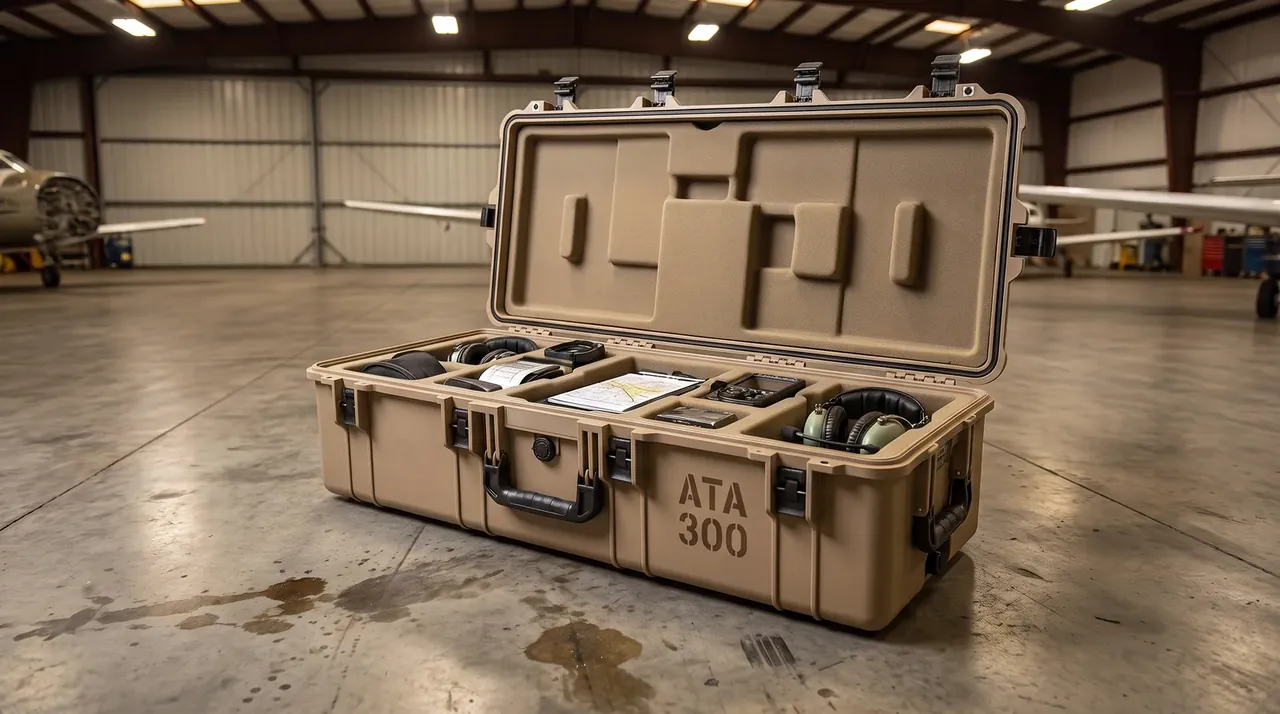
Below 20% compression the force is short and the device shifts 2 mm inside the liner; above 30% the liner turns hard, passes shock straight through and the peak rises 15%. The 25% target sits between those two lines.
Density matters as much as thickness: at the same squeeze a 45 kg/m³ foam clamps 30 N less than a 60 kg/m³ foam, so a thickness-only specification is incomplete.
Liner and suspension add up, they do not replace each other. The suspension lowers the peak, the liner holds the device on that lower platform, and whichever layer is weak eats the margin of the other.
Stored at 40 ℃ for 12 months, 30 mm EVA takes 6% compression set and loses 10 N, so recheck it after 18 months.
When clamping feels weak, measure compression first: 5 mm more thickness buys 20 N, restoring the squeeze recovers 40 N.
5. When to suspend and when a liner is enough
The first test is the fragility of the equipment. Above 40 G, a protective case with a 30 mm liner is enough; between 25 G and 40 G, four-point suspension is required; below 25 G, the transport band has to be modelled as well.
Travel frequency is the second line. Above 6 air shipments a year with handling at both ends, the suspension premium pays back; under 2 a year, a lined case is cheaper.
Weight is the third. Past 25 kg the points are rated for twice the dynamic load and the case gains 3 kg of its own.
One condition gets skipped: whether the liner can wrap the device. Protruding shafts and handles leave gaps, and no suspension stops movement there. Fit the liner first.
Cross any one of the three lines and the structure should change; adding foam to the existing case will not close a 45 G gap.
Conclusion
Case vs flight case damping reduces to three numbers: a 1.2 m peak of 40 G against 85 G, a natural frequency kept off 8 Hz to 15 Hz, and a liner squeeze held between 20% and 30%. Let one slip and the other structure is wasted. Judge in order: fragility, shipments a year, total weight. When all three land on the protective side, line the case and stop; when they land on the suspension side, four points are not optional. Put those values on the acceptance sheet, because extra foam cannot replace a missing suspension stage. Two lines belong there as well: the year the points were made and the date of the last drop. Points are replaced every two years and liners rechecked at 18 months, otherwise the 40 G of year one drifts toward 70 G by year three.
| Metric | Case with liner | Flight case, 4 points |
|---|---|---|
| 1.2 m peak | 85 G | 40 G |
| Natural frequency | Follows liner | 8 Hz to 15 Hz |
| Isolation | 0 to 4 dB | 12 dB |
| Liner squeeze | 20% to 30% | 20% to 25% |
| Fragility served | Above 40 G | 25 G to 40 G |
This article discusses container-side specifications and design implications only, and does not cover any handling, loading or use of the contents.
Related Reading
- What a flight case is built from
- Drop testing on all six faces
- Setting cushion liner thickness
- Checking seals after a shock
Related Products
- 8 Series — Gun Cases; Military Equipment Cases; Camera Equipment Cases; Drone Cases; Watch Cases; Knife Cases; First Aid Cases; Electronics Equipment Cases
- WL8-2812 PP Gun Case — model WL8-2812
- All protective cases and toolboxes: 7 series, 158 models