

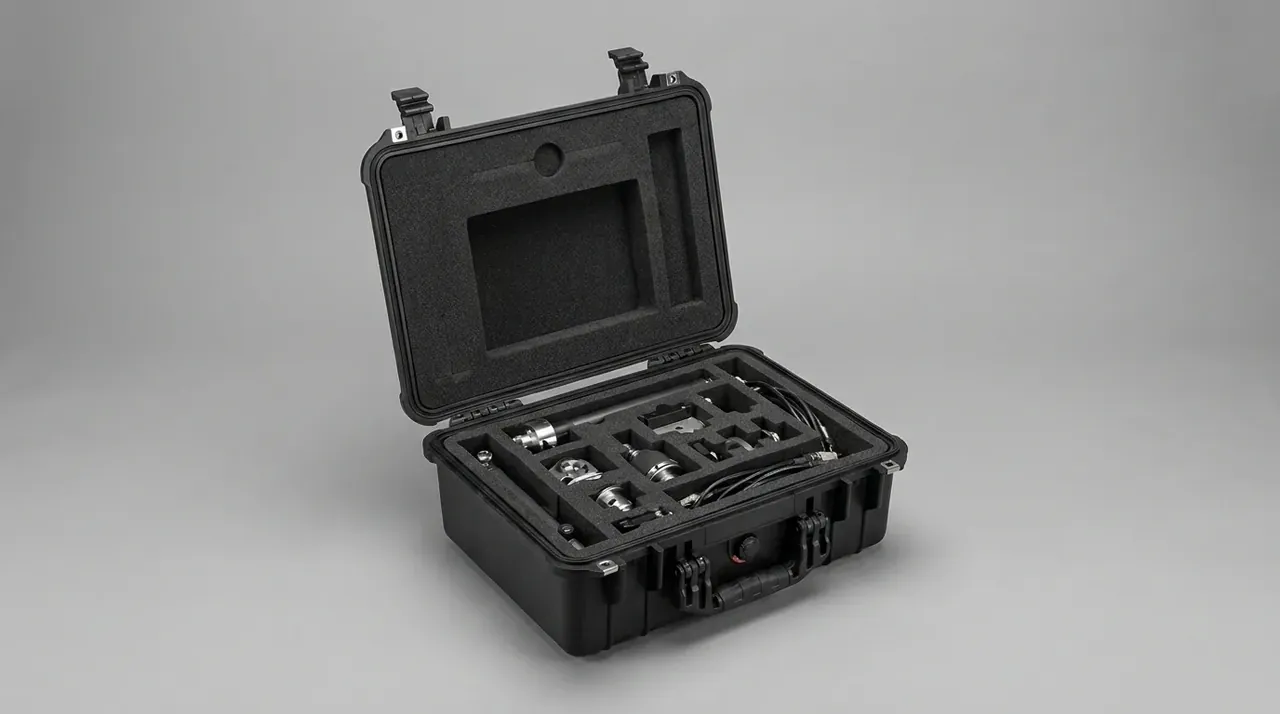
Quick answer: In the case vs safe question the first difference is weight: on the same 28 L interior, a 3 mm steel safe weighs 45 kg and a 4 mm PP case weighs 5 kg, so one gets pried and the other carried off.
Table of contents
- Weight comes before locks
- Fire for 30 min
- Prying for 30 min
- UL 72 h immersion and 28 L
- How far a case protects
- FAQ
1. Weight comes before locks
A case can be dragged away and a safe cannot, so the first layer of theft resistance is mass. On the same 28 L interior, a 3 mm steel body arrives at 45 kg and a 4 mm PP body at 5 kg. That 40 kg gap decides whether one person can lift the thing at all.
Moving a 45 kg body from the floor to a 1.2 m bench takes two people and three grip changes in 30 m. A 5 kg case goes 200 m in one hand.
| Item | Steel safe | PP case |
|---|---|---|
| Interior | 28 L | 28 L |
| Empty weight | 45 kg | 5 kg |
| Carriers | 2 people | 1 person |
| Moving 200 m | Trolley, about 15 min | By hand, about 3 min |
| Fixing | Four expansion bolts | No anchor point |
Watch the last row. A case has no anchor point, so it leaves the site in 90 s and the best lock only delays that by 30 s. A safe bolts into masonry at four points, and removing it needs tools, time and noise.
Anchoring is the threshold buyers forget. A case body has no mounting holes, so it hangs on an 8 mm cable through the handle, which cuts in 2 min. Here case vs safe parts company structurally: one trusts the shell, the other trusts the building. Bolt pull-out also depends on the wall, since four M10 bolts hold 24 kN in C25 concrete but only 600 kg in hollow brick.
2. Fire for 30 min
Thirty minutes of fire resistance comes from the core, not the steel. A paper-based board holds 12% to 18% bound water, which turns to steam and carries heat out of the wall, holding the interior below 120 ℃. Paper chars at 175 ℃, and those 55 ℃ are the whole point of the half hour.
A PP shell goes the other way. Polypropylene softens at 120 ℃, and 4 mm of it collapses within 90 s under an 843 ℃ flame; smoke enters in 60 s at 200 ℃, and paper, film and drives do not last 5 min. On material grounds, plastic leaves the contest before it starts.
The 30 min curve is not flat either. The first 10 min heat fastest, the top and bottom of the interior differ by 25 ℃, and the last 10 min run on whatever bound water is left. The 120 ℃ in a report is a peak, not an average, which is why case versus safe has no middle grade on fire.
3. Prying for 30 min
Thirty minutes of prying is three resistances stacked: a 3 mm cold-rolled door plate that refuses a bar a fulcrum, a 12 mm door rebate that leaves no gap for a blade, and a 6-row cylinder that pushes manipulation past 15 min. Remove one and the half hour drops to 8 min.
A case resists through stiffness, not thickness. PP at 4 mm has about one sixtieth the bending modulus of steel, so a bar beside a latch lifts the lid 20 mm in 30 s, and each plastic latch shears at roughly 120 N.
| Attack | Steel safe | PP case |
|---|---|---|
| Bar at the door edge | 30 min, shut | 30 s, lid lifted |
| Shearing latches | No exposed latch | 120 N each, 20 s |
| Cylinder manipulation | 6 rows, past 15 min | Padlock hole, 1 min |
| Carrying it off | 45 kg, two people, a van | 5 kg, one hand, 90 s |
| Immersion | Seam seepage, not sealed | IP67, 1 m for 30 min |
The rows that hurt are the last two. A case loses on immersion and on being carried away, yet beats the safe on damp, dust and drops, because it was never designed to resist a person.
4. UL 72 h immersion and 28 L
UL 72 h immersion is the other line on a fire safe: the body sits under 1.2 m of water for 72 h with no ingress. It exists because fire hoses flood a scene, and paper that survives flame can still be ruined by water.
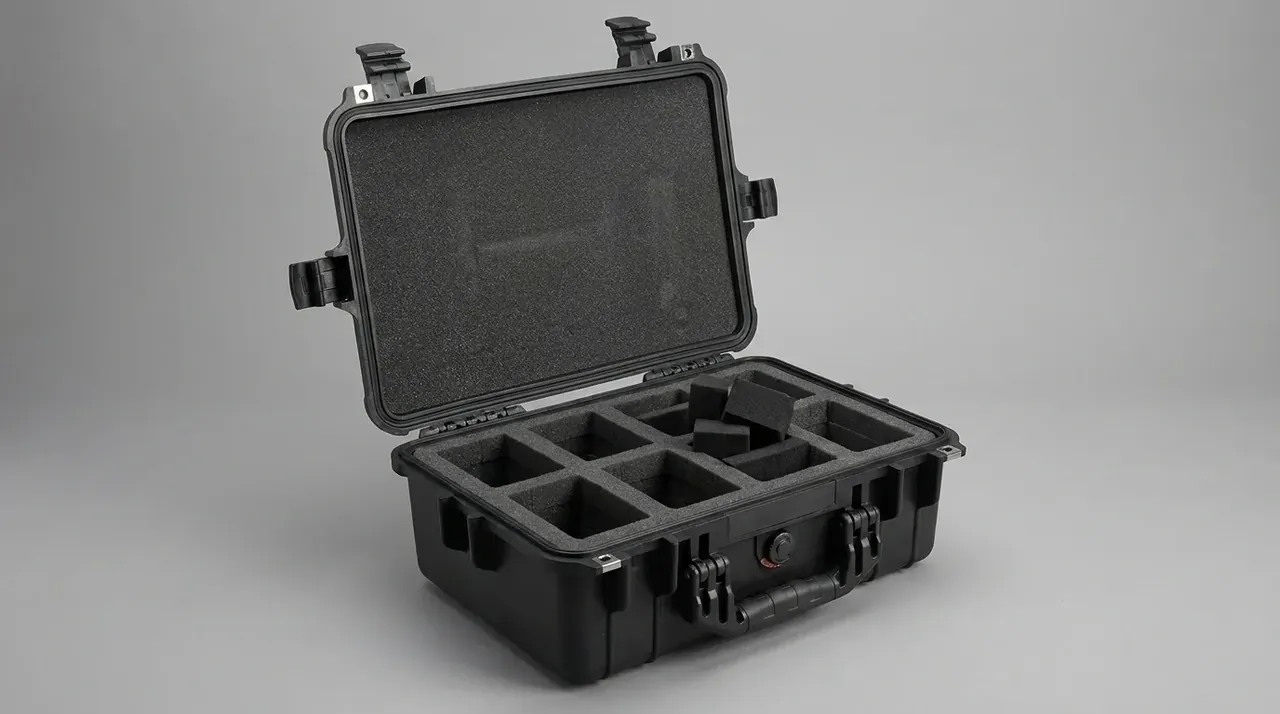
A case offers IP67, which is 1 m for 30 min, one hundred and forty-fourth of that duration.
What fits in 28 L drives the choice more than any rating. Three reams of A4 take about 15 L, and two drive cases bring it to 22 L. Interior height counts too: at 420 mm A4 stands upright, at 250 mm it can only lean and usable volume falls from 28 L to 19 L.
5. How far a case protects
The theft position of a case fits in one line: it stops the opportunist, not the professional. It stops the 30 s opportunist and slows the screwdriver attempt at 3 min; it does not keep a box closed for two weeks against tools and a van.
A ratio helps: value divided by the cost of removal. For a 5 kg case that cost is nearly zero, so no ratio is high enough; for a 45 kg safe it is two people and a van, and a ratio above 3 justifies the safe.
The needs overlap in one place. Damp archives, documents that travel monthly, contracts in a site office, all want moisture protection plus casual theft cover, and the answer is a case chained to a fixed point rather than a fire safe on wheels. A faster test is how often the box leaves its place in a year: zero means a safe, four or more means the case is the working unit.
Conclusion
Split fire and theft into two tests and the boundary appears. Fire asks whether the interior stays under 120 ℃ for 30 min, which only a paper core achieves while a PP shell collapses in 90 s. Theft asks whether the body can leave the site, and 45 kg with four bolts against 5 kg with no anchor are two endings. Case vs safe is not a substitution but two curves that touch only where gear must travel and must stay dry. Work in three steps: write down the failure temperature of what you protect and only above 175 ℃ discuss a fire safe; count how often it moves in a year and past four times refuse 45 kg; check whether the site allows an anchor.
| Need | Fire 30 min | Theft 30 min | Choice |
|---|---|---|---|
| Contracts, long term | Needed | Needed | Steel safe |
| Drives and film, short transit | Not needed | Casual only | PP case |
| Site storage, 20 min scale | Not needed | Casual only | Case on an anchor |
| Damp room, light theft risk | Not needed | Dryness first | PP case |
| Fire rating plus travel | Needed | Not needed | Safe at base, case in transit |
This article discusses container-side specifications and design implications only, and does not cover any handling, loading or use of the contents.
Related Reading
- Choosing an airtight plastic safety case
- Airtight and immersion test methods
- Locks and body specs for security cases
Related Products
- 8 Series — Gun Cases; Military Equipment Cases; Camera Equipment Cases; Drone Cases; Watch Cases; Knife Cases; First Aid Cases; Electronics Equipment Cases
- WL8-2812 PP Gun Case — model WL8-2812
- All protective cases and toolboxes: 7 series, 158 models