

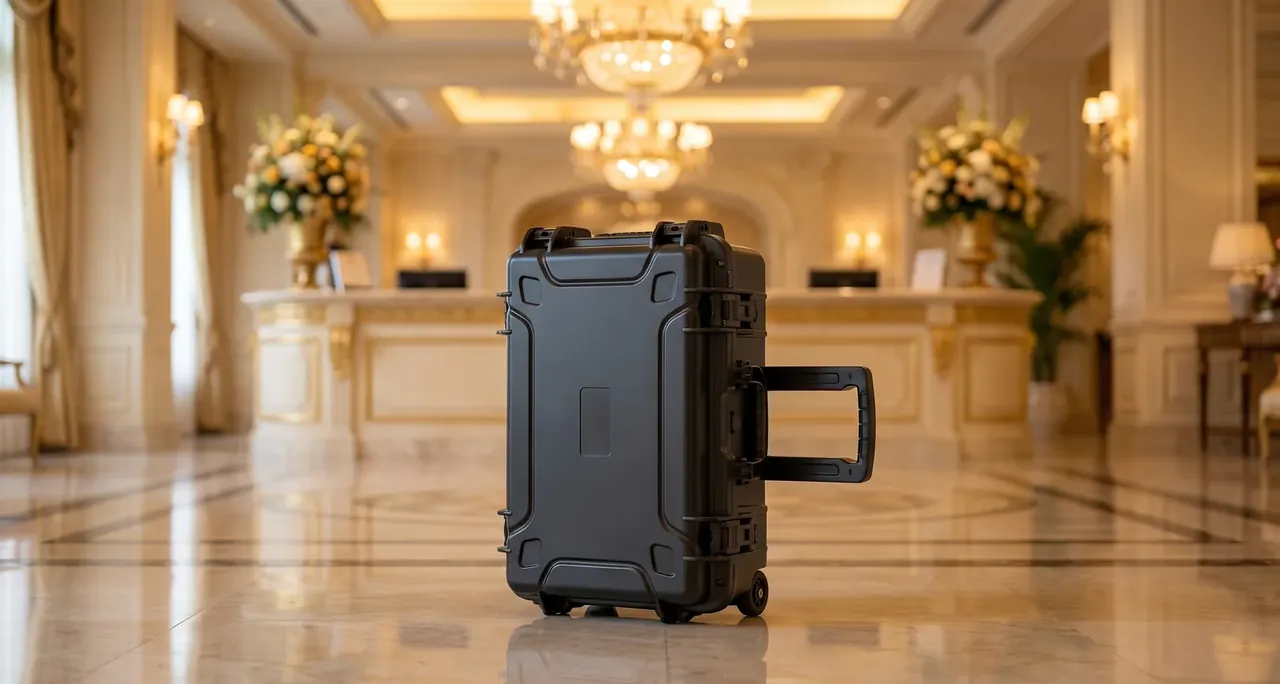
Quick answer: Case wheel service starts with one question: has the grease turned milky grey? If it has, water is already in the raceway.
Table of contents
- Case Wheel Service Begins With Emulsified Grease
- Teardown Order: Nut, Washer, 608ZZ Bearing
- 0.3 mm of Axial Play vs Bearing Noise
- Bearing or Whole Wheel: The 40 kg Line
- FAQ
1. Case Wheel Service Begins With Emulsified Grease
Three cases from one batch sat on a warehouse floor. Two rolled smoothly; the third dragged and stopped dead every half turn. Pulling the hub cap showed grease turned into a pale grey paste with a water sheen, and two brown rust lines pressed into the outer raceway.
That is water, not wear. Past 3% water absorption the lithium soap skeleton collapses, the film can no longer carry 40 kg per wheel, and balls run metal on metal. Wear then climbs several times faster than on a dry duty cycle.
Judging it needs no instruments. Wipe the exposed grease onto paper: greyish white colour, gritty smear, water ring. Two of the three means flooded. Fresh grease is pale yellow, and the shift to grey is soap meeting water, visible at a glance.
Water arrives by three routes: a 5 mm puddle during wet loading that covers the lower half of the wheel, a hose-down, or overnight condensation in a coastal store. The third is ignored, and one rainy season is enough to grow rust inside the raceway.
Case wheel service has to be blunt here: emulsified grease is irreversible. Topping it up traps the water and the drag returns within two months. Coastal wheels rust in 3 days, inland wheels in 3 weeks, so port fleets check quarterly and inland fleets twice a year.
2. Teardown Order: Nut, Washer, 608ZZ Bearing
This wheel set runs a 608ZZ: 22 mm outside diameter, 8 mm bore, 7 mm width, shielded both sides. The shield blocks dust but not immersion, which is why water reaches the raceway.
Three tools cover the job: a 5 mm hex key, a 10 mm open-end wrench, a circlip plier. Work forwards, or the housing suffers: pry off the hub cap, release the M6 axle bolt, lift the circlip.
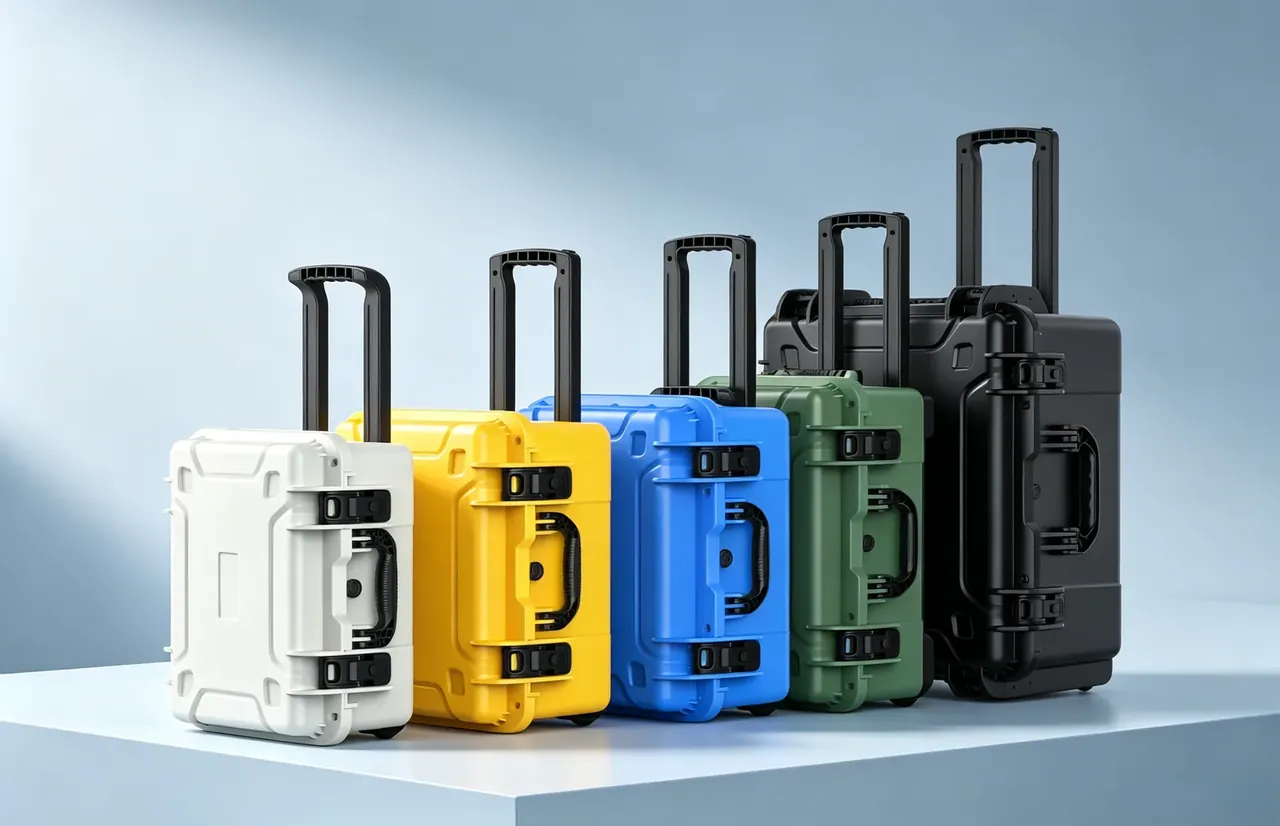
Read the thread first. White powder or brown staining means water travelled the axle bore, and both bearings will usually go. Keep the washers in order, thin inboard and thick outboard; reversed, the wheel rubs the housing wall.
Press the bearing out on its outer ring, never the inner one. Force on the inner ring passes through the balls and dents the raceway, and fresh grease cannot undo that. Refit at 5 N·m with a drop of medium threadlocker; axial float afterwards is low torque, not a missing shim.
Budget 12 min per wheel. Measure three dimensions while it is off: 8 mm axle, 22 mm bore, 7 mm width. Replace the axle at 7.85 mm, treat the bore as soft at 22.2 mm, and expect drag once crushed shields pull width down to 6.6 mm.
3. 0.3 mm of Axial Play vs Bearing Noise
Measure play with a dial indicator: plunger on the rim, hand pushing and pulling along the axle, reading difference is the play. 0.3 mm is the line. Below it, run. Above it, replace.
A new 608ZZ sits at 0.05 to 0.15 mm. At 0.3 mm the raceway has begun to spall and the wheel rocks by hand. Past 0.5 mm, stop greasing: the housing has opened up too, and a new bearing will not sit tight.
Noise splits three ways. A sandpaper hiss means rust or grit in the raceway. A click once per revolution means a spalled ball or deformed cage. A squeak means the bushing is dry, and 2 g of grease usually silences it.
| Symptom | Criterion | Action |
|---|---|---|
| Grease grey and milky | 2 of 3 water signs on paper | Replace bearing pair |
| Axial play | Above 0.3 mm | Replace bearing |
| Rust spots | Over 5 one side, 0.05 mm deep | Replace bearing |
| Continuous hiss | Audible at 30 cm | Replace bearing |
| One side stiff | Stops within 3 turns | Regrease 2 g, recheck |
Drag also comes from the tread. Asphalt residue doubles rolling resistance while the wheel still turns silently. Wash with water below 40 ℃ and neutral detergent, never solvent, which softens the rubber.
Leave 1 g per side, 2 g total, about a third of the cavity. Past 80% fill the balls churn the grease into a vortex and raise temperature by 8 ℃. Check the drop point: above 180 ℃ for a sun-baked hub, while a 120 ℃ calcium grease bleeds oil at 60 ℃.
4. Bearing or Whole Wheel: The 40 kg Line
Each wheel is rated 40 kg, four wheels carry 160 kg, and a 1.5 safety factor leaves about 106 kg usable. An overweight case needs a larger diameter, not a costlier bearing. The step case wheel service schedules skip is doing that arithmetic first.
A bearing alone costs CNY 4.5, a pair CNY 9, plus 12 min of labour, so a wheel repair lands under CNY 15.
Three conditions demand the whole wheel: tread wear past 0.8 mm, rim roundness error over 1.2 mm, or an axle bore worn oval beyond 0.15 mm. The first two make the case pull sideways; the third leaves a new bearing loose from day one.
A complete wheel is CNY 38, four of them CNY 152, against CNY 60 for bearings. The CNY 92 gap is settled by tread depth: above 1.5 mm remaining, fit bearings; once ribs show through, fit wheels.
On one axle, when one bearing floods the other usually fails within 2 weeks; grease paths connect and vapour travels the bore, so pairing saves money. Do not change diameter casually either: 75 mm to 100 mm lifts ground clearance from 18 mm to 30 mm, and the higher centre of gravity tips a loaded case more easily.
Stock 8 bearings and 2 complete wheels per 20 cases, under CNY 100 of inventory, enough for one flooding event. In case wheel service the costly part is never the part; it is waiting for a delivery.
Conclusion
Work the case wheel service decision backwards: measure play, read the tread, then decide whether to open the hub. Play inside 0.3 mm, 1.5 mm of tread and three free turns mean 2 g of grease is enough. Grey grease, rust spots or a hiss at 30 cm mean new bearings. Tread wear past 0.8 mm, roundness error of 1.2 mm or an oval bore beyond 0.15 mm mean a complete wheel. Run in that order, case wheel service stays under CNY 15 per wheel per year and stretches the replacement cycle from 1 year to 3. Print the table below and tick it at the bench; it beats judging by feel.
| Check | Threshold | Action |
|---|---|---|
| Grease colour | Grey, milky, water ring | Replace 608ZZ pair |
| Axial play | 0.3 mm or less passes | Replace bearing above |
| Rust spots | 5 or fewer and shallow | Recheck in 1 week |
| Tread depth | 1.5 mm or more | Bearings only |
| Tread wear | Above 0.8 mm | Whole wheel |
| Axle bore | Oval above 0.15 mm | Wheel and housing |
| Flooding record | Not handled in 24 h | Strip and inspect |
This article discusses container-side specifications and design implications only, and does not cover any handling, loading or use of the contents.
Related Reading
- Trolley handle and wheel case structure
- PU versus TPR wheel materials
- Quarterly checklist for wheeled cases
- Case repair and spare parts paths
Related Products
- 8 Series — Gun Cases; Military Equipment Cases; Camera Equipment Cases; Drone Cases; Watch Cases; Knife Cases; First Aid Cases; Electronics Equipment Cases
- WL8-2812 PP Gun Case — model WL8-2812
- All protective cases and toolboxes: 7 series, 158 models