

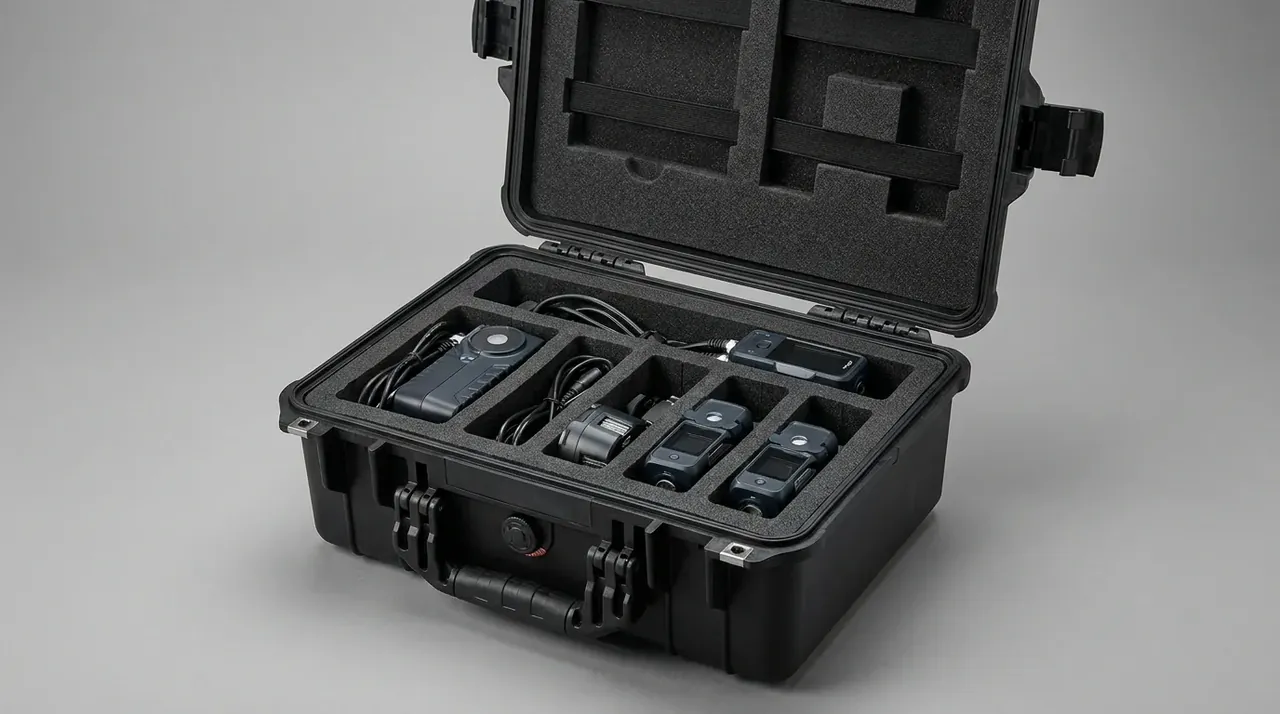
Quick answer: A charging gun case is sized by the cable, not by the box: a 32 mm cable needs a 160 mm radius, and a 7.5 m run pushes it to 240 mm.
Table of contents
- Why the Bend Radius Comes First
- Two Cable Lengths, Two Coil Diameters
- The Connector Head Gets Its Own Cavity
- From −30 °C to 50 °C: Radius Follows Temperature
- Fixture, Slots and the Compressive Pad
- FAQ
1. Why the Bend Radius Comes First
Bend a 32 mm charging cable to a 160 mm radius and the jacket stretches 10% on its outer face; bend it to 100 mm and the stretch reaches 16%, where a TPU sheath turns pale. Every dimension inside a charging gun case traces back to that ratio.
The 15% ceiling is the useful one: 32 mm divided by twice 15% gives 107 mm, rounded up to five times the diameter at 160 mm for a 5 m cable.
A 160 mm radius makes a 320 mm coil. Add 4 mm of wall, 20 mm of foam and 15 mm of clearance and the interior needs 400 mm square; the shell lands at 470 × 370 × 200 mm, 4.6 kg empty.
A tighter coil is not free: the inner face compresses, the outer stretches, and after three months the copper takes a wavy set that shows up as drifting attenuation. Thirty extra millimetres of width buys about two years of cable life.
2. Two Cable Lengths, Two Coil Diameters
A 5 m and 7.5 m cable do not share a floor. The longer one carries 1.5 times the side pressure per unit length at the same radius, so its floor moves from 160 mm to 240 mm and the coil grows from 320 mm to 480 mm.
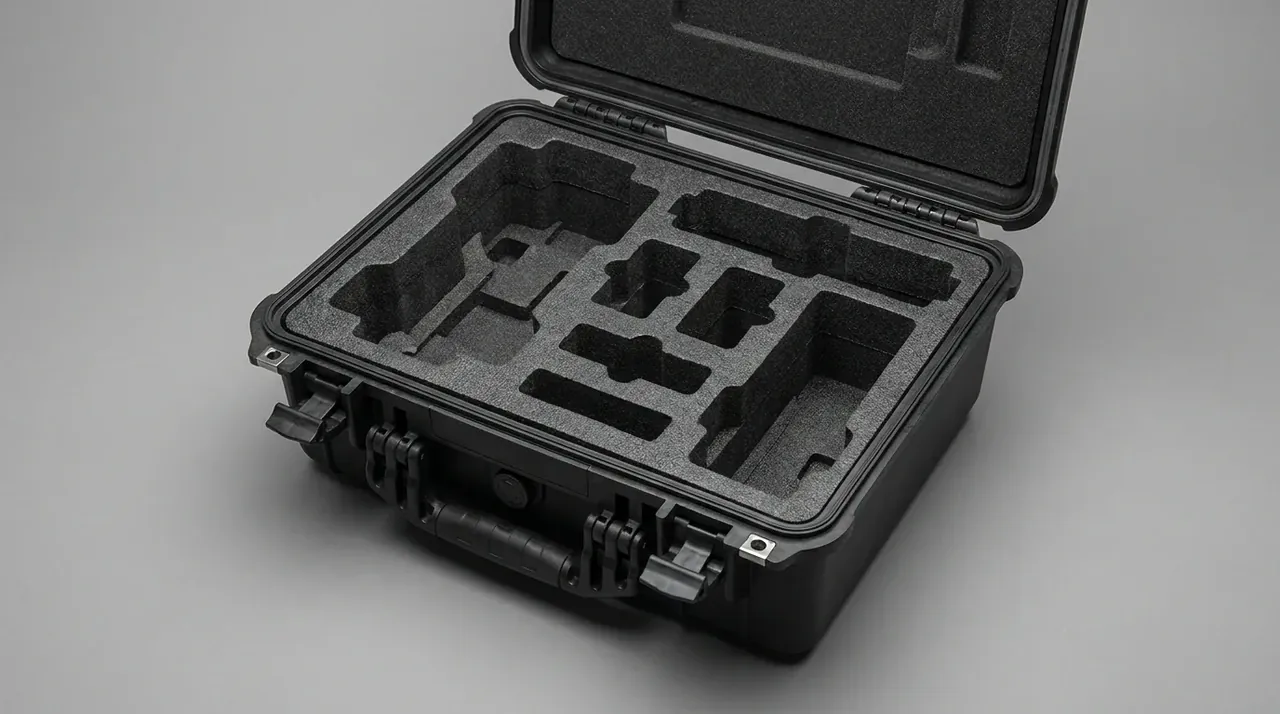
The drum sets the centreline radius: φ300 mm gives 166 mm and 1.04 m per turn for 5 m in 4.8 turns, while φ460 mm gives 246 mm and 1.55 m for 7.5 m in the same 4.8 turns.
| Cable length tier | Radius floor | Drum fitted | Length per turn | Turns | Coil outside |
|---|---|---|---|---|---|
| 5 m | 160 mm | φ300 mm | 1.04 m | 4.8 | 364 mm |
| 7.5 m | 240 mm | φ460 mm | 1.55 m | 4.8 | 524 mm |
| 5 m, −30 °C store | 240 mm | φ460 mm | 1.55 m | 3.2 | 524 mm |
Matching turns keeps the shell shallow: the 100 mm wide drum takes 3 turns side by side at 32 mm with a 2 mm gap, so 4.8 turns become 3 plus 1.8 over 3 mm EPE and coil height falls from 96 mm to 67 mm.
The drum and foam cavity change; shell, lid and latches share one mould, cutting mould cost from 6.8 to 3.9 CNY per unit.
3. The Connector Head Gets Its Own Cavity
A gun head weighs 6 kg and rides on a 32 mm cable, so it is a point load. On the windings it presses a 12 mm dent, and the jacket edge splits there after about 500 cycles. The head therefore gets its own 180 × 140 × 90 mm cavity with a 15 mm EPE floor and 40 mm of relief at the mouth.
Placement beats size. The grommet is 60 mm across with an 8 mm fillet, so the cable leaves along an arc rather than a square edge. It sits 90 mm from the drum; any closer and the cable turns 90° at the port, dropping the local radius to 40 mm.
The 25 mm foam wall leaves free length where the cable bends out of the head; below 20 mm the bend point lands on the wall and the radius falls to 60 mm.
4. From −30 °C to 50 °C: Radius Follows Temperature
Jacket flexibility tracks temperature. At 23 °C a 32 mm cable runs at 160 mm; at 0 °C the factor is 1.2, giving 192 mm; at −30 °C it is 1.5, giving 240 mm, and 7.5 m goes from 240 to 360 mm.
| Storage temperature tier | Radius factor | 5 m floor | 7.5 m floor | Drum to fit |
|---|---|---|---|---|
| 50 °C | 1.0 | 160 mm | 240 mm | φ300 mm |
| 23 °C | 1.0 | 160 mm | 240 mm | φ300 mm |
| 0 °C | 1.2 | 192 mm | 288 mm | φ460 mm |
| −30 °C | 1.5 | 240 mm | 360 mm | φ460 mm |
At the hot end the constraint changes. At 50 °C the jacket softens and the coil weight flattens the lower layer; stack more than 2 high, or store at 60 °C, and the flat spot is permanent.
The cable also has to be coiled warm: below 0 °C the modulus triples, so winter work is done indoors above 15 °C. A φ700 mm drum would force a 780 mm interior and a 7.2 kg shell, so cold-climate versions ship with 5 m cable.
5. Fixture, Slots and the Compressive Pad
The drum must neither rotate nor rattle. Each stub protrudes 25 mm into a U-slot 20 mm deep and 26 mm wide with 1 mm of axial play; a 10 mm EPE pad presses from the lid, so vertical movement is zero and lateral stays within 2 mm.
| Drum diameter tier | Cable served | Shaft stub | Slot depth | Interior height | Loaded weight |
|---|---|---|---|---|---|
| φ300 mm | 5 m | 25 mm | 20 mm | 110 mm | 13.6 kg |
| φ460 mm | 7.5 m | 25 mm | 20 mm | 130 mm | 16.2 kg |
| φ700 mm | 7.5 m, cold store | 30 mm | 24 mm | 160 mm | 21.5 kg |
Vibration is checked at 1.5 g, where 9 kg of cable puts 200 N on two slots and the pad. Slot walls are 6 mm thick with two 3 mm ribs; the handle is rated at 21.5 kg, 60 kg static.
Conclusion
Every dimension derives from one ratio. A 15% strain limit gives a 160 mm floor, the floor a 320 mm coil, the coil a 400 mm interior, and the interior a 470 × 370 × 200 mm shell. The 7.5 m cable lifts the floor to 240 mm and swaps the drum to φ460 mm. Put that chain on the drawing and the radius becomes a dimension to inspect rather than a habit to argue about.
Related Reading
- How to size a cable storage box
- Shock protection for charger module cases
- Stacking and circulation for charger module cases
- Choosing an industrial equipment case
- Dividing cavities in field inspection cases
Related Products
- 8 Series — Gun Cases; Military Equipment Cases; Camera Equipment Cases; Drone Cases; Watch Cases; Knife Cases; First Aid Cases; Electronics Equipment Cases
- WL8-2812 PP Gun Case — model WL8-2812
- All protective cases and toolboxes: 7 series, 158 models