

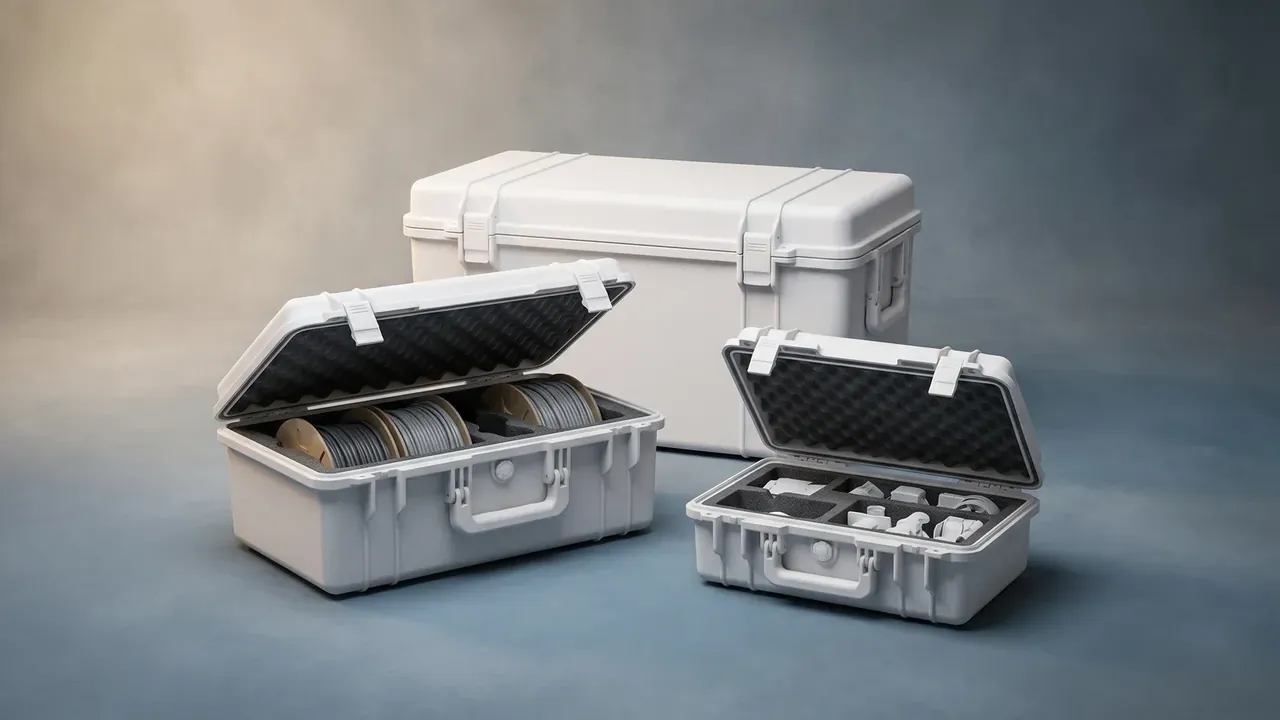
Quick answer: Acceptance cost on a clear waterproof plastic case sits mostly in rework, not in testing. Five readings — transmittance, haze, wall, vacuum, latch pull — hold a 12 CNY rework down to 3 CNY and keep a batch out of the return lane.
Table of contents
- Where the acceptance cost of a clear waterproof plastic case sits
- Transmittance and haze as hard numbers
- Three field checks for sealing and latches
- Repair, downgrade or reject: where the cost splits
- FAQ
1. Where the acceptance cost of a clear waterproof plastic case sits
One clear waterproof plastic case leaves the line at 46 CNY, a rework pass costs 12 CNY, and a returned batch costs 8,500 CNY. Those numbers decide where inspection effort belongs.
Inside the 12 CNY sit cord removal at 3 CNY, polishing out haze at 5 CNY and refitting latches at 4 CNY, with downtime uncounted. A 2,000-piece return is worse: freight both ways and re-inspection, with late delivery unbilled.
| Failure | Cause | Cost per unit |
|---|---|---|
| Haze above limit | Low mould temperature | 12 CNY rework |
| Water at the flange | Gasket under-compressed | 8,500 CNY per batch |
| Latch under 200 N | Insert boss offset | 8 CNY repair |
| Wall below 2.0 mm | Short hold time | 46 CNY scrap |
The money is spent late, the cause sits early.
2. Transmittance and haze as hard numbers
Appearance arguments over clear parts are hard to settle, since looks cloudy is an opinion. Written as numbers, it becomes a comparison of readings.
Transmittance is measured on a 2 mm plaque at 550 nm and must reach 88%; haze must stay at or below 6%, and past 9% the eye reads a white film.
Wall and clarity pull against each other. A 2.2 mm wall is common; thinning to 2.0 mm buys two points of transmittance while the side wall dishes under vacuum and the seal shifts.
| Item | Instrument | Pass value |
|---|---|---|
| Transmittance | Spectrophotometer | 88% minimum |
| Haze | Haze meter | 6% maximum |
| Colour difference | Colorimeter | 1.5 maximum |
| Scratches | Eye and loupe | 0.1 mm wide, two per face |
3. Three field checks for sealing and latches
Sealing can be checked on the shop floor with three actions and a stopwatch.
- Vacuum: draw to -25 kPa, hold 60 seconds, drop no more than 1.0 kPa; more means a gap at the flange or valve.
- Immersion: sink to 200 mm for 20 minutes, dry, weigh; a gain above 1.5 g is ingress, and the clear body shows the water line without opening.
- Latch pull: pull each of the two latches to 200 N and hold 5 seconds; no spring-back and no boss movement passes.
One more check belongs at low temperature: two hours at -10 °C, then three open-and-close cycles, where a brittle latch lot shows itself. It is skipped because of the wait, and it causes most winter complaints.
Clear does not mean visible.
4. Repair, downgrade or reject: where the cost splits
The line between disposal routes is not pass and fail, but whether rework costs more than the margin on one unit.
A batch at 6% to 9% haze polishes back at 4 CNY a unit and one day lost; a 1.0 to 2.0 kPa drop takes a new cord at 6 CNY and two days; 82% to 88% transmittance ships as non-display grade at thirty percent off; a leak or crack returns the batch.
| Route | Trigger | Cost per unit | Schedule |
|---|---|---|---|
| Polish | Haze 6% to 9% | 4 CNY | 1 day |
| New cord | Drop 1.0 to 2.0 kPa | 6 CNY | 2 days |
| Downgrade | Transmittance 82% to 88% | 30% off | None |
| Return | Leak, crack | 8,500 CNY | Over 7 days |
On a 2,000-piece batch, draw 20 units; one leak widens the sample to 50, and two more failures return the batch, a rule that belongs in the contract.
Sampling strength decides who pays, so it cannot be left to the inspector's mood. Draw too few and the return lands on the supplier; draw too many and the hours move into the unit price. Both sides know where the line sits, which is why the ratio is argued before tooling rather than after a failure. The arithmetic is simple: a 12 CNY rework and an 8,500 CNY return differ by about seven hundred times, so sampling must lean towards return risk. Write the 20 and 50 nodes into the sheet and the split stops depending on goodwill. What is complicated is settling that before the mould is cut.
Conclusion
Acceptance on a clear waterproof plastic case is money spent early: a few dozen CNY for a haze reading, a few minutes for vacuum and immersion, against a batch that needs no rework. Put the five pass lines in the contract and the routes in the acceptance sheet, and the unit cost of a clear waterproof plastic case stays where it was quoted.
This article discusses only the container (case body) side of specifications and design intent, and does not cover any handling, loading or use of the contents.
Related Reading
- IP ratings and test conditions for hard cases
- Storing case moulds against rust
- Pallet marks, carton count and weight
Related Products
- 8 Series — Gun Cases; Military Equipment Cases; Camera Equipment Cases; Drone Cases; Watch Cases; Knife Cases; First Aid Cases; Electronics Equipment Cases
- WL8-2812 PP Gun Case — model WL8-2812
- All protective cases and toolboxes: 7 series, 158 models