

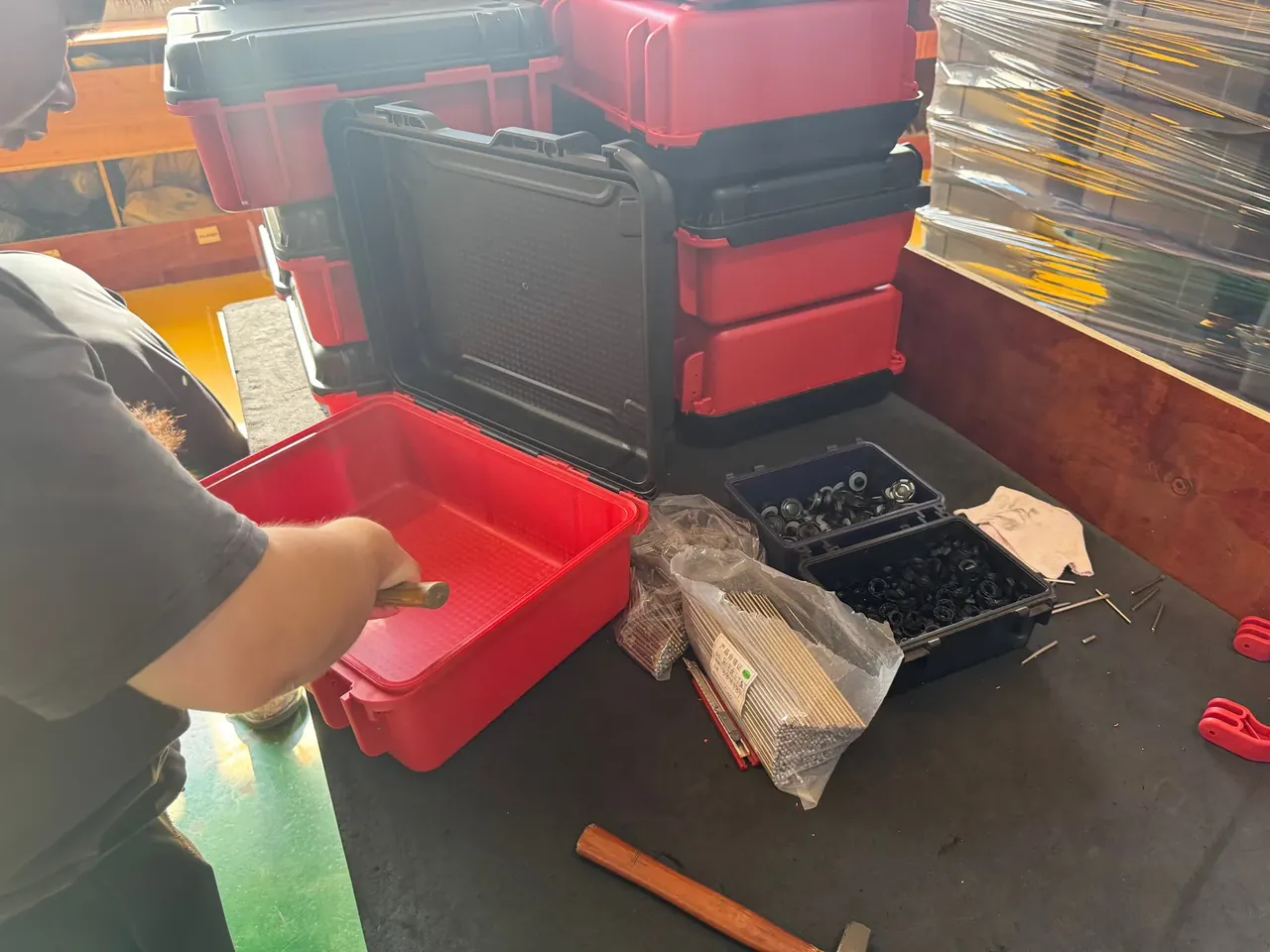
Quick answer: A cold chain vs cooler hold-time gap is half shell and half plate count: levelled at two 500 g plates, the pair runs 4.6 h against 3.3 h.
Table of contents
- Where the gap comes from
- Where 12 W comes from
- How narrow the 2–8 ℃ band is
- Pre-chilling and the 36 h route
- Levelling the plate count
- FAQ
1. Where the gap comes from
Two identical plates, one box still under 8 ℃ at 36 h, the other past 10 ℃ at 8 h, a claim that leaves out two things: the 36 h box carried 16 plates, the 8 h box 4, and 8 h is when the cooler hit 10.2 ℃, not how long it held 2–8 ℃, which was 6.5 h.
The shells differ as well. Both hold 20 L; the cold chain box runs a 45 mm wall of 30 mm vacuum insulation plus 15 mm polyurethane, the cooler a 25 mm polyurethane wall, giving heat transfer coefficients of 0.30 and 0.55 W/(m²·K), a factor of 1.8.
A 0.5 mm paper strip finds the leaks. Slide it around a closed lid and any point it pulls freely is a gap; the cold chain box allows no more than 2 such points, the cooler usually has 4 at the corners, which account for 15% of its heat load.
| Item | Cold chain | Cooler | Effect |
|---|---|---|---|
| Wall | 45 mm, VIP 30 + PU 15 | 25 mm PU | U 0.30 vs 0.55 |
| Seal | Double lip, 2 catches | Single lip, 1 | Leak 8% vs 15% |
| Volume | 20 L, 16 slots | 20 L, 4 slots | Plate count |
| Weight | 7.8 kg | 4.6 kg | Handling |
Per plate, the 36 h run works out at 2.25 h against 1.63 h for the 6.5 h cooler run, a 38% gap. That is what the wall and seal are worth, and the remaining 62% is plate count.
2. Where 12 W comes from
The cold chain box loses 9.7 W through its envelope: 32 ℃ ambient against a 5 ℃ average, 27 K, 0.30 W/(m²·K) over 1.2 m². Three openings add 2.3 W averaged over the run, so sizing uses 12 W.
| Source | Calculation | Value | Share |
|---|---|---|---|
| Envelope | 0.30 × 1.2 × 27 | 9.7 W | 81% |
| Openings | 3 × 30 s | 2.3 W | 19% |
| Total | 12 W | 100% | |
| Cooler | 0.55 × 1.0 × 27 | 17 W | — |
At 12 W, 36 h needs 432 Wh. Sixteen plates of 500 g at 200 kJ/kg hold 444 Wh, a margin of 12 Wh or 2.7%, which is why 36 h is the ceiling and three more hours push the box past 8 ℃.
The cooler divides the same way: 111 Wh over 17 W gives 6.5 h, which is how a unit rated for 8 h passes while never holding 2–8 ℃ that long.
Heat load falls as the box warms: 5 ℃ to 8 ℃ cuts the difference to 24 K and envelope loss by 11%, so an average-based estimate overstates hold time by 8%.
3. How narrow the 2–8 ℃ band is
The band is 6 K wide and a 5 ℃ phase change sits above its middle. A plate against the wall reads 0.5 ℃ locally, one packed against the load pushes a side to 1.8 ℃, so a 20 mm air gap costs 1.5 L of volume.
Openings are measurable. At 32 ℃ ambient, 30 s per opening, starting from 5 ℃: the first lifts the box 1.8 ℃, the second 2.4 ℃, the third 3.1 ℃, with 22, 35 and 48 min to settle back.
| Opening | Before | At closing | Rise | Recovery |
|---|---|---|---|---|
| 1 | 5.0 ℃ | 6.8 ℃ | 1.8 ℃ | 22 min |
| 2 | 3.2 ℃ | 5.6 ℃ | 2.4 ℃ | 35 min |
| 3 | 2.9 ℃ | 6.0 ℃ | 3.1 ℃ | 48 min |
Three openings lift the average load from 9.7 W to 12 W and cost 3.5 h, or 1.2 h each. The cooler pays more for the same behaviour: same volume, thinner wall, 40% slower recovery, about 6 h lost.
Plate position is easy to overlook. Eight plates stacked in the base leave a 2.6 ℃ spread top to bottom; stood on four sides the same eight give 0.8 ℃. Past 2 ℃ the top compartment crosses 8 ℃ first and the run fails while the average still reads 5.5 ℃.
4. Pre-chilling and the 36 h route
A plate taken from a −18 ℃ freezer needs 12 h for its core to reach −15 ℃. At 6 h the core is still −6 ℃ and only 62% of the latent heat is stored, which is the same as leaving 4 plates at home.
The 36 h figure belongs to trunk routes: 1200 km door to door with one transfer and one opening. Air freight usually clears in 24 h and needs 12 to 14 plates; a 4 h city run is covered by 2 plates in a 25 mm wall.
Vacuum panels carry the long route. At 0.004 W/(mK) a 30 mm panel equals 60 mm of polyurethane, but it punctures, so all four corners take a 15 mm wrap, the thinnest section of the box.
5. Levelling the plate count
Level the plates and the comparison returns to the wall. At 2 plates each: 56 Wh over 12 W gives 4.6 h, 56 Wh over 17 W gives 3.3 h, a 1.3 h gap. At 8 plates: 18.5 h against 13 h.
The gap widens with plate count because the cooler's 17 W stays fixed: it runs 1.3 h at 2 plates and 5.5 h at 8, so a small-plate test understates the difference.
Plate count has a ceiling. Sixteen plates plus the box weigh 15.8 kg, near a single-person lift limit; 20 plates drop the box to 1.2 ℃ and break the lower limit.
Conclusion
The cold chain vs cooler arithmetic ends on one table: stored energy divided by heat load, then compared with the measured run. Sixteen plates of 444 Wh at 12 W give 37 h calculated and 36 h measured, using 97% of capacity; eight plates give 18 h; four cooler plates of 111 Wh at 17 W give 6.5 h with no margin at all; two plates give 3.2 h. Multiply route hours by heat load, add 3%: if the total exceeds the stored energy, add plates, and if not, fix the seal and the opening count first. Plates buy time, walls save it.
| Build | Plates | Stored | Load | Calculated | Measured |
|---|---|---|---|---|---|
| Cold chain | 16 | 444 Wh | 12 W | 37 h | 36 h |
| Cold chain | 8 | 222 Wh | 12 W | 18.5 h | 18 h |
| Cooler | 4 | 111 Wh | 17 W | 6.5 h | 6.5 h |
| Cooler | 2 | 56 Wh | 17 W | 3.3 h | 3.2 h |
This article discusses container-side specifications and design implications only, and does not cover any handling, loading or use of the contents.
Related Reading
- Insulation gap between coolers and protective cases
- Sizing coolant plates for a cold chain box
- Temperature bands for pharmaceutical cold chain
- Trunk routes, hours and transfer points
Related Products
- 8 Series — Gun Cases; Military Equipment Cases; Camera Equipment Cases; Drone Cases; Watch Cases; Knife Cases; First Aid Cases; Electronics Equipment Cases
- WL8-2812 PP Gun Case — model WL8-2812
- All protective cases and toolboxes: 7 series, 158 models