

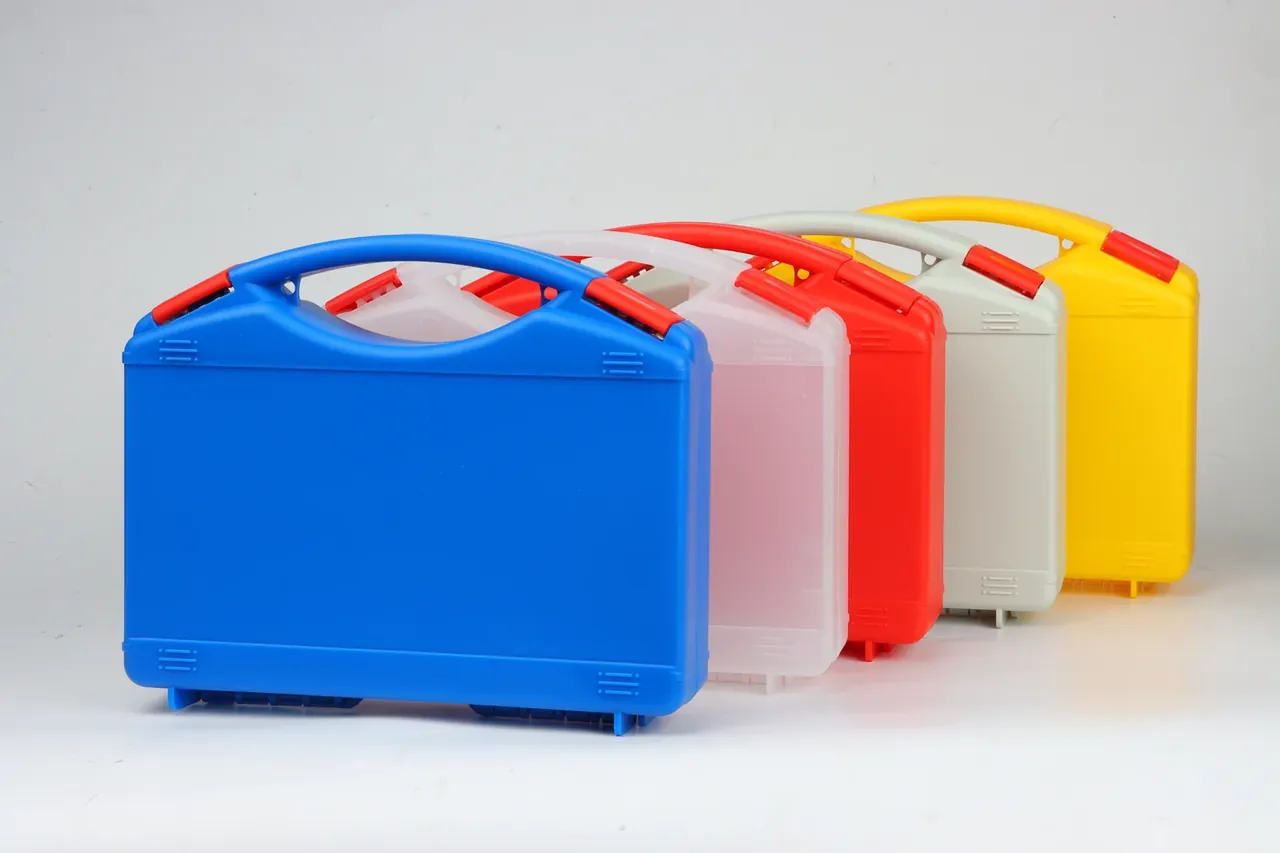
Quick answer: A Colored Protective Case is sized backwards from its loads: cavity from payload plus foam, wall from stack deflection and drop energy, then ribs, latches and a gasket.
Table of contents
- The Minus 25 C Road and Air Cycle: Four Loads on One Colored Protective Case
- From Cavity Size Back to Outline and Wall Thickness
- Ribs Carry the Stiffness Once Wall Thickness Stops
- Latches, Hinges and Gasket: The Fit-Up Numbers
- FAQ
1. The Minus 25 C Road and Air Cycle: Four Loads on One Colored Protective Case
One consignment goes 240 km by road, then by feeder aircraft. Within 24 hours the case meets a tailgate drop, hours of vibration and an unpressurised hold at -25 C. Each load lands on a different wall.
The example carries an 18.5 kg rangefinder in a 486 x 306 x 178 mm cavity, stacked four high for 60 days, so the lowest lid takes 68 kg.
| Load | Where it lands | Spec it sets | Value here |
|---|---|---|---|
| Stack, 68 kg on lid | Lid panel and ribs | Lid wall, rib pitch | 3.2 mm, ribs at 90 mm |
| 1.2 m corner drop | Corners, base edges | Radius, corner wall | R8, 3.6 mm |
| 3 to 5 Hz vibration | Hinge pin, latches | Retention, pin size | 200 N, 4 mm |
| Hold at -25 C | Side walls | Cold toughness | Copolymer PP, 8% modifier |
The last row is the one buyers forget. A Colored Protective Case that survives a 1.2 m drop at room temperature can split at the rib roots at -25 C, where copolymer polypropylene loses 30 to 40 percent of its impact strength.
2. From Cavity Size Back to Outline and Wall Thickness
Cavity first, outline second. The instrument measures 480 x 300 x 172 mm; with 3 mm of foam per face the cavity lands at 486 x 306 x 178 mm.
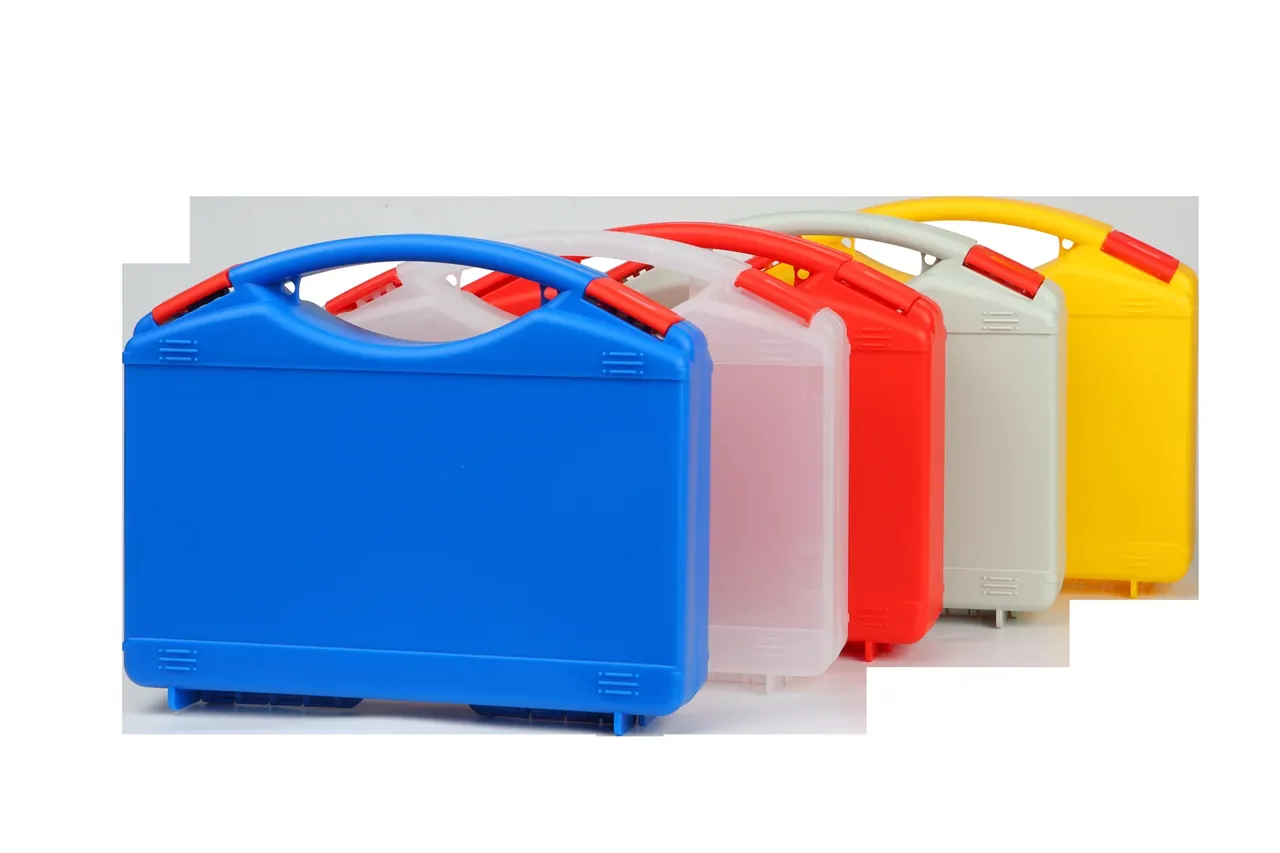
Outline equals cavity plus two walls, two rib heights and clearance, giving 520 x 340 x 212 mm at a 3.2 mm wall. Material is quoted on the outline, volume on the cavity.
The wall is calculated twice and the larger wins. For stiffness, treat the lid as a beam: 486 mm span, 68 kg load, deflection capped at 1/300 of span, which returns 3.2 mm. For impact, take the drop energy: 1.2 m fall, 24.5 kg, on an 8 mm corner radius, which needs 3.6 mm.
Mould scale runs at 1.6 percent, holding the cavity to ±0.6 mm and walls to ±0.15 mm.
| Member | Governing load | Thickness | Tolerance |
|---|---|---|---|
| Lid panel | Stack | 3.2 mm | ±0.15 mm |
| Side wall | Side impact | 3.6 mm | ±0.15 mm |
| Corner, base edge | Corner drop | 3.6 mm, R8 | ±0.2 mm |
| Latch boss | 200 N pull | 4.0 mm local | ±0.1 mm |
3. Ribs Carry the Stiffness Once Wall Thickness Stops
Each extra 0.5 mm adds 180 g per case, 2.2 kg on a pallet of twelve. The Colored Protective Case stops at 3.2 mm and hands the rest to ribs.
- Rib thickness at 0.55 of wall, here 1.8 mm; past 0.6 the root sinks and a pale face shows it.
- Rib height 6 mm, lifting section modulus about 1.9 times; taller ribs intrude on foam.
- Root fillet R0.8; below 0.5 the melt shears hot and the part whitens.
- Base edges carry a 1.5 mm pad under a double rib, so the case never stands on rib ends.
4. Latches, Hinges and Gasket: The Fit-Up Numbers
Latches follow the perimeter: 1.72 m outline, two at 0.86 m spacing. Thin it further and the lid centre pops a gap on impact. Retention is 200 N, 1.1 times the inertia of 18.5 kg at 3 g.
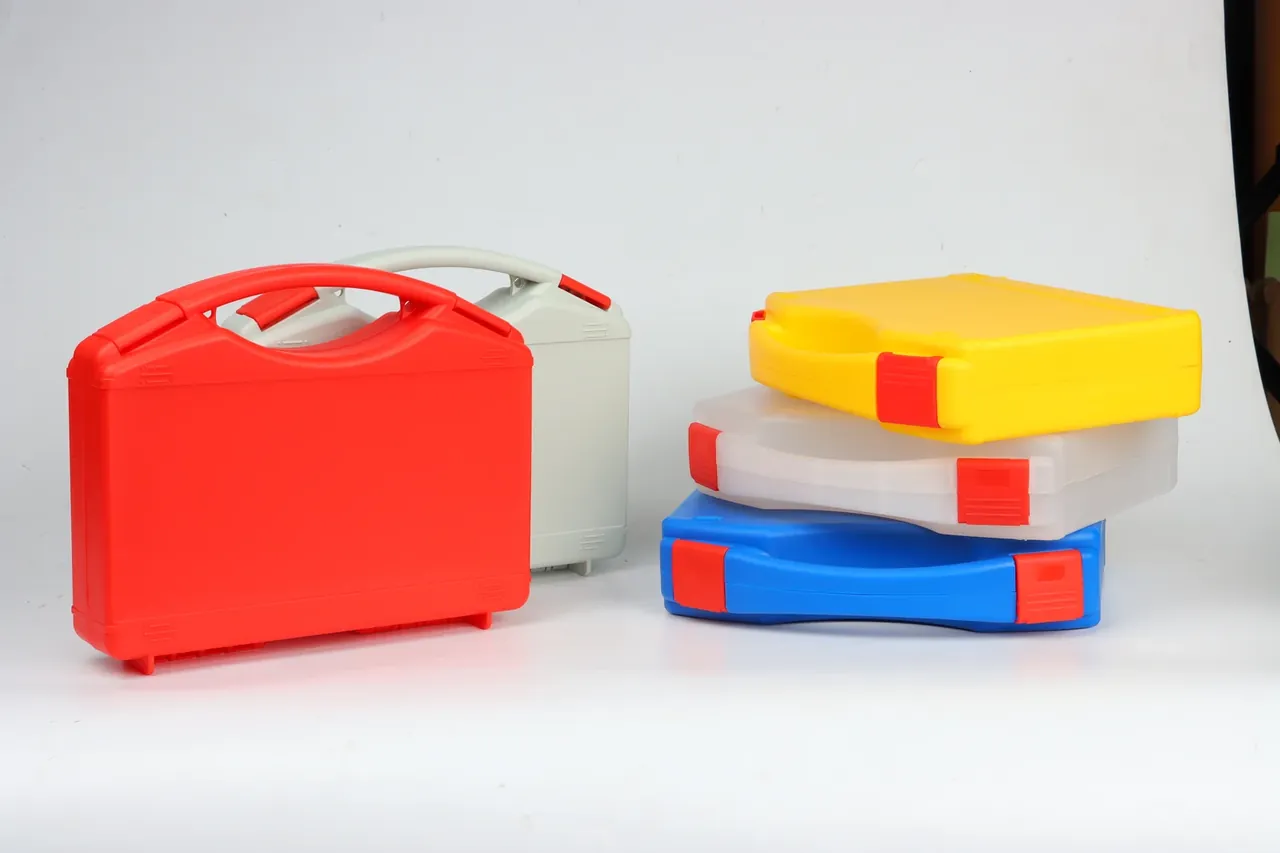
Hinges use a 4 mm stainless pin through four lugs, rated 120 N per side and 5000 cycles. Leave 0.1 mm of play: tighter seizes, looser shifts 2 mm.
Gasket stock is EPDM, 3 mm section, compressed 30 percent in a 3.6 mm groove. Under 20 percent rain gets in within ten minutes; past 45 the latches need a hard push.
The handle is rated 40 kg for a 24.5 kg case, its 4 mm root fused into the lid rib. A handle tied only to the panel whitens as soon as a loaded Colored Protective Case leaves a shelf.
Conclusion
Loads set wall thickness, wall thickness sets rib geometry, rib geometry sets where latches and hinges sit. Cavity, outline, wall, rib pitch and retention lock together, so moving one sends you back through the other four. Put those numbers on a drawing with tolerances and a winter shipment will not split at the corners, which is what a Colored Protective Case specified from a load case buys.
This article discusses only the container (case body) side of specifications and design intent, and does not cover any handling, loading or use of the contents.
Related Reading
- How a colored protective case is moulded
- Wall thickness and load rating for heavy-duty cases
- Specifying a cartridge protective box body
Related Products
- 8 Series — Gun Cases; Military Equipment Cases; Camera Equipment Cases; Drone Cases; Watch Cases; Knife Cases; First Aid Cases; Electronics Equipment Cases
- WL8-2812 PP Gun Case — model WL8-2812
- All protective cases and toolboxes: 7 series, 158 models