

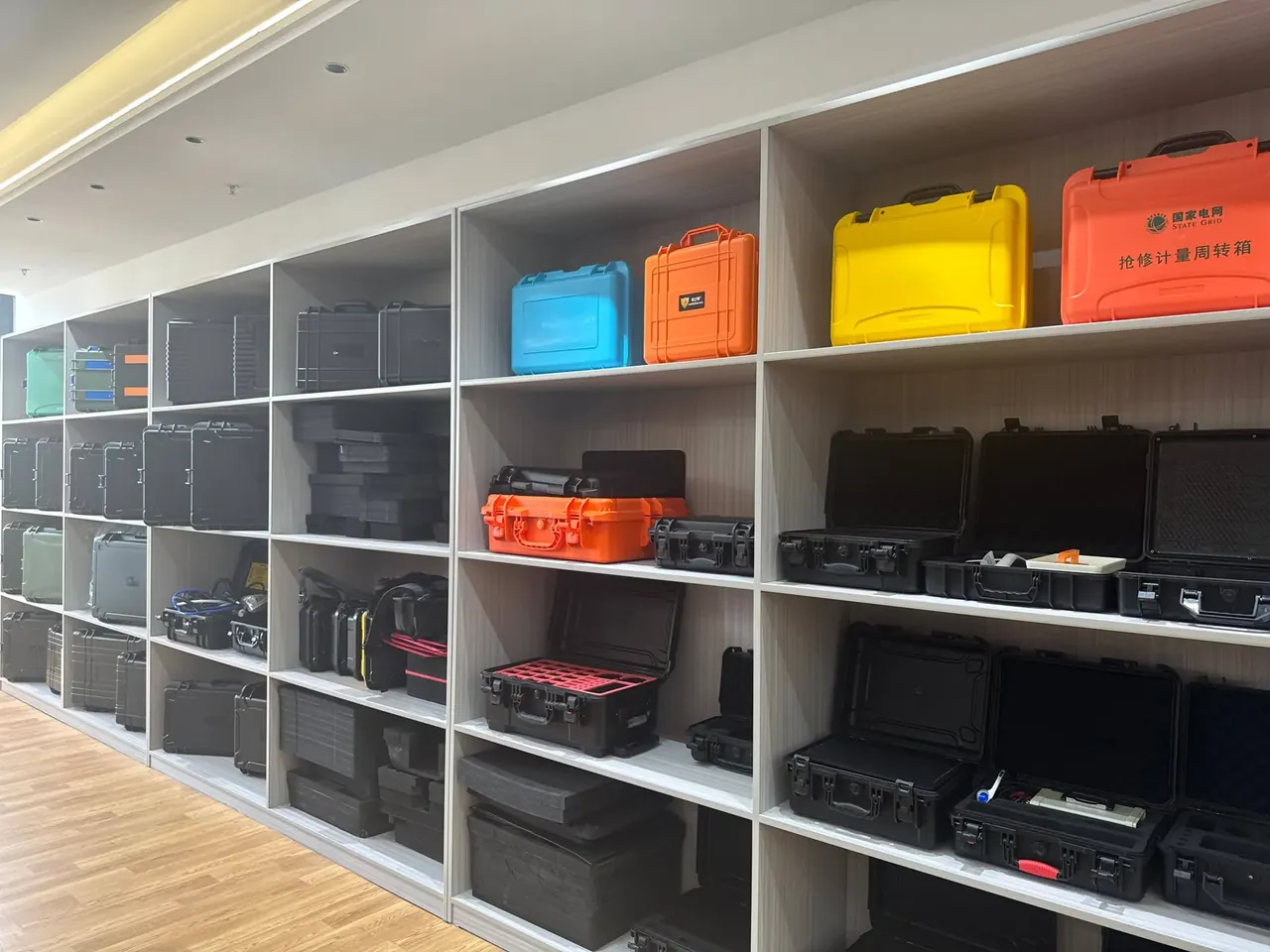
Quick answer: A Colored Protective Case is coloured inside the moulding machine, not in a paint booth. Masterbatch runs at 1.5 to 3 percent on a matching carrier, melt holds at 215 to 225 C for under 6 minutes, a dark-to-light change purges 3 barrel capacities, and each batch keeps 3 samples for 24 months.
Table of contents
- Where the Colour Comes From
- Let-Down Ratio and Mix Uniformity
- Melt Temperature and Residence Time
- Purging: Dark to Light
- Retention Samples and Traceability
- FAQ
1. Where the Colour Comes From
A Colored Protective Case is coloured either in the resin or on the surface. Paint frees the colour, but a knock exposes bare plastic; in-resin pigment keeps its colour through a scuff, so volume production runs it.
The carrier is where plants slip. A copolymer polypropylene body fed a polyethylene-carrier pellet meets a two-to-one viscosity gap, the pellet never disperses, and flow marks show on the surface. Black hides them; light blue does not.
Inorganic pigment survives past 300 C but tints weakly, needing about 30 percent more for a deep shade. Organic pigment is vivid and tops out near 240 C, so the orange and yellow on a Colored Protective Case have a narrower window than black.
| Masterbatch | Carrier | Load | Shades | Risk |
|---|---|---|---|---|
| inorganic | homopolymer PP | 25% | white, grey | weak tinting |
| organic | copolymer PP | 30% | orange, yellow | decomposes when hot |
2. Let-Down Ratio and Mix Uniformity
The ratio is the most direct colour knob and the one most often changed by hand. The band is 1.5 to 3 percent: dark holds at 1.2, white climbs to 4 because titanium dioxide needs volume fraction to bury the grey base.
Dosing runs loss-in-weight at plus or minus 0.3 percent. At 2 percent, 100 kg of resin takes 2 kg of masterbatch and swing stays under 6 g; a volumetric disc instead varies 8 percent with hopper level. Dry blending wants a drum at 30 rpm for 8 minutes, or masterbatch settles and the first shots come out dark. On one orange, 1.8 and 2.0 percent differ by Delta E 0.9, visible from half a metre.
3. Melt Temperature and Residence Time
Polypropylene runs at 215 to 225 C, where carrier and base reach similar viscosity and mixing completes. Past 240 C the organic pigment breaks down, orange turns brick and yellow greys.
Residence is the quiet variable. At three times shot weight, melt sits about 5 minutes; an oversized press on a small mould stretches that past 10, worth Delta E 0.6 at identical settings. On a 250 tonne press holding 1.2 kg, a stop over 20 minutes without purging scraps the first three shots. Back pressure adds shear heat, 6 C from 8 to 12 MPa, and mould temperature shifts gloss.
4. Purging: Dark to Light
Sequence decides purge cost. Orders for a Colored Protective Case arrive mixed, black through yellow; run light before dark and the black swallows the residue, halving purge time.
Dark to light needs transition compound at 3 to 5 barrel capacities, so 4 to 6 kg on a 1.2 kg barrel. Dose one capacity and the screw root and check ring keep the old colour, leaving dark streaks in a fixed position that wiping only spreads. The nozzle comes off and the runner sweeps at 260 C; the first shot is scrapped.
| Change | Purge | Scrapped | First article |
|---|---|---|---|
| light to dark | 1 capacity | 2 shots | shot 3 |
| dark to light | 3 to 5 capacities | 4 shots | shot 5 |
| black to white | 5 capacities, nozzle off | 6 shots | shot 7 |
5. Retention Samples and Traceability
Most shade complaints on a Colored Protective Case come from two batches mixed in one shipment, not from a bad batch. Each batch keeps three samples, first shot, mid-run and last, labelled with colour code, masterbatch lot, machine, melt range and timestamp, stored dark for 24 months.
Lot variation needs its own gate: one colour code still drifts Delta E 0.3 to 0.5 between lots, and blending two stacks the error, so anything past 0.5 is board-checked first. A cavity number and timestamp moulded inside the body carry a complaint back to machine, shift, material lot and sample; one orange run measured Delta E 1.4 against stock from two months earlier.
Conclusion
Colour on a Colored Protective Case is four steps in series: a carrier that matches the resin, a ratio of 1.5 to 3 percent, a melt window of 215 to 225 C, and a purge at three barrel capacities. Let one slip and the drift appears in the finished stack. Write the ratio into the work instruction, log the temperatures, lock the samples, and the shade of a Colored Protective Case becomes repeatable.
This article discusses only the container (case body) side of specifications and design intent, and does not cover any handling, loading or use of the contents.
Related Reading
- Colour Customisation for Protective Cases
- Visual Colour Management on the Line
- Two-Color Injection Overmoulding Cases
- Injection Moulded Protective Case
Related Products
- 8 Series — Gun Cases; Military Equipment Cases; Camera Equipment Cases; Drone Cases; Watch Cases; Knife Cases; First Aid Cases; Electronics Equipment Cases
- WL8-2812 PP Gun Case — model WL8-2812
- All protective cases and toolboxes: 7 series, 158 models