

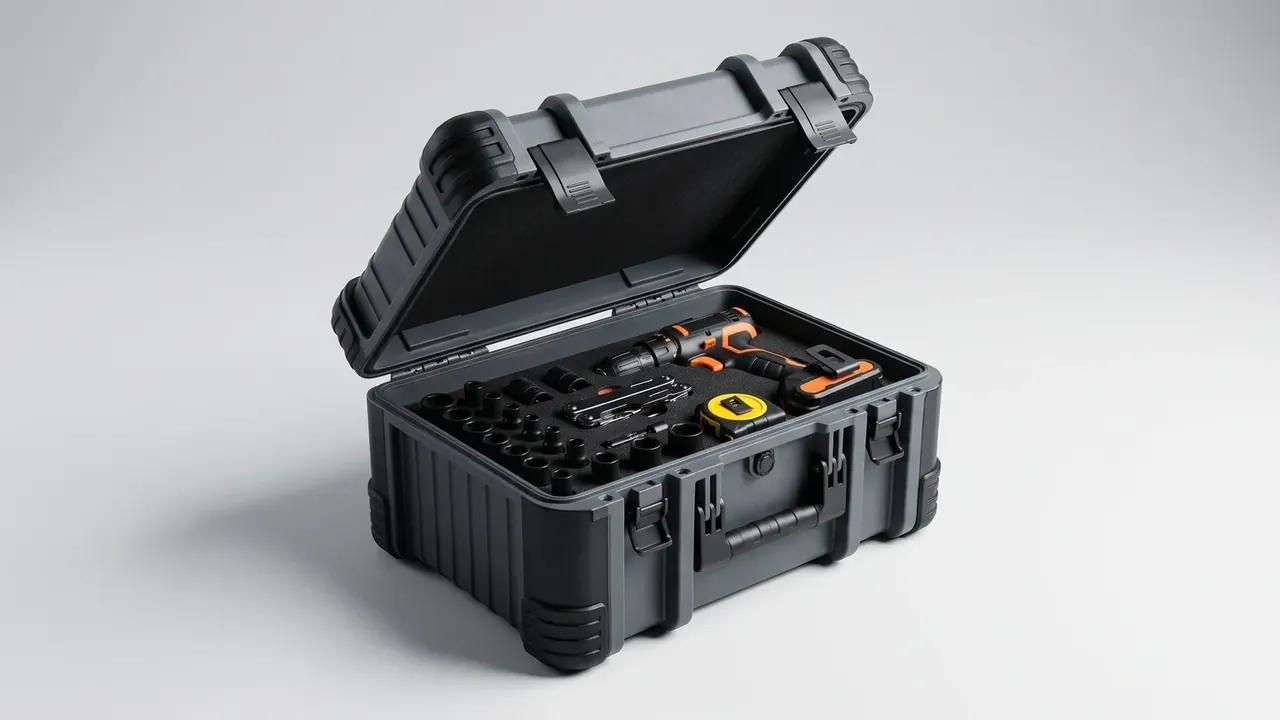
Quick answer: Check whether the list fits the cells, how many seconds one item takes, the loaded weight, the protection margin the chain needs, and the cost per kilogram per year. Weight them 30, 20, 15, 20 and 15, then score each candidate; a three-point gap is a tie.
Table of contents
- Five criteria for choosing a consolidated tool kit
- Criterion one: the list comes before the interior
- Criteria two and three: access time and loaded weight
- Criterion four: protection margin for the transport chain
- Criterion five and scoring: lifetime cost and traceability
- FAQ
1. Five criteria for choosing a consolidated tool kit
A consolidated tool kit is usually quoted from an outline drawing: external size, material, minimum order. The tool list is missing, and a list cannot be compared the way a drawing can. Five measurable criteria give the candidates a common denominator.
Weights are uneven on purpose. List fit takes thirty, because an error there cannot be recovered elsewhere. Access time and protection margin take twenty each: one is paid every shift, the other a rare event that costs a shipment. Loaded weight and lifetime cost take fifteen each.
| Criterion | Weight | Measure | Penalty |
|---|---|---|---|
| List and interior | 30 | lines against cells | cells short |
| Access time | 20 | seconds per item | crew drops it |
| Loaded weight | 15 | gross weight | nobody lifts it |
| Protection margin | 20 | drop, IP rating | moisture inside |
| Lifetime cost | 15 | cost per kg-year | replaced early |
2. Criterion one: the list comes before the interior
Sort the list by the longest edge of each item and group it four ways: sockets, wrenches and pliers, screwdrivers, gauges. Cell format follows from each group's longest edge.
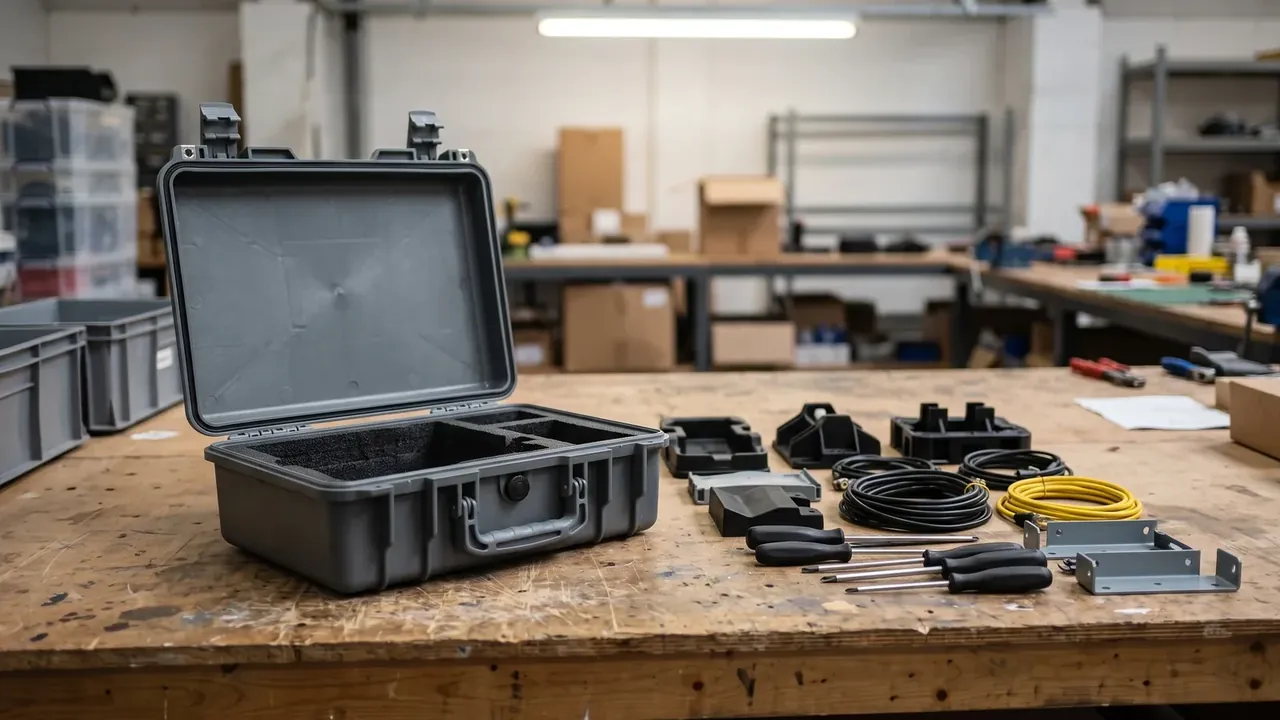
A 560 by 380 by 210 mm interior holds 44.7 litres, of which about 31 litres take tooling, a usable rate of 69 percent; the rest is wall, finger gap and clearance. Tolerance is plus or minus 1.5 mm, foam openings sit 2 mm larger than the tool, and depth carries a 10 mm finger gap. Those numbers decide whether 42 list lines become 38 cells: sockets to 75 mm bores, wrenches to 260 mm slots, gauges to a 300 mm channel.
3. Criteria two and three: access time and loaded weight
Access is measured in seconds: one shallow layer takes 35 seconds; a two-layer layout needs the upper tray lifted, and the same item becomes 57 seconds. That 22-second gap, at twelve openings a day over 300 days, is 22 hours a year.
Tie the latch to cycles: 3,600 openings a year, or 18,000 in five years, so a case latched for 8,000 cycles needs a mid-life replacement. Weight is the harder limit: 18 kg gross for one carrier, 22 kg for two, and a 4 kg body leaves 14 kg of payload.
4. Criterion four: protection margin for the transport chain
Size the margin against the worst leg, not the average one. What damages a case is not the motorway but the toss between two handling steps. Write IP65 and a 1.2 m drop on all six faces into the contract.
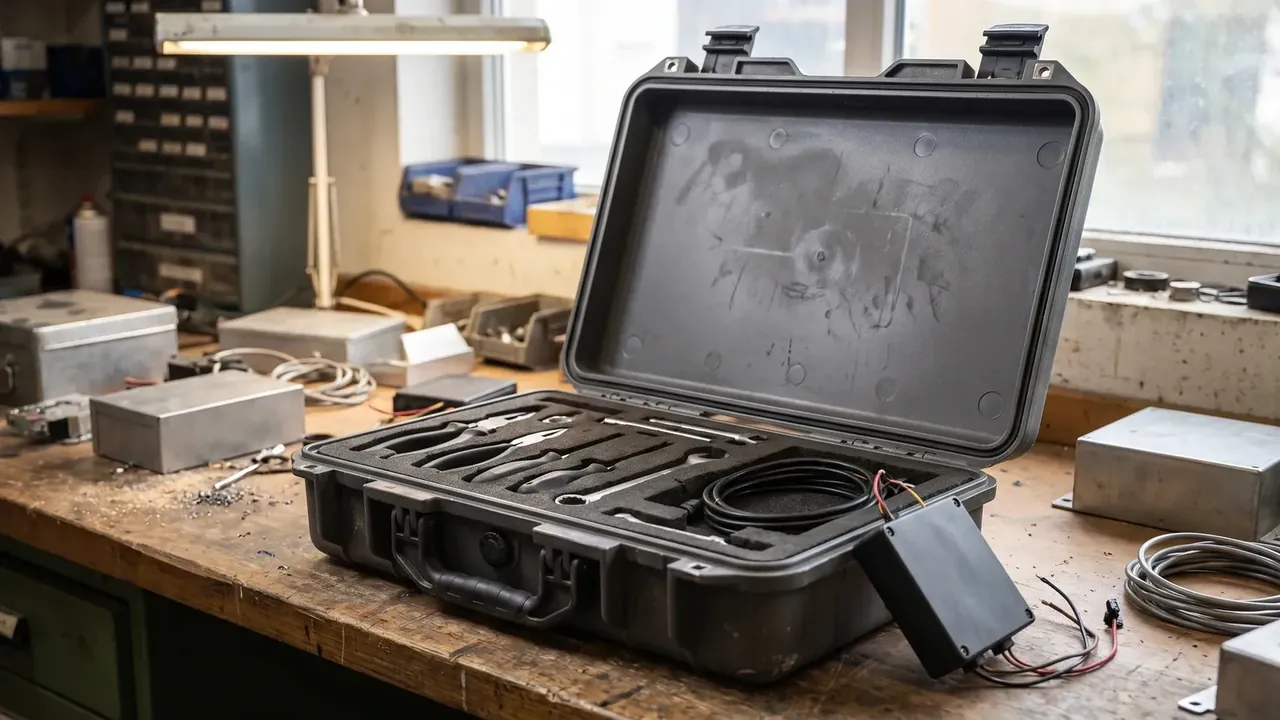
Sealing depends on compression, not thickness. A gasket held at 30 to 40 percent recovers best; over-compressed it takes a set, under-compressed it weeps. The -20 to 60 C range matters where the gasket stiffens. After 3 hours of vibration, check cell shift and foam set under 5 percent.
5. Criterion five and scoring: lifetime cost and traceability
Annualise the cost: purchase price plus spares and any mid-life replacement, divided by payload and years. A 900 CNY case carrying 25 kg for eight years works out near 4.5; half the price replaced after five years costs more. Traceability rests on serial label, seal holes, list plate and tray numbers.
| Criterion | Weight | A | B | C |
|---|---|---|---|---|
| List and interior | 30 | 26 | 22 | 27 |
| Access time | 20 | 16 | 18 | 12 |
| Loaded weight | 15 | 11 | 13 | 9 |
| Protection margin | 20 | 18 | 14 | 16 |
| Lifetime cost | 15 | 10 | 12 | 14 |
| Total | 100 | 81 | 79 | 78 |
Three points apart, so read the heaviest criterion: B loses eight on list fit.
Conclusion
Choosing a consolidated tool kit means replacing five preferences with five verifiable numbers: cell count, seconds per item, loaded weight, drop and IP rating, and cost per kilogram per year. The service record five years out is the honest verdict on any consolidated tool kit.
This article discusses only the container (case body) side of specifications and design intent, and does not cover any handling, loading or use of the contents.
Related Reading
- List control and loss prevention
- Consolidated tool kits in machine tool configuration
- Selection points for weapons consolidated tool kits
- How a tool kit chest is built
Related Products
- 8 Series — Gun Cases; Military Equipment Cases; Camera Equipment Cases; Drone Cases; Watch Cases; Knife Cases; First Aid Cases; Electronics Equipment Cases
- WL8-2812 PP Gun Case — model WL8-2812
- All protective cases and toolboxes: 7 series, 158 models