

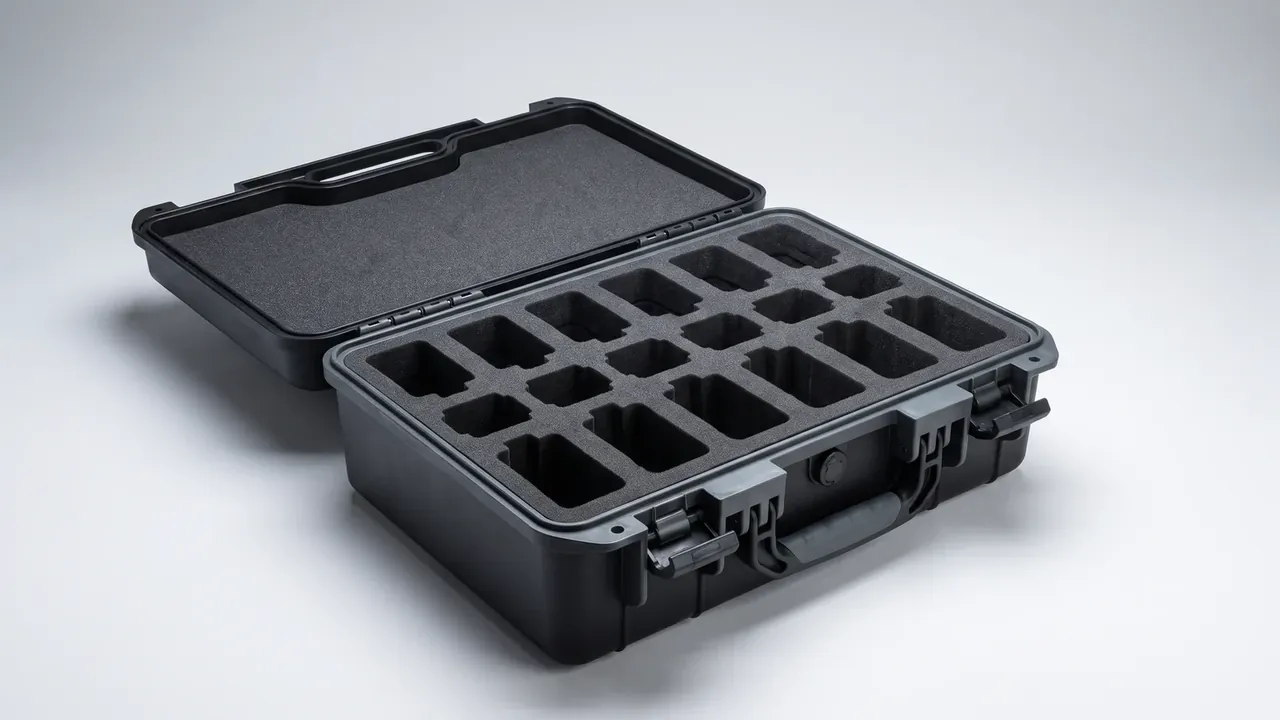
Quick answer: A custom EVA foam insert for cases is specified by four numbers: cavity size, total thickness, density with hardness, and die clearance. Thickness runs 2 mm under cavity depth, 60 kg/m³ at Shore A25 holds about 3 kg, and cuts hold ±0.8 mm.
Table of contents
- What Sets a Custom EVA Foam Insert for Cases
- Density and Hardness to Load
- Layer Count and Thickness
- Die Clearance and Cut Tolerance
- Temperature Humidity and Recovery
- FAQ
1. What Sets a Custom EVA Foam Insert for Cases
Four numbers decide a custom EVA foam insert for cases: cavity size, total thickness, density with hardness, and the clearance at each pocket.
Order matters. Measure the cavity, set total thickness to depth minus 2 mm of preload, then pick density against item weight and clearance against how the part is picked up. A 480 by 360 by 180 mm cavity carries 178 mm of foam.
| Parameter | Sets | Usual value |
|---|---|---|
| Cavity | Outline and nesting | Measured at the tightest point |
| Thickness | Preload, travel | Depth minus 2 mm |
| Density | Load, recovery | 38 to 90 kg/m³ |
| Clearance | Grip, release | 1 to 2 mm a side |
2. Density and Hardness to Load
Density sets weight, hardness sets how far a thumb sinks, and the pair has to match. 38 kg/m³ at Shore A18 suits parts under 1 kg, 60 at A25 is the general grade, and 90 at A35 takes components above 5 kg. Raise density without hardness and the pocket walls slump under load.
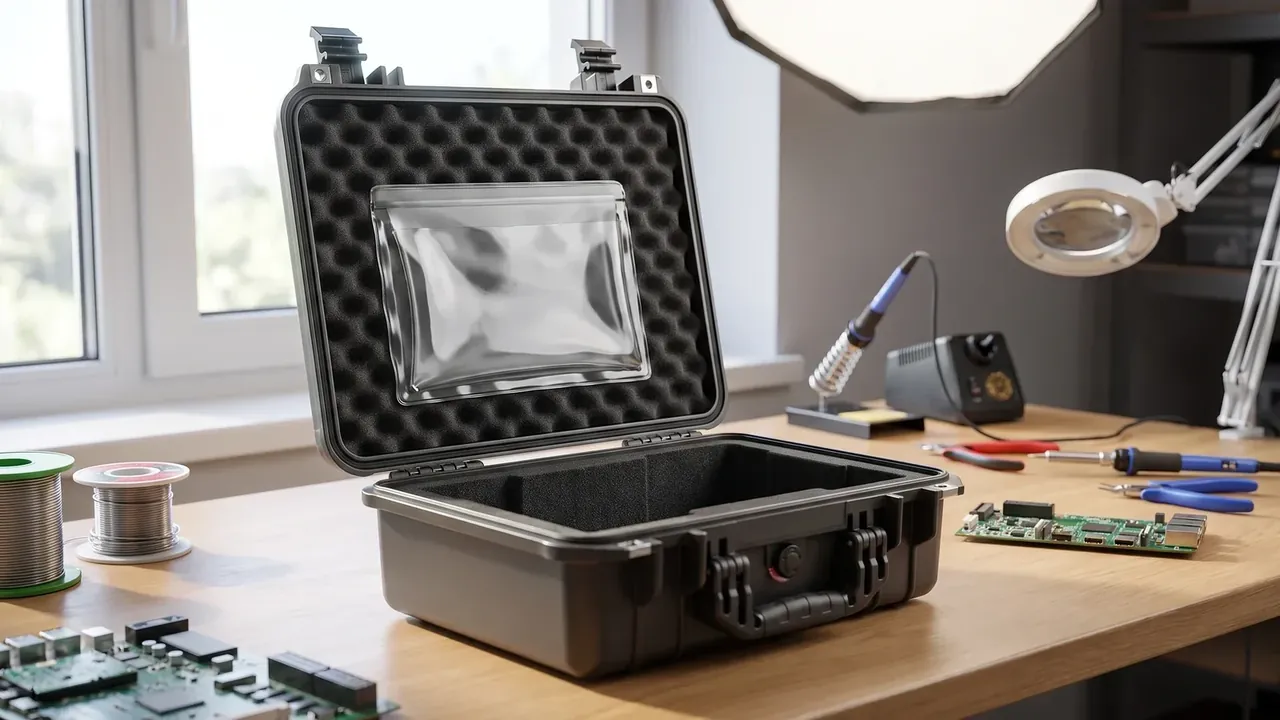
Load is simple to estimate. A 100 by 100 mm bearing face at 60 kg/m³ and A25 holds about 3 kg at 25 percent compression; more compression carries more, but recovery drops with it. Past 3 kg, widen the face or step up to 90 density. Extra thickness adds travel, not capacity.
3. Layer Count and Thickness
Most runs build three layers: a flat lid sheet, a die-cut middle, a flat base. The lid presses, the middle locates, the base absorbs impact, and a model change replaces the middle alone.
Work thickness back from the cavity. 178 mm splits into 95 mm of pocket, 20 mm of lid and 63 mm of base. Pocket depth is item height plus 5 mm so fingers can reach the part, and the lid closes onto that gap: a 90 mm item sits in a 95 mm pocket.
Under 20 mm of base, drop energy passes straight to the case wall; 63 mm acts as a crushable column and cuts peak acceleration in a one metre drop by roughly thirty percent.
4. Die Clearance and Cut Tolerance
Clearance follows handling: 1.5 mm a side for fingers, 1 mm for tweezers, 2 mm for gloves. Under 1 mm the foam grips the part too hard to pull out; over 2 mm it slides in transit and wears against the pocket wall.
Cuts hold plus or minus 0.8 mm, with 1 mm per 100 mm of squareness. Bridges between pockets stay 8 mm or wider, since a 5 mm bridge is what fails first in vibration. Pocket corners take R3, because a square corner cracks after repeated handling.
| Item | Value | Check |
|---|---|---|
| Clearance | 1 to 2 mm | By handling method |
| Cut tolerance | ±0.8 mm | Five points, caliper |
| Bridge | 8 mm minimum | Visual and caliper |
| Corner | R3 | No sharp edge |
5. Temperature Humidity and Recovery
Service life follows the environment. A custom EVA foam insert for cases runs from minus 20 to 60 °C: above 60 it softens and pocket walls creep, below minus 20 it stiffens and parts jam. A sea container reaches 65 °C, so export orders need that limit in the specification.
Recovery is measured as compression set: 70 °C, 25 percent compression, 22 hours, thickness back to 90 percent or better. Water absorption stays under 1 percent, or moisture sits in the pocket and hardware rusts first. Six months of sunlight yellows and embrittles the face, so inserts ship wrapped in black PE.
Conclusion
A custom EVA foam insert for cases comes down to four numbers and three layers: cavity size sets the outline, total thickness sets the preload, density with hardness sets the load, clearance sets the feel. Put those on the drawing and the first sample fits, and the custom EVA foam insert for cases project avoids a second round.
This article discusses only the container (case body) side of specifications and design intent, and does not cover any handling, loading or use of the contents.
Related Reading
- How custom foam inserts are made
- Comparing foam cutting methods
- Fitting an insert into a case
- Dividers and inserts working together
Related Products
- 8 Series — Gun Cases; Military Equipment Cases; Camera Equipment Cases; Drone Cases; Watch Cases; Knife Cases; First Aid Cases; Electronics Equipment Cases
- WL8-2812 PP Gun Case — model WL8-2812
- All protective cases and toolboxes: 7 series, 158 models