

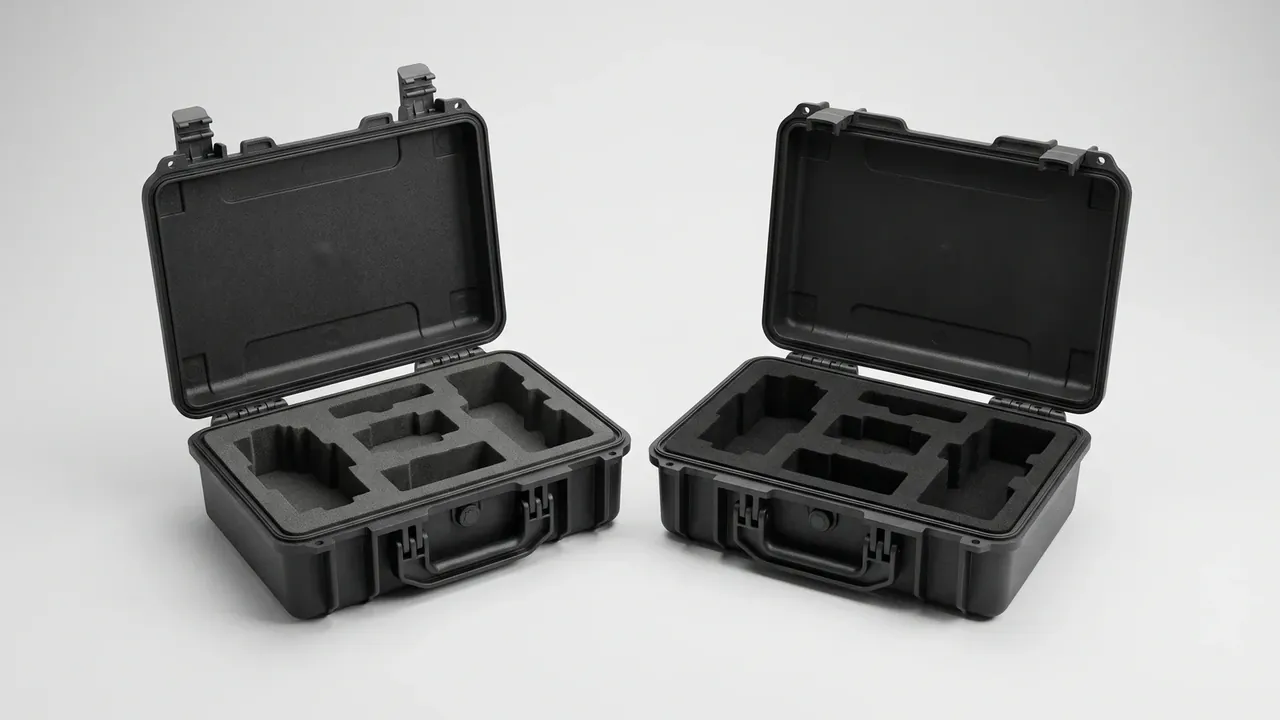
Quick answer: A custom foam insert protective case is specified from the inside out: measure the item, set the cavity, then add 3–5 mm of clearance per side, the foam layers and the wall. Clearance wrong and the insert will not go in; wall thin and the stack collapses.
Table of contents
- Sizing a Custom Foam Insert Protective Case from the Inside Out
- How Much Clearance the Insert Needs
- Layer Stackup, Density and Hardness
- Cutting Methods and Minimum Wall Between Cavities
- Case Wall, Outer Size and Stacking Load
- FAQ
1. Sizing a Custom Foam Insert Protective Case from the Inside Out
Enquiry sheets open with an external size of 600 × 400 × 230 mm because it is easy to measure. Build to it and the cavity shrinks to 520 × 330 × 180 mm, too small for the item.
Cavity figures belong at rim and base. Injection mouldings carry 1.5–2° of draft, so a 200 mm deep case is 3 mm narrower per side at the bottom; rotomoulded bodies lose 5 mm.
Only then does the layer split matter.
| Material | Density (kg/m³) | Hardness | Layer |
|---|---|---|---|
| PU convoluted foam | 20–30 | Very soft | Lid |
| EVA foam | 38–80 | Shore A 25–45 | Cut cavity |
| PE crosslinked foam | 35–60 | Shore C 40–60 | Base |
Two EVA sheets both marked 45 kg/m³ can feel a grade apart, so a custom foam insert protective case drawing needs density, hardness and thickness side by side.
2. How Much Clearance the Insert Needs
Clearance is the gap between insert and cavity wall, 3–5 mm per side, built from ±2 mm moulding variation and ±1 mm die cutting.
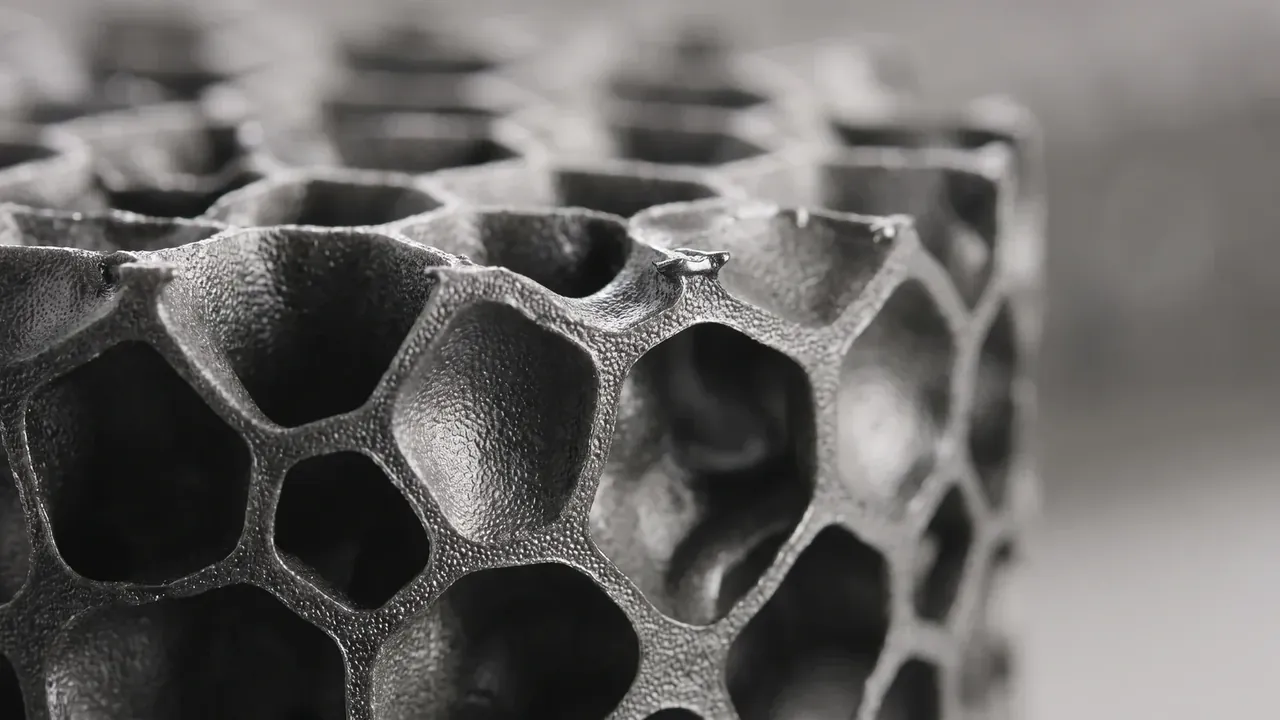
3 mm suits an injection-moulded PP body; 5 mm suits rotomoulded PE, whose 5–7 mm wall shrinks more freely.
Clearance handles wall fit, compression handles the item: 10–15% side interference holds the load still, and the lid foam adds 3–5 mm of preload.
3. Layer Stackup, Density and Hardness
A custom foam insert protective case usually carries 20 mm of PE base foam, an EVA cavity layer and 15 mm of PU foam in the lid; that 35 mm comes off cavity depth first.
Density follows unit weight: 38–45 kg/m³ below 3 kg, 50–60 up to 10 kg, 65–80 above. A 600 × 400 mm set moved from 45 to 70 gains 0.6 kg.
Shore A 25–45 for EVA and Shore C 40–60 for PE do not convert. EVA stiffens 8 Shore A at −20 °C and creeps above 60 °C, so cold-chain work wants 1 mm more per cavity side.
4. Cutting Methods and Minimum Wall Between Cavities
Die cutting suits 200+ pieces and cuts up to 80 mm deep at the lowest cost; CNC routing covers deep pockets; waterjet leaves no heat-affected edge.
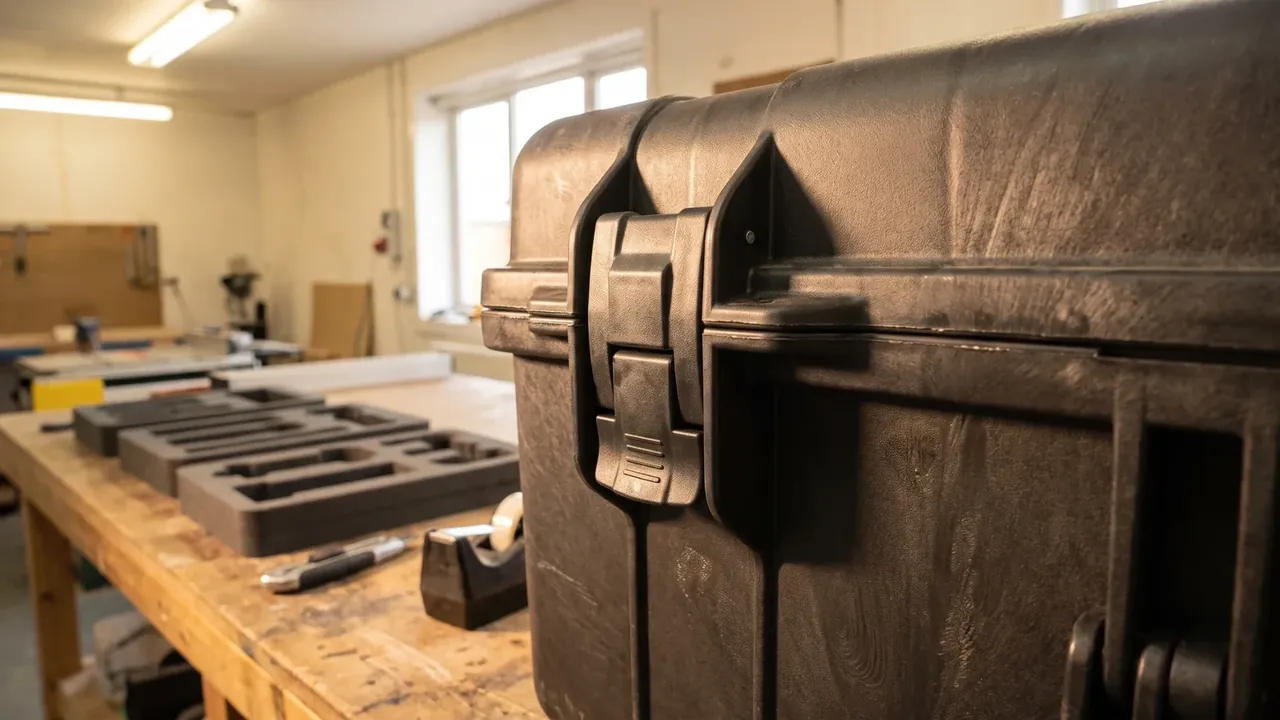
Minimum wall between cavities is most often left off the drawing: 8 mm under 2 kg, 10–12 mm normally, 15 mm above 10 kg.
Cavities run 2–3 mm shallow so the lid presses the top face, corners at R3–R5, with a finger notch between neighbours.
| Item weight | Base foam | Wall between cavities | Process |
|---|---|---|---|
| Under 2 kg | 15 mm | 8 mm | Die cutting |
| 2–10 kg | 20 mm | 10–12 mm | CNC routing |
| Over 10 kg | 25 mm | 15 mm | Routing or waterjet |
5. Case Wall, Outer Size and Stacking Load
Outer size chains from the cavity: plus foam, clearance, wall and latch protrusion. A 520 × 330 × 180 mm cavity with 10 mm foam, 3 mm clearance and a 3 mm wall makes 552 × 362 × 218 mm outside.
PP walls run 2.5–3.5 mm, 4.5 mm at rib roots; PE 5–7 mm with corners no tighter than R8. Each millimetre adds 0.35 kg on a 600 × 400 body.
Load is pressure on the base: 25 kg over two pads should compress under 2 mm, and 4 mm means the item has reached the shell.
Five cases high put about 100 kg on the bottom unit and sag its lid 2–3 mm; ribs or a pallet hold it. From 1.2 m onto six faces, three edges and a corner, a custom foam insert protective case needs 3 mm of residual compression.
Conclusion
The specification of a custom foam insert protective case is an addition chain from the inside out: cavity from the item, clearance from tolerance, layers from weight, wall from stacking load. Put those four numbers on one drawing and the custom foam insert protective case stays reproducible at reorder.
This article discusses only the container (case body) side of specifications and design intent, and does not cover any handling, loading or use of the contents.
Related Reading
- How to write foam insert specifications onto a drawing
- Die cutting, CNC routing and waterjet compared
- Locating and fixing an insert inside the case
- Choosing internal dividers and cavity layouts
Related Products
- 8 Series — Gun Cases; Military Equipment Cases; Camera Equipment Cases; Drone Cases; Watch Cases; Knife Cases; First Aid Cases; Electronics Equipment Cases
- WL8-2812 PP Gun Case — model WL8-2812
- All protective cases and toolboxes: 7 series, 158 models