

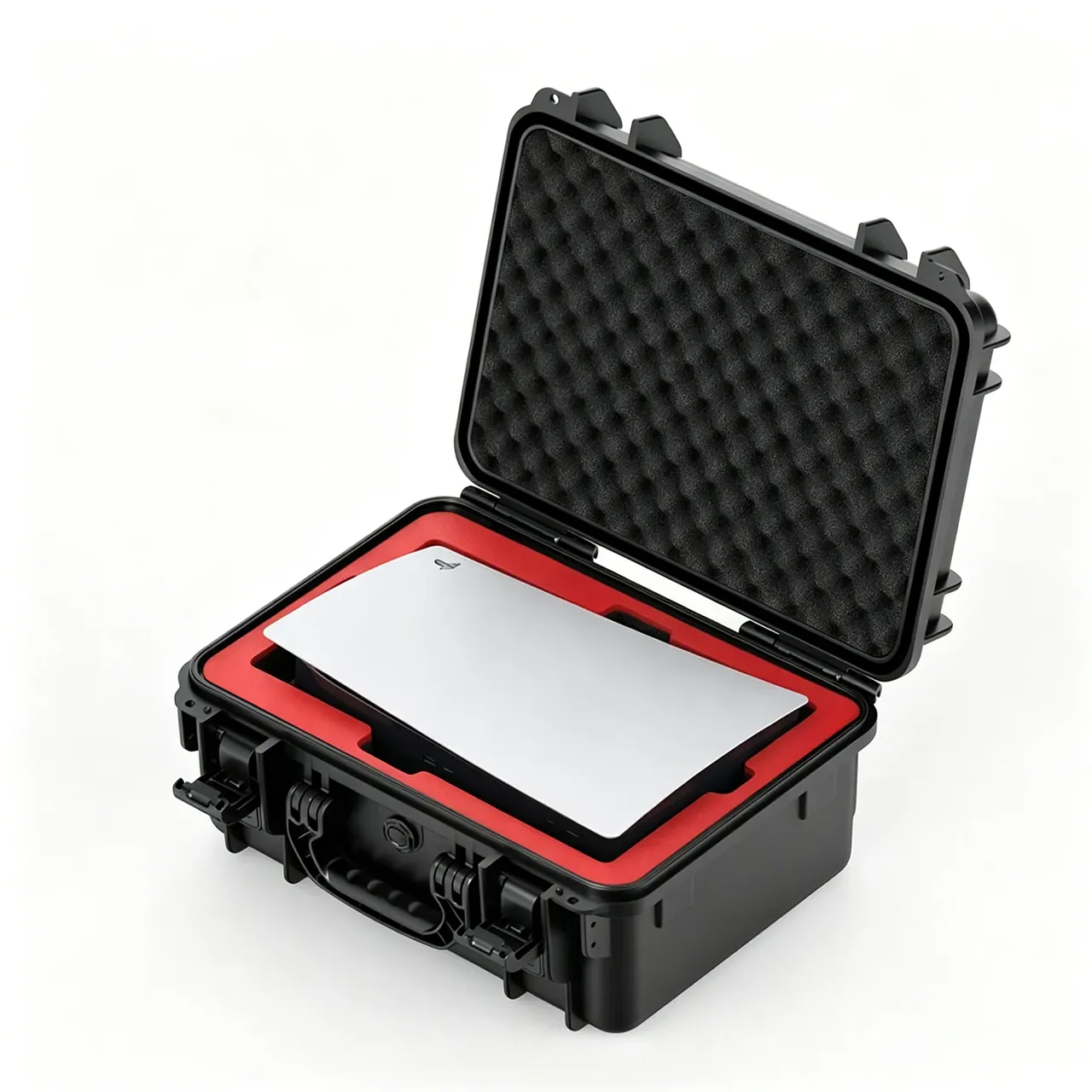
Quick answer:Custom Industrial Equipment Case Dimensions form a chain: 20–30 mm pickup clearance, foam in 15/25/40 mm and an outer size rounded up in 50 mm steps.
Table of contents
- How to Take the Envelope Points
- Allowance for Operation and Pickup
- Stacking Foam Thickness onto Cavity Clearance
- Wall Thickness to Outer Size
- Aligning the Outer Envelope with the Pallet Module
- FAQ
1. How to Take the Envelope Points
A custom case is not the device footprint plus five centimetres; it is a chain of allowances from the equipment to the outer shell. Get the first link wrong and every later one inherits the error.
Custom Industrial Equipment Case Dimensions begin with an envelope, not a body. The plan view takes the largest projection, terminal boxes, heat sinks and nameplates included; the front view the highest point, lifting eyes and handles included; the side view the widest point, flanges and ports included. Then a datum line names the face on the base and the face at the wall.
Permanent protrusions are separated from removable ones: handles, castors and guards come off, so each is flagged for a pocket or a cut-away.
| Layer | What is added | Value | Usual mistake |
|---|---|---|---|
| First | Device envelope | Extreme readings on three axes | Body only, handle and terminal box missed |
| Second | Pickup clearance | 20–30 mm | Passed as 5 mm per side |
| Third | Foam thickness | 15, 25 or 40 mm | Base counted, lid forgotten |
| Fourth | Wall thickness | 2.5–3.5 mm | Nominal wall, ribs ignored |
| Fifth | Outer round-up | Steps of 50 mm | Cavity not rechecked afterwards |
Read the table downward, adding one layer at a time.
2. Allowance for Operation and Pickup
A device in a case still needs a hand to reach it. Custom Industrial Equipment Case Dimensions reserve 20–30 mm here, measured from the device edge to the cavity wall rather than from a handle to the lid.
The lower bound comes from fingers: an adult index and middle finger closed together run about 20 mm, and below that the only way to lift a device is to pinch an edge. The upper bound comes from movement: past 30 mm the device has room to slide, and every turn of the truck becomes an impact.
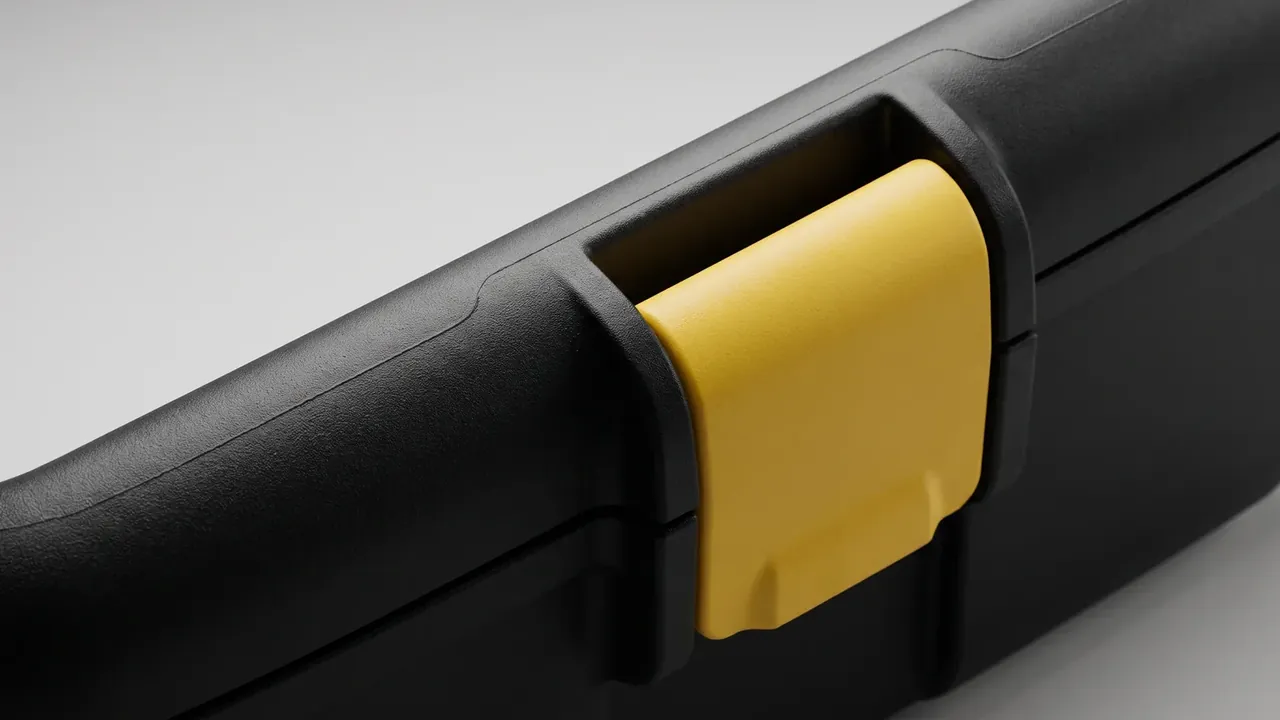
Pickup gaps follow the real grip points. A flat panel is gripped on its two narrow sides, so each side gets a 20–30 mm notch. An upright unit is gripped at a top handle, so the notch is cut in the lid at that position, never in the base.
Lid direction counts: a side-opening case cannot sit against a wall, and a top-opening case needs lid height plus 20–30 mm.
3. Stacking Foam Thickness onto Cavity Clearance
Foam is the layer Custom Industrial Equipment Case Dimensions drop most often. Foam comes in three steps of 15, 25 and 40 mm, chosen by mass and outline: 15 mm for light panels, 25 mm as the general step, 40 mm for devices with bosses or irregular profiles.
Cavity clearance and foam thickness are two separate accounts. A cut block keeps 1–2 mm per side between wall and device, which is assembly clearance; foam thickness is the material between cavity floor and case floor, and neither stands in for the other. Write 25 mm of foam without the clearance and the cavity either grips the device or lets it rattle.
At 25–45 kg/m³ a 25 mm EVA sheet holds a compression set within 5% at 25% compression, 23 °C, 24 h, so the device does not bottom out. Drop the density and the same thickness sags into a dish that never recovers.
Both faces count. Egg-crate foam in the lid takes the same steps, yet many drawings size the base only and give the lid the thinnest step, pinching the device at the top.
4. Wall Thickness to Outer Size
Once the cavity is fixed, the outer size is addition. Custom Industrial Equipment Case Dimensions count the wall at 2.5–3.5 mm, one skin each side, with ribs and corners added separately.
Wall thickness in Custom Industrial Equipment Case Dimensions is not a constant. A flat panel runs 2.5 mm while rib roots and latch seats thicken to 3.5 mm, and bosses counted as flat wall make the case foul its neighbour on the pallet. Mark rib height on the drawing instead of naming the wall alone.
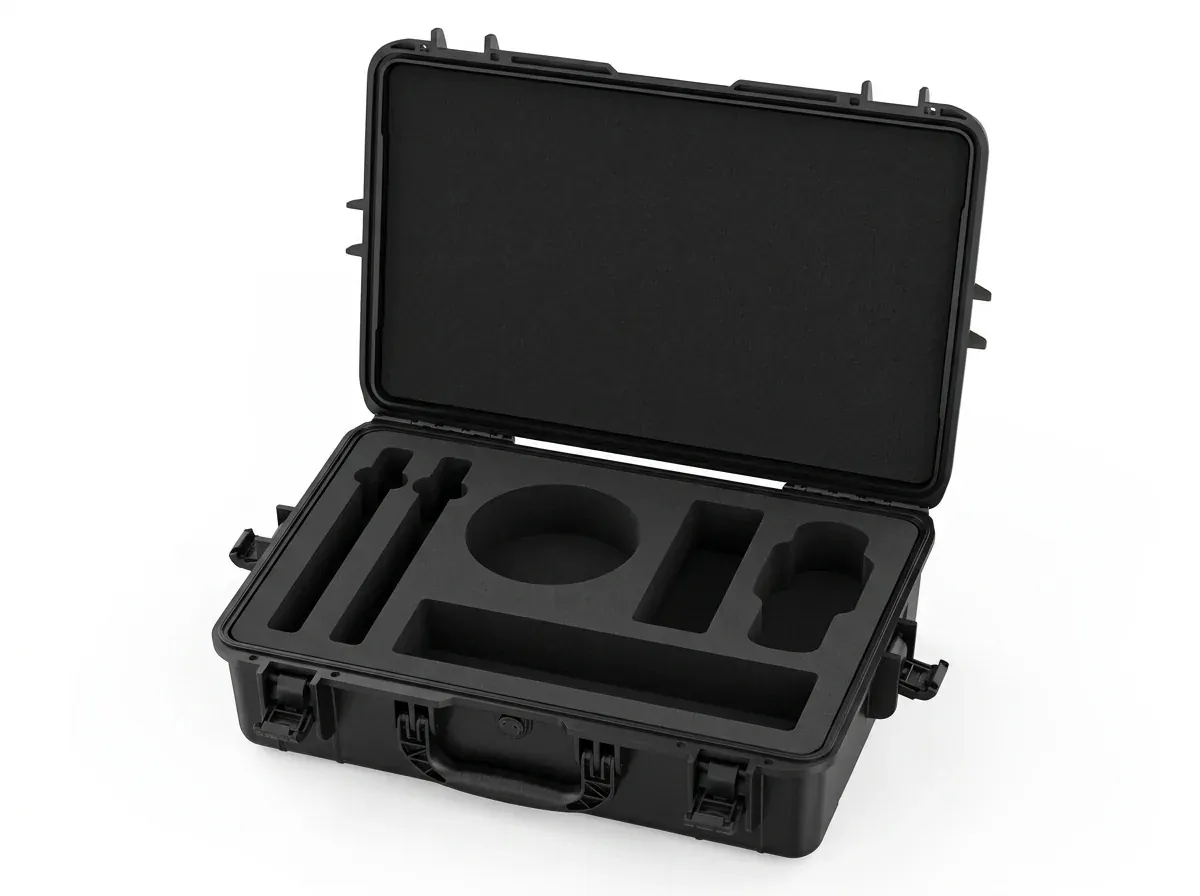
Rounding comes last. Every layer adds up to an odd figure, which is raised in steps of 50 mm, upward rather than to the nearest. After rounding the cavity is checked again: the outer size grew by tens of millimetres, the internal size did not, yet the pallet layout has changed.
One sentence holds the chain: cavity length plus two walls plus rib height plus round-up gives the outer length, with width and height following. Round before adding the wall and a second round-up appears.
5. Aligning the Outer Envelope with the Pallet Module
A finished case travels on a 1200×1000 mm pallet, so the 50 mm step decides the count per row and per layer.
Custom Industrial Equipment Case Dimensions are most often left half done here: each case is sized perfectly on its own, then leaves a strip of dead space on the pallet and pulls container utilisation below 82%. Pull the outer size onto the module, accept a little extra cavity allowance, and the strip closes.
| Outer size | Per layer | Spare | Layout |
|---|---|---|---|
| 600×500 mm | 4 | 0 | Two rows of two, full |
| 400×500 mm | 6 | 0 | Three rows of two |
| 300×250 mm | 16 | 0 | Many small units |
| 550×450 mm | 4 | 100 mm | Outer size to be revised |
Dimensional ruling: if a drawing check puts the single-side clearance between cavity and device under 2 mm or beyond 30 mm, the dimension chain was valued wrongly.
One reverse check closes the job. Add the envelope, both clearances, the foam and the two walls, and see whether the total returns to the outer size. If not, a middle layer was taken wrongly and Custom Industrial Equipment Case Dimensions are not signed off.
Related Reading
- What a custom case specification has to state
- Usable volume and the corners you lose
- MOQ and tooling amortisation for custom cases
- How custom case mould costs are built up
JUNZHIJIA
Related Products
- 8 Series — Gun Cases; Military Equipment Cases; Camera Equipment Cases; Drone Cases; Watch Cases; Knife Cases; First Aid Cases; Electronics Equipment Cases
- WL8-2812 PP Gun Case — model WL8-2812
- All protective cases and toolboxes: 7 series, 158 models