

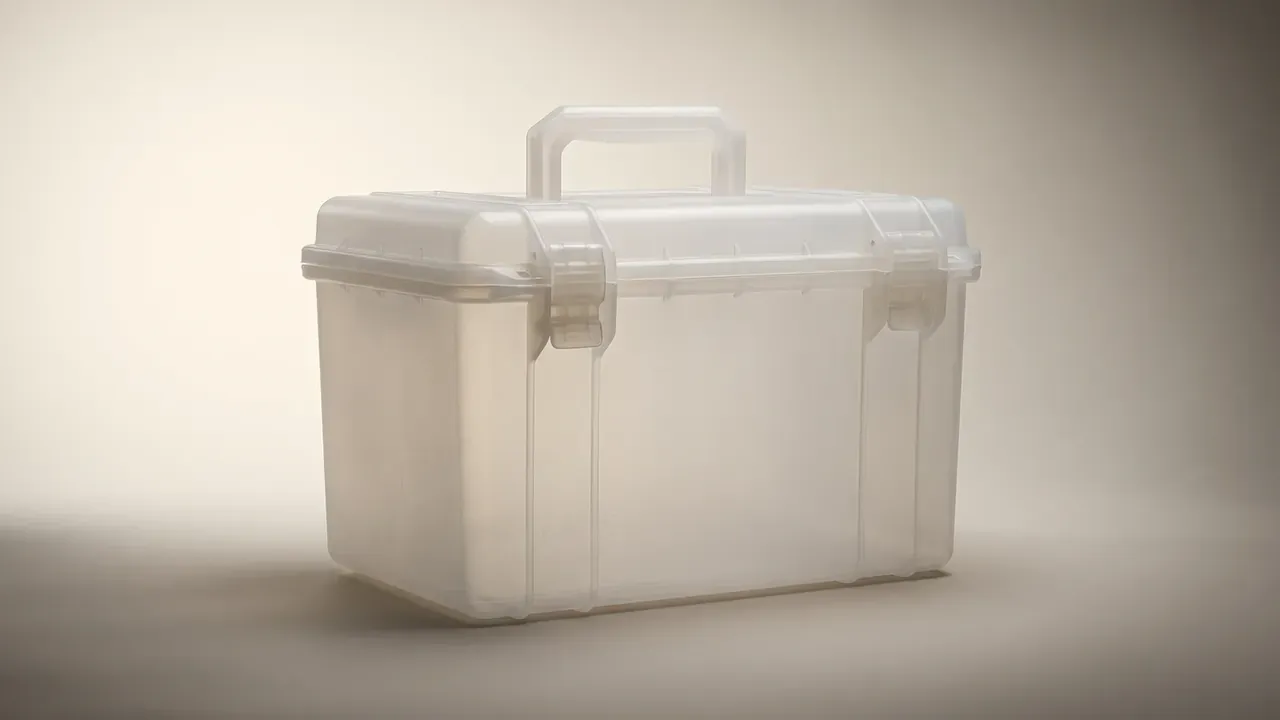
Quick answer: A custom size plastic case should not be specified from the outside in. Set the usable cavity first, then wall thickness, then the envelope, and finish with the stacking allowance, each step with its own tolerance.
Table of contents
- Why Quoting the Outer Size First Guarantees Rework
- What the Internal Cavity Loses: Four Allowances
- Three Wall Thickness Bands and Their Size Ranges
- Converting to Outer Size and the Stacking Allowance
- FAQ
1. Why Quoting the Outer Size First Guarantees Rework
The first line on most enquiry sheets is the outer dimension, because the pallet and shelf were fixed first. On a custom size plastic case that order turns against the buyer: once the envelope is frozen, wall and ribs can only move inwards, and 8 to 12 mm of cavity disappears.
| Starting point | Sample rounds | Parts reworked | Rework cost (RMB) | Time to production |
|---|---|---|---|---|
| Outer size first | 3 | Lid depth and wall | 6000 | 52 days |
| Cavity first | 1 | None | 0 | 34 days |
The outline is an outcome, not an input.
The cavity is the input. Measure what fits, add handling clearance, pick the wall band, then let wall, ribs and fit set the envelope: half a day on paper, five weeks at the tool if reversed.
A drawing that marks the cavity as reference hands the decision to the toolmaker, who optimises for the mould, not the load.
2. What the Internal Cavity Loses: Four Allowances
Nominal cavity and usable space on a custom size plastic case differ by four allowances. Take 420 × 300 × 160 mm: the figure means clear space, not mould steel.
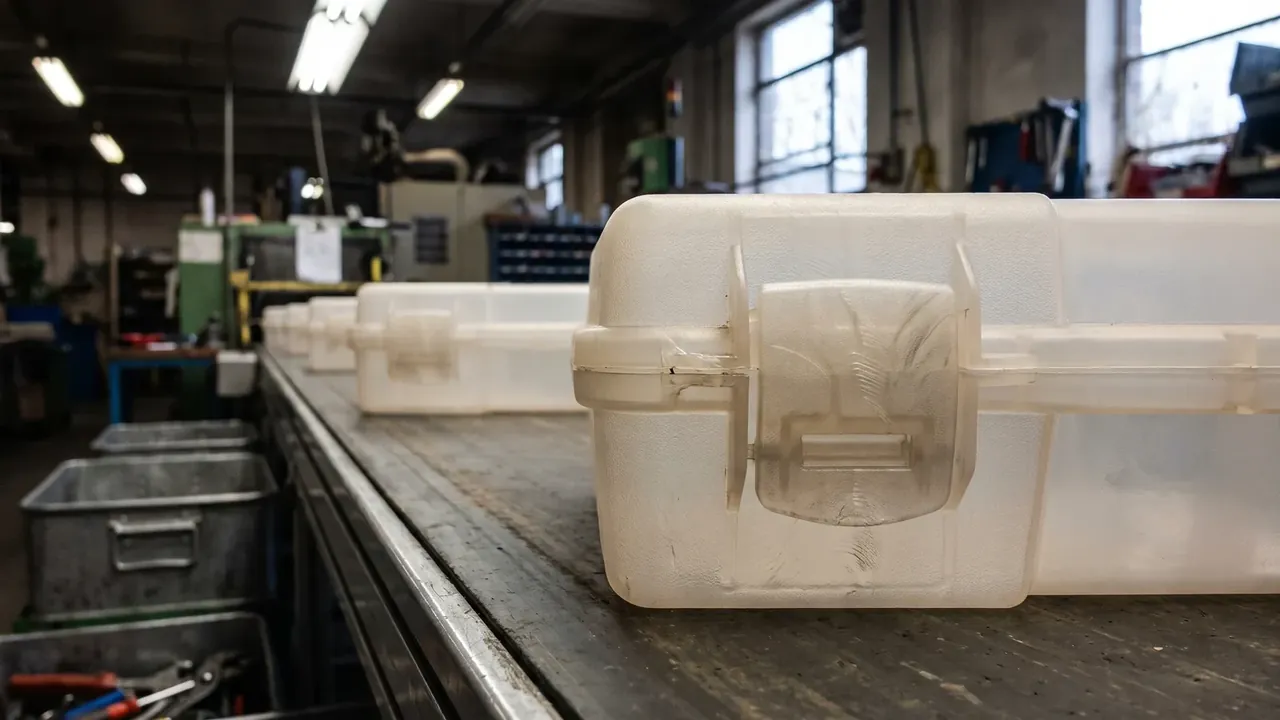
The four items:
- Ribs: vertical stiffeners stand 5 mm proud, so height beside a rib is lost
- Draft: 1.0 degree removes 2.8 mm per side over 160 mm of depth
- Lid depth: the dish is 18 mm deep, so height runs from the lid's inner face
- Corners: an R8 radius takes a block from each corner, so width is quoted at the tightest line
Together they turn 420 × 300 × 160 mm into about 410 × 292 × 150 mm, and those 10 mm are the thickness of an instrument shell.
So the cavity is written as minimum usable clear space, with the measuring position in brackets: length and width 20 mm above the base.
3. Three Wall Thickness Bands and Their Size Ranges
Wall thickness follows cavity length, not the load figure on the enquiry sheet. Deflection grows with the cube of the span, so a rib beats a thicker wall.
| Cavity length | Main wall | Base wall | Rib height | Case weight | Top load |
|---|---|---|---|---|---|
| Under 280 mm | 2.3 mm | 2.8 mm | 4 mm | 0.9 kg | 25 kg |
| 280 to 560 mm | 2.8 mm | 3.4 mm | 6 mm | 1.8 kg | 45 kg |
| 560 to 900 mm | 3.6 mm | 4.2 mm | 9 mm | 3.4 kg | 70 kg |
The band edges are not arbitrary. Moving the main wall from 2.8 to 3.6 mm adds 30% weight for 40% more bending stiffness. The same material in a 6 mm rib more than doubles stiffness, which is why large bodies are ribbed and small ones thickened. Thick-to-thin ratio has a ceiling too: 7 mm against 2.8 mm passes 2.5 to 1, and the thick zone is still shrinking when the thin one has set. Shrinkage is compensated at 1.6%, higher along the flow, then corrected from the first article. On trial, measure cavity centre, near the gate and away from it. A spread above 0.5 mm means uneven cooling.
Cross a band and the case changes in the hand before it changes on the scale.
4. Converting to Outer Size and the Stacking Allowance
The envelope of a custom size plastic case is calculated from the cavity plus wall, rib and fit allowance on both sides. A 420 mm cavity with a 2.8 mm wall, a 6 mm rib and 1.4 mm of fit gives 440 mm.
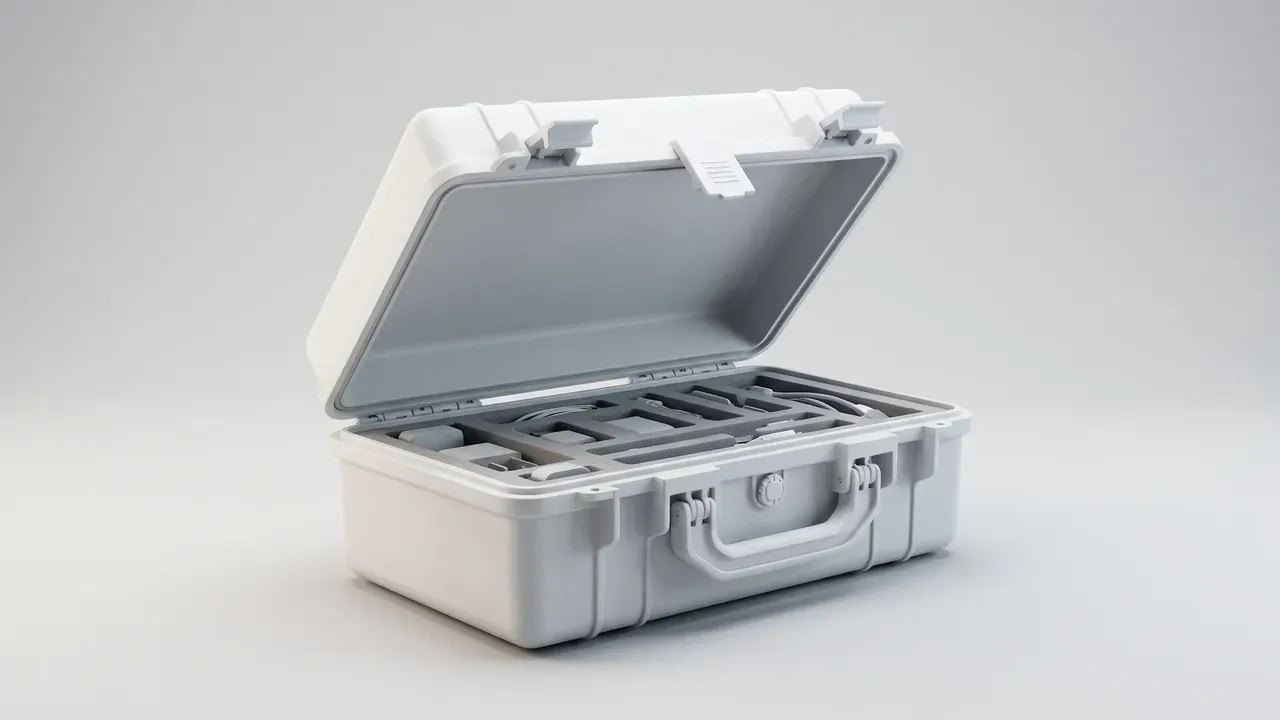
The stacking allowance is the last step on a custom size plastic case, and the first to be cut. Four tiers at 9 mm give 27 mm, absorbing ±0.8 mm on the cavity, ±0.12 mm on the wall and ±1.2 mm on the envelope.
| Tiers stacked | Allowance per tier | Total allowance | Top load required |
|---|---|---|---|
| 2 | 4 mm | 4 mm | 34 kg |
| 3 | 6 mm | 12 mm | 52 kg |
| 4 | 9 mm | 27 mm | 70 kg |
Without it the lid sags first. A 2 mm sag halves latch engagement, and by the third tier the stack slides sideways.
Conclusion
A custom size plastic case runs along a one-way chain: the cavity sets usable space, wall thickness sets span, the envelope sums them, and the stacking allowance absorbs the tolerances between. Run in order and one sample round converges; run backwards and two mould changes may still not fit. Every revision of a custom size plastic case deserves that chain on page one.
This article discusses only the container (case body) side of specifications and design intent, and does not cover any handling, loading or use of the contents.
Related Reading
- How case size bands are divided
- Cushioning and wall thickness in shockproof cases
- Cavity and panel allowance in instrument cases
Related Products
- 8 Series — Gun Cases; Military Equipment Cases; Camera Equipment Cases; Drone Cases; Watch Cases; Knife Cases; First Aid Cases; Electronics Equipment Cases
- WL8-2812 PP Gun Case — model WL8-2812
- All protective cases and toolboxes: 7 series, 158 models