

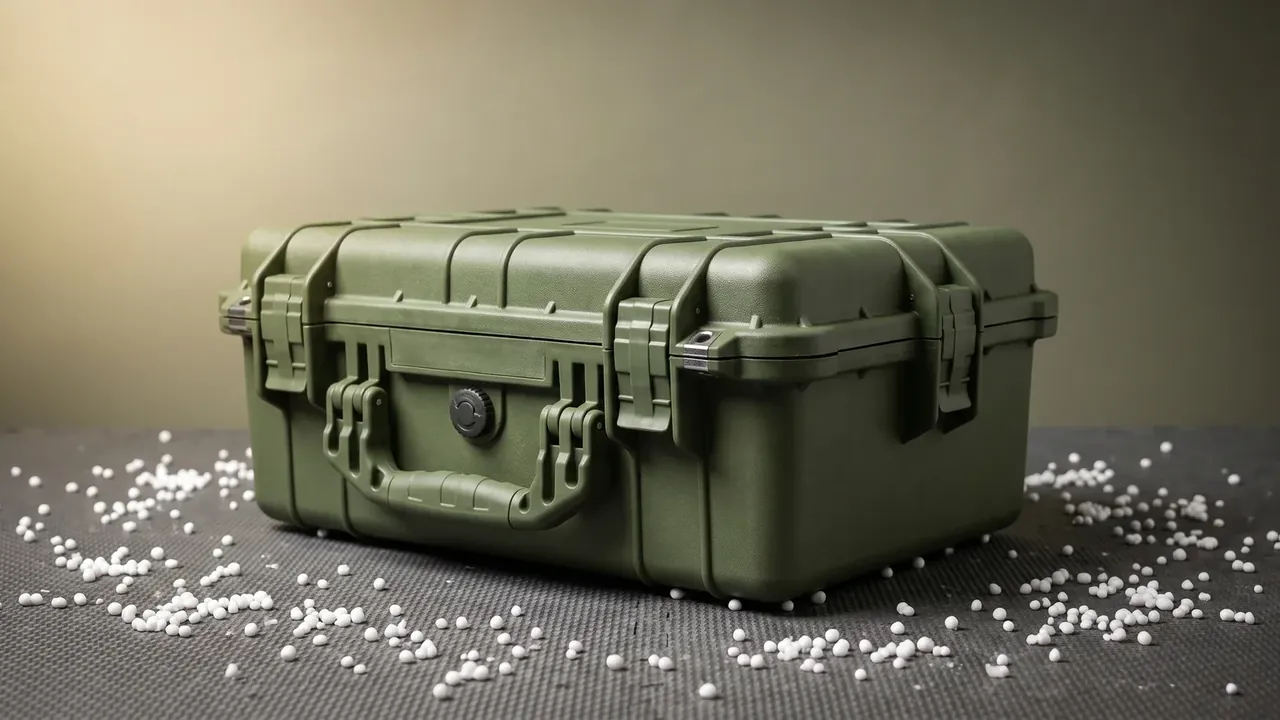
Quick answer: A shockproof case is specified not by the word rugged but by three numbers: drop height, impact points, and the cushioning travel between load and wall. Fix those, and wall thickness, ribs and foam density follow.
Table of contents
- Shockproof case specifications: three numbers
- Drop height: from where, and how many times
- Liner: density, thickness and compression
- Clearance: how much between load and wall
- Writing the three numbers into an RFQ
- FAQ
1. Shockproof case specifications: three numbers
A shockproof case is an energy converter. A 12 kg case dropped from 1.2 m lands at 4.85 m/s with 141 J, absorbed within a few dozen millimetres. Acceleration is velocity squared over twice the travel: 25 mm gives about 48 g, 50 mm gives 24 g.
The numbers pull against each other: 1 mm more wall costs 2 mm of cavity. Work back from the load, never the outside.
| Parameter | Sets | Typical value | Decided by |
|---|---|---|---|
| Drop height | Input energy | 0.6–1.2 m by weight | Transport mode |
| Cushioning travel | Acceleration peak | 25–50 mm per side | Cavity and liner |
| Liner density | Absorption | 45–80 kg/m³ | Load weight |
The shell owes three things: no through-cracks, no popped latches, no direct impact path. A 3.0–3.4 mm polyethylene wall is enough once radii and ribs spread the load.
2. Drop height: from where, and how many times
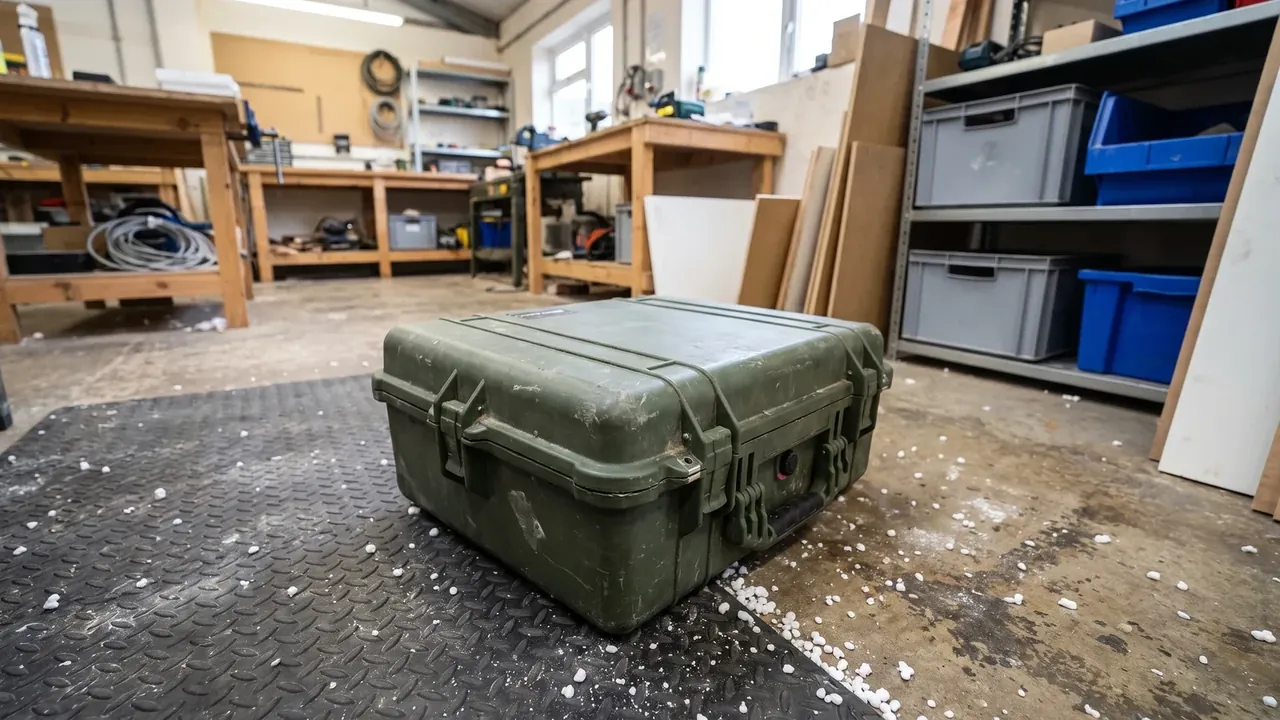
Height is banded by gross weight: 1.2 m below 9 kg, 1.0 m to 18 kg, 0.8 m to 27 kg, 0.6 m above that.
The corner is worst, since energy concentrates on a small area; the bottom edge is neglected, yet it loads the latches hardest. Drop each point three times: foam crushes a third of the way on the first hit and bottoms out on the second. Condition at minus 10 °C before repeating, because polyethylene turns brittle.
| Gross weight | Drop height | Points | Main criterion |
|---|---|---|---|
| Under 9 kg | 1.2 m | Corner, three edges, six faces | Corner cracks |
| 9–18 kg | 1.0 m | Corner, three edges, six faces | Joint gap, gasket |
| 18–27 kg | 0.8 m | Corner, three edges, base | Base set, liner |
| Over 27 kg | 0.6 m | Corners and bottom edges | Handle roots |
Pass criteria: no through-crack, latches engaged, gasket seated, liner compressed under ten percent. Miss one and the height stays off the datasheet.
3. Liner: density, thickness and compression
EVA at 60–80 kg/m³ rebounds slowly and suits heavy loads; EPE at 25–35 is cheap and takes a set after one hit; PU at 35–55 rebounds fast. Higher density absorbs more but passes more acceleration to the load, the commonest misjudgement.
Thickness is travel: 25 mm on the sides, 30 mm above and below, 40 mm sideways past 15 kg. Below 20 mm, foam is crushed in a 1.2 m drop. Cut pockets 3–5 mm shallower than the part and hold plus or minus 1 mm.
4. Clearance: how much between load and wall
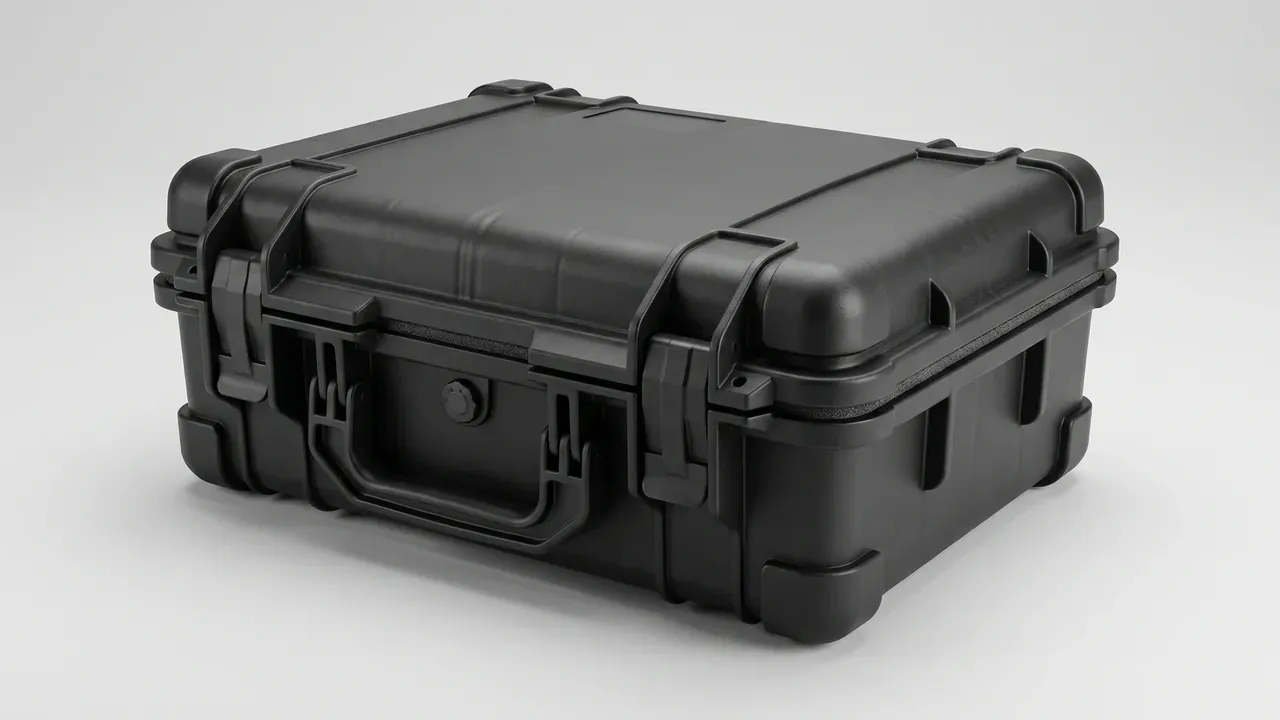
Clearance is two gaps added: load to liner, liner to wall. Start at 25 mm per side and 30 mm at the top; too little and foam bottoms against the wall before compressing halfway.
Too much fails as well: a cavity 60 mm wider lets the load shift, and the second impact lands where no foam sits. Cavity length is load plus twice liner plus twice gap, so a 400 mm part needs 464 mm. An off-centre load turns in the air, and the face without ribs lands first.
5. Writing the three numbers into an RFQ
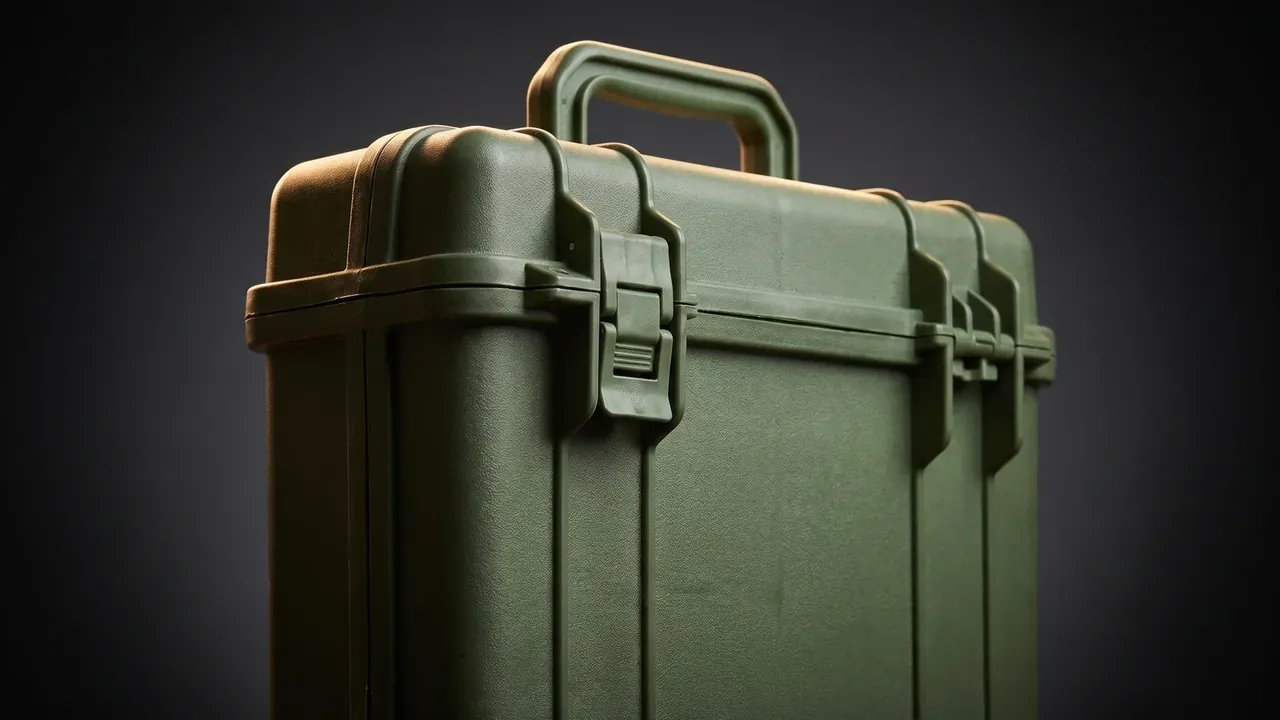
An RFQ that says shockproof and extra thick leaves the supplier guessing. Pin five fields: weight and outside dimensions, internal cavity, drop height and impact points, test standard, liner material with density.
Add acceptance and cold conditioning, plus the residual liner thickness after compression, or two suppliers cannot be compared on one specification.
Conclusion
Shockproof case specifications come down to one line: weight buys height, travel buys acceleration, clearance buys stability. Put all three on the RFQ.
This article covers container-side specifications and design implications only, not the handling, loading or use of the contents.
Related Reading
- How a shockproof case absorbs impact
- Foam liner types for cases
- Comparing foam materials for cases
- Drop and vibration clauses in MIL-STD-810H
Related Products
- 8 Series — Gun Cases; Military Equipment Cases; Camera Equipment Cases; Drone Cases; Watch Cases; Knife Cases; First Aid Cases; Electronics Equipment Cases
- WL8-2812 PP Gun Case — model WL8-2812
- All protective cases and toolboxes: 7 series, 158 models