

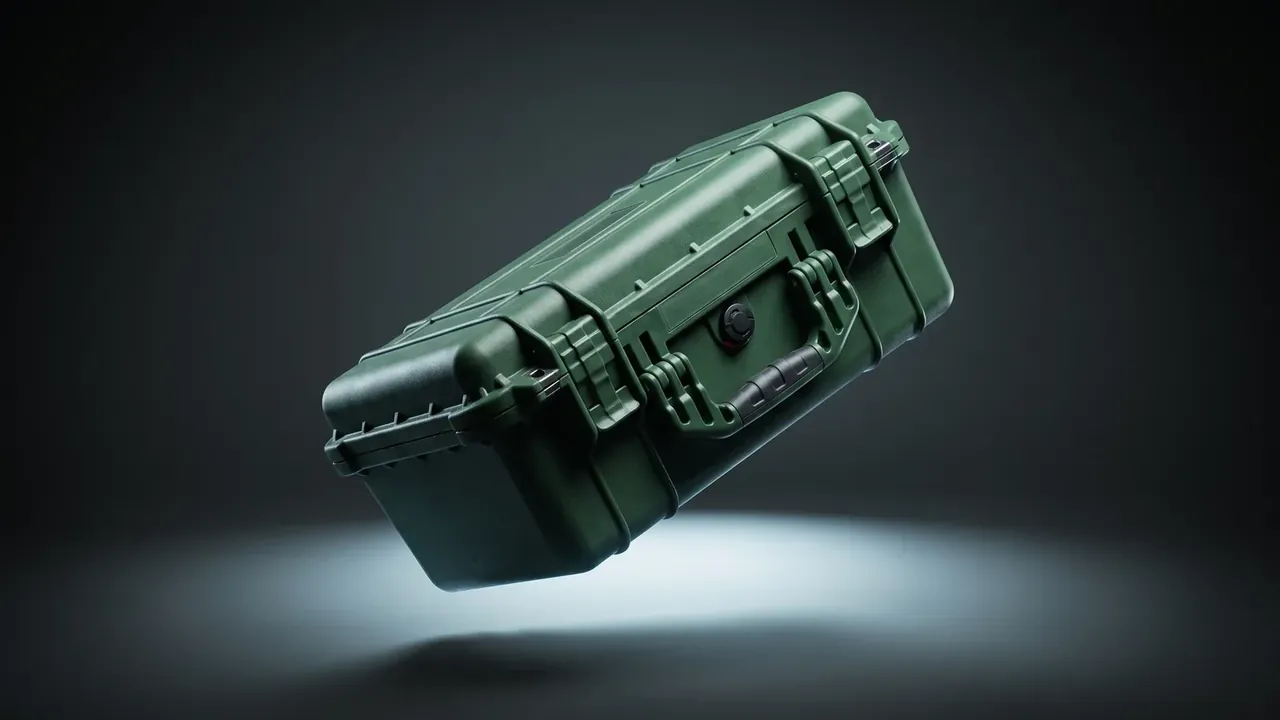
Quick answer: Size a Customized plastic transport case from three weights, not from a cavity drawing: 52.8 kg per unit, 158 kg from the stack above and 1.0 kN once road transport at 2 g applies. They land on the handle, base and latches, putting the wall at 5.5 to 6 mm.
Table of contents
- Load First: Three Weights Behind the Drawing
- Cavity Clearance From the Equipment
- Wall Thickness from Deflection and Creep
- Structure Buys the Wall Back
- Test Conditions That Make a Rating Stick
- FAQ
1. Load First: Three Weights Behind the Drawing
Most enquiry sheets open with cavity dimensions; the first line should be weight. Wall thickness, rib pitch, feet and latch rating on a Customized plastic transport case derive from three numbers: unit gross weight, the stack above, and transport acceleration.
A 42 kg pump with an 8.2 kg shell and 2.6 kg of foam gives 52.8 kg. Four-high storage puts 158 kg on the bottom unit, road transport at 2 g adds 1.0 kN, and rail marshalling at 4 g doubles the latch requirement.
| Load source | Value | What it sizes |
|---|---|---|
| Unit gross weight | 52.8 kg | Handle and hinges at 2× |
| Stack above | 158 kg | Base and side walls |
| Road inertia | 1.0 kN | Latches and hinge pin |
2. Cavity Clearance From the Equipment
Cavity size is built face by face. Equipment at 520 × 380 × 240 mm with 25 mm at each side and 30 mm above and below gives 570 × 430 × 300 mm. An 18 mm connector adds 40 mm of length on its own.
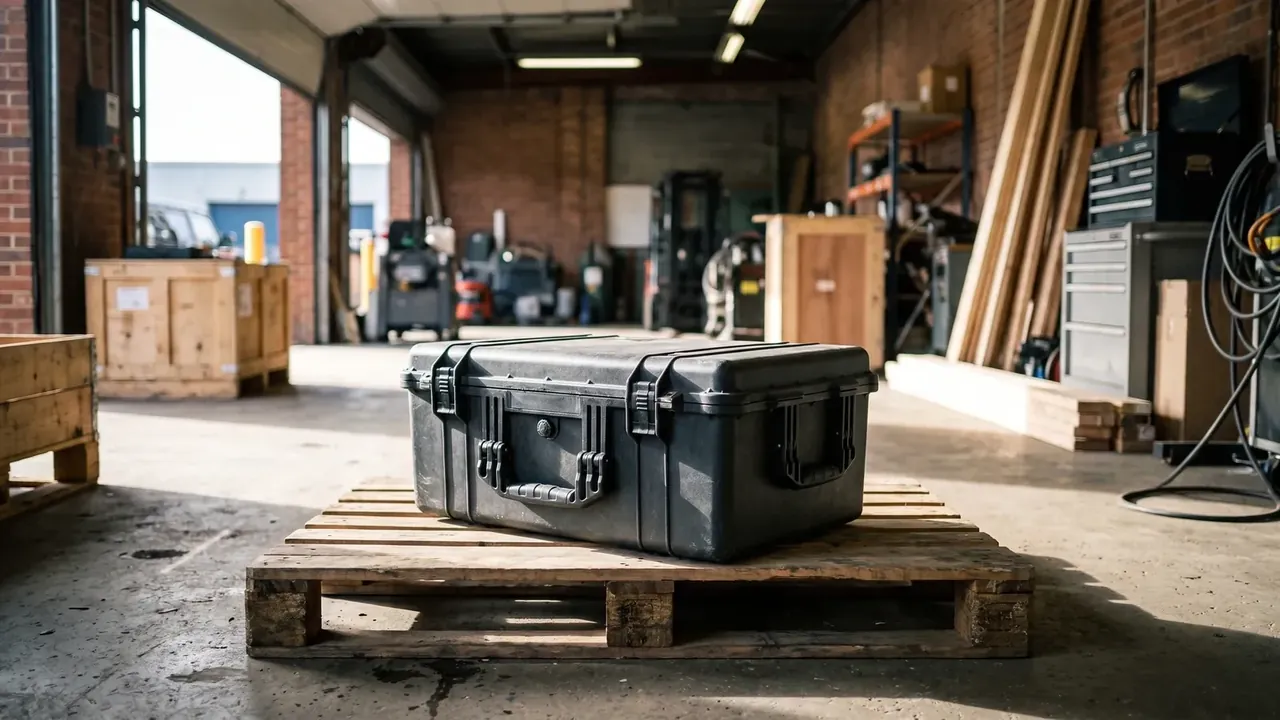
Finger clearance adds 25 to 30 mm, and above 200 mm of depth a webbing tab, or a loaded unit only tips out. Draft eats more: one degree per side closes 1.7 mm per 100 mm, so a 300 mm cavity is 5 mm narrower at the base than the rim.
Shrinkage adds 9 to 12 mm to a 600 mm cavity at 1.5 to 2.0 percent, so the tool is cut oversize. Foam dies cut R8 at best, so the cavity needs R15, or a 3 to 5 mm gap appears.
3. Wall Thickness from Deflection and Creep
Wall thickness is not picked from a ladder; deflection sets it. On a 400 mm span a 4 mm PP base sags 2.8 mm under 158 kg in 24 hours, and 5.5 mm brings that to 0.9 mm. Deflection runs with the cube of thickness, so one stack level moves the spec a step.
Creep makes short readings useless: at 23 °C PP reaches 2.2 times its initial deflection after 1000 hours.
| Cavity length | Gross | Main wall | Rib pitch | Stack |
|---|---|---|---|---|
| up to 400 mm | up to 80 kg | 3.0 to 3.5 mm | 90 mm | 3 high |
| 400 to 600 | 80 to 150 kg | 4.0 to 5.0 mm | 100 mm | 3 to 4 |
| 600 to 800 | 150 to 250 kg | 5.5 to 6.5 mm | 110 mm | 4 |
| 800 to 1000 | 250 to 400 kg | 6.5 to 8.0 mm plus posts | 120 mm | 4 to 5 |
Material shifts the table: ABS needs 0.8 times the PP wall, HDPE 1.25, rotomoulded PE 1.4. At 900 mm and four high, injection PP takes 8 mm with posts against 11 mm of rotomoulded PE. At −20 °C PP keeps 45 percent impact strength.
4. Structure Buys the Wall Back
Adding wall costs weight and cooling time together, so the real move is trading structure for thickness.
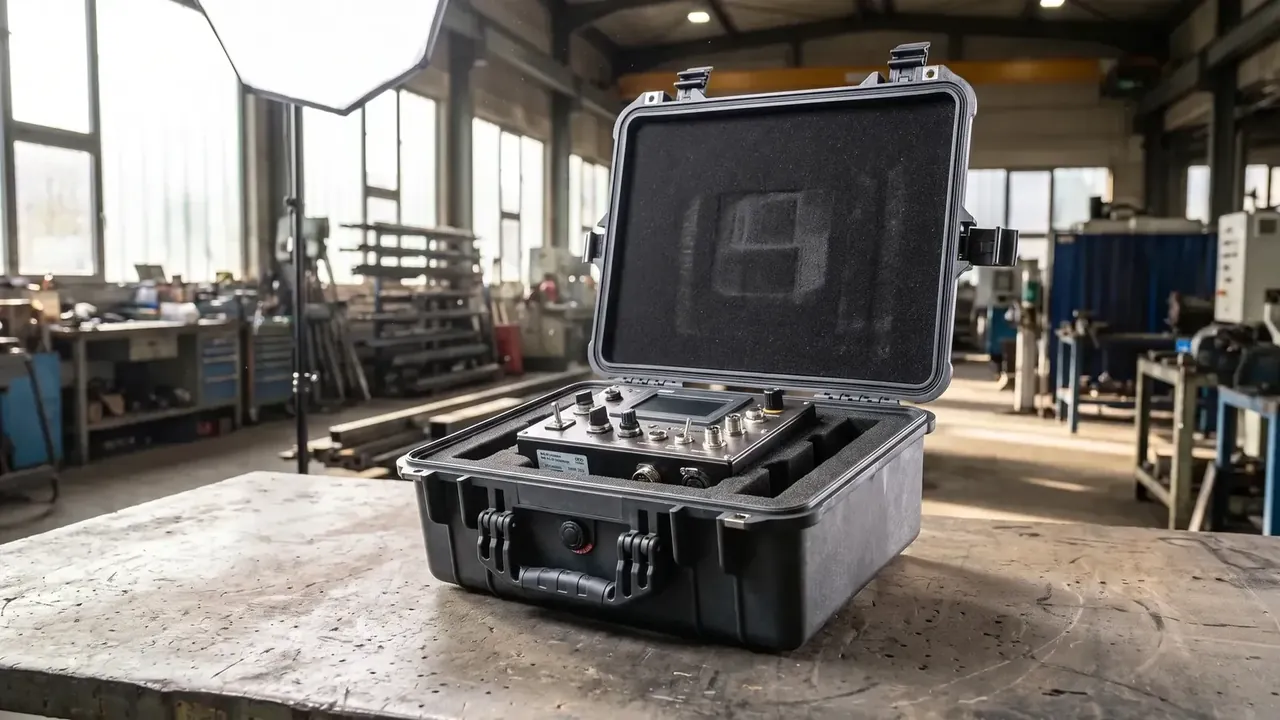
- Ribs: no taller than 3× the wall, 0.6× thick, 90 to 120 mm pitch, R2 at intersections
- Corners: R8 outside, R12 inside, 20 percent extra wall
- Hinges: 5 mm 304 pin, 6 mm boss, under 0.2 mm growth after 3000 cycles
- Latches: 3.0 mm tongue at 1.0 kN; shaving it to 2.4 mm costs 30 percent
- Feet: 15 mm high, load posts on the corners
Ribs have a ceiling: above 3× wall height the root cools slowly and the face sinks. A 60 mm wall with 2 mm ribs matches the section modulus of a 4.5 mm flat panel for 18 percent more weight.
Corners take the first hit. Going from 5 to 6 mm at the four corners pulls cracking in a 1 m drop from 30 percent to under 10, while the same millimetre across the shell adds 1.9 kg.
5. Test Conditions That Make a Rating Stick
A drawing that says 200 kg says nothing. Stack at 1.5× the weight above, hold 24 hours, allow 3 mm of height change, and require 2 mm of recovery an hour after unloading.
Drop testing runs corner, edge, face at 0.8 m, one set at room temperature and one at −18 °C, struck within 30 seconds of a four-hour soak. Vibration runs three axes at 30 minutes with no latch release and under 1 mm change in cavity diagonal, since 1 mm of growth is 1 mm of cushion travel lost.
Tolerances close the loop: cavity ±1.5 mm, wall ±0.3 mm, weight ±3 percent, flatness 1.5 mm per metre. Relax the wall tolerance and the 5.5 mm figure is void.
Conclusion
Sizing a Customized plastic transport case is a one-way chain: three weights set the load, the load sets wall and stack height, structure trades for thickness, tolerances lock it. Follow that order and the Customized plastic transport case lands on a 5.5 to 6 mm wall.
This article discusses only the container (case body) side of specifications and design intent, and does not cover any handling, loading or use of the contents.
Related Reading
- Choosing an air transport protective case
- Structure of ADR and IMDG hazmat cases
- Certification items for ammunition boxes
Related Products
- 8 Series — Gun Cases; Military Equipment Cases; Camera Equipment Cases; Drone Cases; Watch Cases; Knife Cases; First Aid Cases; Electronics Equipment Cases
- WL8-2812 PP Gun Case — model WL8-2812
- All protective cases and toolboxes: 7 series, 158 models