

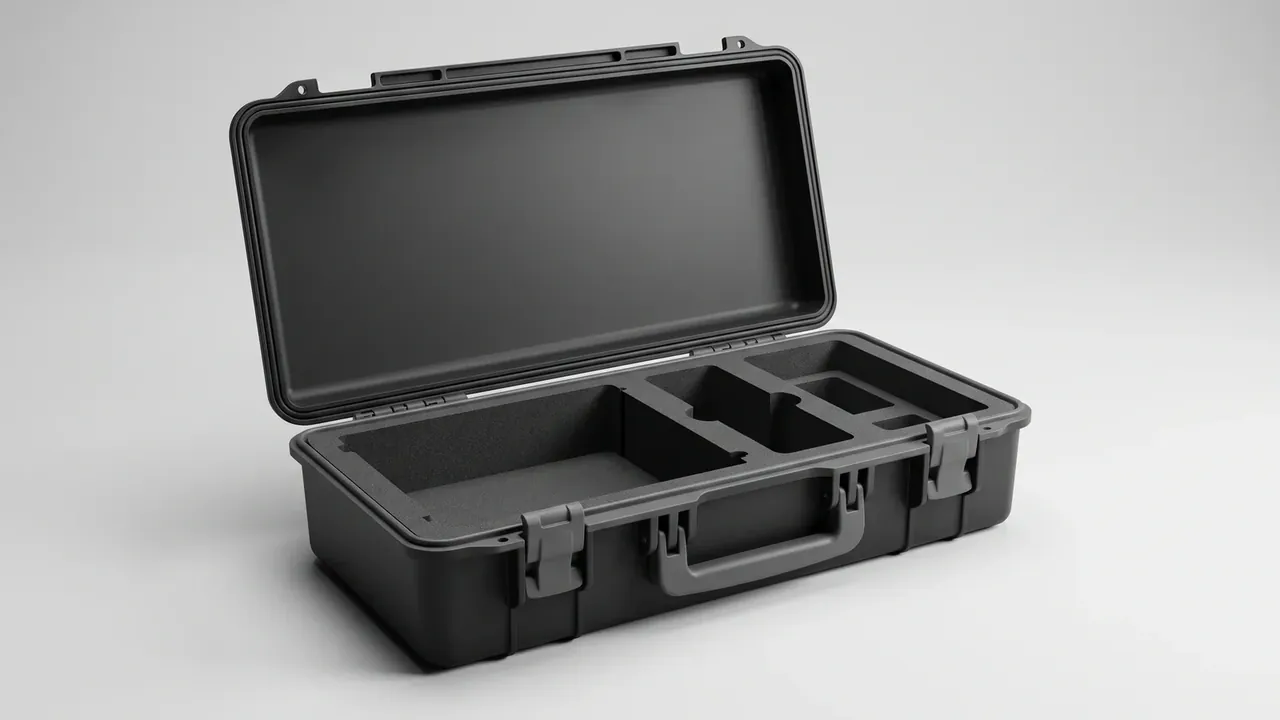
Quick answer: A deck equipment case is signed off at 500 h of salt spray, but hinge pins, springs and four lashing points decide whether it closes after three years.
Table of contents
- What 500 Hours of Salt Spray Tests
- Hardware Grade and Plating: 304, 316 and Zinc
- Lashing Points and Lifting Lugs
- Deck Vibration, Stacking and Base Friction
- Drain Holes, Condensation and Layup
- FAQ
1. What 500 Hours of Salt Spray Tests
Neutral salt spray runs to ISO 9227: 5% sodium chloride, pH 6.5 to 7.2, 35 °C, deposition 1 to 2 mL per 80 cm² per hour. Five hundred hours is the usual export line: no red rust on metal parts, white rust allowed.
That line never grades a whole deck equipment case. PP and ABS do not rust; at 500 h they lose 10% to 15% of gloss and under 3% of strength. What fails is the latch spring, hinge pin, handle pivot and nameplate rivets, under 2% of the volume.
Glass-filled grades add a path: fibre ends wick moisture, and a 0.2 mm bloom appears at a rib root, invisible until the next drop.
Hours to sea: 24 h of spray is about one temperate marine year, halved on a tropical deck, so 500 h is 6 to 8 years temperate and 3 to 4 low-latitude.
2. Hardware Grade and Plating: 304, 316 and Zinc
Grade comes first. 304 has no molybdenum, 316 has 2% to 3%, and those points lift pitting potential: 304 pits at 300 to 400 h where 316 reaches 720 h clean.
Plating is the second route: zinc at 8 μm covers 96 to 120 h, nickel at 15 μm reaches 240 h, zinc flake twice that. Cost separates them, 316 running 40% to 60% above 304 and triple a plated part.
Opening frequency sets the choice. Under 20 cycles a year, a 316 hinge pin and a nickel-plated 304 spring are enough on a deck equipment case. Daily use needs 316 in the spring, where a small section fails by fracture.
Two details remain. 316 threads gall, so use molybdenum disulphide paste. Stainless against PP makes no galvanic couple, but the gap under a rivet head traps salt; a ring of sealant shuts it.
3. Lashing Points and Lifting Lugs
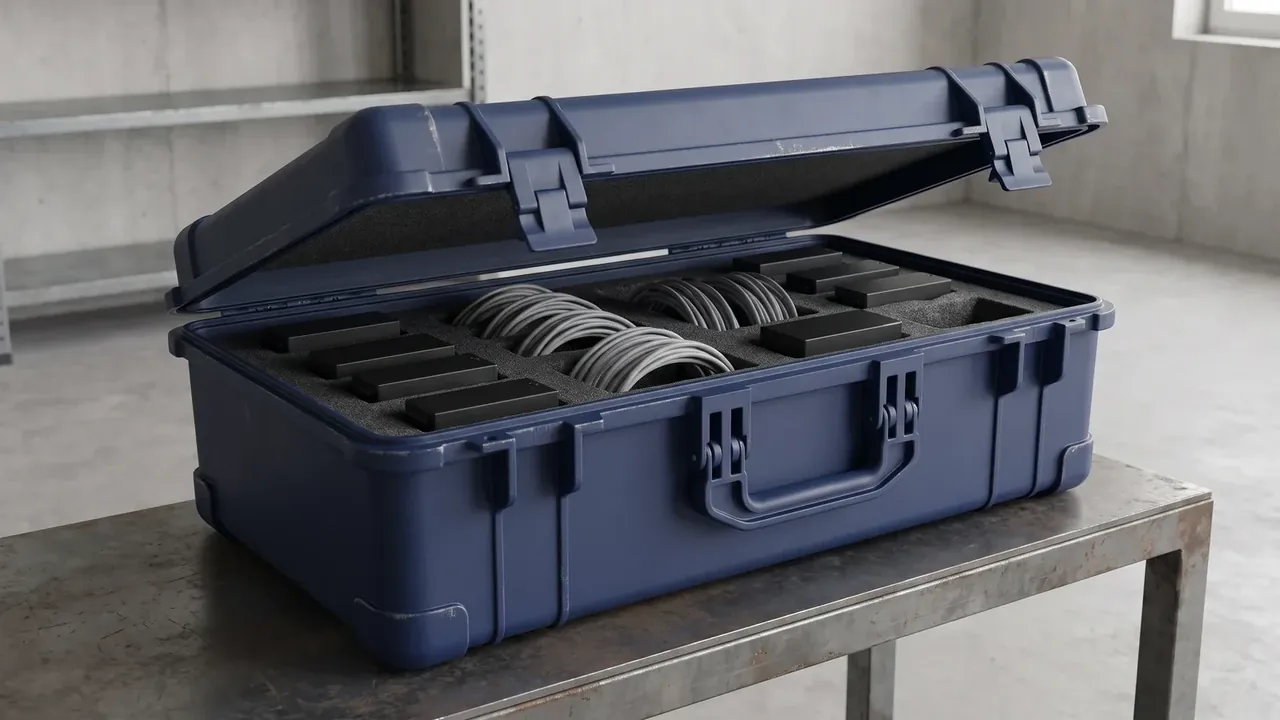
Lashing follows acceleration, not weight. Roll gives 0.5 g lateral and 1.0 g vertical, so a 45 kg deck equipment case on four points carries 165 N each, making a 2 t D-ring look oversized a hundredfold.
The margin is deliberate. Straps are tensioned by hand with ±40% scatter and knots add concentration, so values are derated by 2.5. Centres sit at least 60% of box length apart and 120 mm above the base, or the case pivots on its lower edge instead of sliding.
Lugs follow sling angle. Four lugs at 45° from vertical see 0.354 of total weight each; at 30° the factor is 0.577, up 63%, so ratings are declared at 30°.
| Fitting | Nominal | Breaking | Working per point | Used for |
|---|---|---|---|---|
| D-ring | 2 t | 10 t | 0.8 t | Four corners |
| Webbing 25 mm | none | 5 t | 0.4 t | Cross lashing |
| Lifting lug | 1.25 t | 5 t | 0.5 t | Vertical lift |
| Tie-down pad | none | 3 t | 0.3 t | Location only |
Working loads are derated by 2.5; breaking values are type-test lower bounds. Confusing the two is how webbing ends up overloaded.
4. Deck Vibration, Stacking and Base Friction
Deck vibration runs 2 to 13.2 Hz off the engine and blade rate. Put the first natural frequency of a deck equipment case inside that band and amplitude grows 3 to 5 times. Pull rib spacing under 120 mm to pass 20 Hz, or use 25 mm foam to hold transmissibility under 0.4.
Stack three high and the bottom lid carries two cases: 90 kg on 0.35 m², or 2.5 kPa. Lid flatness must stay inside 0.5 mm, or the load sits on four edges and the centre sags 1.5 mm.
Neoprene pads at 3 mm give 0.6 dry and 0.4 wet, dropping to 0.25 with oil on deck, where a case at 15° of roll walks. Design 15% compression: harder will not bed, softer takes a set.
| Item | Value | Criterion |
|---|---|---|
| Natural frequency | above 20 Hz | clear of 2 to 13.2 Hz |
| Stack height | 3 high | 2.5 kPa on lid |
| Lid flatness | 0.5 mm | feeler blocked |
| Pad thickness | 3 mm | 15% compression |
| Friction | 0.6 dry / 0.4 wet | no slip at 15° |
Sweep 5 to 100 Hz for 2 h per axis, then check sprung latches and shifted gaskets.
5. Drain Holes, Condensation and Layup
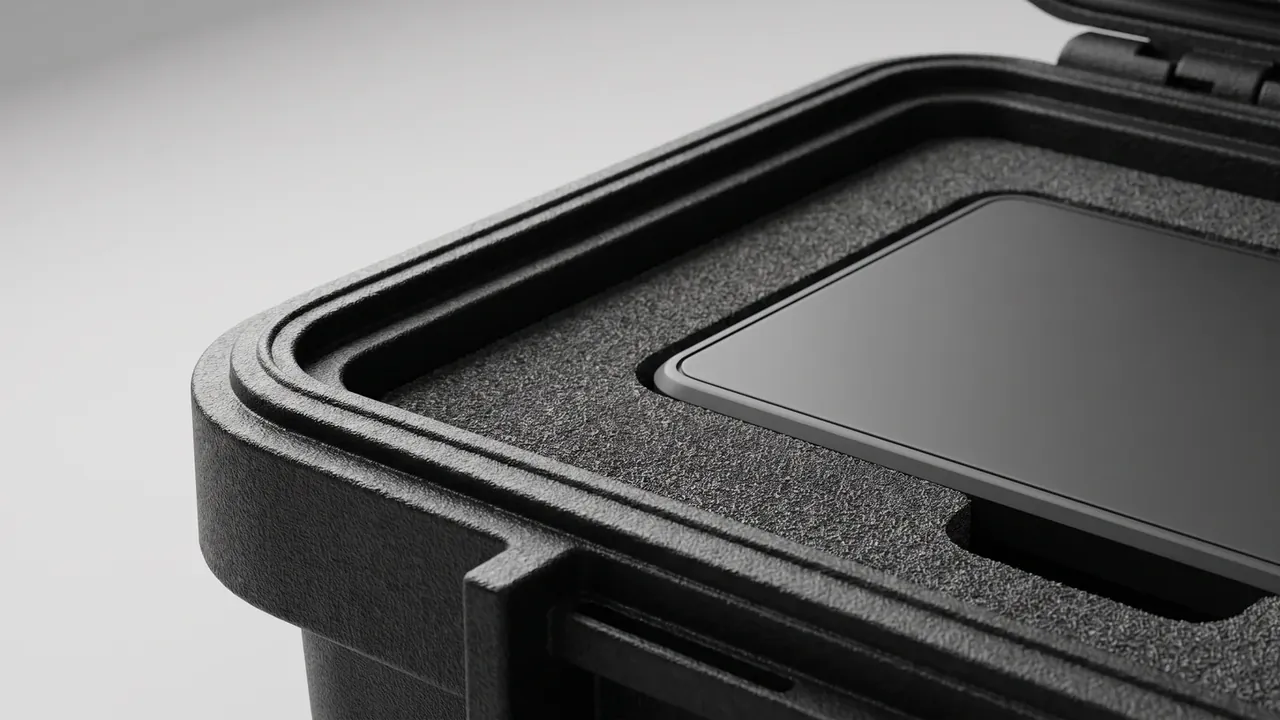
Drain holes sit at the lowest point, 8 mm across, two per deck equipment case, at the ends of the long sides. Eight millimetres empties 0.5 L in 10 min; at 5 mm salt blocks half the bore.
The hole is the weak point of any rating. An IP67 deck equipment case needs a labyrinth: a 3 mm internal weir and a 30° external lip hold 12.5 L/min of spray for 3 min. A through-hole fails a rain test.
Condensation takes the other path. Seal 50 L at 20 °C and 60% RH, let the wall fall to 5 °C, and 3.2 g drops out, reaching 8% foam moisture in two weeks. A 100 g silica pack holds it; regenerate at 120 °C.
Quarterly layup: 2 h of ventilation, silicone grease on the gasket, two drops of oil per hinge pin, drain holes cleared of salt.
Conclusion
Four numbers carry the specification of a deck equipment case. Salt spray at 500 h grades the latch spring and hinge pin, not the moulding, and 316 pushes the line to 720 h. Lashing is sized on 0.5 g lateral acceleration, four points at 165 N, with the 2 t D-ring absorbing scatter. Vibration from 2 to 13.2 Hz is dodged by 120 mm rib spacing. An 8 mm drain behind a weir and 100 g of silica against 3.2 g of condensate finish the list.
This article covers the container side only, meaning housing specification and design intent, not any handling, loading or use of the contents.
Related Reading
- Corrosion detailing for crane-mounted deck cases
- Materials and sealing for marine protective cases
- Fishing and vessel gear cases in service
Related Products
- 8 Series — Gun Cases; Military Equipment Cases; Camera Equipment Cases; Drone Cases; Watch Cases; Knife Cases; First Aid Cases; Electronics Equipment Cases
- WL8-2812 PP Gun Case — model WL8-2812
- All protective cases and toolboxes: 7 series, 158 models