

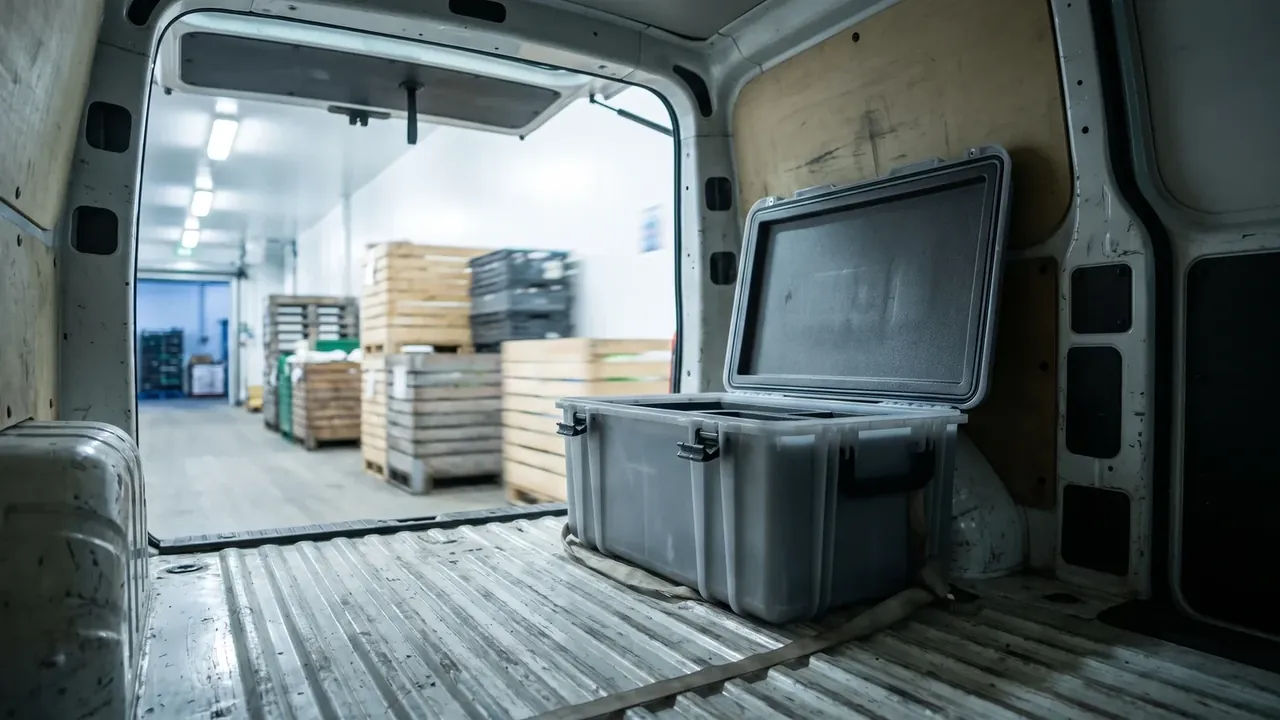
Quick answer: Specifications for a Deployable Hard Case rest on three lines: the dimension chain fixes usable volume, wall thickness fixes weight and impact margin, and stacking fixes the base. Settle one line alone and the other two return as rework.
Table of contents
- Deployable Hard Case Dimension Chain
- Wall Thickness and Total Weight
- Load Rating, Stacking and Base
- Protection Ratings and Tests
- Cutouts and Panel Reinforcement
- FAQ
1. Deployable Hard Case Dimension Chain
A Deployable Hard Case is dimensioned from the outside in: outline size follows the transport envelope, the cavity is what a user gets, and wall, ribs and lid lip sit between them. A 1200 × 800 × 600 mm case with a 5 mm wall and 3 mm ribs gives a cavity of 1184 × 784 × 584 mm, about 542 L.
Tolerances are banded by size: 2 mm either way to 600 mm, 3 mm to 1200 mm, 4 mm above. Flatness holds at 1.5 mm per metre, the lid gap stays under 1.2 mm, and holes sit within 0.5 mm. The 18 mm lid lip takes no cavity space yet decides whether the gasket groove can compress.
| Element | Value | Limit |
|---|---|---|
| Outline | 1200 × 800 × 600 mm | 3 mm either way |
| Wall | 5.0 mm nominal | 4.2 mm minimum |
| Cavity | 1184 × 784 × 584 mm | 4 mm either way |
2. Wall Thickness and Total Weight
Walls are never uniform: a nominal 5 mm case runs 6.5 mm at the corners and may fall to 4.2 mm across large flats, so a specification states both.
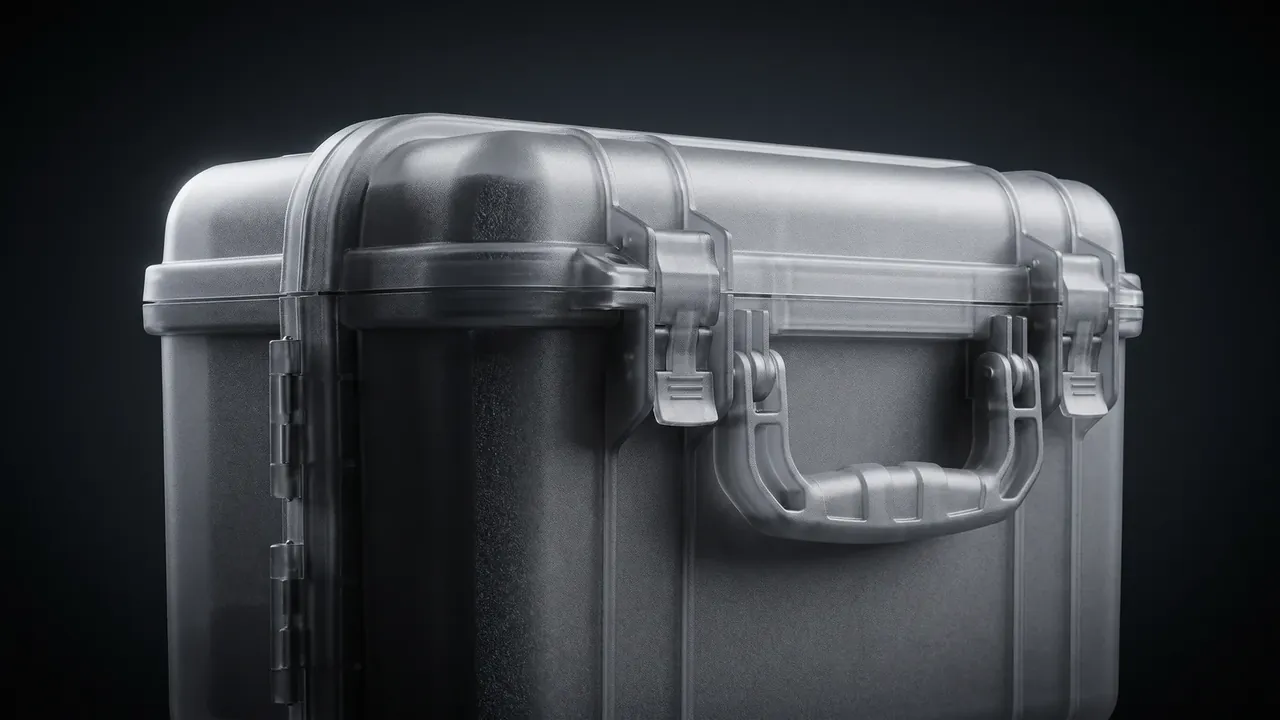
Weight is surface area times wall times density. At 0.94 g/cm³ and 3.66 m² of developed surface, a 5 mm wall takes 17.2 kg of compound, ribs and inserts add 15 percent for 19.8 kg, and hardware with liner adds 3.2 kg, so about 23 kg empty.
| Wall | Compound | With ribs | Empty |
|---|---|---|---|
| 4.2 mm | 14.4 kg | 16.6 kg | 19.8 kg |
| 5.0 mm | 17.2 kg | 19.8 kg | 23.0 kg |
| 6.0 mm | 20.6 kg | 23.7 kg | 26.9 kg |
Five to six millimetres buys about 20 percent more impact resistance for 3.9 kg. Thickness comes from charge weight and oven time: a 3 mm steel mould at 260°C, 18 minutes heating and 12 minutes cooling holds uniformity within 0.6 mm.
3. Load Rating, Stacking and Base
Load splits three ways, and the specification keeps them apart: what a case carries, what a stack transmits, what lifting gear sees.
Rated load is 45 kg against 23 kg empty, so a full case is 68 kg. Three-high stacking puts 136 kg on the bottom unit, and with a factor of 3 for surge and offset the base is checked at 408 kg. Load passes through four corner pads of 2400 mm², about 0.14 MPa, which timber and concrete take, and asphalt marks.
4. Protection Ratings and Tests
A rating is a test result, not a label. IP67 means no ingress at 1 m for 30 minutes; IP66 means no ingress under 12.5 L/min spray for 3 minutes.
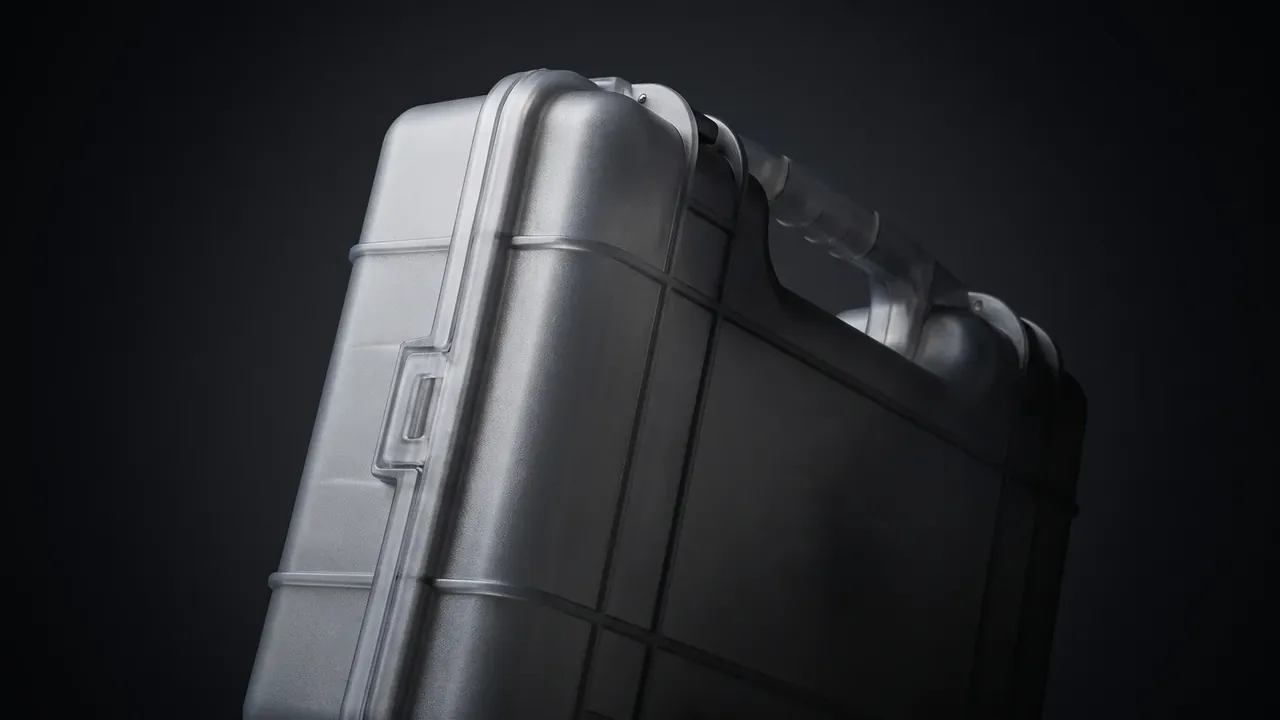
Cycling runs 10 passes between -35°C and 65°C at 4 hours each, with the pressure test repeated afterwards to a 2 kPa drop. PE shrinks far more than steel, cracking the plastic around each insert. Dust is tested at level 6 with 2 kPa of vacuum, vibration sweeps 10 to 500 Hz for an hour per axis, and a 1.2 m drop on six faces, three edges and a corner may add no more than 0.5 mm of lid gap.
5. Cutouts and Panel Reinforcement
Every cutout costs stiffness. Holes sit 30 mm clear of a radius, cut area stays under 15 percent of the face, and 25 mm of rib remains between openings.
| Opening | Reinforcement | Fastener |
|---|---|---|
| Up to 25 mm | 3 mm rolled lip | M25 gland, 2.5 N·m |
| Up to 80 mm | 5 mm lip, 2 mm plate | 4 × M5, 3.5 N·m |
| Over 80 mm | 8 mm lip, 3 mm plate | 6 × M5, 3.5 N·m |
A lip raises edge stiffness threefold and an aluminium plate spreads bolt tension over an 80 mm square. Lip alone is not enough: radial cracks appear within six months. Each cutout needs a 1.5 mm silicone gasket under the gland, with the gland torqued to 2.5 N·m and backed off half a turn.
Conclusion
The specification of a Deployable Hard Case is a set of numbers that restrain each other: the chain sets the cavity, wall thickness sets weight, stacking sets the base, ratings set the test order. Band the tolerances, split load into three, and the Deployable Hard Case specification will hold.
This article discusses only the container (case body) side of specifications and design intent, and does not cover any handling, loading or use of the contents.
Related Reading
- How a deployable hard case is built
- Choosing a deployable hard case
- Reading shockproof case specifications
- Setting a protective case size range
Related Products
- 8 Series — Gun Cases; Military Equipment Cases; Camera Equipment Cases; Drone Cases; Watch Cases; Knife Cases; First Aid Cases; Electronics Equipment Cases
- WL8-2812 PP Gun Case — model WL8-2812
- All protective cases and toolboxes: 7 series, 158 models