

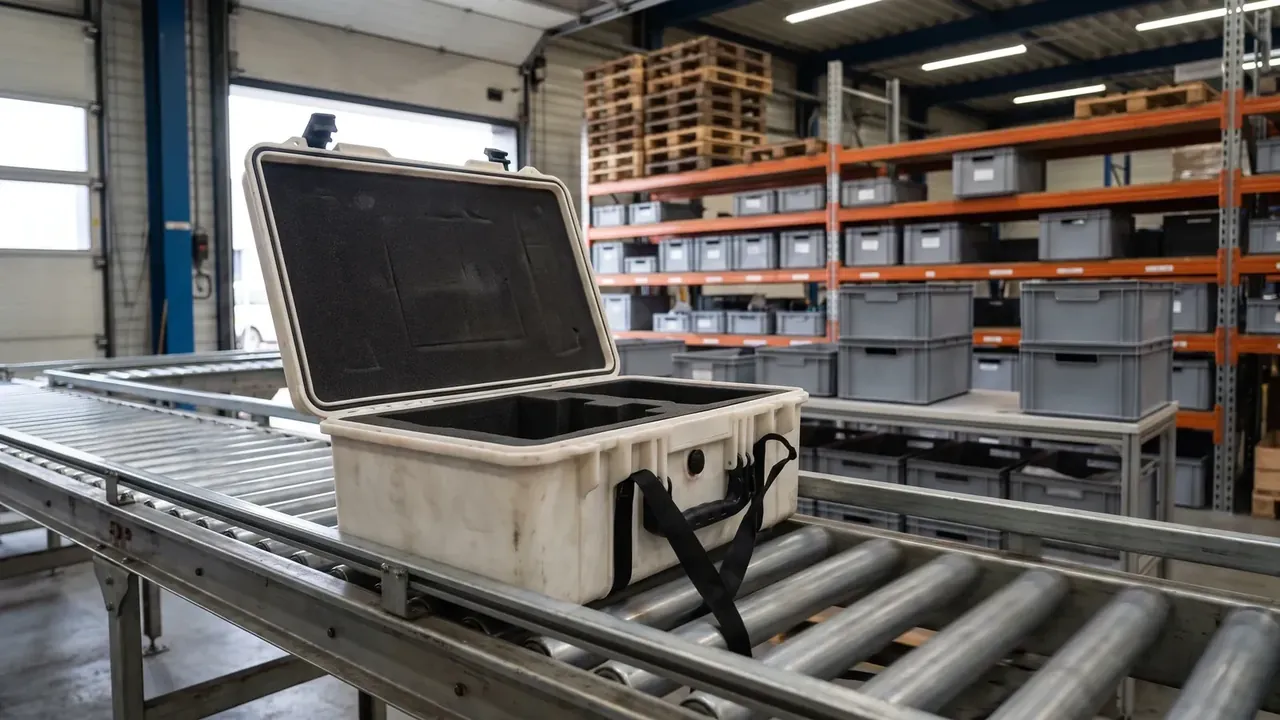
Quick answer: Acceptance runs in four layers: appearance, pressure and drop, stacking and salt spray, then documents. Each layer needs an item, a limit, a method and a sample size, or nothing can be cited in a dispute.
Table of contents
- Acceptance Items and Decision Logic for a Deployable Hard Case
- Appearance, Dimensions and First-Article Splits
- Pressure, Drop and Vibration Testing
- Stacking, Salt Spray and Latch Life
- Sampling Plans and Nonconformance Handling
- FAQ
1. Acceptance Items and Decision Logic for a Deployable Hard Case
A standard turns usable into numbers two people can agree on. For a Deployable Hard Case the layers are appearance, performance, endurance and documents, each answering what is measured, how, and the pass line.
Write every clause as item, limit, method and sample size. Surfaces shall be smooth gives two verdicts; no wall point below 3.8 mm, sixteen points per case, two out of tolerance allowed gives one.
Class A is checked on every case: full latch closure. Class B is sampled for dimensions, wall and cosmetics. Class C is the yearly type test. A new cavity, a change of material, a wall change above 5 percent or a site move forces a full retest.
2. Appearance, Dimensions and First-Article Splits
Cosmetic clauses cannot stay adjectives. Not permitted: cracks, punctures, exposed inserts, short shots on the sealing face. Limited: sink marks no deeper than 0.3 mm and 10 mm long, two per face. Accepted: flow lines and a colour shift within 1.5.
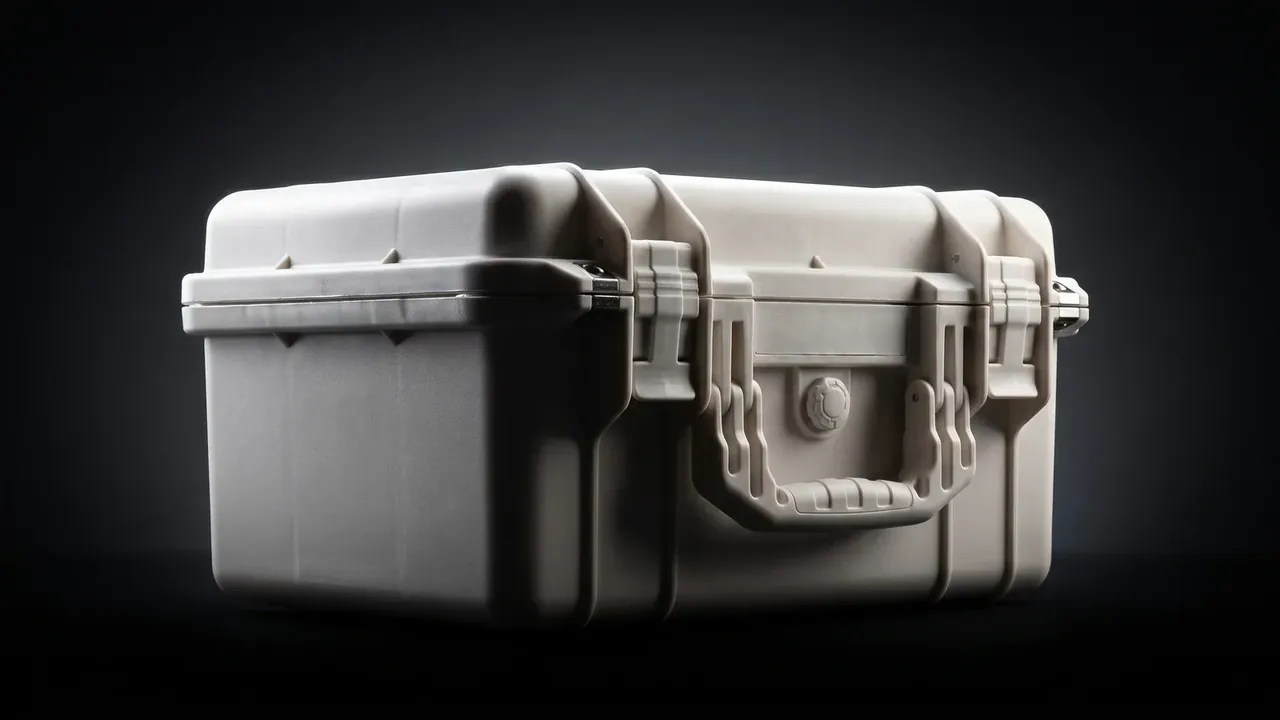
The dimension chain follows assembly: envelope tolerance plus or minus 2 mm, rim flatness within 1.0 mm, lid-to-body offset within 1.5 mm, and 1.5 to 2.5 mm per side in the stacking groove, or cold shrinkage jams them.
Wall thickness is read by ultrasonic gauge at five points on the base, two per side wall, three on the lid. First article: three cases; batch: eight for appearance, five for dimensions.
3. Pressure, Drop and Vibration Testing
Pressure comes first: charge to 30 kPa, hold 60 s, pass if decay stays within 0.3 kPa; vacuum mirrors it. Water immersion is for disputes.
| Item | Condition | Verdict |
|---|---|---|
| Pressure | 30 kPa held 60 s | Decay within 0.3 kPa |
| Drop | 1.2 m, six faces, three edges, four corners | Latches shut, no through crack |
A drop verdict describes the state after impact: offset within 2 mm, a latch that still opens with one hand, a gasket still in its groove. Thirteen impacts; a 5 mm dent is allowed if not whitened.
Vibration is a sine sweep from 10 to 500 Hz at 1.5 g, one octave per minute, thirty minutes per axis, pressure rechecked after.
4. Stacking, Salt Spray and Latch Life
Stacking models storage. Take five high: a laden case weighs 60 kg, so the bottom unit carries 240 kg at 40°C for 24 h, then unload, rest an hour and measure height loss. For a Deployable Hard Case the limit is 3 mm, with no dishing.
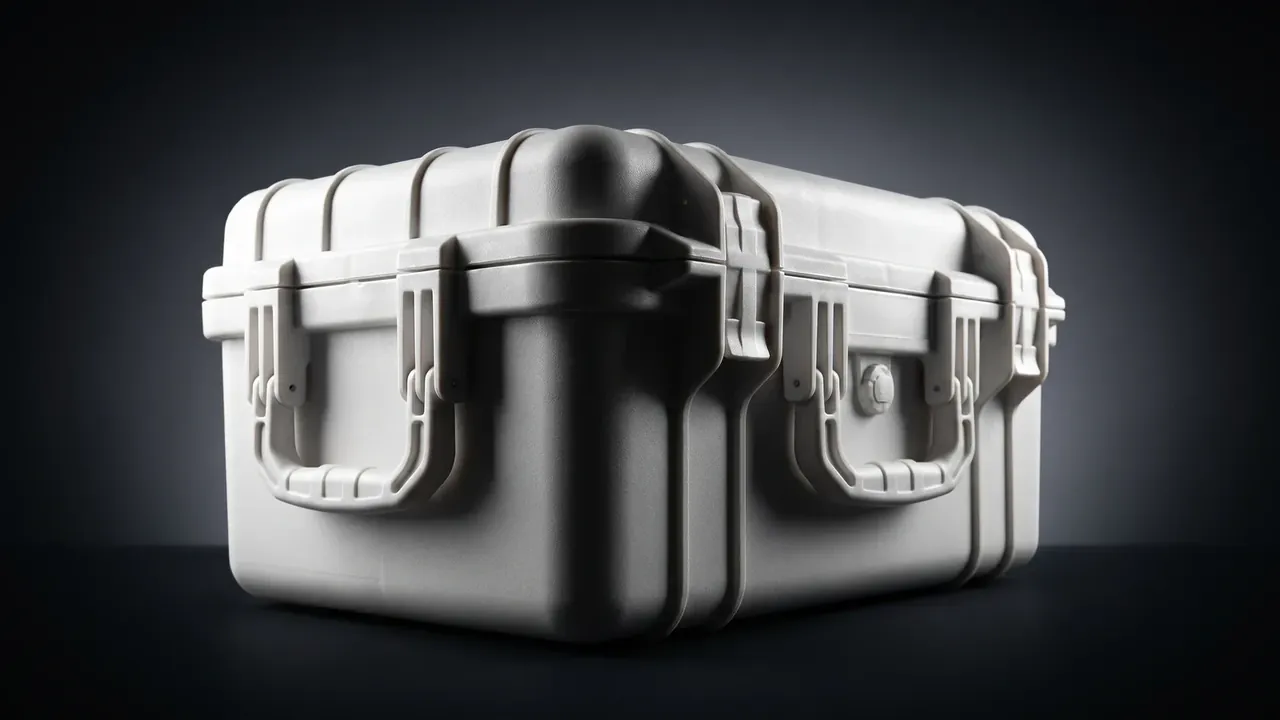
Salt spray targets metal: 5 percent sodium chloride at 35°C for 480 h. Corrosion on hinges, pins and inserts stays under 5 percent, with no effect on travel and no pitting.
Latch life is 5,000 cycles at ten per minute. Design force is 120 N, decay under 30 percent, so the floor is 84 N, with pin wear under 0.2 mm. Glass-filled bodies need 500 cycles at -20°C, where the failure is cracking.
5. Sampling Plans and Nonconformance Handling
Sampling is an adjusted counting plan at inspection level II, single sampling: AQL 2.5 for major defects, 4.0 for minor.
| Batch | Sample | AQL 2.5 | AQL 4.0 |
|---|---|---|---|
| 151 to 280 | 32 | Accept 2, reject 3 | Accept 3, reject 4 |
| 281 to 500 | 50 | Accept 3, reject 4 | Accept 5, reject 6 |
| 501 to 1200 | 80 | Accept 5, reject 6 | Accept 10, reject 11 |
One Class A defect rejects the batch outright. A failed type test stops shipment until the full set is repeated; rework is screened 100 percent.
Documents close the loop: packing list, per-case sheet, material grade and resin lot, mould number, report numbers, certificate. One trace code per case leads back to machine, shift, resin lot and inspector.
Conclusion
The value of a Deployable Hard Case standard is not clause count but whether each clause can be judged. Give every item a limit, a method and a sample size, then add the Class A rule and the retest triggers. The pass must be repeatable, and that is what a Deployable Hard Case standard is for.
This article discusses only the container (case body) side of specifications and design intent, and does not cover any handling, loading or use of the contents.
Related Reading
- What defines a deployable hard case
- Choosing a case for mobility and stacking
- Incoming inspection for military supply cases
- Quality control points on a case assembly line
Related Products
- 8 Series — Gun Cases; Military Equipment Cases; Camera Equipment Cases; Drone Cases; Watch Cases; Knife Cases; First Aid Cases; Electronics Equipment Cases
- WL8-2812 PP Gun Case — model WL8-2812
- All protective cases and toolboxes: 7 series, 158 models