

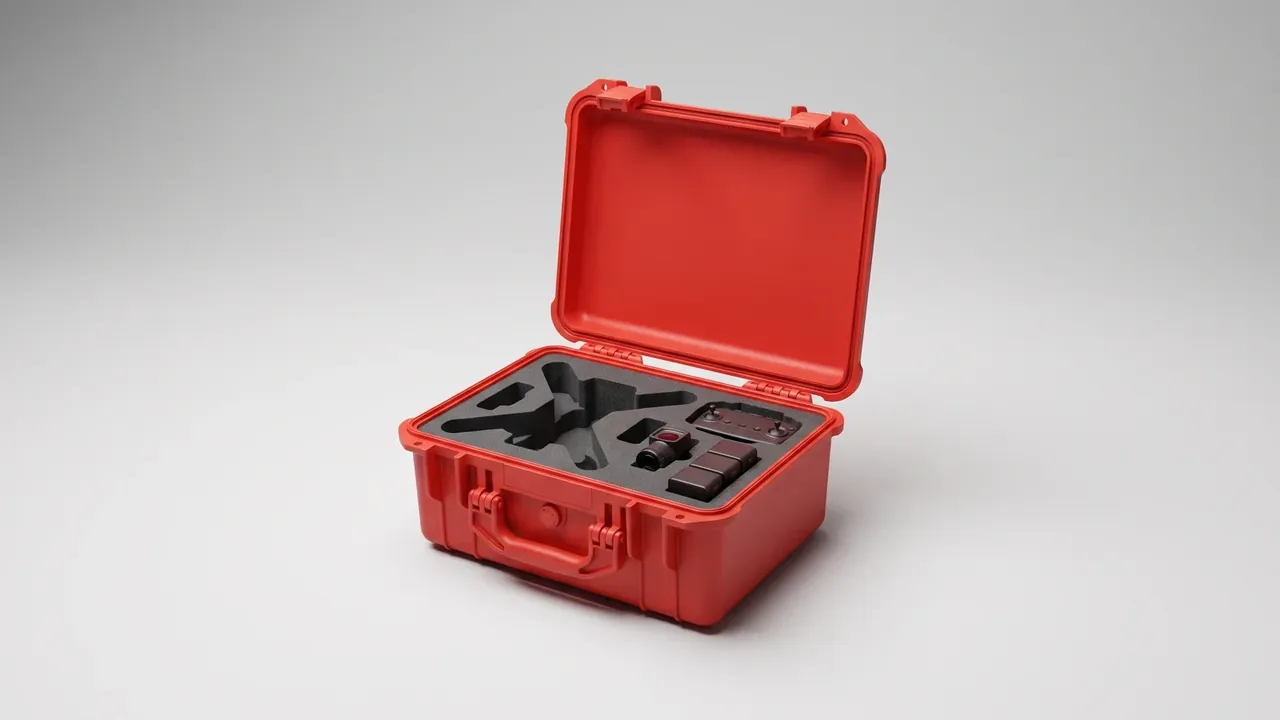
Quick answer: A drone case is accepted item by item, not by first impression. Dimensions, seal, drop, latch life and ageing each carry a written pass line, sampling follows the lot size, and defects are judged as a lot.
Table of contents
- How the Drone Case Inspection Splits into Three Layers
- Where the Appearance and Dimension Lines Sit
- How Seal and Drop Tests Are Judged
- Latch Life and Thermal Ageing Rulings
- Sampling Plans and How a Failed Lot Is Handled
- FAQ
1. How the Drone Case Inspection Splits into Three Layers
Acceptance sheets fail when every check shares one page and the inspector passes parts by feel. A drone case is judged at three levels, each with its own pass line and signature.
Incoming covers the PP melt flow index, the masterbatch lot and the hardware. A shift beyond ±0.3 g/10min returns the lot, since the same settings then mould a different wall. Valve diaphragms must crack between 0.015 and 0.025 MPa.
| Level | Items | Release condition |
|---|---|---|
| Incoming | melt index, masterbatch, valve pressure | all three pass |
| First article | 12 dimensions, colour, unit weight | all inside tolerance |
| Patrol | appearance, lid gap, latch force | three clean groups |
| Outgoing | 80-unit sample, 3 seal retests | defects at or below Ac |
First article cannot be skipped. Every mould change, colour change or stop over four hours needs a fresh one, and a unit weight drift beyond ±2.5% means the wall has already moved.
2. Where the Appearance and Dimension Lines Sit
Appearance starts arguments at goods-in, so every item needs a number. Colour is judged on ΔE against the signed sample at 1.5 or less; sink marks stay under 0.3 mm on the A surface and 0.6 mm on the B, flash under 0.2 mm, scratches under 5 mm with two per face.
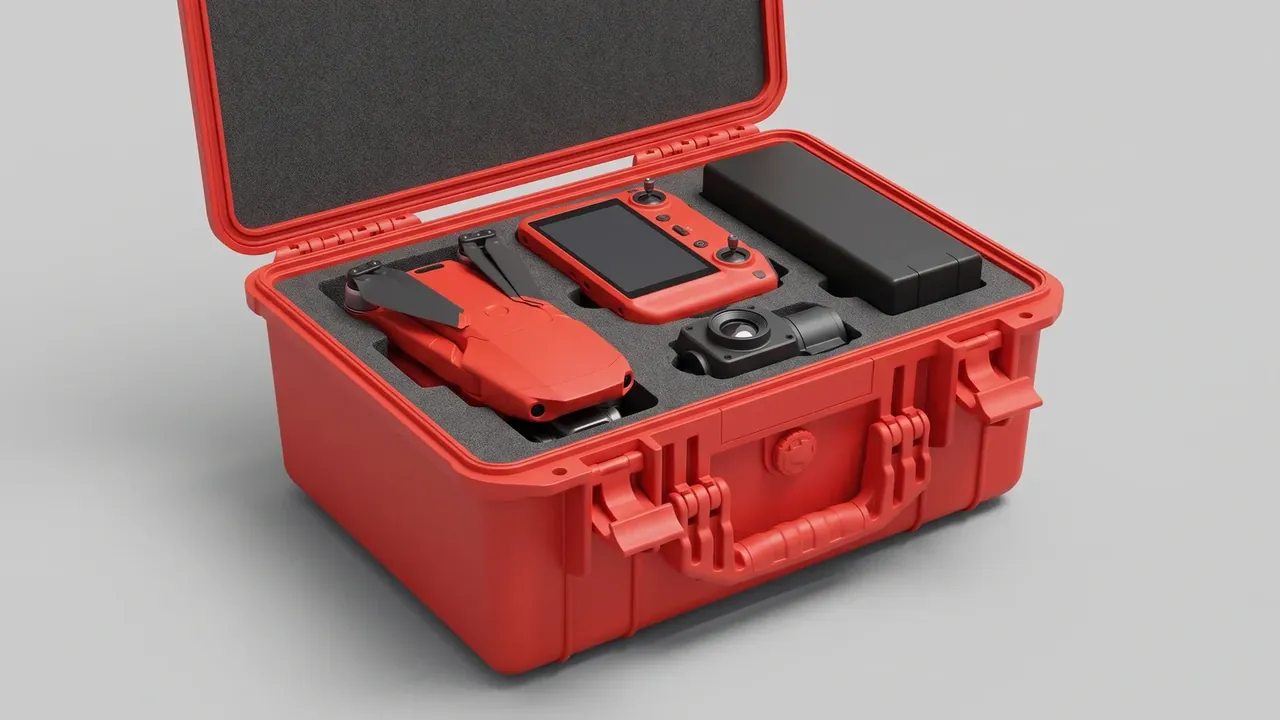
Dimensions split into envelope and fit. The 520×390×215 mm outer size carries ±2.0 mm and the 470×340×180 mm cavity ±1.5 mm. Lid gap stays at or under 1.5 mm across eight feeler-gauge points, spread 0.6 mm. Floor flatness is 1.0 mm, and foam leaves 1.0–1.5 mm per side.
Hinge coaxiality and latch-seat symmetry are usually missing: beyond 0.6 mm the lid sits high on one side, gasket compression varies by 10%, and water enters at the low corner.
3. How Seal and Drop Tests Are Judged
Sealing a drone case is settled by immersion and pressure decay. The closed case sits under 1 m of water for 30 minutes; after drying, the cavity must show no water and the indicator paper no colour change. Pressure decay charges to 20 kPa and accepts a drop of 1.0 kPa or less in 60 seconds.
| Test | Condition | Pass ruling |
|---|---|---|
| Immersion | 1 m, 30 min | dry cavity, unchanged paper |
| Pressure decay | 20 kPa, 60 s | 1.0 kPa drop or less |
| Drop | 1.2 m, 10 drops | no through-crack, latches shut |
| Vibration | 3–100 Hz, 30 min | pins travel under 1 mm |
Drop testing follows one corner, three edges and six faces, ten drops from 1.2 m at the real all-up weight. No through-crack, no latch release, no lid shift beyond 3 mm. The seal is retested afterwards, since cracks open at the corner rib roots.
4. Latch Life and Thermal Ageing Rulings
Latch judgement on a drone case has two stages. Outgoing force is 55 N ± 8 N, averaged over three pulls at the tongue centre; after 2,000 open-close cycles it must still reach 35 N.
Thermal cycling runs -20 °C for 4 hours and 55 °C for 4 hours, three cycles, unopened. Pressure decay is measured at once, permanent gasket set may not exceed 1.2 mm, and 72-hour salt spray must rate 9 or better.
5. Sampling Plans and How a Failed Lot Is Handled
Sampling follows GB/T 2828.1, normal inspection, single sampling, level II. A lot of 501–1200 units maps to code J, sample 80; 1201–3200 to K, sample 125.
| Class | Typical items | AQL | Ac/Re at n=80 |
|---|---|---|---|
| Critical | seal failure, latch release | 0 | 0 / 1 |
| Major | dimension, cracks | 0.65 | 1 / 2 |
| Minor | colour, scratches | 1.5 | 3 / 4 |
A failed lot is never sorted and shipped quietly: every unit is inspected and the lot resampled, or the lot is rejected. A concession needs written confirmation of the defect and quantity plus two retained samples kept 24 months.
Conclusion
An acceptance standard earns its keep when every line becomes an action: who measures, with what, where the reading lands, and the consequence. Fix the list once and a drone case is accepted on data, not on feel.
This article discusses only the container (case body) side of specifications and design intent, and does not cover any handling, loading or use of the contents.
Related Reading
- Drone case selection guide
- Drone case problems and fixes
- Case assembly quality control
- Case production SOP standards
Related Products
- 8 Series — Gun Cases; Military Equipment Cases; Camera Equipment Cases; Drone Cases; Watch Cases; Knife Cases; First Aid Cases; Electronics Equipment Cases
- WL8-2812 PP Gun Case — model WL8-2812
- All protective cases and toolboxes: 7 series, 158 models