

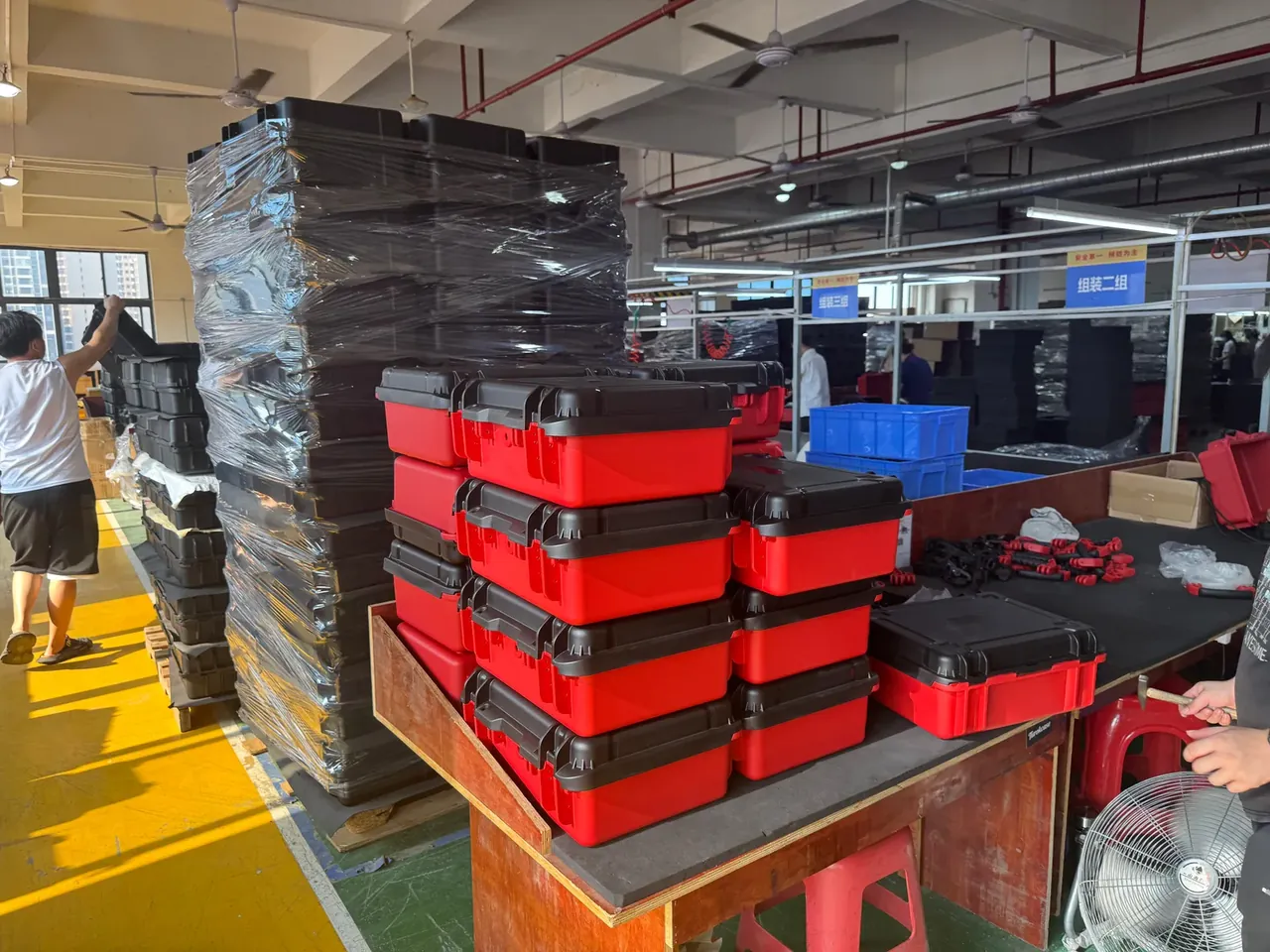
Quick answer: A drone dock case defends one measurement above all: 2 mm per metre of flatness on a 1.2 m landing platform, held from the factory floor to the tower base.
Table of contents
- Why a Landing Platform Deforms in Transit
- Reading the Flatness Number
- Rib Layout and the 15 mm Buffer Layer
- Lifting, Stacking and Vibration Limits
- A Three-Point Measuring Routine
- FAQ
1. Why a Landing Platform Deforms in Transit
A 1.2 m landing platform leaves the plant as a plate 30 mm thick, carried at four corners. On a bench it is stable. Load it into a van, run 300 km of highway and two stretches of gravel, and it can arrive twisted, because every force that reaches the plate comes in through the case.
The plate is the soft half of the system. A PP shell can be thickened until it stops deflecting; the platform cannot, since its thickness and support points belong to whoever designed the dock. That inversion is what separates this product from an ordinary equipment case.
Flatness is a system result, not a case specification.
Four loads matter. Static weight puts 85 kg on the bottom panel, stacking adds another 85 kg, and 1.5 g swept from 5 to 200 Hz works the foam by a fraction of a millimetre every minute.
2. Reading the Flatness Number
A figure such as 2 mm per metre is often copied onto a whole plate as one tolerance, which is not what it means. The allowance applies along any 1 m span, in any direction, read from a straight edge laid on the surface. A 1.2 m plate has more room end to end than a 0.8 m one, and the diagonal needs its own limit because twist shows up there first.
| Platform edge | Flatness allowed | Diagonal difference | Ribs in the base |
|---|---|---|---|
| 0.6 m | 1.2 mm/m | 1.5 mm | 4 |
| 0.8 m | 1.5 mm/m | 2 mm | 4 |
| 1.0 m | 2 mm/m | 2.5 mm | 5 |
| 1.2 m | 2 mm/m | 3 mm | 6 |
| 1.5 m | 2.5 mm/m | 4 mm | 8 |
A saddle passes a four-edge check: flat at the rim, low in the middle. Two crossed diagonals catch it in under a minute. Above 1.5 mm of twist, correction becomes replacement.
3. Rib Layout and the 15 mm Buffer Layer
Ribs stiffen the base, and the instinct is to add more. Past a point the mould fights back. At 40 mm rib height, 200 mm pitch and 6 mm root thickness, a 1.2 m base holds peak deflection under 1.2 mm; tighten the pitch to 150 mm and cooling shrinkage adds 0.5 mm of ripple that no further ribbing removes.
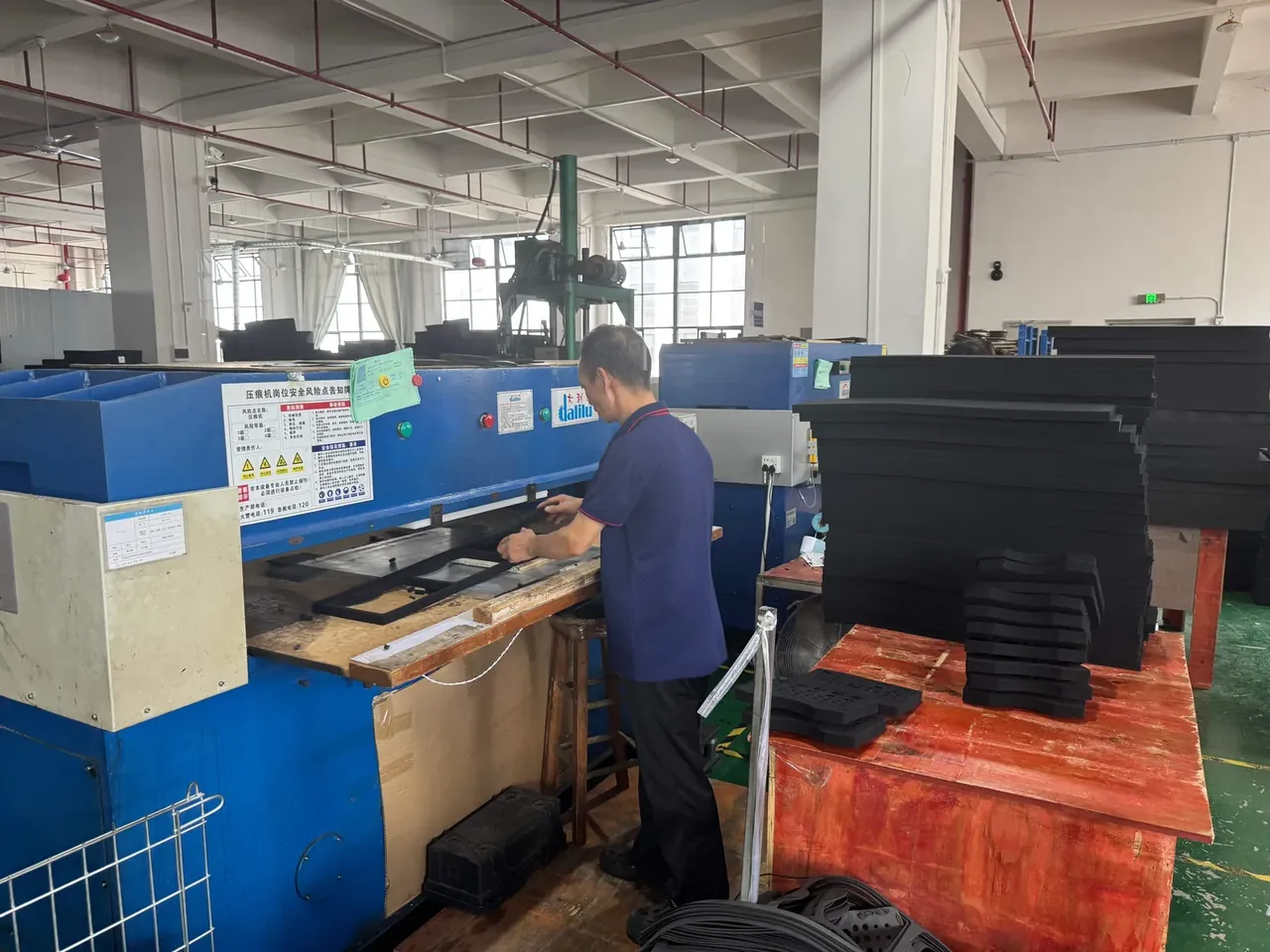
The buffer is 15 mm of EPE at 30 kg/m³, cut as one piece. A splice is a hinge: across a 5 to 200 Hz sweep the halves move 0.3 mm apart, and that step pushes into the plate edge, exactly where flatness is measured. Cut tolerance is ±1 mm with 2 mm clearance.
Softer is not better. Foam under 25 kg/m³ crushes 4 mm under an 85 kg static load: corners sink, the middle stays high, and the lid bows the plate into an arch.
| Attachment | Buffer thickness | Compression when closed | Platform sizes | Watch out for |
|---|---|---|---|---|
| One-piece cut | 15 mm | 20% | 1.2 m and up | ±1 mm cutting tolerance |
| Strip assembly | 15 mm | 20% | below 0.8 m | 0.3 mm joint offset |
| Adhesive backing | 10 mm | 25% | 0.6 m | creep above 55 °C |
| Glue dots | 12 mm | 22% | 0.8 to 1.2 m | dots at 150 mm pitch |
| Channel insert | 15 mm | 18% | 1.5 m | 2 mm slot clearance |
Wall thickness is the last lever. Going from 8 mm to 10 mm lifts the empty shell from 85 kg to 96 kg and turns a two-person carry into a crane job.
4. Lifting, Stacking and Vibration Limits
Four lugs, 21 kg of static load each, and that holds only while slings hang vertical. At 60° a single sling carries 24.5 kg, at 45° it carries 30 kg, at 30° it carries 42.5 kg. With a dynamic factor of 2, slings rated at 85 kg are the minimum.
The lugs sit 150 mm in from the long edges. Corner lifting bows the centre of the base; moving pick points inward reverses about 0.4 mm of that sag. Fit 5 mm rubber pads where slings cross the shell; a bare hook cuts a 2 mm notch at the plate edge.
Stacking is capped at two. Two high puts 170 kg on the bottom case; three high puts 255 kg there, and 48 hours later the base keeps 0.8 mm of set.
Vibration is gentler. A 1.2 m assembly usually resonates between 20 and 25 Hz, where lid and plate move about 0.2 mm apart. Thirty minutes is 36000 cycles, enough for the foam to collapse 0.5 mm in one corner.
| Storage scenario | Stack height | Load on bottom case | Time allowed | Re-check |
|---|---|---|---|---|
| Plant buffer stock | 2 | 170 kg | 30 days | 1 unit every 15 days |
| Road transport | 1 | 85 kg | 8 hours | on arrival |
| Sea freight | 2 | 170 kg | 45 days | diagonal first |
| Open yard | 1 | 85 kg | 7 days | cover every 3 days |
Forklift pockets are cut 120 mm high, and the tines load the base at close to 300 kg. A 3 mm steel liner running 50 mm past the opening spreads it; without one the lip rolls up after about 20 lifts.
5. A Three-Point Measuring Routine
Measure the same plate three times, at dispatch, before loading and on arrival, and write the figures on one card. A drift above 0.5 mm identifies which leg of the journey did the damage.
Read the corners in place, but wait 10 minutes: the lid foam still pushes upward and biases the gauge low by 0.3 mm. Between -20 °C and 55 °C the modulus of PP moves about 20%, so 1.8 mm outdoors in winter is not 1.8 mm indoors.
Conclusion
The payload is a thin plate, so the design work sits in the base rather than the walls: six ribs at 200 mm pitch, 15 mm of one-piece EPE, four lugs 150 mm inboard, a two-high stacking cap. Hold flatness to 2 mm per metre and the diagonal to 3 mm, and the platform arrives ready to bolt down. A drone dock case adds no stiffness of its own; it only stops transport from spending the stiffness the platform already has.
Related Reading
- Drone transport: arm and battery retention
- Foam insert layout for dock cases
- Industrial equipment case sizes and load ratings
- Field cases for power inspection crews
Related Products
- 8 Series — Gun Cases; Military Equipment Cases; Camera Equipment Cases; Drone Cases; Watch Cases; Knife Cases; First Aid Cases; Electronics Equipment Cases
- WL8-2812 PP Gun Case — model WL8-2812
- All protective cases and toolboxes: 7 series, 158 models