

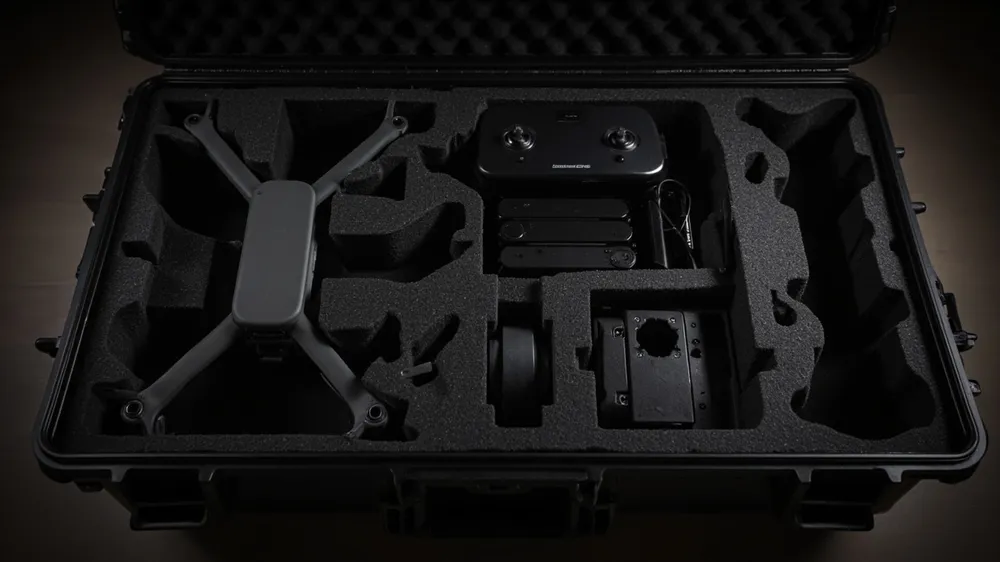
Many judge a drone case by shell hardness and latch shine, ignoring the part that actually decides safety — the interior. The shell catches the hit; the foam absorbs and spreads it. A rigid shell with a crude interior can drive force straight into the gimbal; a well-designed interior can save fragile parts even in an ordinary shell. This guide starts from design rules so you can tell whether an interior truly protects.
The Interior Is the Real Core
The parts that fail first are the gimbal, propellers and screen/antenna, all protected by foam, not shell. A hard shell that lets the gimbal touch a rigid wall still transmits impact on drop. Judge the interior first, then the shell.
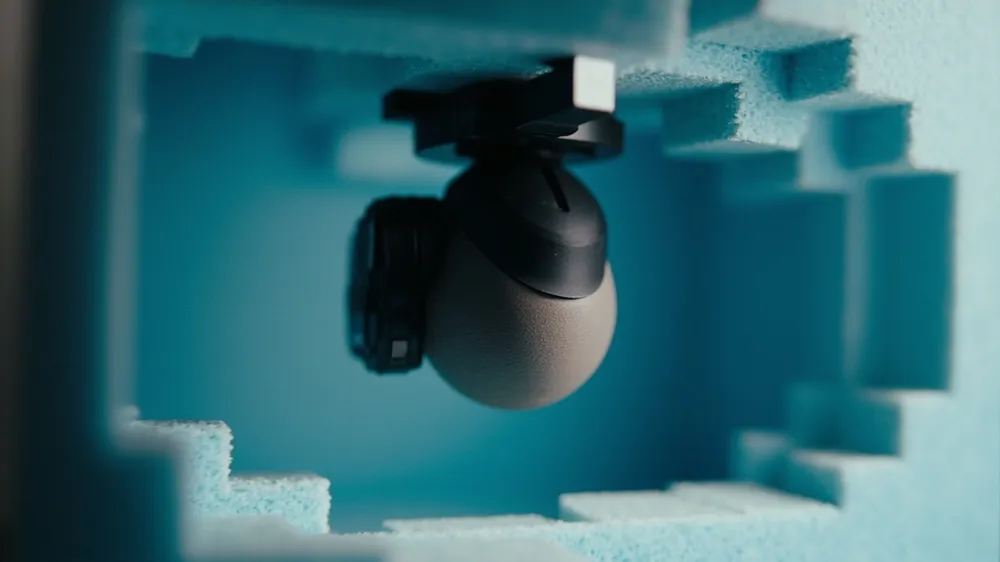
Suspend the Gimbal
The gimbal is spherical and extremely fragile. The correct approach is suspension: the cavity contacts only the rigid mounting features, leaving the spherical body free with clearance. On impact, force is not passed through direct wall contact.
The wrong approach is "tight wrap" — seat the whole gimbal in a form-fit cavity. Looks stable, but impact goes straight from wall to gimbal. Suspension's keyword is "support, do not hug".
Restrain, Do Not Press, the Propellers
Propellers are slender and snap under side load. Correct: lay flat with side restraint — own slot, foam clamps both sides to stop lateral movement, but no top-down pressure. The force direction should be "limit displacement", not "compress".
For folding props, design the cavity to the folded shape, so the tip does not punch through foam into the shell. Many cases leave too little clearance at the tip, defeating protection.
Carry the Battery, Do Not Let It Hang
The battery is the heaviest item; if it hangs, it shifts in transit and hits other parts. Correct: the battery bay carries its weight, bottom-supported, sides restrained. If transport involves heat, consider insulation.
Multi-battery users need isolation: each cell in its own bay, avoiding friction or short risk. Industry kits with several batteries make this essential.
Zone the Controller and Accessories
Controller and accessories get their own positions to avoid abrasion with the aircraft. Frequently used items (controller) go where fastest to reach; rarely used (spare props, tools) go deep. Zoning logic is "layer by use frequency".
| Part | Design point |
|---|---|
| Gimbal | Suspended, clearance around |
| Props | Flat, restrained, not pressed |
| Battery | Supported and isolated |
| Controller | Independent, easy access |
| Accessories | Deep, low frequency |
Foam Material Choice
| Material | Traits | Use |
|---|---|---|
| EVA | Good rebound, thermoforms, low cost | Most common, volume |
| PE (cross-linked) | Stiffer, stronger support | Heavy part support |
| PU (sponge) | Soft, high absorb, sheds | Light cushion |
| Pick-and-pluck | Tearable grid, flexible | Temporary/variable load |
Density is the hidden metric: one density step down quietly cuts protection and invites collapse. Write density and thickness into the contract to prevent downgrade. See the interior-downgrade note in factory capability.
Process: Thermoform, Die Cut, CNC
- Thermoforming: mould-pressed cavities, accurate and durable, volume, the usual choice.
- Die cutting: blade-cut foam, flexible and fast, but complex cavities and long-term durability lag.
- CNC carving: highest precision and flexibility, small batch/custom, higher cost.
See interior process and EVA thermoforming.
Multi-Layer Solves Space Conflict
Consumer cases are space-tight and use layers: aircraft plus controller on top, batteries plus accessories below, separated by a divider. Layers achieve both "compact" and "zoned" — the key to consumer space efficiency, as long as layers do not press fragile parts.
Weight and Cost Balance
Foam is a real share of case weight; over-thickening is heavy and costly. Balance: thicken around fragile parts, thin elsewhere. Trimming cavities from twelve to eight often saves more than lowering foam density, without losing protection.
Maintenance and Replacement
Foam ages, collapses, takes permanent dents. Good design is replaceable: interior as independent modules, swap one without scrapping the case. See foam relining. Before each close, check cavities for debris that prevents a tight seal.
Summary
The iron rules of drone case interior: suspend the gimbal, restrain the props, carry the battery, zone the accessories, write density into the contract, pick process by volume. The shell decides whether the case survives the drop; the interior decides whether the drone breaks. Flip the interior out and look before trusting ten shell specs.
For interior process see production process; for material see material selection.