

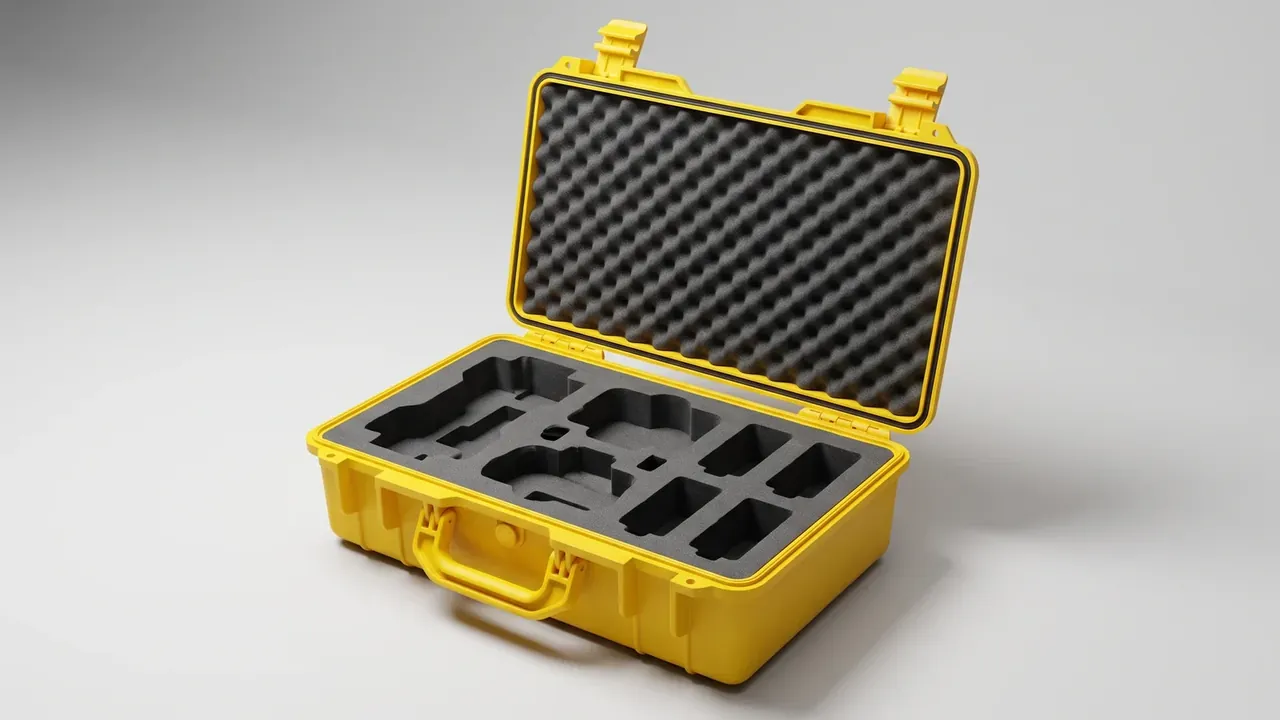
Quick answer: A drone transport case holds three items that pull in different directions, so fix each on its own number: an arm recess 1.5 mm wider than the folded profile, battery pockets no more than 2 mm oversize in a separate bay, and 20 mm of clear space above the controller sticks. Get those right and the gimbal usually needs no recalibration after 26 drops from 1.2 m.
Table of contents
- Three contact points to fix first
- Arms: shape holds them, straps do not
- Batteries: bays, charge and heat
- Controller: 20 mm above the sticks
- Foam and shell in numbers
- FAQ
1. Three contact points to fix first
Body, batteries and controller share the same foam and ask for different things. The body needs its movement limited without load on the gimbal, the batteries need their own bay and a heat barrier, and the controller needs two protruding sticks kept clear of everything. The three most common repairs map onto those three gaps.
An arm that rattles is the first. A recess 4 mm wider than the arm feels generous at the bench, but in transit the arm pivots on its hinge and hammers the foam wall; after 2,000 km the hinge shows visible play. Batteries sharing a bay with the body is the second: at 60 °C in a parked car the two warm each other, the pack swells, the shell takes a set. A stick pressed into lid foam is the third, and the potentiometer drifts within six months. None of these faults sits in the shell; they sit in the millimetres between foam and hardware, which is where the drawing has to carry a number.
2. Arms: shape holds them, straps do not
A folded arm keeps 0.3 mm of play at the hinge; that is the mechanism, not a build error. The foam should stop the arm using that play rather than crush it: cut the recess to the measured folded profile plus 1.5 mm, take the depth to 60 percent of arm thickness, and leave 5 degrees of draft so the arm drops in without force.
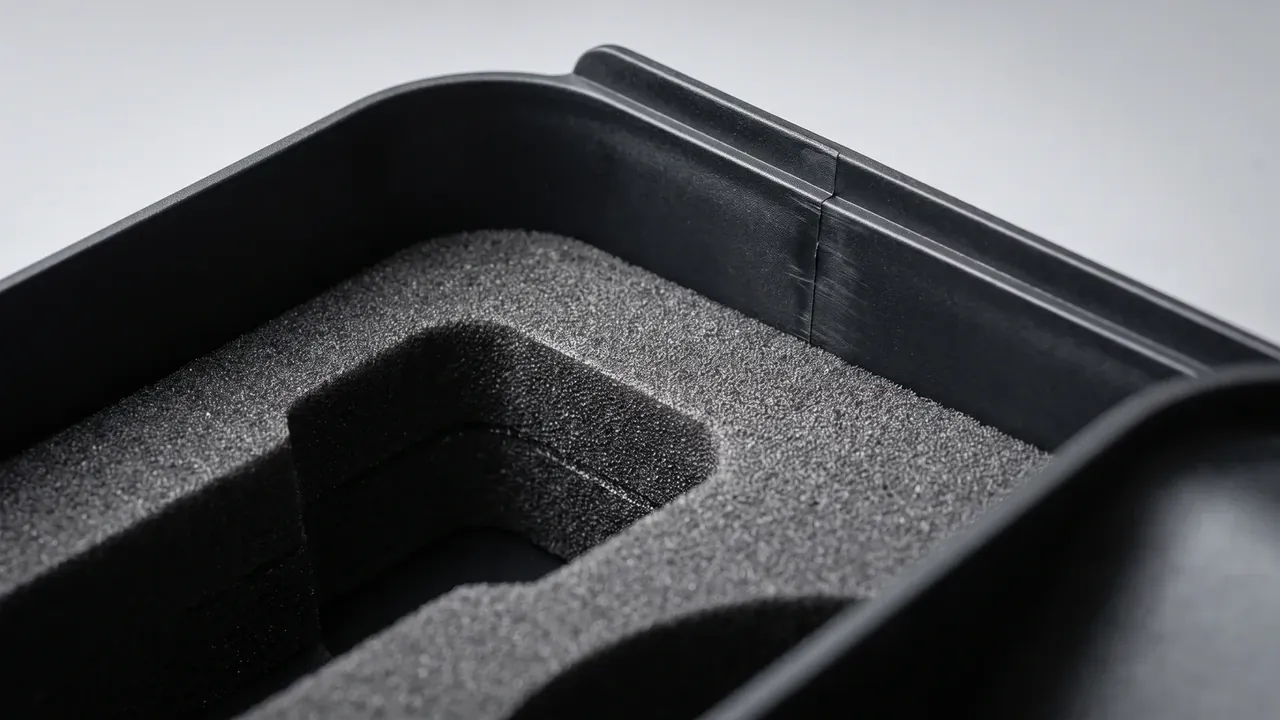
Strapping is the usual wrong answer. A nylon strap pulls the arm down, the load runs through the arm into the hinge block and motor mount, and under 5 to 200 Hz vehicle vibration those two points develop play first. To stop lengthwise movement, a foam step against the arm end is enough, because the force lands on the tube, not the joint.
The gimbal is the second load path. It is free once power is off, and a 40 g camera module can see a hundred times its own weight in a 1.2 m drop, so the pocket floor stays 5 mm clear and the body rides on two foam shoulders instead. Props travel apart: a folded prop left under load loses flatness, and 0.5 mm of warp becomes vibration at flying speed. A flat slot 12 mm deep holds two blades.
3. Batteries: bays, charge and heat
Batteries are the only part with a transport rule attached. Under usual airline practice, packs below 100 Wh may travel in the cabin, 100 to 160 Wh need carrier approval and a limit of two, and anything above 160 Wh stays off passenger aircraft.
| Pack size | Carriage rule | Bay | Heat barrier |
|---|---|---|---|
| Under 100 Wh | Cabin, count set by airline | Shared bay, own pocket | 2 mm maximum clearance |
| 100 to 160 Wh | Approval, two maximum | Own pocket, away from gimbal | 10 mm foam wall |
| Above 160 Wh | Not in cabin | Freight packing | Insulated shell |
Storage charge is missed more often than bay layout: a pack held at 4.2 V per cell loses about 5 percent of capacity in 30 days, while at 3.8 V the same month costs under 1 percent.
Heat depends on colour and parking: a closed car reaches 60 °C, while a light grey or yellow shell runs 8 °C cooler and keeps the interior under 45 °C.
4. Controller: 20 mm above the sticks
Each stick stands 18 mm tall and is the most exposed part of the kit. Cut the pocket 20 mm deep and leave 3 mm between stick top and lid foam, so the foam touches without loading it sideways. Twenty newtons of side load is enough to shift the potentiometer, which shows up as slow drift after release.
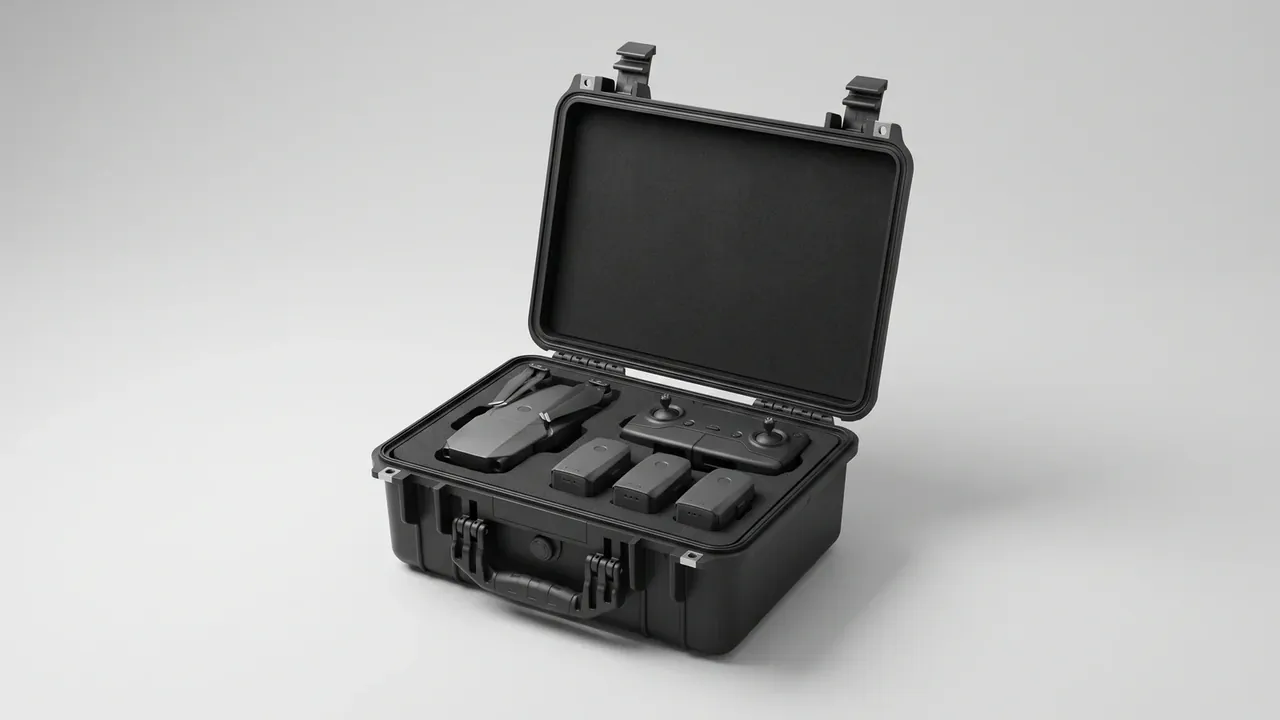
Screens and antennas split into two variants: a built-in screen goes face down on a 2 mm EVA pad so the glass never sits on hard foam, and external antennas fold flat before going in, because the root clip cracks under repeated load.
Keep the controller out of the battery bay: the shell is usually ABS, so a swelling pack needs 10 mm of foam between the two pockets.
5. Foam and shell in numbers
Density and rebound decide the foam: polyethylene at 25 to 35 kg/m³ is cheap and weathers well, which suits body and battery cradles; EVA at 45 to 65 kg/m³ springs back faster and takes a finer cut, which suits controller faces.
Three numbers describe the shell: a PP body at 3.5 mm wall weighs about 4.8 kg empty, and 12 kg loaded with a mid-size quadcopter is where a handle stops being enough and wheels start. The gasket is 50 Shore A at 25 percent compression, checked by an air test at 20 kPa for 60 seconds with a drop of 0.5 kPa or less. Drop testing runs 26 impacts from 1.2 m, and the corners and hinge side take the first inspection.
| Check | Criterion | If out |
|---|---|---|
| Arm recess | Under 1 mm of movement | Add a 2 mm EVA shim |
| Battery pocket | 2 mm maximum clearance | Re-cut or add a divider |
| Stick clearance | 3 mm with lid closed | Deepen pocket or add a guard |
| Air hold | 0.5 kPa or less at 20 kPa in 60 s | Check gasket and valve |
| Silica pack | Recharge every 3 months at 120 °C for 2 h | Replace when coloured |
Press the pocket floor monthly: a rebound over two seconds means the foam has fatigued, and the dimensions still measure correct while cushioning has halved.
Conclusion
Fixing a drone in a transport case is about clearance, not tightness: 1.5 mm at the arms, 2 mm at the batteries in their own bay, 20 mm above the sticks. Put those numbers on the drawing and gimbal recalibration, swollen packs and drifting sticks stay out of the repair log.
This article discusses only the container (case body) side of specifications and design intent, and does not cover any handling, loading or use of the contents.
Related Reading
- Sizing a drone case for the airframe
- Protecting props and gimbals in transit
- Battery cases: bays and fire separation
- Shock protection and how to judge it
- Moisture-proof cases: seals and desiccant
Related Products
- 8 Series — Gun Cases; Military Equipment Cases; Camera Equipment Cases; Drone Cases; Watch Cases; Knife Cases; First Aid Cases; Electronics Equipment Cases
- WL8-2812 PP Gun Case — model WL8-2812
- All protective cases and toolboxes: 7 series, 158 models