

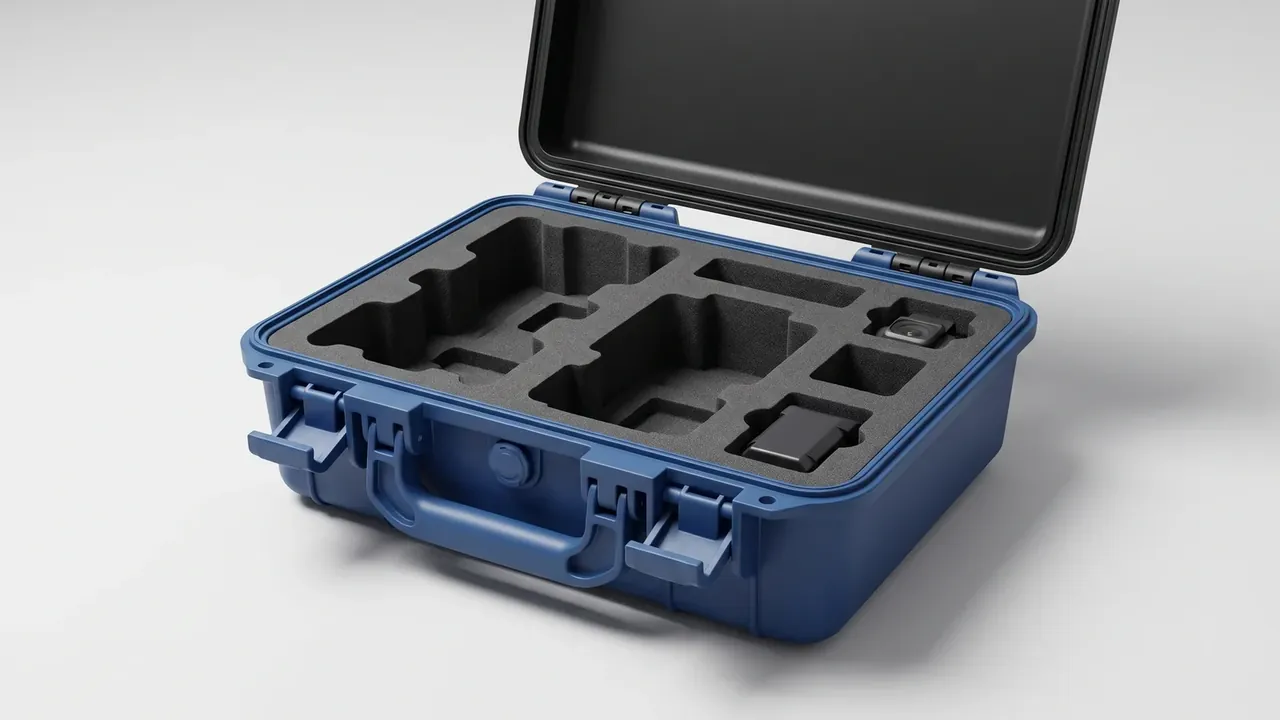
Quick answer: Measure the folded airframe diagonal first. A drone plastic protective carrying case wants 15 mm clearance per side, a 3.0 mm wall, foam at 45 and 25 kg/m3, and a 1 m immersion test before you commit.
Table of contents
- Five Checks That Decide a Drone Plastic Protective Carrying Case
- Cavity Size and Airframe Posture
- Wall Thickness Against Carry Weight
- Foam Density and Gimbal Support
- Handle, Latches and Seals on the Bench
- FAQ
1. Five Checks That Decide a Drone Plastic Protective Carrying Case
Three cases swallow the same drone; the difference shows after landing. A drone plastic protective carrying case passes five checks together: clearance, wall against empty weight, foam zoning, seal and latches, and the handle.
| Check | What to look at | Threshold | Common mistake |
|---|---|---|---|
| Cavity clearance | Diagonal plus props | 15 mm each side | Measuring length only |
| Wall and weight | Measured thickness | 3.0 mm, 2.9 kg | Weighing the whole case |
| Foam zoning | One pocket per item | 45 body, 25 gimbal | One density throughout |
| Seal and latches | Witness mark, force | Two latches at 60 N | Counting latches only |
| Handle | Rivets, static load | 25 kg for 2 hours | Lifting it empty |
2. Cavity Size and Airframe Posture
Measure the airframe first: diagonal, thickness, props on or off. A 397 mm diagonal inside a 480 × 350 × 190 mm cavity leaves 15 to 24 mm per side, enough for foam to grip.
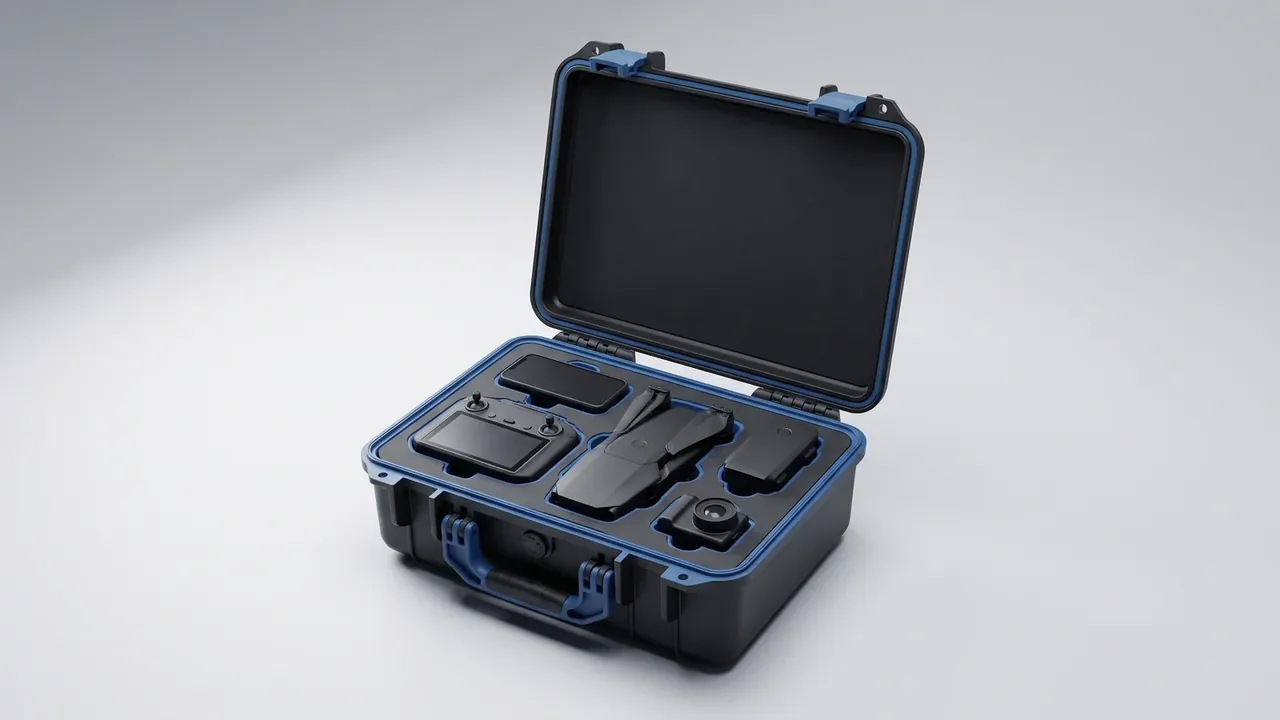
Posture sets height: folded arms 95 mm, props left on adding 40, raised sticks another 55. Past that, the only option is cutting through to the base, sending impact into the airframe.
More clearance is not better. Past 30 mm the foam thickens until the lid is hard to latch, or leaves a gap where the airframe slides.
3. Wall Thickness Against Carry Weight
A drone plastic protective carrying case with a 3.0 mm PP wall around a 480 × 350 × 190 mm cavity lands near 2.9 kg empty. At 2.4 mm it drops to 2.2 kg, but corner deflection in a 1.2 m six-face drop climbs from 2 mm to over 6 mm.
Strength is not linear in weight: 2.4 to 3.0 mm adds 0.7 kg and doubles corner strength, while another 0.6 mm adds 0.9 kg for 30 percent.
| Wall | Empty weight | Corner deflection, 1.2 m | Suits |
|---|---|---|---|
| 2.4 mm | 2.2 kg | Over 6 mm, hinge cracks | Van transport |
| 3.0 mm | 2.9 kg | About 2 mm | Walking in, field use |
| 3.6 mm | 3.8 kg | Under 1.5 mm | Rough roads |
A ribbed base is 40 percent stiffer, costing 6 mm of height.
4. Foam Density and Gimbal Support
Foam is the only part of a drone plastic protective carrying case touching the airframe, so density cannot be fixed later. The body wants 45 kg/m3 EVA; the lens and gimbal want 25 kg/m3. One density throughout puts every drop load on the gimbal shaft.
Zoning does three things: float the gimbal 8 mm clear, give each battery a 5 mm divider, and face the sticks up in a pocket 3 mm deeper than they are tall. Die cuts want 1.5 to 2 mm of interference.
5. Handle, Latches and Seals on the Bench
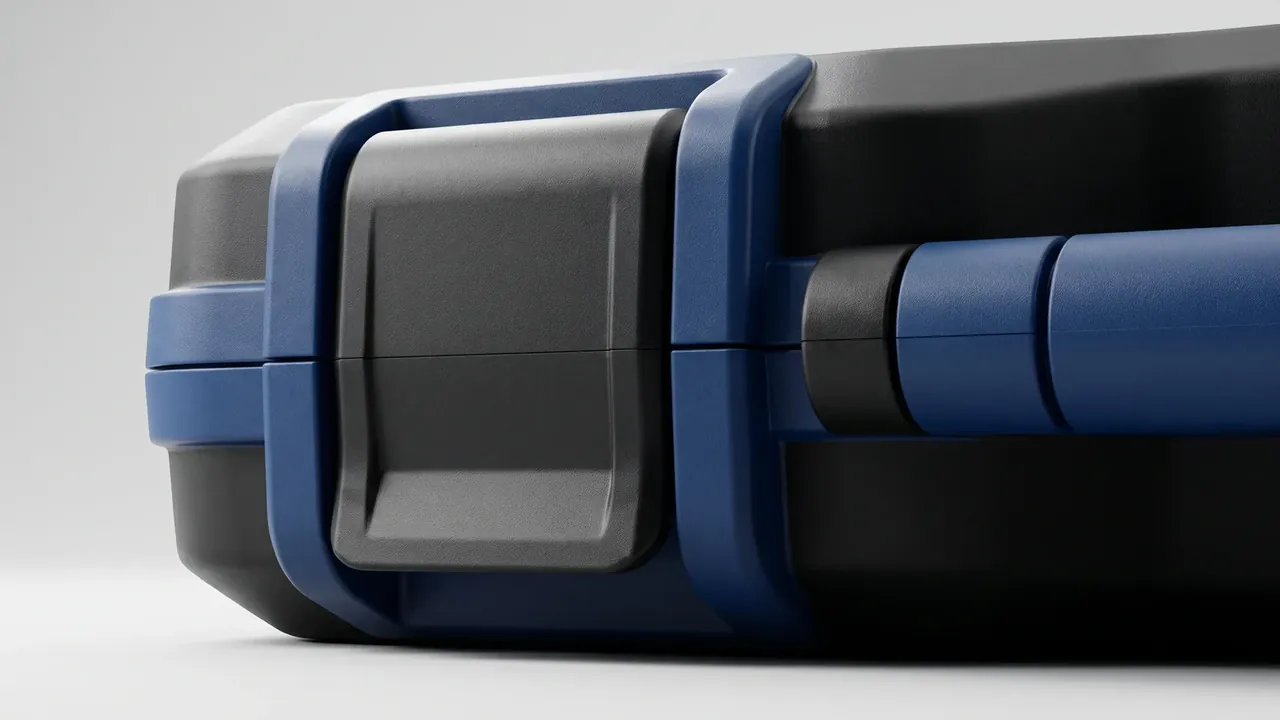
Three checks settle on a drawing; two need hands. Hang 25 kg on the handle for 2 hours: rivets stay tight, plastic must not whiten.
Two latches at 60 N close with one gloved hand. Once shut, the seal shows a continuous mark 2 to 3 mm wide; one break means no seal. Immerse 1 m deep for 30 minutes.
| Test | Method | Pass | Fail |
|---|---|---|---|
| Handle load | 25 kg, 2 hours | Rivets tight | Whitening at rivets |
| Latch closing | One gloved hand | About 60 N, crisp snap | Needs both hands |
| Seal witness | Open after closing | Continuous mark | Gaps in the mark |
| Immersion | 1 m, 30 minutes | Tissue bone dry | Damp corners |
| Hinge gap | Feeler gauge | Within 0.5 mm | Uneven, stiff action |
Hinge gap is skipped most: past 0.5 mm the lid rocks, the seal rubs, and sealing fails within months.
Conclusion
Measure, size, settle the wall, zone the foam, then test the handle and the seal. Clearance and foam decide daily comfort; wall and latches decide whether the kit survives one drop. Chosen that way, a drone plastic protective carrying case earns its place on the walk in.
This article discusses only the container (case body) side of specifications and design intent, and does not cover any handling, loading or use of the contents.
Related Reading
- Custom foam insert specifications
- Comparing foam cutting methods
- Six common drone case problems
- Choosing a wheeled protective case
Related Products
- 8 Series — Gun Cases; Military Equipment Cases; Camera Equipment Cases; Drone Cases; Watch Cases; Knife Cases; First Aid Cases; Electronics Equipment Cases
- WL8-2812 PP Gun Case — model WL8-2812
- All protective cases and toolboxes: 7 series, 158 models