

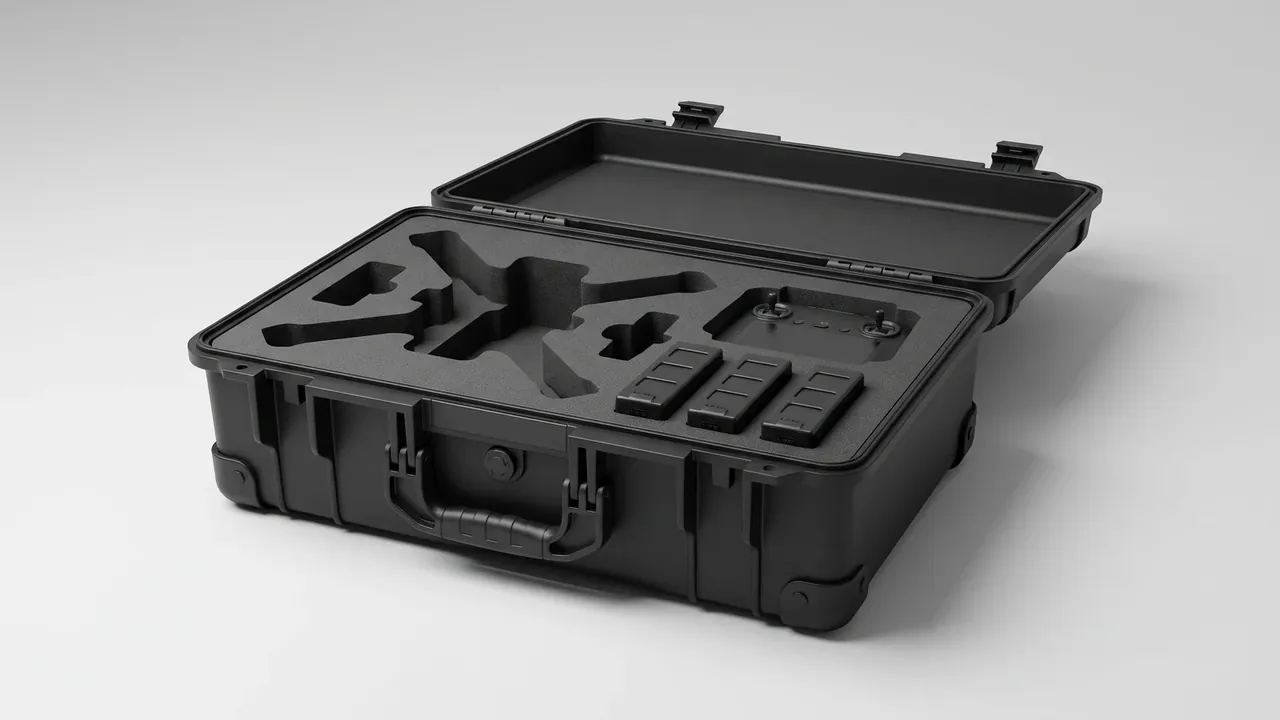
Quick answer: Choose a drone transport case by load format, then by stack load, vibration travel, dock drops and closure cycles. Transit damage comes from hours of static load and repeated handling more than one big fall, so stacking comes first.
Table of contents
- Load Format Comes First for a Drone Transport Case
- How Much Foam Collapses Under Stack Load
- Vibration Travel and Airframe Fixing
- Dock Handling and Cycle Life
- Pre-Shipment Checks and Packing
- FAQ
1. Load Format Comes First for a Drone Transport Case
Load format decides the other four criteria. Shipping whole saves time but grows the box; folding props saves volume and costs minutes of reassembly. Either way the outer size, liner and packed weight of a drone transport case change.
Shipping whole, leave 8 mm on length and width beyond the widest span and 20 mm on height, for a damping pad and a lid compression layer. A stacked case deflects at the lid, so a tight allowance lets the airframe touch the cover.
| Load format | Outer size | Packed weight | Site prep |
|---|---|---|---|
| Aircraft whole | 620 x 470 x 280 mm | 32 kg | 2 minutes |
| Props folded | 560 x 420 x 240 mm | 26 kg | 6 minutes |
| Airframe split | 480 x 380 x 220 mm | 21 kg | 10 minutes |
Keep packed weight under 32 kg: 8.6 kg of case, 4.2 kg of airframe and 19 kg of batteries reach it, and anything heavier costs a handler balance.
2. How Much Foam Collapses Under Stack Load
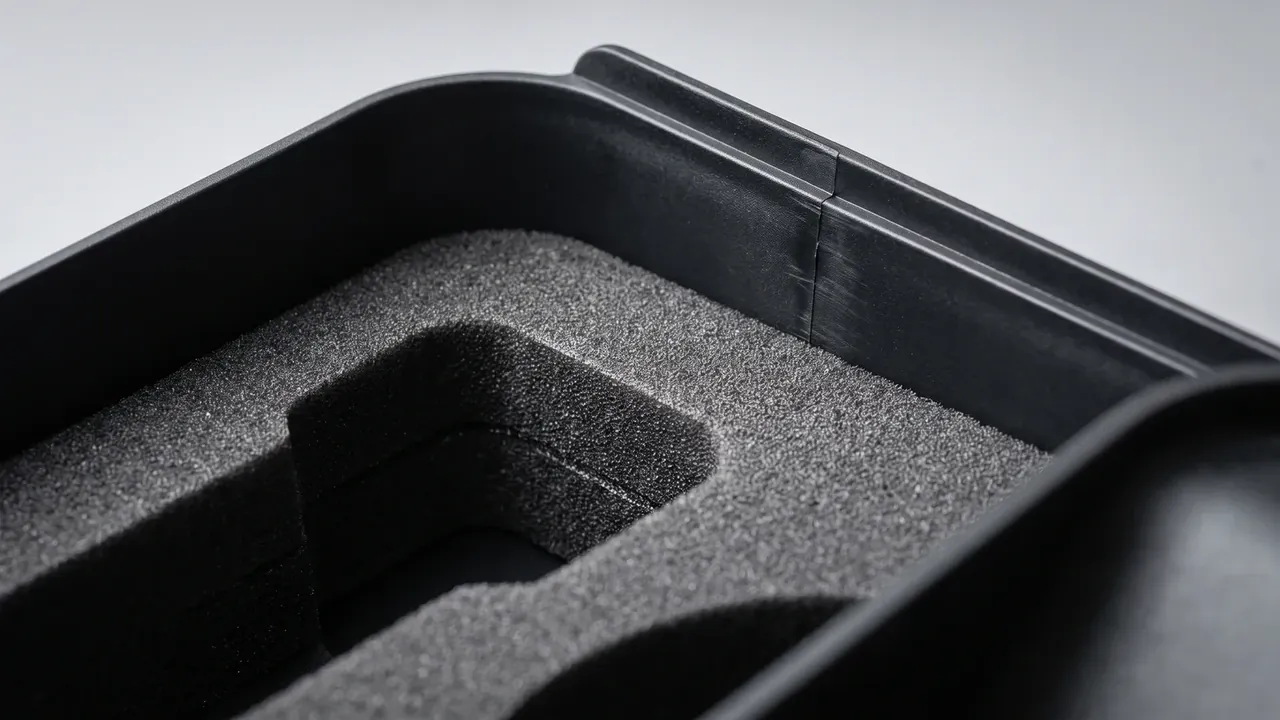
Protection is one impact; transport is hours of static load. Stack three high and the bottom drone transport case carries 64 kg on the lid for 72 hours.
| Stack | Load on lid | Duration | Allowed set |
|---|---|---|---|
| 2 high | 32 kg | 72 hours | 1 mm |
| 3 high | 64 kg | 72 hours | 2 mm |
| 3 high at 60 C | 64 kg | 72 hours | 3 mm |
Hold permanent set to 2 mm. Beyond that, marks form at the cavity floor, the airframe sinks and the arms stop meeting the walls; at 60 C the same foam sets 3 mm.
The fix is a 5 mm hard load plate in the lid, not thicker foam: it spreads force into the walls and keeps a three-high stack under 1.5 mm of set.
3. Vibration Travel and Airframe Fixing
Road vibration rarely cracks a case, but it walks the airframe around its cavity. Sweep 5 to 500 Hz and dwell 35 minutes: sound designs hold travel under 1.5 mm, and past 3 mm the arms rub and shed dust.
Three things control travel: cavity depth, lid compression and straps. Cut the cavity to two thirds of the airframe height, let the lid pad take the rest at 3 to 5 mm of compression, and give batteries 2 mm of clearance in their own slots.
4. Dock Handling and Cycle Life
Dock drops are lower than expected and far more frequent: sortation lines and tail lifts produce falls near 0.8 m, corners first. A 4 mm corner wall with a 12 mm radius halves the cracking rate.
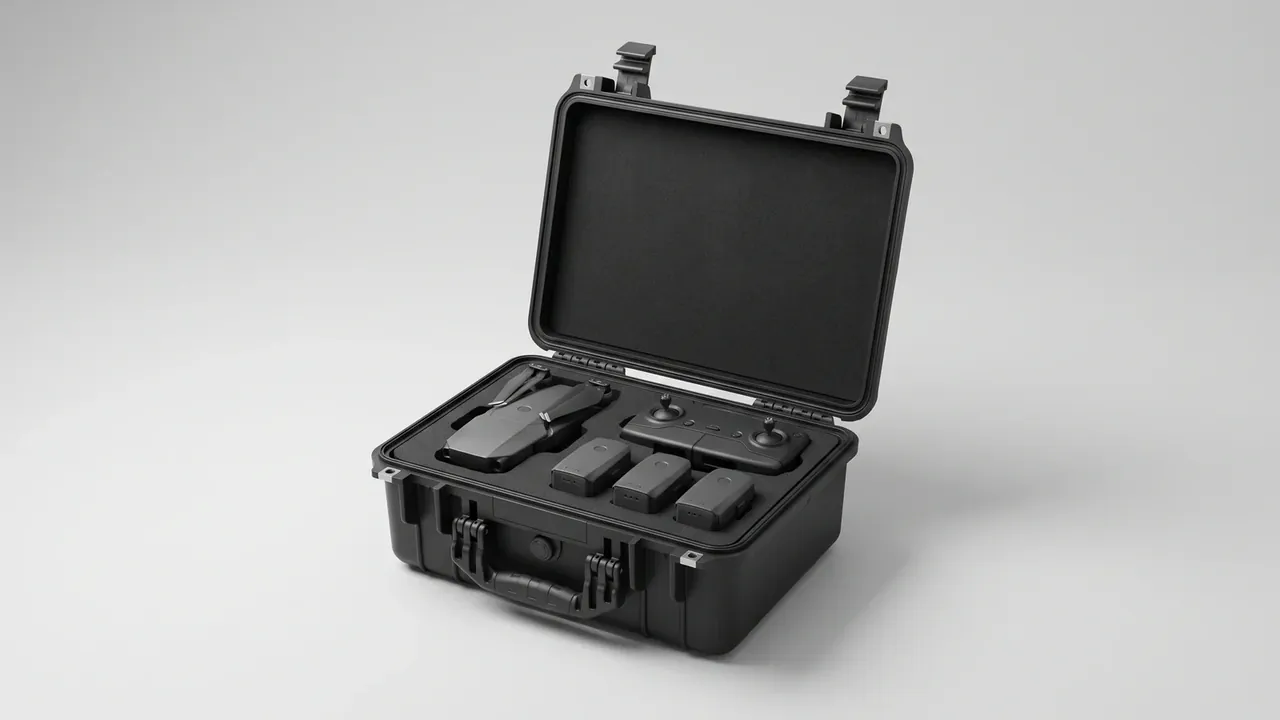
Four parts set cycle life, in order of replacement.
| Part | Life target | Replace when |
|---|---|---|
| Gasket | 5,000 closures | Set exceeds 30% |
| Hinge pin | 5,000 closures | Wear passes 0.3 mm |
| Latch | 3,000 closures | Preload below 2 mm |
| Handle | 50 kg static | Rivets work loose |
5. Pre-Shipment Checks and Packing
The pre-shipment check confirms this trip, not the specification. On a 1,200 x 800 mm pallet a 620 x 470 mm case sits two per layer and twelve over two tiers: one truck unit.
Match packing to mode: corner guards for a full truckload, a tamper seal for less-than-truckload, stretch wrap for multimodal, which makes six cases behave as one load. Labels go 30 mm in from the top corner of the short side, readable on a stacked drone transport case.
Conclusion
Selection order for a drone transport case runs opposite to a protective case: load format, then stack load and vibration travel, then handling cycles and packing. Get the format wrong and four criteria need recalculating; miss the stack load and the foam collapses in the warehouse. That is what a drone transport case specification exists to prevent.
This article discusses only the container (case body) side of specifications and design intent, and does not cover any handling, loading or use of the contents.
Related Reading
- Export packaging and case fit
- Pallet marking standards
- Preventing storage and stack damage
- Drone case selection: envelope and zoning
Related Products
- 8 Series — Gun Cases; Military Equipment Cases; Camera Equipment Cases; Drone Cases; Watch Cases; Knife Cases; First Aid Cases; Electronics Equipment Cases
- WL8-2812 PP Gun Case — model WL8-2812
- All protective cases and toolboxes: 7 series, 158 models