

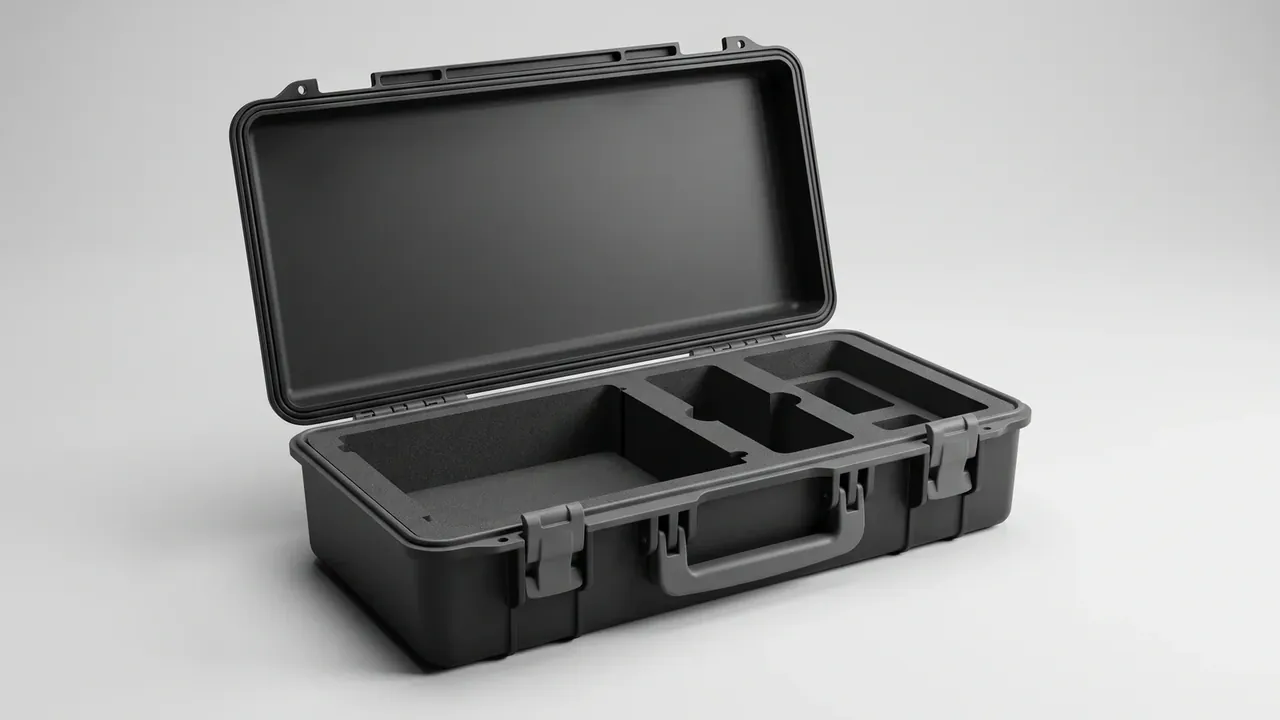
Quick answer: The site decides the configuration of a drop-resistant equipment case, not the other way round. Vehicle work turns on tie-down points, field work on the insert, airport handover on corner blocks and wheels, repair rotation on how fast bays change.
Table of contents
- Where a Drop-Resistant Equipment Case Meets Its Drops
- Vehicle and Shelter Mounts: Tie-Down Points and Stack Levels
- Field Sites: Cushioning Comes From the Insert
- Airport and Multimodal Handover: Corners and Wheels
- Repair Crews and Rotation: Configuration Swaps
- FAQ
1. Where a Drop-Resistant Equipment Case Meets Its Drops
A laboratory drop is a clean free fall; a real one is not. A case sliding off a tailgate hits an edge, tumbles and lands on a corner, and one slipping off a strap carries sideways speed. A drop-resistant equipment case survives that rotating sequence.
| Drop source | Common height | Main contact area |
|---|---|---|
| Slipped strap | 1.2 m | Bottom corner and edge |
| Tailgate slide | 0.9 m | Side edge, then corner |
| Stack collapse | 2.0 m | Lid centre and latches |
Heights cluster at 1.2 m from the shoulder, 0.9 m at the tailgate and 2.0 m from a stack top. From 2.0 m the lid centre lands first, and latch seats tear open more often than the body cracks.
2. Vehicle and Shelter Mounts: Tie-Down Points and Stack Levels
On a vehicle the first job for a drop-resistant equipment case is keeping it still. Floor rings sit 500 mm apart, and misaligned points force a diagonal strap that loosens over every bump. Shelter stacking runs three high at 45 kg, so the bottom case carries 135 kg.
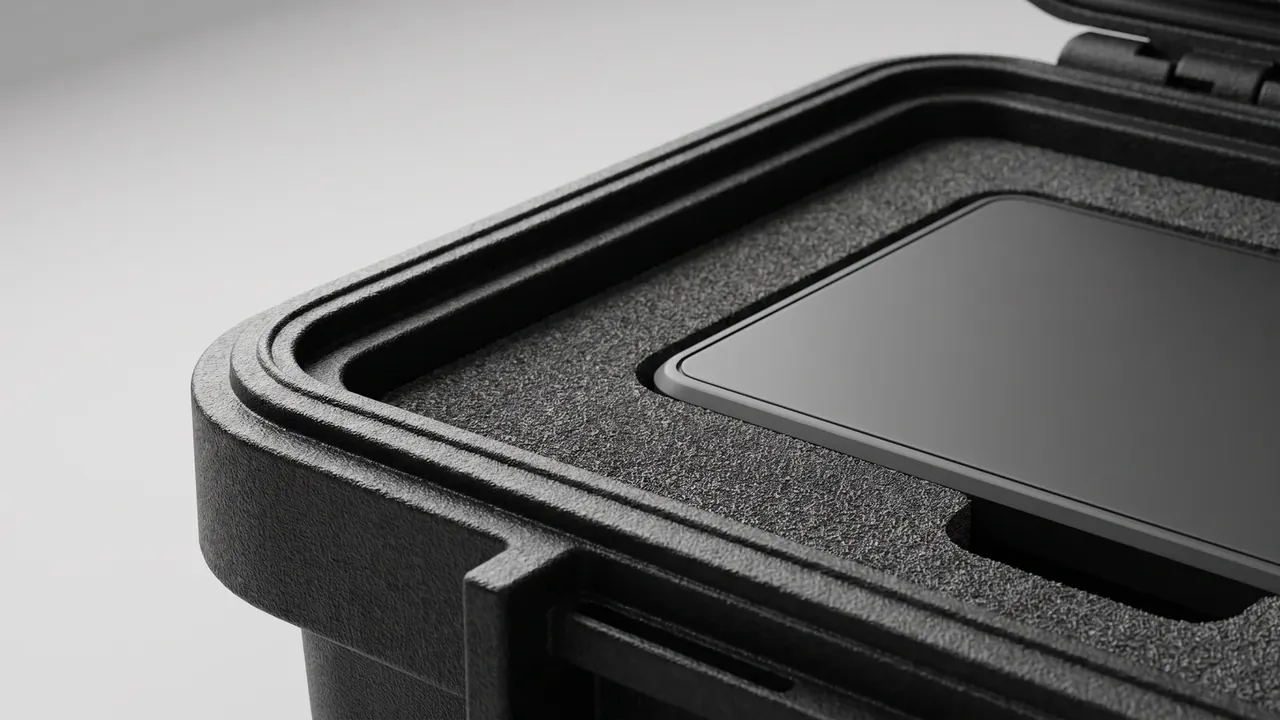
Vibration wears more than drops: from 5 to 200 Hz for an hour per axis, the handle pin and latch axle loosen first, so vehicle versions recess the handle. Straps are 25 mm wide at 400 N.
3. Field Sites: Cushioning Comes From the Insert
In the field there is no tailgate: cases are handed down 0.6 to 0.8 m onto gravel or frozen ground, so the insert absorbs almost everything.
| Field condition | Insert arrangement | Key figure |
|---|---|---|
| Gravel, hand carried | 25 mm foam, corner blocks | 12 mm extra at corners |
| Frozen or hard ground | Twin layers, separate bays | 8 mm bay walls |
| Dust | Foam wrapped in film | Wipe the rim first |
The insert starts at 25 mm of 45 kg/m³ polyethylene with 12 mm blocks at the corners; foam spreads a point strike, and swapping those blocks moves the peak by about 30 percent. Shared bays are the usual mistake: loose instruments strike each other harder than the wall.
4. Airport and Multimodal Handover: Corners and Wheels
Airport drops are low and frequent: a baggage tractor crosses a 30 mm step at 15 km/h and the case lands a dozen times per flight, so wear collects at corner blocks and wheel mounts rather than on the wall.
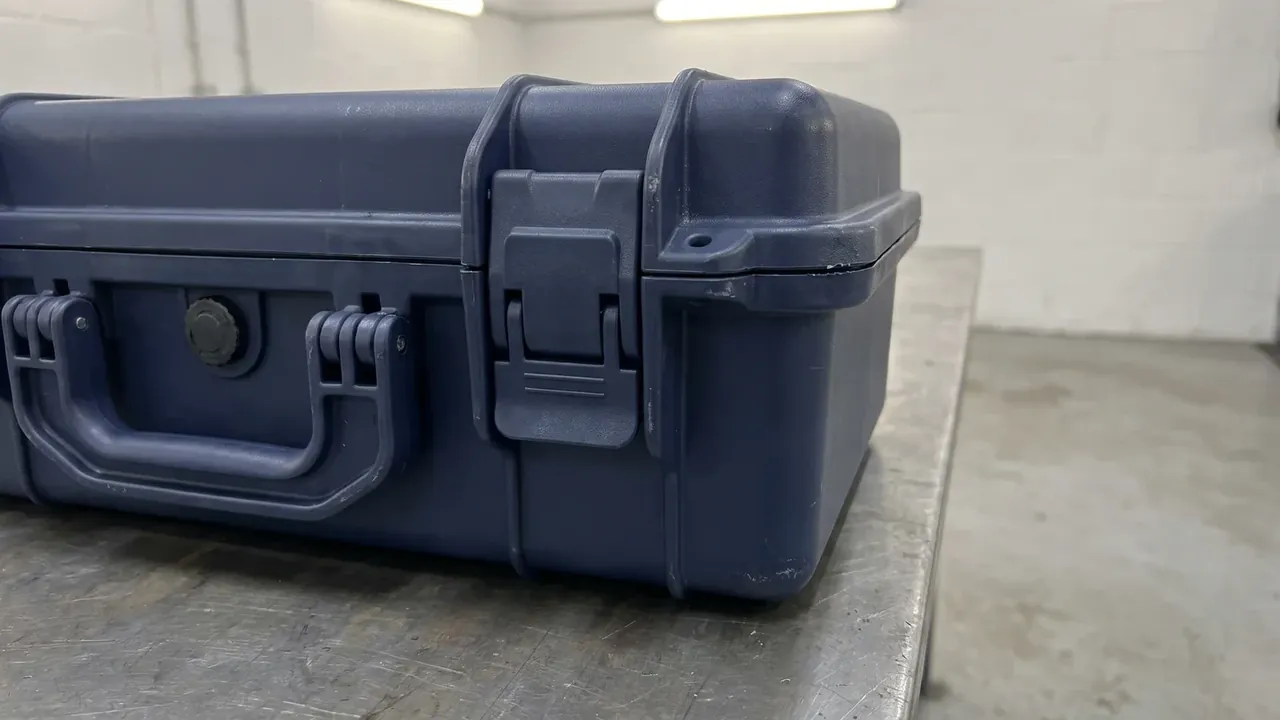
On a drop-resistant equipment case, corner blocks wrap three faces at 4 mm thick and sit 0.5 mm clear of the body on countersunk screws, so the block deforms first and the screw is spared the shear. Wheels are 75 mm and rated 60 kg each: four suit a flat floor, two plus a pull handle track better over thresholds. Container stacking above 1.5 m loads the lid statically, so creep matters more than drop height.
5. Repair Crews and Rotation: Configuration Swaps
A repair vehicle reloads every shift, so the layout has to change: dividers in slots at 25 mm pitch let a 60 L case go from six bays to two in ten minutes.
| Duty cycle | Configuration | Decision figure |
|---|---|---|
| Single-shift inspection | Two bays, light foam | Under 12 kg per case |
| Three-day post | Four bays plus tool slots | Two dividers |
| Long field stay | Six bays plus spares layer | 40 mm spares layer |
Rotation also needs a fast fitness check at the depot: block wear past 2 mm, a latch that closes too easily, foam crumbling at the cuts. Any one retires the case, and at −35 °C the foam drops to 35 kg/m³.
Conclusion
The five sites differ in drop attitude and handling count: vehicles fear movement, field sites fear point impact, airports fear repeated knocks, repair crews fear a layout that cannot change. A drop-resistant equipment case earns its place by taking one hit on every handover.
This article discusses only the container (case body) side of specifications and design intent, and does not cover any handling, loading or use of the contents.
Related Reading
- Loading scenarios for military supply transport cases
- How equipment cases are applied across industries
- How the cushioning structure of a shockproof case is built
- Drop test conditions for airdrop cases
Related Products
- 8 Series — Gun Cases; Military Equipment Cases; Camera Equipment Cases; Drone Cases; Watch Cases; Knife Cases; First Aid Cases; Electronics Equipment Cases
- WL8-2812 PP Gun Case — model WL8-2812
- All protective cases and toolboxes: 7 series, 158 models