

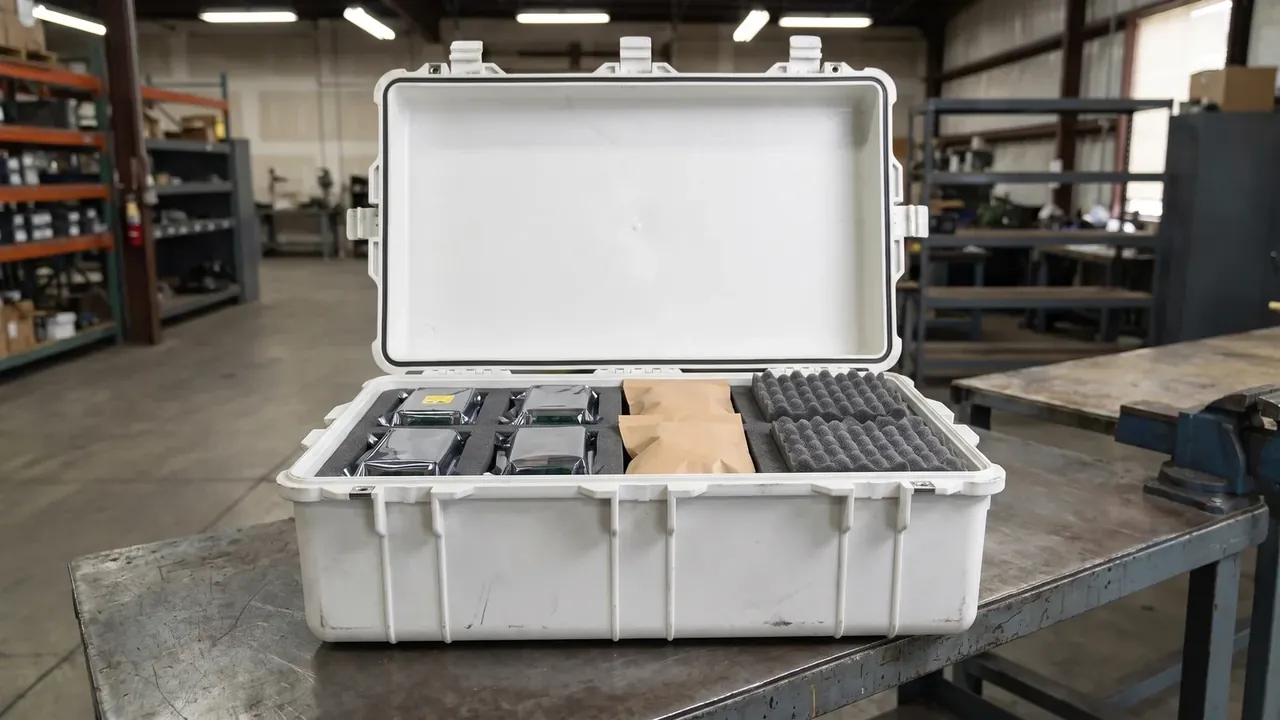
Quick answer: Fix compound and regrind share first, then UV hours, hammer mass with test temperature, hinge cycles and latch pull force. Four numbers turn year-five drop performance into arithmetic.
Table of contents
- Five Criteria for a Durable Plastic Protective Case
- Resin Grade and Additives
- UV Aging and Outdoor Exposure
- Drop Hammer and Cold Brittleness
- Hinges, Latches and Spares
- FAQ
1. Five Criteria for a Durable Plastic Protective Case
Two boxes labelled copolymer HDPE can differ twofold in drop performance. Grade, additives and wall distribution decide the fifth year, not the delivery day.
| Check | Number to obtain | Frequent mistake |
|---|---|---|
| Compound | Grade, melt index, regrind | Trusting virgin material |
| UV aging | Hours, retention | Asking about colour |
| Drop hammer | Mass, height, temperature | Room temperature only |
| Hinge and latch | Cycles, pull force | Judging by feel |
The checks run in order: compound, UV aging, drop hammer, hinge and latch fatigue, spares. Skip the first and every later test is measured against the wrong baseline, because the checks fight each other: higher regrind pulls the drop value down, and thin walls come back as rib roots, where cracks start.
2. Resin Grade and Additives
Injection-moulded bodies use copolymer HDPE at a melt flow rate of 6 to 9 g/10 min at 190 °C and 2.16 kg. On a 600 mm body, lifting the index from 7 to 12 costs over twenty percent of the drop value.
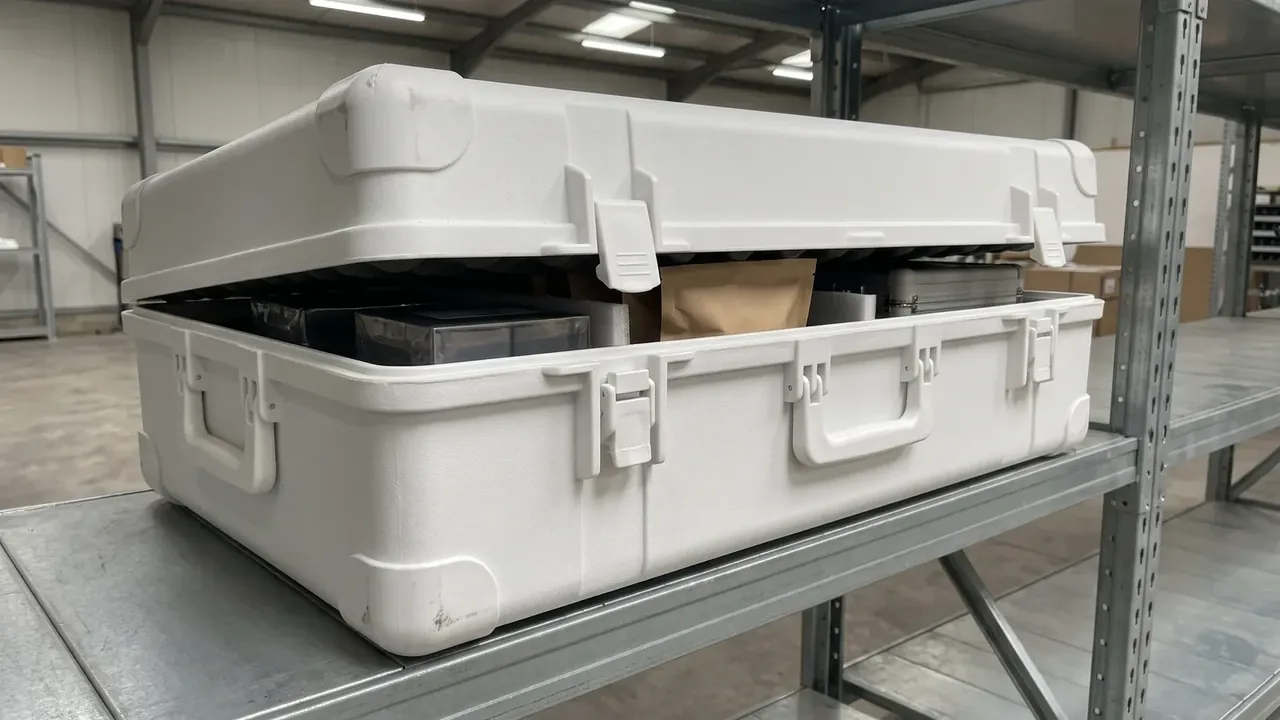
A Durable Plastic Protective Case normally carries 2.0 to 2.5 percent carbon black, 0.3 percent hindered amine light stabiliser and 0.1 percent antioxidant. Under 1.5 percent carbon black the skin chalks after two summers.
Regrind is the vaguest number in a Durable Plastic Protective Case quotation. To 15 percent, impact loses under five percent; at 30 percent the drop value can fall by a third while colour and finish look unchanged. Put the ratio in the contract.
3. UV Aging and Outdoor Exposure
Ask which lamp and which cycle before accepting any aging figure. A UVA-340 run of 1000 hours at 60 °C on an eight-hour light, four-hour condensation cycle is the usual entry point; a xenon run of 500 hours at 0.51 W/m² at 340 nm cannot be compared with it.
Colour is the weaker criterion. Within ΔE 3 is acceptable, but Charpy impact retention after aging, normally 70 percent, decides. Under 60 percent the surface looks sound while a corner knock opens a crack.
Twelve months of open storage in southern China delivers about 55 kWh/m² of UV, near 800 lab hours at 15 hours per unit. Outdoors, a Durable Plastic Protective Case should sit 150 mm off the floor.
4. Drop Hammer and Cold Brittleness
A hammer result means nothing without mass, height and temperature. The room-temperature test uses 5 kg from 1 m onto one bottom corner and both long-side midpoints. The cold group soaks four hours at minus 20 °C, is struck within 30 seconds, and passes with a dent under 6 mm and no through crack.
Cold is where cases separate. An 8 mm dent at 23 °C is deformation; the same blow at minus 20 °C can split the wall. The threshold sits near a 3.2 mm wall, below which stress at the corner radius turns impact into a crack.
Attitude matters too. A corner drop concentrates energy into a few square centimetres; a face drop is easiest to pass and most often quoted, yet says little about the margin in a Durable Plastic Protective Case.
5. Hinges, Latches and Spares
A 4 mm 316 stainless pin in a POM bushing should stay within 0.6 mm of play after 20,000 cycles, which at eight openings a day covers six years and ten months.
A latch rated 350 N and still holding 280 N after 3,000 cycles is sound on a Durable Plastic Protective Case; below that a loaded case springs open and the gasket never compresses.
| Part | Key figure | Replace when |
|---|---|---|
| Hinge pin | 4 mm, 316 stainless | Play above 0.6 mm |
| Latch | 350 N, 3,000 cycles | Holding under 280 N |
A spares kit ordered with the first batch is the cheapest decision here. Pins, latches and gaskets cost under ten percent of the case yet decide whether it is repaired or scrapped.
Conclusion
Durability is four checkable numbers: melt index with regrind share, aging hours with impact retention, hammer mass with height and temperature, hinge and latch cycles. Written into the enquiry they make quotations comparable, and they settle at specification stage whether the box survives a corner drop in year five. That is why a Durable Plastic Protective Case deserves the extra half day of checks.
This article discusses only the container (case body) side of specifications and design intent, and does not cover any handling, loading or use of the contents.
Related Reading
- How to specify a PP plastic case
- Injection-moulded protective case structure
- How rotational moulding sets wall thickness
- Material comparison for portable plastic tool boxes
Related Products
- 8 Series — Gun Cases; Military Equipment Cases; Camera Equipment Cases; Drone Cases; Watch Cases; Knife Cases; First Aid Cases; Electronics Equipment Cases
- WL8-2812 PP Gun Case — model WL8-2812
- All protective cases and toolboxes: 7 series, 158 models