

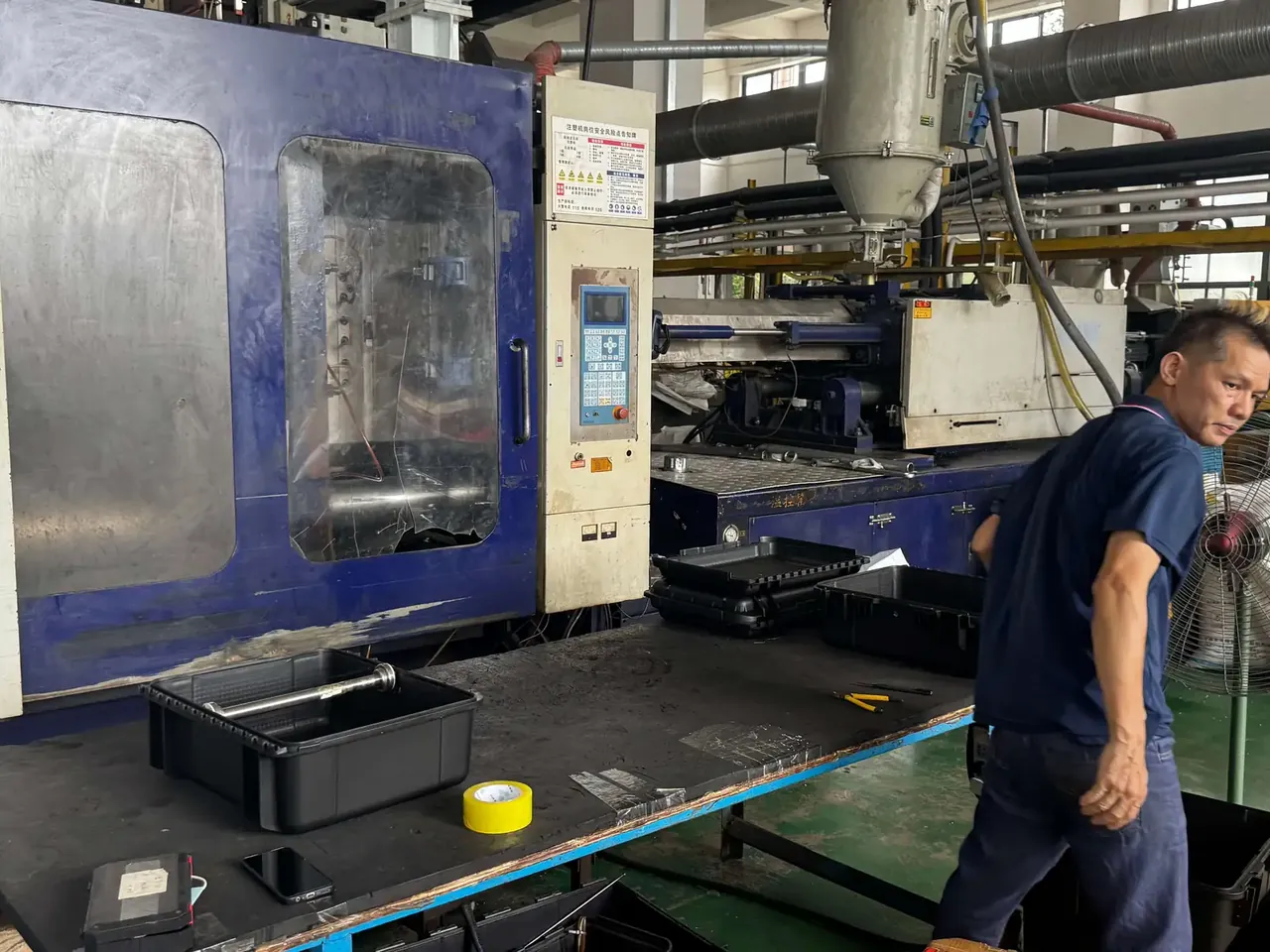
Quick answer: Choosing an injection molded protective case comes down to four accounts: wall thickness sets empty weight and drop resistance, ribs buy stiffness without mass, tooling has to be amortised over a batch, and the batch decides unit cost and lead time. Fix wall and volume first, then ribs and tool structure.
Table of contents
- The Wall Thickness Account
- Rib Layout Without Adding Mass
- Tooling Cost and How It Amortizes
- Batch Size and the Unit-Cost Curve
- A Checklist and the Trial Run
- FAQ
1. The Wall Thickness Account
Wall thickness comes first: it sets weight, stiffness and moulding difficulty at once. On a 500 by 350 by 180 mm case, 2.5 mm runs about 1.9 kg empty, 3.0 mm about 2.3 kg, and 4.0 mm about 3.1 kg.
Stiffness follows the cube of thickness, so the useful window is narrow. Moving from 2.5 to 3.0 mm lifts bending stiffness about 1.7 times for 20 percent more weight, while 4.0 mm doubles stiffness again but adds 60 percent to mass.
| Wall (mm) | Empty weight (kg) | Relative stiffness | Typical use |
|---|---|---|---|
| 2.5 | about 1.9 | 1.0 | Indoor storage, light handling |
| 3.0 | about 2.3 | 1.7 | General transport, single stacking |
| 4.0 | about 3.1 | 4.1 | Drop duty, multi-layer stacking |
2. Rib Layout Without Adding Mass
Ribs top up stiffness after the wall is fixed. A 40 mm grid on the base of a 3.0 mm case reaches two to three times the stiffness of a flat panel for 15 to 25 percent more weight, since material sits further from the neutral axis.
Rib thickness is where cases go wrong. Keep the main rib at 0.6 to 0.7 of the wall, so 1.8 to 2.1 mm on a 3.0 mm case, and under 0.8 or the opposite face sinks. Height stays within three times the wall, roots at 0.25 to 0.5 mm radius, draft 0.5 to 1 degree.
3. Tooling Cost and How It Amortizes
Tooling cost is a set of structure decisions. A single-cavity 718H tool with a simple parting line lands near 80,000 yuan; slides, a hot runner and polished cavities push a mid-size tool to about 150,000; two cavities or a large body start at 250,000.
Steel sets life, since 718H suits about 300,000 shots while a million needs S136. A second cavity doubles cost and output together, and every slide adds machining hours.
| Tooling (yuan) | At 3000 pcs | At 5000 pcs | At 10,000 pcs |
|---|---|---|---|
| 80,000 | 26.7 | 16.0 | 8.0 |
| 150,000 | 50.0 | 30.0 | 15.0 |
| 250,000 | 83.3 | 50.0 | 25.0 |
4. Batch Size and the Unit-Cost Curve
Unit cost has four blocks: material, moulding, tooling amortisation and packing. The first two stay flat while amortisation falls as a hyperbola, so the sum drops steeply and then flattens.
On the same case, a 150,000 yuan tool with about 18 yuan of material and moulding gives roughly 68 yuan at 3000 pieces, 48 at 5000 and 33 at 10,000.
| Batch (pcs) | Amortisation (yuan/pc) | Total unit cost (yuan) | Lead time (days) |
|---|---|---|---|
| 3000 | 50.0 | about 68 | 25 |
| 5000 | 30.0 | about 48 | 30 |
| 10,000 | 15.0 | about 33 | 40 |
5. A Checklist and the Trial Run
The checklist covers dimensions, loads, structure and appearance: internal and external size, lid clearance, rated load, stacking layers, drop height, hinge and latch positions, and the sink level you accept.
Trials run twice. T1 checks fill and release; T2 checks size and lid fit, with a diagonal within 1.5 mm and a gap even at about 0.5 mm. Write the tolerances in: wall plus or minus 0.1 mm, weight 3 percent, loaded drop from 1.2 m.
Conclusion
Work the four accounts in order and selection stops being guesswork: wall sets weight and stiffness, ribs restore stiffness at the same mass, tooling amortises across the batch, and the batch sets unit cost and lead time. The hard part is the order: lock volume and load first, derive wall and ribs from them, and argue about tool structure last. Done that way, the quote and the part match for an injection molded protective case.
This article discusses only the container (case body) side of specifications and design intent, and does not cover any handling, loading or use of the contents.
Related Reading
- Costing a case from tooling to unit price
- How wall thickness maps to case strength
- Rib spacing and thickness limits
- What T1 and T2 trial runs should prove
Related Products
- 8 Series — Gun Cases; Military Equipment Cases; Camera Equipment Cases; Drone Cases; Watch Cases; Knife Cases; First Aid Cases; Electronics Equipment Cases
- WL8-2812 PP Gun Case — model WL8-2812
- All protective cases and toolboxes: 7 series, 158 models