

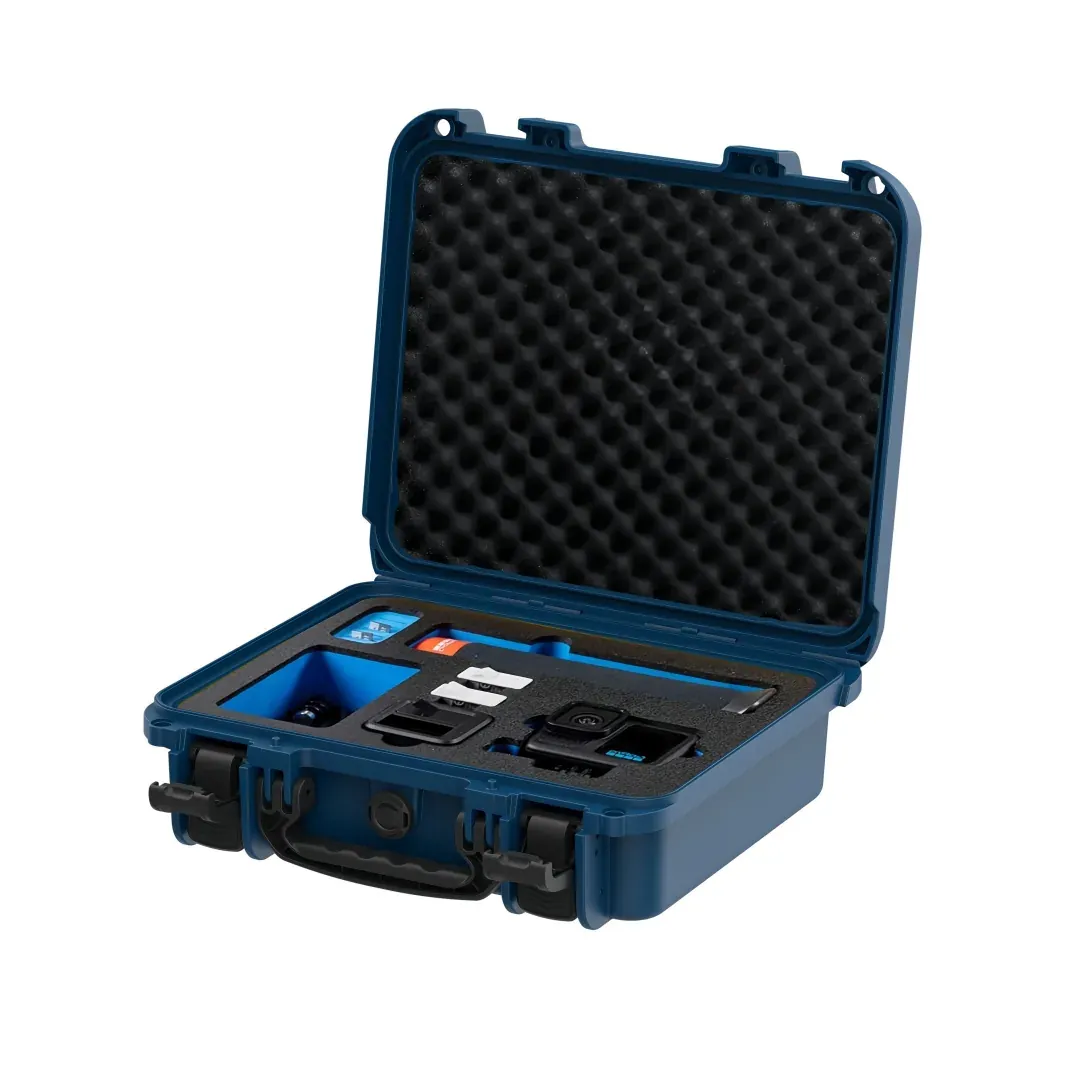
Quick answer: Dustproof and Waterproof Industrial Case Design rests on one compression line: a 4.5 mm groove, 25%–30% squeeze, IP6X dust and IPX7 immersion.
Table of contents
- Dust reaches a case through gaps, not the front face
- How seal squeeze pairs with groove dimensions
- Silicone, EPDM and PVC: which one where
- The relief valve: sealing a case you still have to open
- What IP6X and IPX7 actually test
- FAQ
1. Dust reaches a case through gaps, not the front face
A leaking case is rarely short of rubber; it is short of groove depth and calculated squeeze. In Dustproof and Waterproof Industrial Case Design, dust follows the same route as water. Particles on the lid are carried away by air, while particles in the joint get pushed inward by every pressure change. Eight hours in a dust chamber lets the finest fraction work along latch pockets and the breather hole.
The route has five links in series: mating face, gasket, groove, latch clamp, relief valve. A mating face that is not flat leaves the other four pressing on a few points. Checking it needs no instrument: close the lid, run a finger around the joint, and any step you feel becomes a breathing channel later. A straight slot is blown clear in one pass, so the joint is usually stepped to force the air to turn twice and drop dust on the outer ledge. Cut the step shallow and the turn does nothing.
2. How seal squeeze pairs with groove dimensions
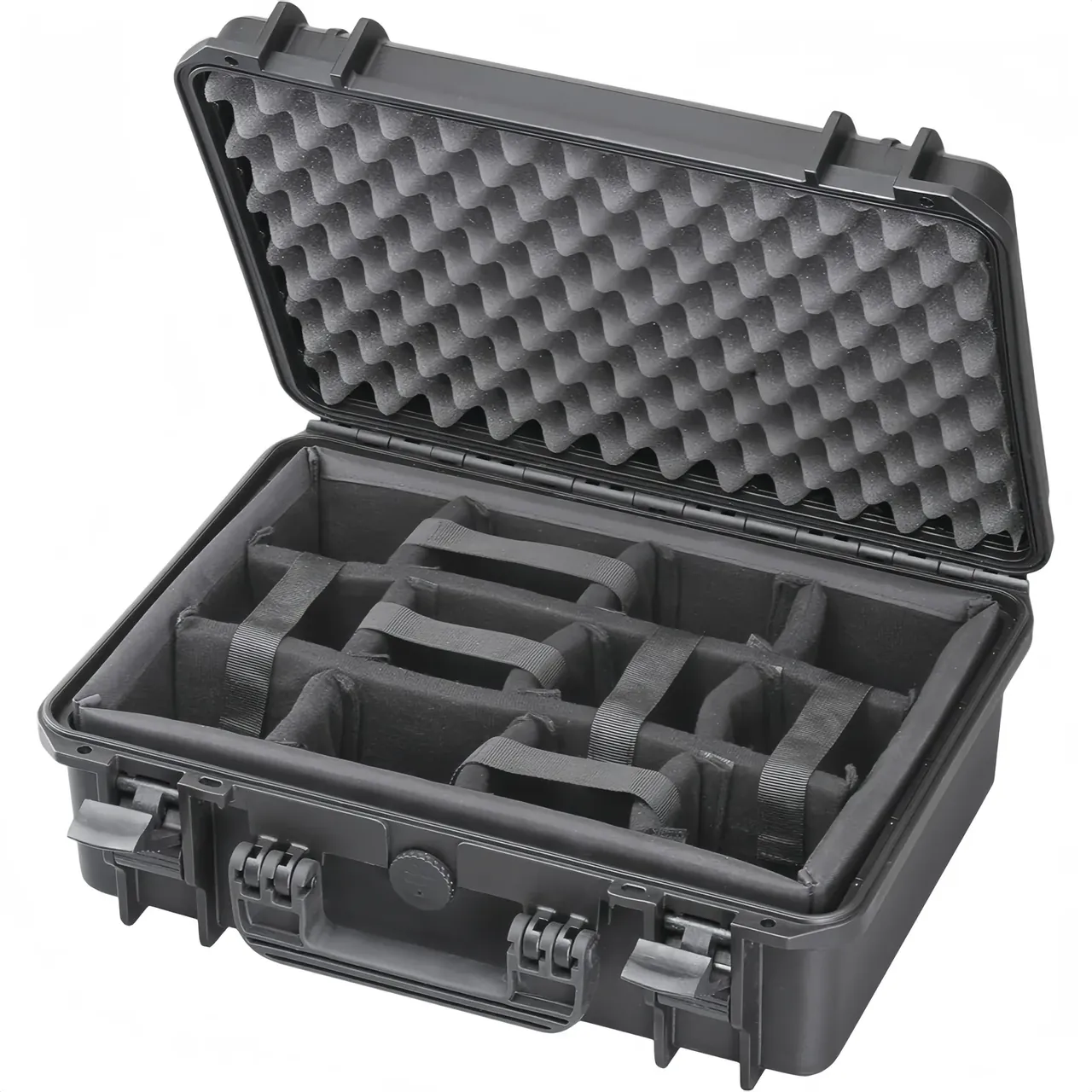
In Dustproof and Waterproof Industrial Case Design, width and depth are arithmetic, not instinct. A 4.5 mm wide, 3 mm deep groove is a common pair, and the cord inside should lose 25%–30% of its section height. Less squeeze and the cord rests at the mouth, sliding sideways once the lid is loaded. More squeeze and the rubber lives under stress, compression set builds fast, and a reopened case never closes to the same height.
Working back from depth sizes the cord quickest. A 4.0 mm cord in a 3 mm groove is squeezed 25%, a 4.3 mm cord 30%. The 4.5 mm width is room to bulge sideways. Too narrow and the rubber locks; too wide and the cord shifts, losing the seal line when the lid twists.
| Groove width | Groove depth | Squeeze | Matching cord |
|---|---|---|---|
| 4.5 mm | 3 mm | 25% | 4.0 mm |
| 4.5 mm | 3 mm | 28% | 4.2 mm |
| 4.5 mm | 3 mm | 30% | 4.3 mm |
In Dustproof and Waterproof Industrial Case Design, hardness is fixed alongside depth. Cord at Shore A 55–65 rebounds fast enough to fill the perimeter in seconds. Softer cord extrudes past the mouth; harder cord cannot absorb warp in the lid. Temperature shifts them too: at −20 ℃ rubber stiffens and a cold-store case feels tight, at 60 ℃ the cord softens and set builds in days.
3. Silicone, EPDM and PVC: which one where
In Dustproof and Waterproof Industrial Case Design the three divide by medium and temperature. Silicone rebounds best and holds hardness across −20–60 ℃, though it is only fair against oils. EPDM resists water and weather and stays tack-free after 48 h of salt spray. PVC is cheap, stiffens in the cold and takes a larger set, which limits it to dry, room-temperature work.
| Sealing material | Hardness | Temperature range | Suitable medium |
|---|---|---|---|
| Silicone | Shore A 55–60 | −20–60 ℃ | Dry air, light moisture |
| EPDM | Shore A 60–65 | −20–60 ℃ | Rain, salt spray, wash-down |
| PVC | Shore A 60–65 | Room temperature | Dry dust only |
The order is medium, then temperature, then cost. Washed metal parts leave alkaline residue, which EPDM handles better than silicone. Optical parts fear plasticiser fogging a lens, which rules PVC out. Sea freight adds 48 h of salt spray, and there the insert corrodes before the cord does. Hardness marking tolerance is missed most often: Shore A 55 and 65 feel alike yet differ enough in a 3 mm groove to leak.
4. The relief valve: sealing a case you still have to open
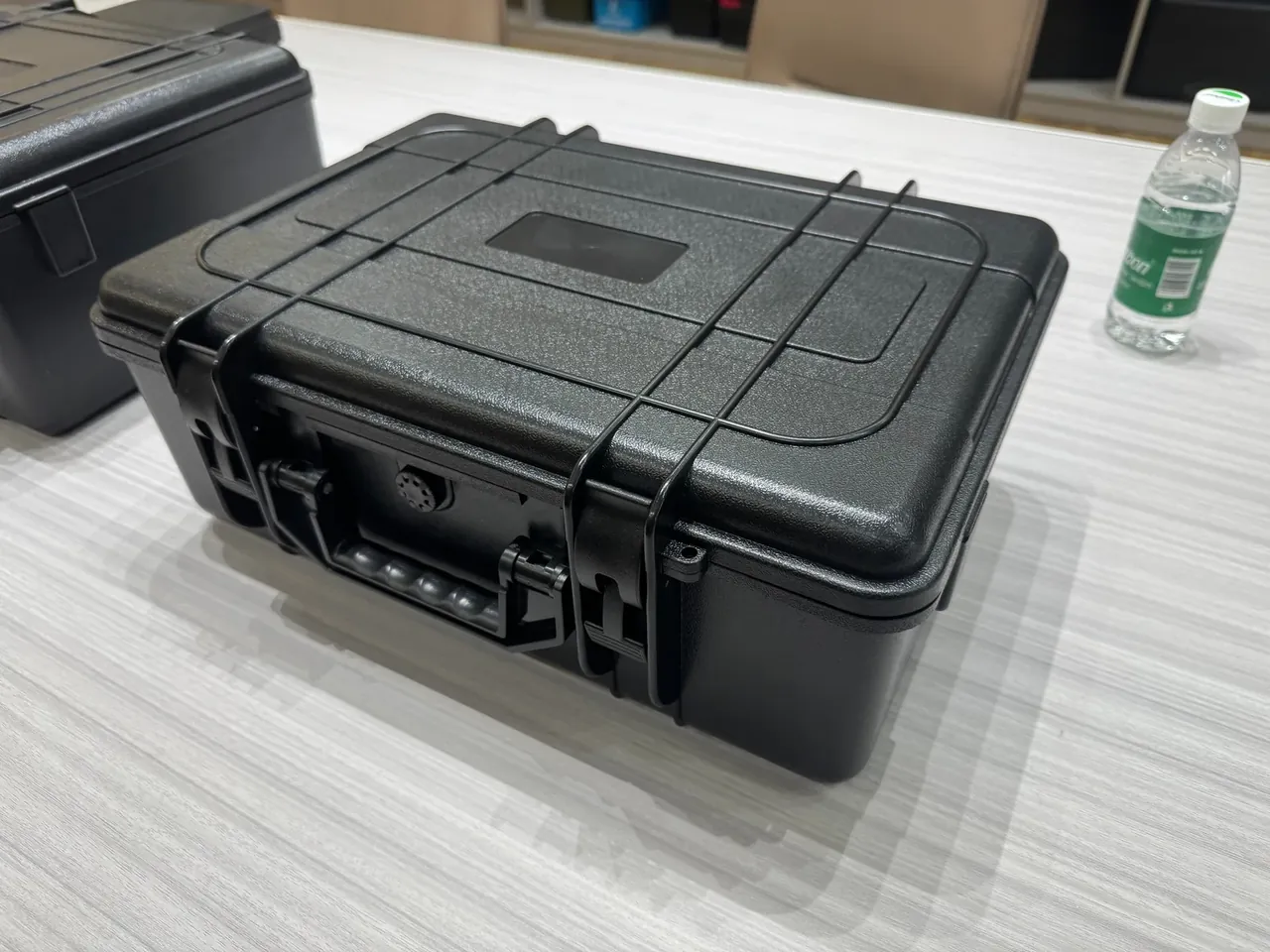
When internal and external pressure diverge, the gasket is either drawn into its groove or lifted off its seat. In Dustproof and Waterproof Industrial Case Design the valve handles that difference: at 0.35 bar the disc opens, air passes, water and dust do not. Air and sea freight swing pressure repeatedly, and a case without a valve hisses as it opens, the sound of rubber held against its will.
Mount the valve high on one wall, clear of pooled water and of the load path behind the latches. The body meets the shell on a lip-held seal, and over-torque collapses that lip until the valve is a hole with a cap.
The temperature clause applies here too. Hold water and case within 5 K, or the difference across the disc pulls water past the lip and the result is neither a pass nor a fail but an artefact.
5. What IP6X and IPX7 actually test
Dustproof and Waterproof Industrial Case Design faces two tests that answer two questions, and neither substitutes for the other. Dust follows IP6X: talc circulated in a chamber for 8 h, judged on whether visible dust reached the inside of the sealing lip. Water follows IPX7: 1 m of clean water for 30 min, water and sample within 5 K, then the lid comes off for indicator paper and liner.
| Protection item | Test condition | Duration | Verdict |
|---|---|---|---|
| IP6X dust | Talc circulated in a chamber | 8 h | No visible dust inside |
| IPX7 water | Immersion in 1 m of clean water | 30 min | No droplets, paper unchanged |
| Temperature control | Water to sample difference | Throughout | 5 K or less |
| Salt spray | Neutral salt fog | 48 h | No white rust on metal parts |
IPX7 says nothing about jet washing and does not license long soaking. A wash-bay hose delivers IPX5 pressure, where the cord meets a different load, so a pass on immersion is no licence to hose a case down.
Seal verdict: after 30 min of IPX7 immersion, any visible droplet inside the case or any colour change on the indicator paper condemns the batch as a sealing failure.
The whole of Dustproof and Waterproof Industrial Case Design reduces to one unbroken compression line: the step keeps dust on the ledge, the groove locates the cord, the squeeze holds contact pressure, the valve releases the difference, and 8 h of dust plus 30 min of water close the argument. Break that line and thickening the rest buys nothing.
Related Reading
- Gasket material: choosing between silicone, EPDM and PVC
- Groove width, depth and how much squeeze to leave
- Dust and water ratings and the conditions behind them
- Case volume, cavity space and the usable ratio
Related Products
- 8 Series — Gun Cases; Military Equipment Cases; Camera Equipment Cases; Drone Cases; Watch Cases; Knife Cases; First Aid Cases; Electronics Equipment Cases
- WL8-2812 PP Gun Case — model WL8-2812
- All protective cases and toolboxes: 7 series, 158 models