


Quick answer: A Dustproof Military Protective Case blocks fine powder via a twin-lip 8.0 mm groove: talc <=0.5 mg after 2 h and compression >=17% after 5000 cycles.
Table of contents
- Groove width tolerance in a Dustproof Military Protective Case
- Inner lid frame and gasket compression
- Reading talc deposits after the chamber test
- Compression recheck after the cycling rig
- Groove-width scrap line for dustproof batches
- FAQ
1. Groove width tolerance in a Dustproof Military Protective Case
A Dustproof Military Protective Case grows two lips around the mouth, leaving an 8.0 mm seal groove held to +/-0.3 mm. The outer lip takes airborne powder, the inner closes again under a pressure difference, and the cavity between leaves no straight path inside. Once the groove drifts, the gasket rocks sideways and dust works through the hairline between lip and strip.
The +/-0.3 mm band comes from the gasket section: closing needs 23% initial compression, and each extra 0.1 mm of width gives the strip slack the frame wastes before loading the lips. The shell is 600x430x260 mm outside, 535x370x190 mm inside, at 4.4 mm wall; empty mass 6.2 kg and rated load 13 kg keep a full lid from pulling the mouth oval. Four latches at 400 N each squeeze the strip, so a groove under 7.6 mm spends half their force and lifts the lid corners.
Production pulls three pieces per cavity at five stations along the long edge; any point outside the band quarantines that cavity. A Dustproof Military Protective Case keeps this log against the cavity number, so a deposit failure traces back without guesswork.
2. Inner lid frame and gasket compression
The inner lid frame is a raised rib pressing into the groove. Too short and only the outer lip loads; too tall and the strip loses rebound. A Dustproof Military Protective Case pairs frame height with groove width so 23% stays even around the perimeter.
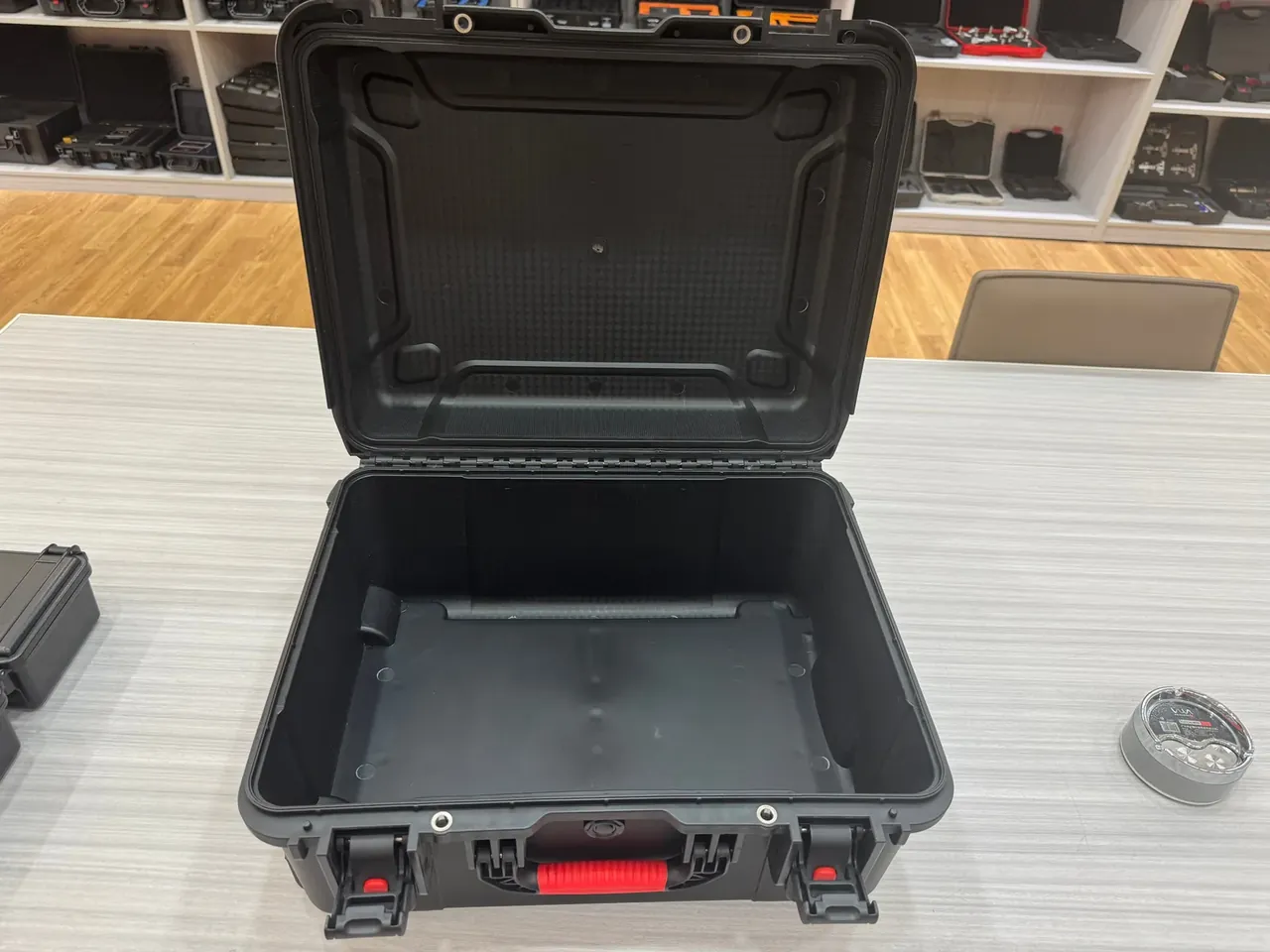
Four latches at 400 N each drive the frame onto its stop; 0.2 mm of wear there shifts compression a whole grade. A metal bush seats the frame, and the press-in depth must still read true after 5000 cycles. Compression is logged per location, since lid-stiffened corners usually fall under 17% first.
| Seal location | Groove measured | Compression |
|---|---|---|
| Long-edge middle | 8.0 mm | 23% |
| Short-edge middle | 8.1 mm | 21% |
| Lid corners | 7.9 mm | 19% |
Nineteen percent leaves two points above the 17% floor. Batch judgement uses the lowest location, not the best piece; three corners below 18% send the frame tool for repair.
3. Reading talc deposits after the chamber test
The chamber test holds a closed Dustproof Military Protective Case in suspended fine powder for 2 h, then weighs what settled inside. The limit is <=0.5 mg: only below it is the mouth seal of a Dustproof Military Protective Case accepted. Opening, sampling and weighing happen on a clean bench outside the cabinet.
The 2 h splits into three phases: concentration builds in the first 30 min, 30-90 min is the main ingress window, and the last phase shows whether deposits converge. Separate increments tell an assembly fault from lost rebound.
| Chamber phase | Concentration | Deposit |
|---|---|---|
| 0-30 min | 2 kg/m3 | 0.08 mg |
| 30-90 min | 2 kg/m3 | 0.31 mg |
| 90-120 min | 2 kg/m3 | 0.44 mg |
At 0.44 mg with only 0.13 mg added last the lot passes; a reading still climbing 0.1 mg per half hour needs a rebound recheck. A Dustproof Military Protective Case is checked against IP66 here, and weighing resolution stays at 0.01 mg so the 0.5 mg line is readable.
4. Compression recheck after the cycling rig
Compression falls with each cycle. A Dustproof Military Protective Case sets its recheck at 5000 open-close cycles: the rig closes at a fixed pace, then free height and press-in depth are remeasured and compression must still be >=17%. Six points below the factory 23% absorb the strip's compression set.
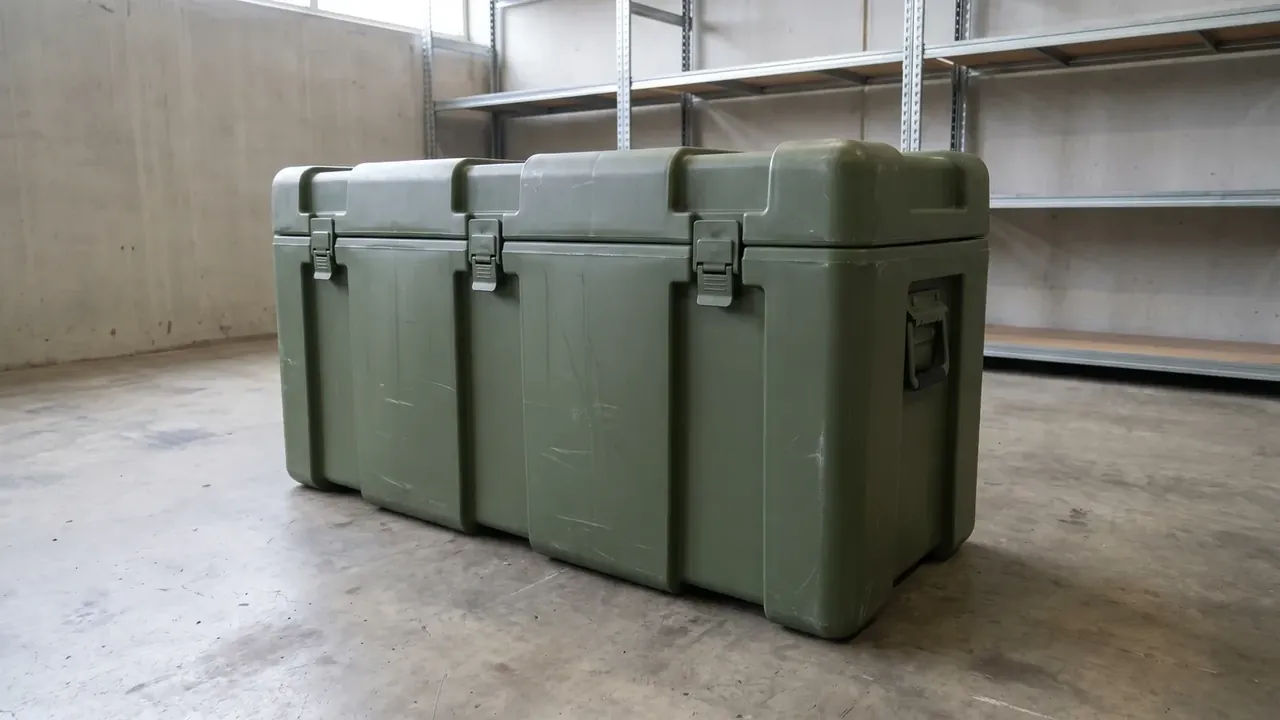
A 1.2 m six-face drop follows. Impact draws the lid corners inward, and a groove moving from 8.0 mm to 8.4 mm drops compression a grade even with an intact strip. Reading the undressed original parts gives the true floor of the lot.
Order matters: 5000 cycles for fatigue first, then the 1.2 m drop for structural shift, or drop distortion is booked as fatigue. Each round is logged at long edge, short edge and corners, judged at the lowest value against 17%. JUNZHIJIA files by cavity and KeXin New Materials (Guangdong) Co., Ltd. signs off compression and groove width before dispatch.
5. Groove-width scrap line for dustproof batches
Judgement is about batch spread, not one pass. Sampling takes three pieces per cavity at five stations; a groove outside 8.0 mm +/-0.3 mm scraps that piece, and more than two scraps quarantine the cavity. Groove width gets its own scrap line in a Dustproof Military Protective Case because good frames and latches hide it until the chamber test, when rework is too late.
Deposit values join the table: one in-tolerance batch splits into well seated pieces near 0.2 mg, shallow frames near 0.4 mg, and biased strips topping 0.6 mg and out.
| Deposit band | Pieces | Verdict |
|---|---|---|
| <=0.25 mg | 46 | release |
| 0.26-0.50 mg | 11 | release and recheck |
| >0.50 mg | 3 | scrap |
All three pieces above 0.5 mg came from the cavity with low corner compression, whose frame log shows 0.2 mm of sink. A Dustproof Military Protective Case therefore chains groove width, compression and deposit: width sets the ceiling, compression tracks decay, deposit closes the gate. JUNZHIJIA releases a batch only when all three clear.
Conclusion
Dust resistance in a Dustproof Military Protective Case rests on an 8.0 mm +/-0.3 mm twin-lip groove, 23% initial compression and a <=0.5 mg deposit after 2 h, with >=17% after 5000 cycles holding end of life. Width sets the ceiling, the frame evens the load, deposit closes the gate; chaining the three beats picking parts on one number. Checking each batch on both rigs and keeping records is what makes a Dustproof Military Protective Case consistent.
Related Reading
- How a dustproof case seals
- Gasket groove geometry
- Choosing a case seal strip
- Dustproof and waterproof case standards
Related Products
- 8 Series — Gun Cases; Military Equipment Cases; Camera Equipment Cases; Drone Cases; Watch Cases; Knife Cases; First Aid Cases; Electronics Equipment Cases
- WL8-2812 PP Gun Case — model WL8-2812
- All protective cases and toolboxes: 7 series, 158 models