


Quick answer: An ECG Monitoring Equipment Case is judged at the hinges: 2 pins of 4 mm, 20,000 cycles, holds at 95° and 120°, and play capped at 0.4 mm.
Table of contents
- Opening Rhythm of an ECG Monitoring Equipment Case
- Hinge Structure and Cycle Count
- Hold Angles and Detent Torque
- Sealing Take-Up at the Cable Ports
- Cycle Log and Replacement Limits
- FAQ
1. Opening Rhythm of an ECG Monitoring Equipment Case
Forty openings a day is ordinary here, and the latch is seldom what fails first; the hinge is. Every lift of the lid runs across the same pair of pins, so a 4 mm diameter carries all of the wear.
An ECG Monitoring Equipment Case does not open evenly. A hand-over lifts the lid a hand's width and closes it. A relocation opens it flat to 95°, a service session to 120°. The motions load the hinge differently: a lid opened a crack turns the pin a few degrees, a full sweep repeats one arc, and at 120° the mass passes the axis so the detent plate takes the moment.
| Opening cycle band | Openings per day | Hinge approach |
|---|---|---|
| Inspection band | Up to 8 | Standard 4 mm pin fit, gap checked twice a year |
| Shift band | 20 to 40 | Self-lubricating bush, quarterly gap check |
| Continuous band | Above 60 | Two hinges share the lid, hardened pin surface |
Forty a day becomes four figures a year: 250 working days gives 10,000, two years 20,000.
2. Hinge Structure and Cycle Count
In the 420 × 330 × 180 mm format the cavity measures 385 × 295 × 150 mm, and the ECG Monitoring Equipment Case carries 2 hinges along that length, each taking half the lid. The pin is 4 mm inside a self-lubricating bush; the 4.0 mm lid wall grows to 6.0 mm at the boss, or the screw holes crack first.
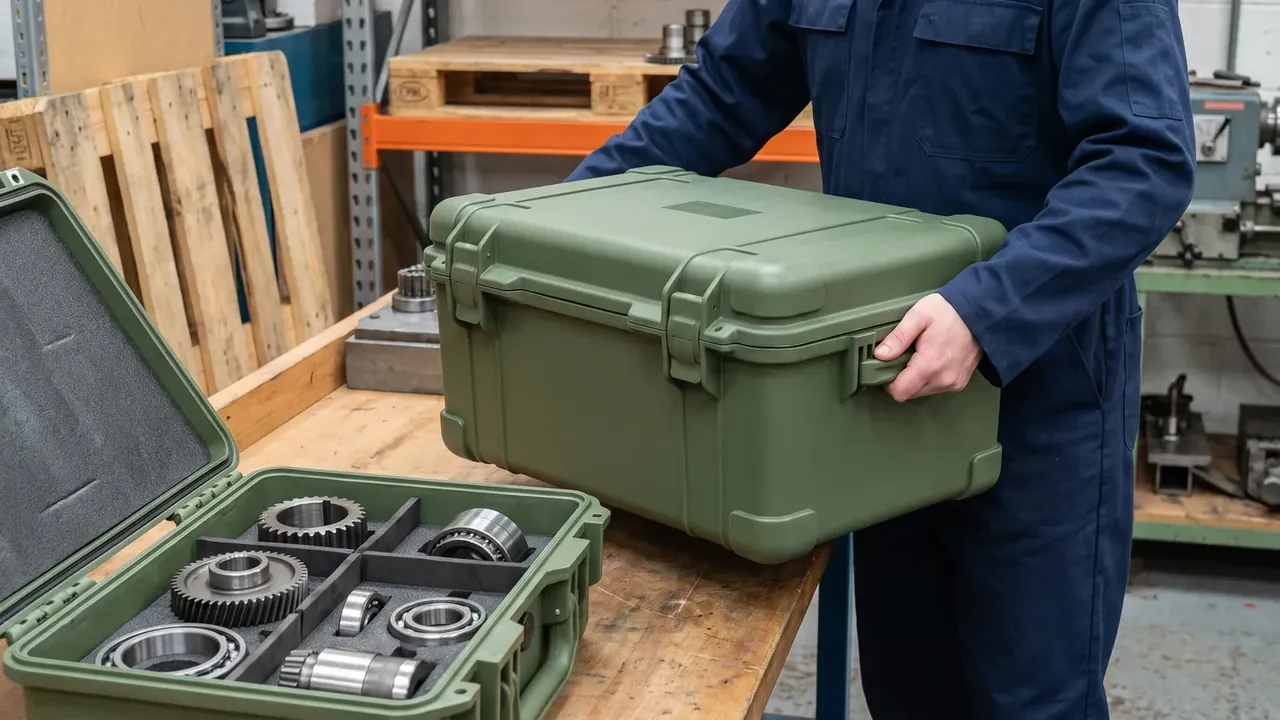
Initial play stays under 0.15 mm. Across a −10 ℃ to +55 ℃ window the hole in a PP lid moves about 0.1 mm, so a tighter fit stiffens the lid in the cold, a looser one lets it rock.
Pin hinges are accepted in two classes, 10,000 and 20,000 cycles. Four openings a day over five years comes to about 7,300, so the 20,000 class leaves double margin for light use. An ECG Monitoring Equipment Case at forty a day compresses that into two years, and only the higher class survives. Class first, structure second: a thickened boss, a bush with wall left in it, a hardened pin surface.
3. Hold Angles and Detent Torque
Only two holds exist on an ECG Monitoring Equipment Case, 95° and 120°. At 95° the lid stops upright and a released lid does not fall back; at 120° it passes the vertical by 30°, the mass sits outside the hinge line and the detent plate holds it.
Detent torque at 95° is 0.8 N·m, the least that stops a released lid sagging. Friction washers and a cam face supply it, not a spring: at −10 ℃ a spring lifts 0.8 N·m to 1.2 N·m, the lid feels heavy and the cam wears round sooner.
| Hold angle | Working posture | Detent torque |
|---|---|---|
| 95° | Standing pick, lid upright | 0.8 N·m |
| 120° | Bench service, mass past the axis | 1.0 N·m |
| Free angle | One hand on the lid | No detent, damping only |
At 120° the setting is 1.0 N·m, as the lever arm grows with the angle.
4. Sealing Take-Up at the Cable Ports
Two openings pierce the shell of an ECG Monitoring Equipment Case, both 22 mm cable ports on the lower edge of the short side. Sealing comes not from a gland nut cranked down but from grommet compression: a cap travel of 3 mm, about thirty percent compression.
That 3 mm is the shortening of the grommet as the lid closes. The bore closes from 22 mm to about 17 mm and grips the jacket. Too little and the cable slips; too much and the grommet takes a set, then the bore weeps.

Two latches of 260 N each pull the gasket down along the long sides. The jet test behind an IP65 claim runs a 6.3 mm nozzle at 12.5 L/min and 30 kPa from 3 m for 3 min; aimed down the jacket, a port is the softest link, so the exits sit low.
5. Cycle Log and Replacement Limits
A cycle log for an ECG Monitoring Equipment Case holds three columns: date, cumulative openings, radial play, read every 2,000 cycles with a feeler gauge from the hinge side.
| Hinge play | Measured where | Action limit |
|---|---|---|
| Under 0.15 mm | Pin to bush, radial | Normal, quarterly recheck |
| 0.15 to 0.4 mm | Same | Regrease, recheck monthly |
| Above 0.4 mm | Same | Swap the hinge set, retest torque |
Past 20,000 cycles with play beyond 0.4 mm, the detent torque at the hold angle falls below 0.5 N·m, because the lid mass drops onto the cam face and flattens the plate.
Stacking five high is a separate path: the lid sees static load, the hinge sees shear, so a sagging lid never appears in the log. The hinge set is under a tenth of the 5.2 kg case but decides the other nine tenths. A swap is lid off, pin out, bush renewed, 200 empty cycles, gap back under 0.15 mm.
Conclusion
An ECG Monitoring Equipment Case stands on three parts, the hinge pair, the detent angle and the cable port, while wall thickness only gets it in the door. Two hinges on a 4 mm pin, play under 0.15 mm, 0.8 N·m and 1.0 N·m at the holds: together they close the loop at 20,000 cycles. Past 0.4 mm of play, change the hinge set.
Related Reading
- The Usable-Volume Calculation
- Hard Case and Carton in Transit
- Structure Points for Hospital Transfer Cases
Related Products
- 8 Series — Gun Cases; Military Equipment Cases; Camera Equipment Cases; Drone Cases; Watch Cases; Knife Cases; First Aid Cases; Electronics Equipment Cases
- WL8-2812 PP Gun Case — model WL8-2812
- All protective cases and toolboxes: 7 series, 158 models