

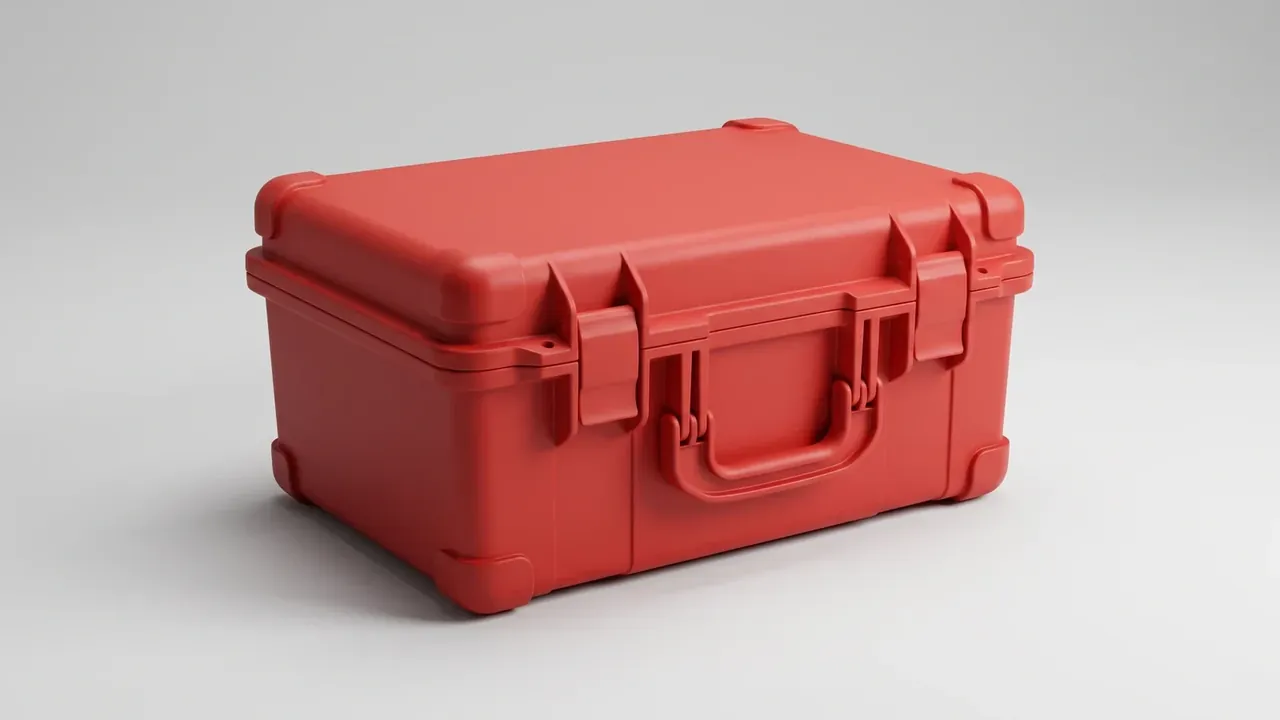
Quick answer: A CSSD transfer case has to survive 90 ℃ wash cycles and 134 ℃ steam without warping, then stay leak-free at IP67 while still wet.
Table of contents
- What Steam Cycles Do to the Material
- Sealing for Wet Transfer with Two Lips and a Drain
- Three Label Fields That Must Stay Legible
- Label Life and Stack Load
- Gasket Interval and Monthly Checks
- FAQ
1. What Steam Cycles Do to the Material
A CSSD transfer case meets temperature before it meets water. A washer-disinfector runs a wet cycle at 90 ℃ for 10 min; the autoclave holds 134 ℃ at 2.1 bar for 4 min. Six to eight loads a day adds up to more than 1500 heat shocks a year on the same shell.
Homopolymer PP deflects at 100–110 ℃ under 0.45 MPa, so the wash is comfortable. The steam stage is survived on dwell time: four minutes will not soften a 3.2 mm wall. The damage shows in the lid, where 500 cycles sag the centre by 0.6–0.9 mm, enough to break the seal line.
Two fixes exist. Four ribs under the lid, wall thickness raised from 2.6 mm to 3.2 mm, hold sag to 0.3 mm; a 316L tray at 0.8 mm carries the load path instead, at 5.4 kg rather than 3.2 kg.
The gasket is judged on two figures, continuous service temperature and compression set. EPDM runs to 120 ℃ continuous and 141 ℃ short-term; silicone to 200 ℃. EPDM is adequate at 134 ℃, provided compression set stays under 25% on ASTM D395 method B at 70 h and 100 ℃.
2. Sealing for Wet Transfer with Two Lips and a Drain
Wet transfer means the CSSD transfer case is pushed away with water still on the shell and drips coming off the tray. IP67, immersion at 1 m for 30 min, covers both the wash-down and the short soaking that follows.
A single lip fails when wet: surface tension carries a water film past the lip and into the groove. The workable layout is two lips, a main lip against the groove floor and a secondary O-ring outside it, with a 1.5 mm drain channel between them that empties through a 6 mm valve at 15° of tilt.
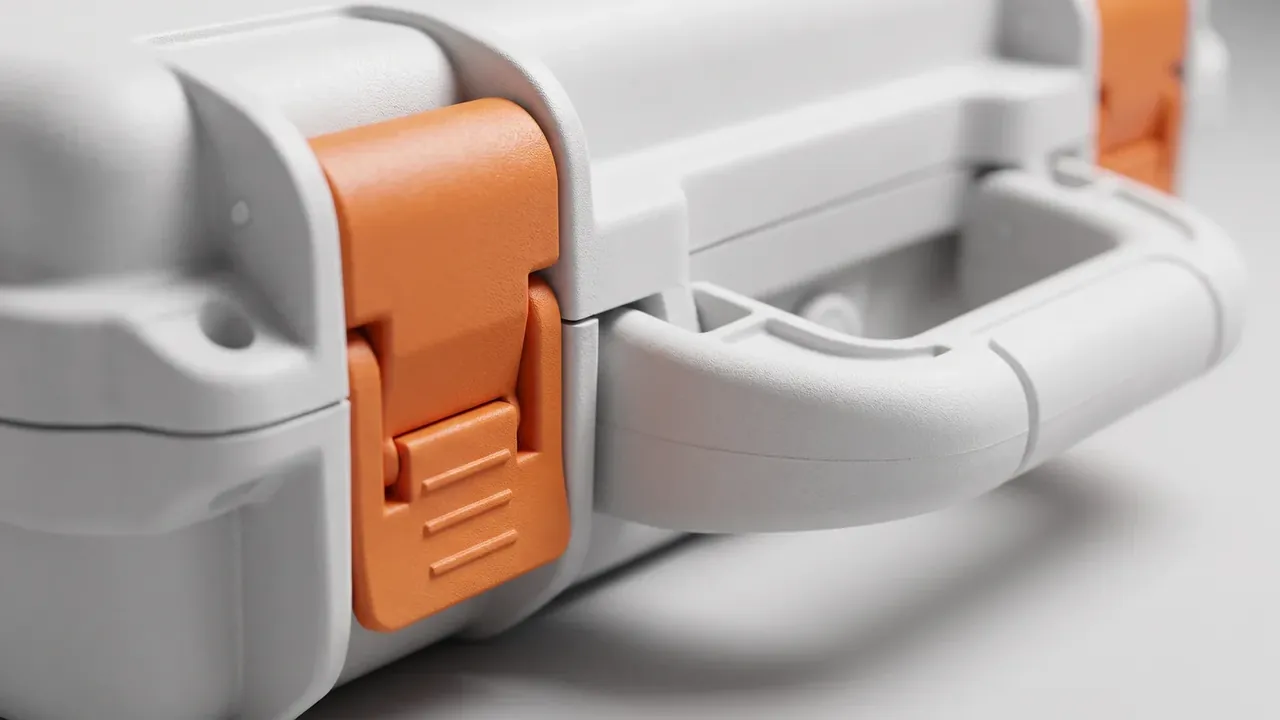
Pressure is the second problem. After sterilisation the interior sits 30–60 mbar below ambient, so the first moment of opening pulls air back through the seal face, water with it. A PTFE membrane vent in the lid, 0.2 μm pore, equalises without passing water.
Compression has to land between 25% and 30%. Under 20% the joint leaks; over 40% the gasket takes a permanent set and rebound drops to 60% after 200 closures.
3. Three Label Fields That Must Stay Legible
Labels on a CSSD transfer case answer three questions: where it goes, which load it belongs to, when it expires. Fixed format in a fixed location is what makes traceability work.
Position fails more often than content. A label on a raised panel is scraped off by the first case stacked on top, so it belongs in a recess 1.2 mm deep with a 3 mm margin.
| Field | Position and size | Format | Durability |
|---|---|---|---|
| Department | Lid recess, 80×50 mm | 4 digits + 2 letters | Legible at 3 m, 5 mm type |
| Steriliser load | Second line of recess | Date + 2-digit load | 134 ℃ for 4 min |
| Expiry | Lower edge, reversed out | Date, 6 digits | 50 wipes at 75% ethanol |
Type height is the hard number: 5 mm reads at 3 m, the limit for checking a case as the trolley passes; at 4 mm the reader stops and lifts it, and the check stops happening.
The data code goes on the side for a reason. Once four cases are stacked only the side wall is exposed, and a scanner at 20–30 cm reads a 30×30 mm code at 0.5 mm modules.
4. Label Life and Stack Load
Labels face alcohol, humid heat and steam. Fifty wipes with 75% ethanol is the routine figure; 48 h at 60 ℃ and 95% relative humidity stands in for a wet-season store room.
Standard polyester blisters at 134 ℃ as moisture in the adhesive flashes. Steam-durable stock uses a polyimide base at four to six times the unit price, so it goes on the two critical fields only.
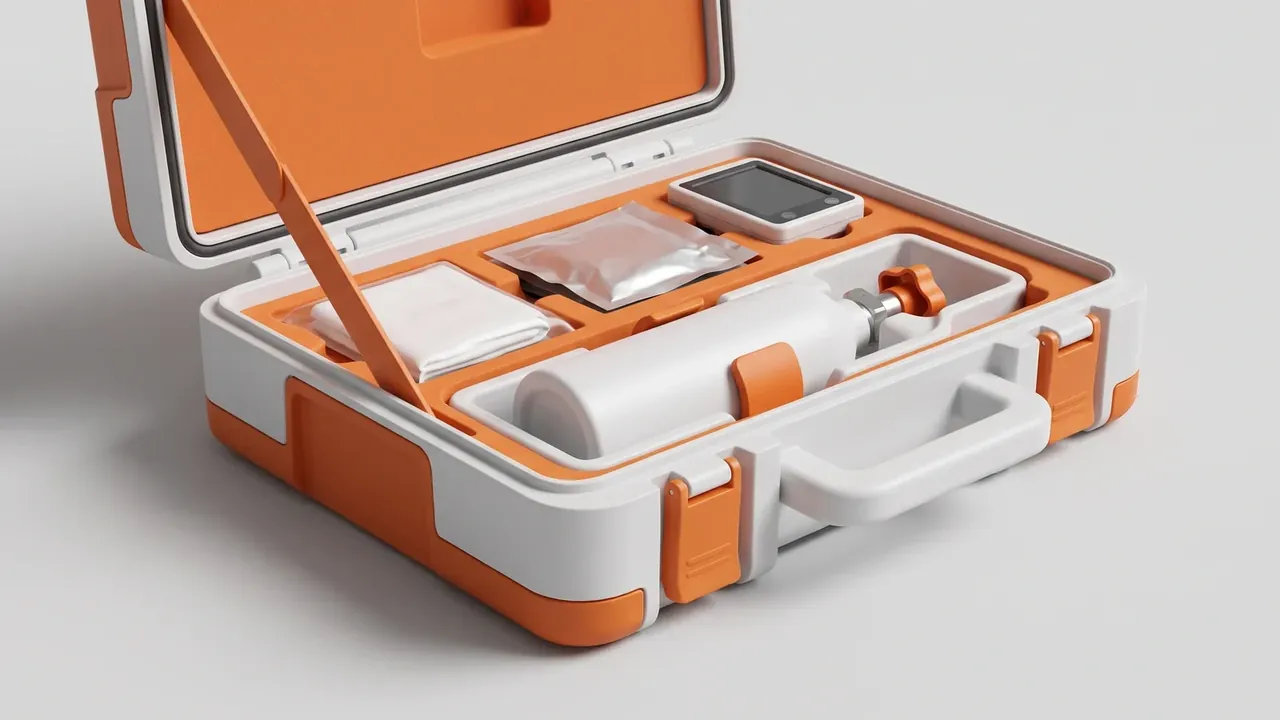
Stack load is a second set of numbers. A single case carries 25 kg on a 3.2 kg shell, and four-high stacking puts 100 kg on the bottom unit for 24 h with no more than 2 mm of deflection. A full CSSD transfer case is rated for a 1.2 m corner drop.
| Check | Value | Pass condition |
|---|---|---|
| Single case load | 25 kg | Handle at 500 N, no set |
| Stacking | 4 high | 100 kg for 24 h, ≤2 mm |
| Full drop | 1.2 m on a corner | No crack, latches hold |
| Gasket life | 500 cycles | Set ≤30% |
5. Gasket Interval and Monthly Checks
The gasket is replaced on whichever comes first, 500 sterilisation cycles or 12 months. At six loads a day, 500 cycles arrives in about three months, so the cycle count drives the schedule.
Monthly checks cover four items: set beyond 30%, hardness up 10 Shore A, a surface crack longer than 0.5 mm, or a joint that has lifted. Any one of them means replacement.
Fitting takes no tools: the old gasket lifts out of the channel, the new one presses in 30 cm at a time, corners mitred at 45°, and the job runs 2 min with spares at 10% of the fleet.
Conclusion
A CSSD transfer case is specified by the numbers that survive the loop: PP at 100–110 ℃ heat deflection and a ribbed 3.2 mm lid against 134 ℃ for 4 min; 25–30% gasket compression with a 6 mm drain and a 0.2 μm vent at IP67; a 1.2 mm recess and 5 mm type so department, load and expiry read at 3 m. Change the gasket at 500 cycles and stack four high at 25 kg each.
This article covers the case body only: material, sealing, hardware and marking. Nothing here addresses the handling, loading or use of anything carried inside.
Related Reading
- Cases built around autoclave cycles
- How medical device transport cases are built
- Medical case standards and acceptance
Related Products
- 8 Series — Gun Cases; Military Equipment Cases; Camera Equipment Cases; Drone Cases; Watch Cases; Knife Cases; First Aid Cases; Electronics Equipment Cases
- WL8-2812 PP Gun Case — model WL8-2812
- All protective cases and toolboxes: 7 series, 158 models