

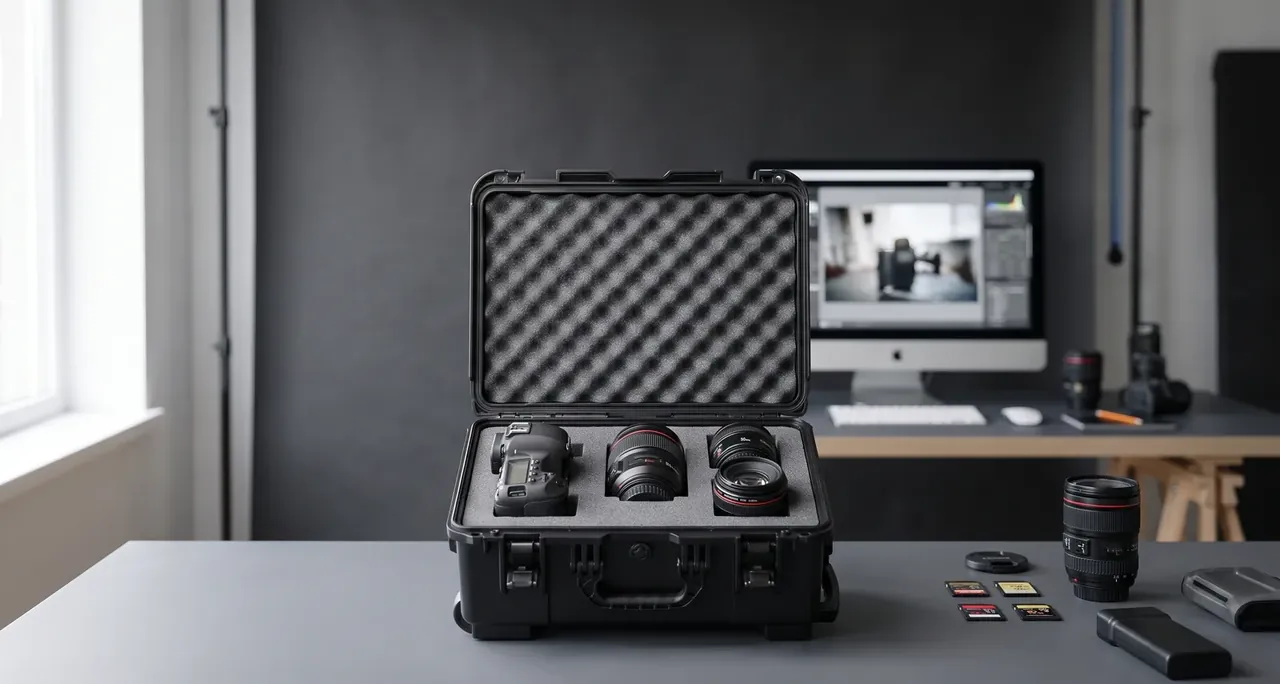
Quick answer: An EL camera case is accepted on two readings: under 0.1 lux with the lid shut, and 20±5 ℃ after 4 h of transport, held by 3 mm fleece and 25 mm foam.
Table of contents
- Why 0.1 lux Sets the Light-Tight Spec
- Black Fleece Lining and the Lid Layer
- Holding 20±5 ℃ with 25 mm Insulation and 400 g of PCM
- Lens Cap Slot, 1 g Vibration, 5 min to Mount
- FAQ
1. Why 0.1 lux Sets the Light-Tight Spec
The camera weighs 1.2 kg, the body measures 155×120×105 mm, the lens is φ80 mm and 110 mm long, and the shell is 460×350×190 mm at 6.8 kg empty, 9.5 kg loaded. None of this is about surviving a drop. An EL camera case has to solve darkness and temperature, because a drop ends one camera while stray light wastes the whole site visit.
A tenth of a lux is a low bar, roughly an 8 mcd indicator lamp 200 mm from the front element. Inside a closed case that much light lifts the background of a dark-frame capture, with no second pass.
The check runs in three steps. Nine meter points go inside, three in the lid, three on the walls, three on the base. The outside is lit to 800 lux by two 18 W tubes 500 mm away, the lid is shut, and every point is read after 10 min. All nine must sit below 0.1 lux; read too early and afterglow inflates the number.
Leaks appear at the lid joint, the catch seats and the cable port. Gasket compression seals the joint, a 2 mm light lip wraps each catch seat, and a φ12 mm plug closes the port; treat all three and the interior falls under 0.05 lux.
| Light path | Treatment | Reflectance | Limit |
|---|---|---|---|
| Lid lining | 3 mm fleece on 15 mm EVA | ≤2% | <0.03 lux |
| Side walls | Black cloth, taped seams | ≤3% | <0.05 lux |
| Lid joint | φ5.0 mm silicone at 3.8 mm | — | <0.08 lux |
| Catch seats | 2 mm light lip | ≤4% | <0.10 lux |
| Cable port | φ12 mm black plug | — | <0.10 lux |
The loosest cell, 0.10 lux, is reserved for catch seats and the port. Driving those to 0.03 lux needs a 5 mm lip and a closing force of 120 N, too stiff for one hand, and an operator who cannot latch the case carries it half closed instead.
2. Black Fleece Lining and the Lid Layer
Lining selection starts with reflectance, not colour. Matt black PVC sits near 8% and plain black EPE at 12%, and either pushes the interior above 0.3 lux under 800 lux outside. A 3 mm fleece drops to 2% and leaves 0.05 lux in the same test.
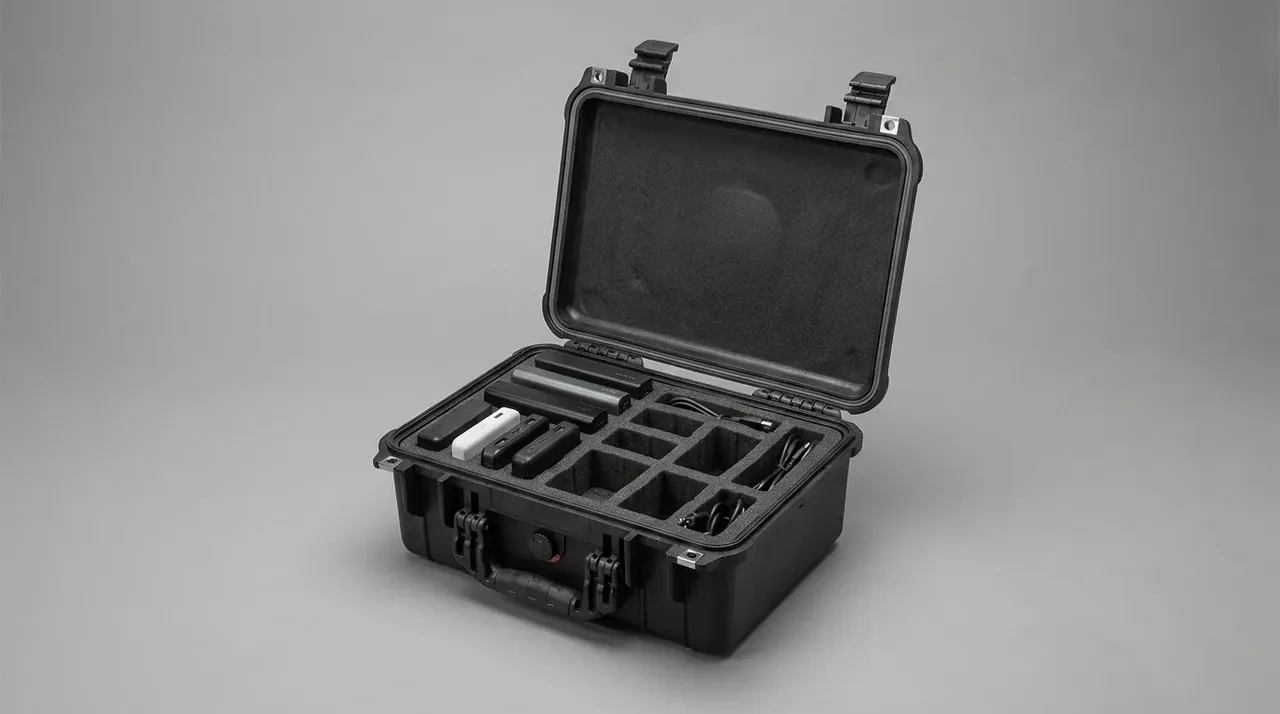
The lid layer is three parts stacked: 15 mm EVA formed to the curvature, 3 mm fleece bonded to it, pile facing inward. Six hook-and-loop tabs let the sheet peel off for washing. Fleece never touches the front element; a 10 mm gap stays between lens face and cloth, and foam absorbs small movement instead of glass resting on fibre.
The base is cut into six bays and two channels. The body bay is 170×130×115 mm with 8 mm corner radii, lens bays are φ85 mm at 120 mm deep, and two 380×45 mm channels take the hood and cables. Each bay keeps 5 mm of clearance, closed by a 10 mm EVA strip.
Fleece also absorbs water: across a wide temperature swing the pile holds the film instead of letting it settle on the glass. The trade is that a saturated lining loses about 30% of its light damping.
| Lens size | Bay diameter | Bay depth | Side clearance |
|---|---|---|---|
| φ60 mm | φ68 mm | 95 mm | 4 mm |
| φ80 mm | φ88 mm | 120 mm | 4 mm |
| φ100 mm | φ110 mm | 140 mm | 5 mm |
Clearance is small on purpose: 8 mm over the lens diameter is the ceiling, and under 4 mm a gloved hand cannot seat the lens.
3. Holding 20±5 ℃ with 25 mm Insulation and 400 g of PCM
Temperature is the harder half, since one case must survive winter and summer. A 4 mm PP wall carries 25 mm of XPE inside, and 400 g of phase-change material with a 21 ℃ melt point sits between bays. The wall takes impact, the foam slows heat flow, and the PCM absorbs or releases heat near 21 ℃ to pin the interior at 20±5 ℃.
Four hours outdoors at -15 ℃ takes the interior from 22 ℃ to 11 ℃, above the 10 ℃ floor. Three hours in a 45 ℃ container lifts it from 21 ℃ to 29 ℃, short of the 30 ℃ ceiling.
A logger rides inside, one reading a minute, 30 days of memory. The curve is for the site rather than the file: check the tail before opening, and if it has drifted toward 10 ℃ or 30 ℃, let the case sit indoors for 10 min first.
Humidity is handled at the same time: a 100 g desiccant pack and a humidity card sit in the lid, changed above 40% RH.
4. Lens Cap Slot, 1 g Vibration, 5 min to Mount
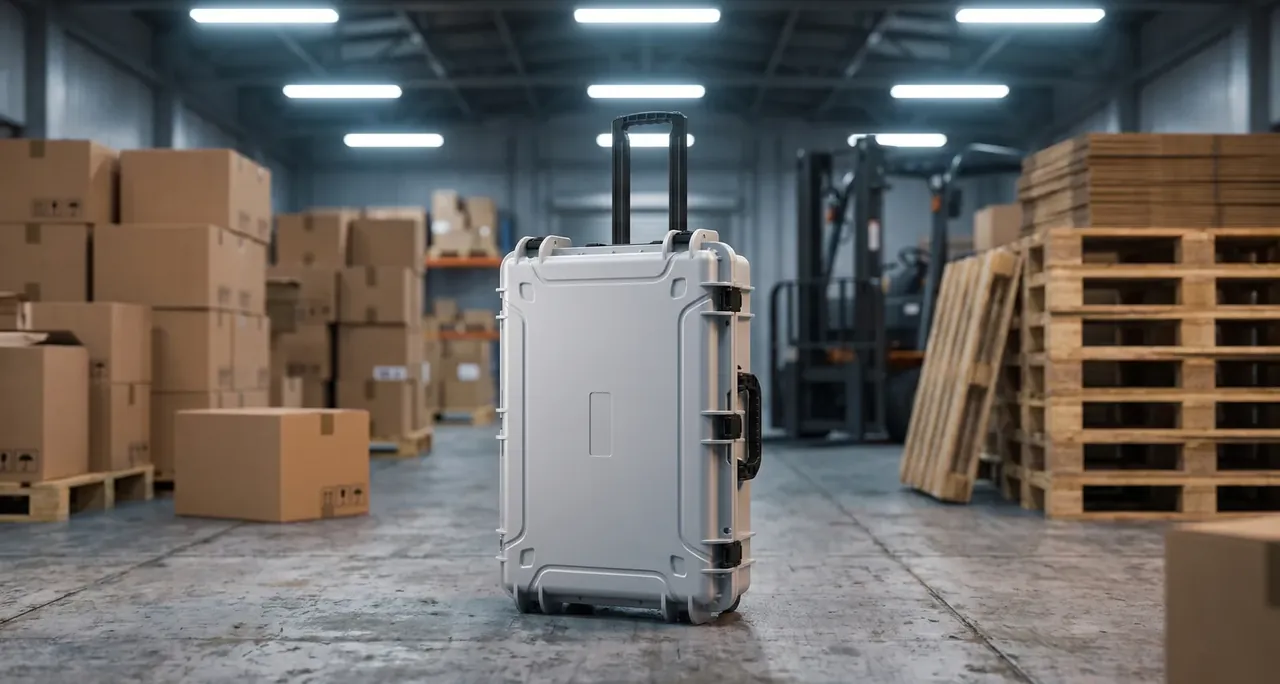
Transport posture comes first: the case stands upright, the handle extends, two 60 mm wheels carry the load, side grip only at a vehicle. Upright keeps the centre of mass near the axle and lets the case track straight for 200 m; it also means every bay needs a vertical stop, 5 mm above and below the body, with a 3 mm silicone washer under each lens.
Vibration runs at 1.0 g from 5–200 Hz for 30 min per axis, then mount play, screen marks and lining shift are checked. Two g also passes, but the wall grows from 4 mm to 5 mm and adds 0.6 kg.
The lens cap gets its own slot, φ95×25 mm, half the depth of a lens bay. Caps get lost, so the slot carries a 15 mm elastic strip that keeps the cap from swinging out with the lid, and an 8 mm recess so a reversed cap cannot sit flat.
Five minutes is the window between opening and shooting: 20 s for two catches, 60 s to lift the camera, 150 s to mount the lens, 230 s overall, leaving 70 s to wipe the element and set focus.
Conclusion
An EL camera case reduces to two figures: 0.1 lux inside, 20±5 ℃ throughout. In structure that means the 2% reflectance of a 3 mm fleece, a φ5.0 mm gasket squeezed to 3.8 mm, 25 mm of insulation matched to 400 g of PCM, and a 25 mm slot for the cap. Put those numbers on the drawing and the acceptance sheet, and the case earns its place.
This article covers only the enclosure (case) side of the specification and design intent, not any handling, loading or use of the items inside.
Related Reading
- Equipment lists for PV site inspection cases
- Bay layout and power for inspection instrument cases
- Choosing tote cases beside a module line
- Carrying and opening field inspection cases
Related Products
- 8 Series — Gun Cases; Military Equipment Cases; Camera Equipment Cases; Drone Cases; Watch Cases; Knife Cases; First Aid Cases; Electronics Equipment Cases
- WL8-2812 PP Gun Case — model WL8-2812
- All protective cases and toolboxes: 7 series, 158 models