

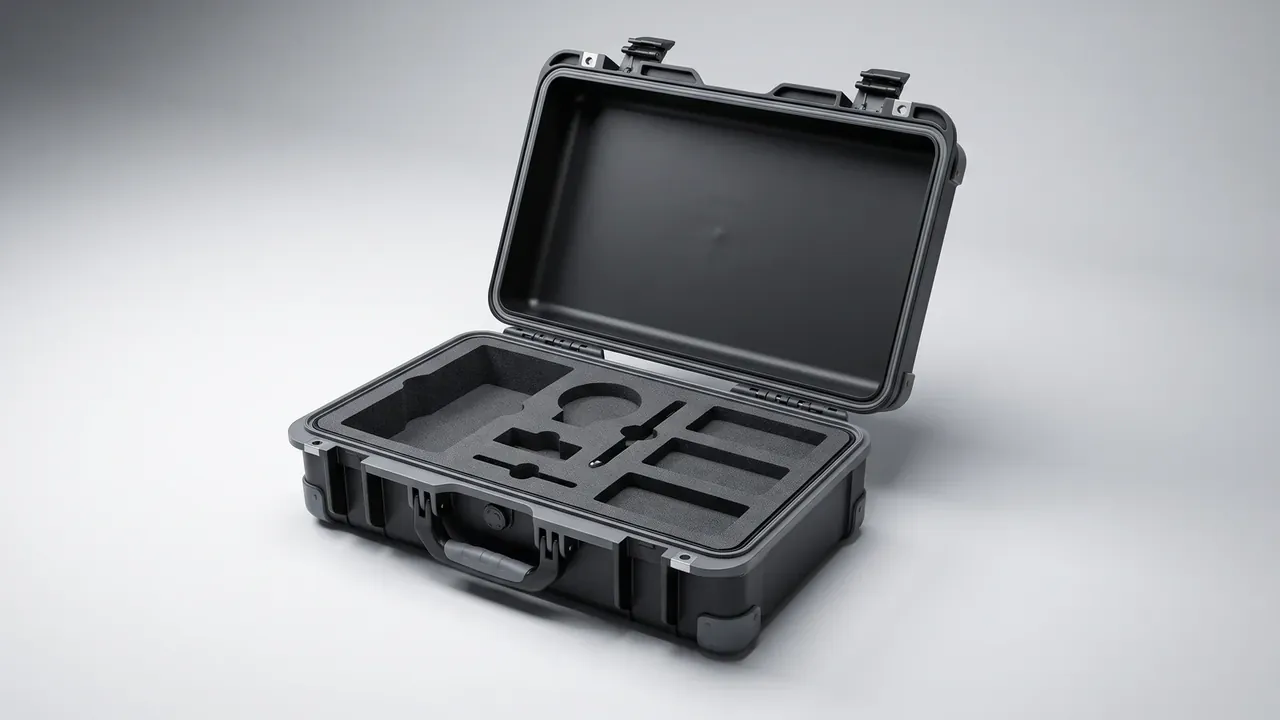
Quick answer: Test Equipment opens 30 times a day, so the case is won on dividers: a 300 × 180 × 80 mm bay, six probe slots and 8 mm dividers at 18 kg loaded.
Table of contents
- Why Access Beats Protection
- Dividers: Three Bays, One Lid
- Envelope, Weight and Carry Distance
- Sealing, Heat and Recovery Time
- FAQ
1. Why Access Beats Protection
A 100 MW farm holds 4000 strings, a two-person crew surveys about 400 modules a day, and the case opens 60 times. Test Equipment sits inside for only 20% of the trip; the rest is lid up, hand in, lid down, so count the openings first and set the IP rating later.
Time per opening adds up. A meter in its own bay takes 3 seconds from lid to grip; one buried under the cable coil takes 11, so 60 openings a day is 8 minutes in which April dust packs the gasket lip.
The meter is drawn 60 times a day against 18 for the probes, yet fills only 41% of the volume, so splitting bays evenly costs 5 seconds on every opening.
2. Dividers: Three Bays, One Lid
Three things order the layout: outline, grip, cable length. Meters run 240 × 130 × 45 mm, so the main bay is 300 × 180 × 80 mm with 30 mm of finger room per side, enough for a glove. Six probe slots take 40 × 40 × 60 mm, and the cable bay is 120 mm clear for 20 m wound in a figure eight.
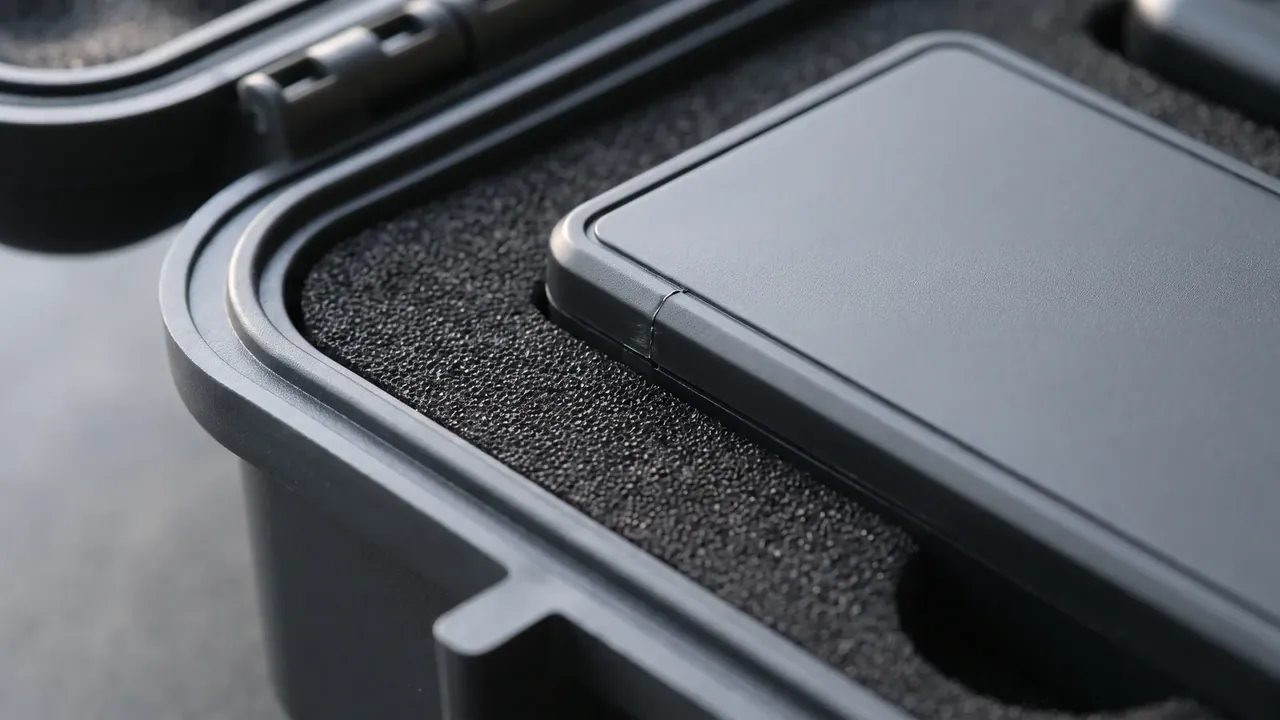
Eight millimetres is the divider compromise. At 5 mm they lean 6 mm under an 18 kg one-handed carry and deform the case pockets; at 12 mm they hold but eat 4 mm of finger room and the meter stops coming out.
| Bay | Footprint | Clear size | Clearance | Access |
|---|---|---|---|---|
| Main | 240 × 130 × 45 mm | 300 × 180 × 80 mm | 30 mm | Lift out |
| Probe | Six at 28 mm | Six at 40 × 40 × 60 mm | 6 mm | Drop in upright |
| Cable | 20 m of 4 mm² lead | 120 × 260 × 70 mm | Against wall | Figure eight |
| Accessory | 150 × 80 × 30 mm | 180 × 100 × 40 mm | 15 mm | Lay flat |
Foam sets the feel. Closed-cell PE at 30 kg/m³ gives about 4 kPa at 10% compression, enough to hold a meter and soft enough for a glove, while 45 kg/m³ stiffens the pocket until a winter glove cannot dig the meter out.
Bay depth sets the closing order. An 80 mm bay against a 45 mm meter needs 30 mm of egg crate in the lid; a 60 mm bay against 55 mm probes leaves 5 mm.
3. Envelope, Weight and Carry Distance
Two constraints fix the envelope: a 1500 mm pickup bed with a 500 mm tailgate, and racks standing 1500 mm off the ground. At 560 × 420 × 230 mm two cases sit abreast with 340 mm to spare and slide under a rack without stooping; at 100 mm wider only one fits.
Loaded, these Test Equipment cases reach 18 kg on a 25 mm handle, and the walk from truck to mid-array is 200 m, so the shell carries a second end handle and crews alternate hands out to 400 m.
Stacking and tie-down go together. Two cases side by side leave 60 mm for a strap, and four 12 mm feet lift the shell off the bed so gravel vibration enters the feet, not the walls; a third case on top puts 54 kg on the bottom one.
Balance matters as much. The 2.1 kg meter sits under the handle and the 3.4 kg coil at the far end, tipping the Test Equipment case 8 degrees one-handed until the cable bay moves to the middle.
4. Sealing, Heat and Recovery Time
At noon in July a backsheet reads 65 °C, and a case left on gravel reaches 55 °C inside; a 10 mm foil shade drops that to 42 °C, after which an IR camera needs 20 minutes to settle to 25 °C ambient, lid open, the pocket holding the body upright.
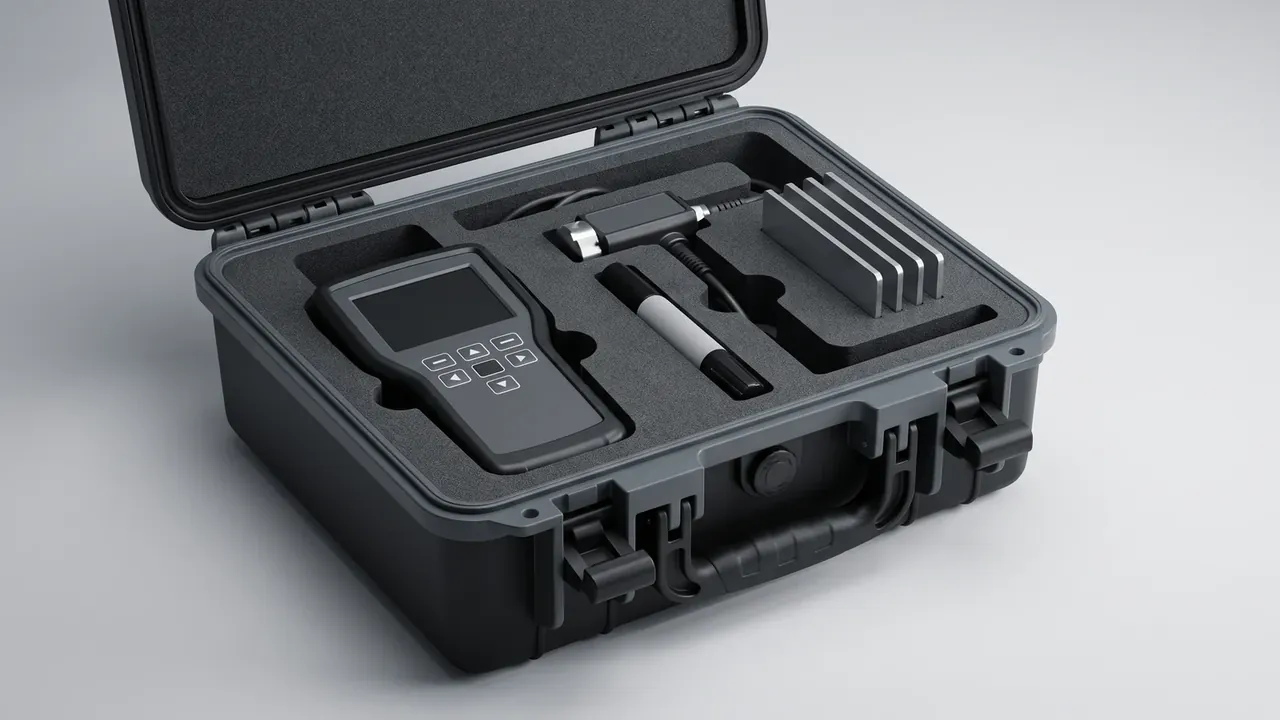
Sealing is IP67: an 8 × 4 mm silicone gasket at 25% to 30% compression, with a valve opening at 8 kPa so a farm at 1500 m stops fighting the lid. At 30 openings a day the lip is checked every 500 cycles, with a new gasket every two years inland.
| Condition | Outside | Inside | Settle time | Action |
|---|---|---|---|---|
| July noon, no shade | 38 °C | 55 °C | 35 min | Move to shade |
| July noon, foil shade | 38 °C | 42 °C | 20 min | Open to cool |
| Winter dawn | -5 °C | -3 °C | 15 min | Open slowly |
| Wet morning | 28 °C | 30 °C | 25 min | Swap desiccant |
Winter is the row crews ignore. At -5 °C the gasket hardens by 7 points and latch effort climbs from 1.8 kg to 2.6 kg, so release one catch, wait 10 seconds, then the second.
Desiccant is sized by volume: 40 litres takes two 50 g packs and 6 hours to fall from 85% to 45% humidity. Four 40 × 60 mm reflective labels and a 200 mm clear sleeve for the survey sheet belong to the shell too.
Conclusion
Configuring a case for test equipment means turning 60 openings a day into clearances: a 300 × 180 × 80 mm main bay with 30 mm of finger room, 8 mm dividers, six 40 × 40 mm probe slots, a 560 × 420 × 230 mm shell at 18 kg, and IP67 with an 8 kPa valve. Get those five numbers right and nobody upends the case in the field.
This article covers case-side specifications and design implications only, and does not address any handling, loading or use of the contents.
Related Reading
- Bays and transport for new-energy site gear
- Totes and fixture boards on module lines
- Instrument cradles for energy test gear
- Case sets for new-energy inspection crews
Related Products
- 8 Series — Gun Cases; Military Equipment Cases; Camera Equipment Cases; Drone Cases; Watch Cases; Knife Cases; First Aid Cases; Electronics Equipment Cases
- WL8-2812 PP Gun Case — model WL8-2812
- All protective cases and toolboxes: 7 series, 158 models