

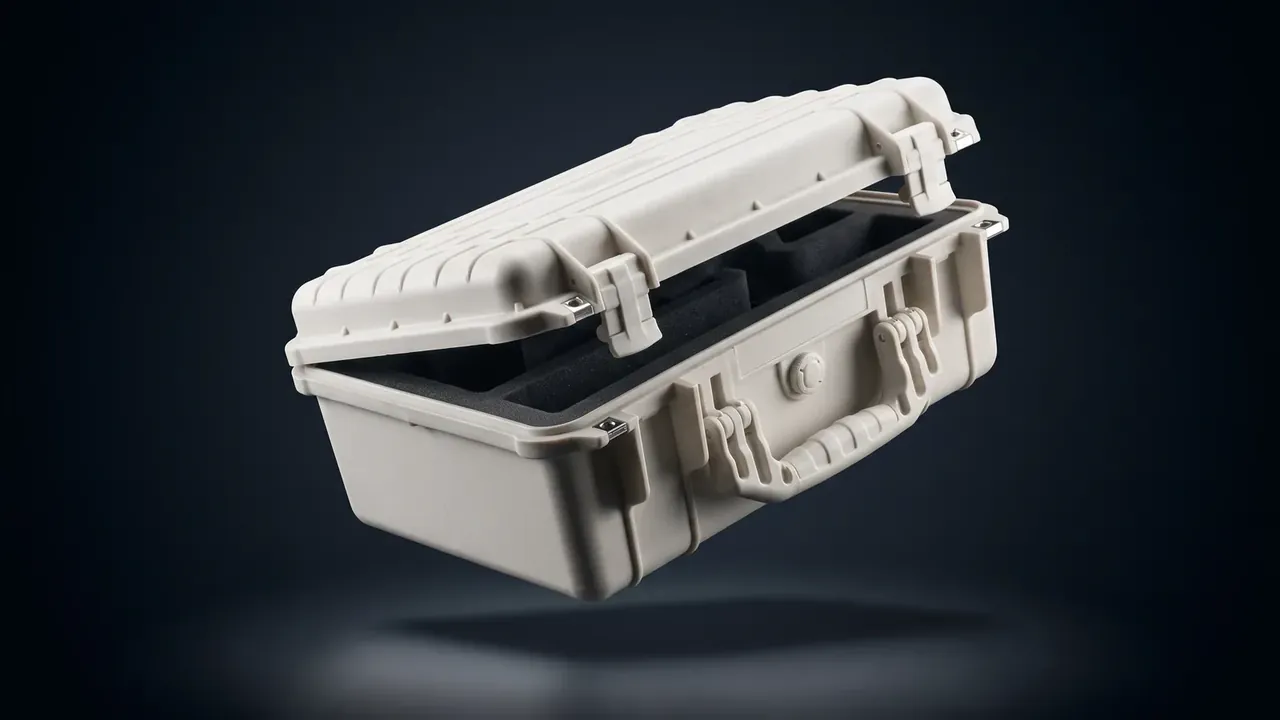
Quick answer: Electric Vehicle Repair Tool Case design starts at 80 kΩ for an 800 V pack, while storage humidity decides the rest of the margin.
Table of contents
- Tool Isolation Requirements for High-Voltage Work
- Storing and Inspecting Insulated Tools
- Packing Density for Sockets and Dedicated Bits
- The Shell in Oil and Coolant Environments
- Moving From the Bay to the Lift
- FAQ
1. Tool Isolation Requirements for High-Voltage Work
The first layer of protection for high-voltage tools is the way they go back into the case. Before any connector is unplugged, gloves and sockets have spent 8 h in that box, and the dust in the cutouts comes out with them.
Electric Vehicle Repair Tool Case isolation is built in three layers. One part per pocket keeps steel off steel. Twenty millimetres of EVA keeps cutting edges off the wall, and four feet lift the base 15 mm clear of wash-down water. Insulating boards are sampled at 1 kV proof voltage, with no metal fastener bridging board and wall.
The insulation floor comes from pack voltage. A DC circuit is counted at 100 Ω/V, which gives 40 kΩ at 400 V and 80 kΩ at 800 V. Those are legal minimums, not acceptance targets; healthy parts sit in the tens of MΩ. A case is never tested as a unit, yet its behaviour over 8 h decides whether a tool still reaches that line.
Voltage class stays separated inside an Electric Vehicle Repair Tool Case. Tools are chosen at the 1000 V DC class and gloves at 1000 V, never mixed. Bus capacitance above 1000 μF stores about 80 J at 400 V, and falling below 30 V after shutdown takes 3 min to 5 min.
The feet are the layer dropped first and attacked first.
2. Storing and Inspecting Insulated Tools
Storage has two rules: a fixed pocket and the right orientation. Sockets stand with the edge up and gloves lie flat in the lid pocket, not under the tools above. A crease is a discharge path at 1000 V, invisible until tested.
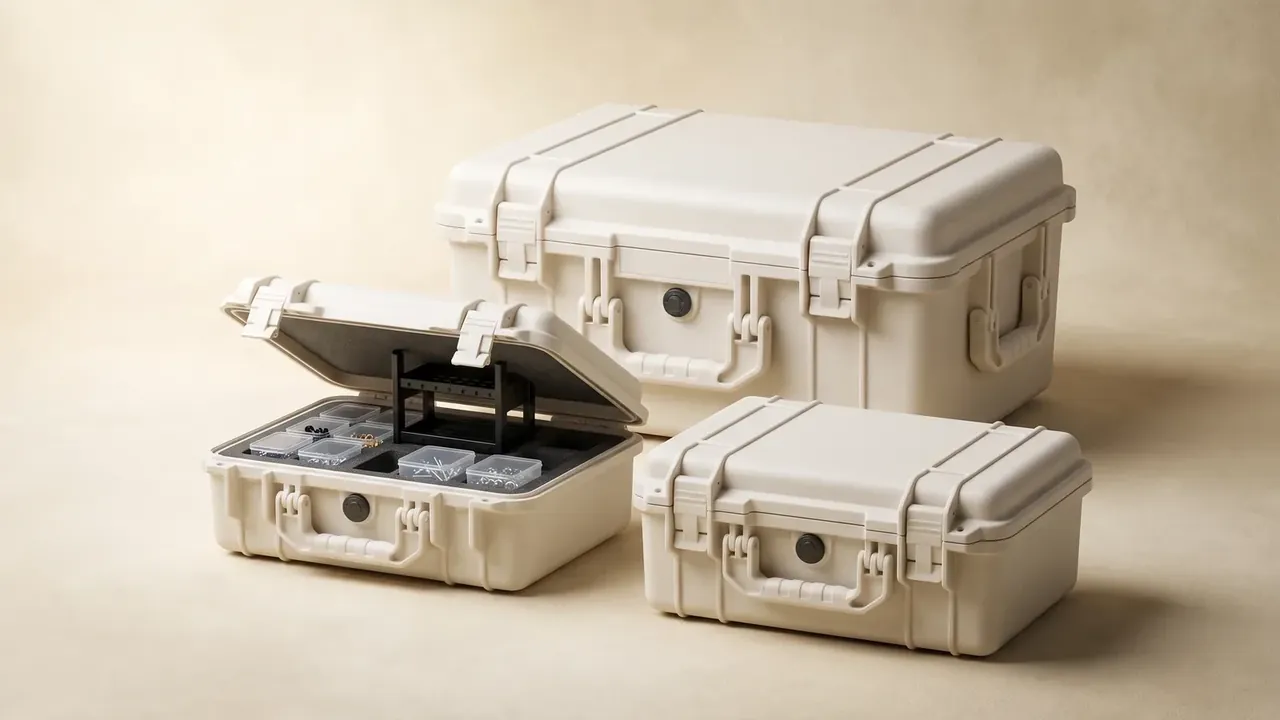
The rejection line is a scratch deeper than 0.2 mm on an insulated tool surface, or humidity inside the case above 60% RH for 8 h straight; either one takes the kit out of service for inspection.
Inspection runs on a cadence: appearance on every return, glove airtightness per shift, latch force monthly. Humidity is logged by a patch recorder, and a reading above 60% RH means fresh desiccant. The lid of an Electric Vehicle Repair Tool Case holds the log card and the gloves only, since anything hard under it will mark the panel.
| Check | Interval | Limit |
|---|---|---|
| Insulation surface | every return | scratch ≤ 0.2 mm |
| Glove airtightness | once per shift | holds 30 s inflated |
| Latch holding force | monthly | ≥ 200 N |
A tool taken off goes straight into its pocket, never onto the lid or the floor; a socket that touched the ground is wiped, because grit in EVA scratches the next part.
3. Packing Density for Sockets and Dedicated Bits
Density is worked backwards from pick time. A high-voltage teardown swaps sockets 12 times, and at 2 s each that is 24 s gone. With fingers landing on the part the cycle falls to 1.5 s, and the same 12 swaps save 6 s.
Density is not tightness. Sockets from 10 mm to 32 mm sit by outside diameter with a 3 mm finger gap, one part in a 30×30 mm pocket, so 24 parts fill a 240 mm × 90 mm field. Tighter and fingers must dig, at 4 s per pick.
Weight follows density. At a 25 kg load the centre of gravity stays within 30 mm under the handle; pile sockets on one side and 30 m of carrying puts the wrist into compensation. The folding handle on an Electric Vehicle Repair Tool Case uses an 8 mm hinge pin, which keeps the palm from pinching.
| Category | Unit mass | Per layer | Pick time | |
|---|---|---|---|---|
| Socket 10–32 mm | 0.12 kg | 30×30 mm | 24 | 2 s |
| Extension bar | 0.35 kg | 20×200 mm | 6 | 3 s |
| Dedicated bit | 0.28 kg | 45×45 mm | 12 | 4 s |
4. The Shell in Oil and Coolant Environments
Material choice begins with water uptake. PP stays below 0.03% after 24 h, so a wash-down does not soak the wall. HDPE shrinks 1.5%–3.0%, which makes deep cavities less stable. ABS at 1.04–1.06 g/cm³ is hard but less oil-resistant.
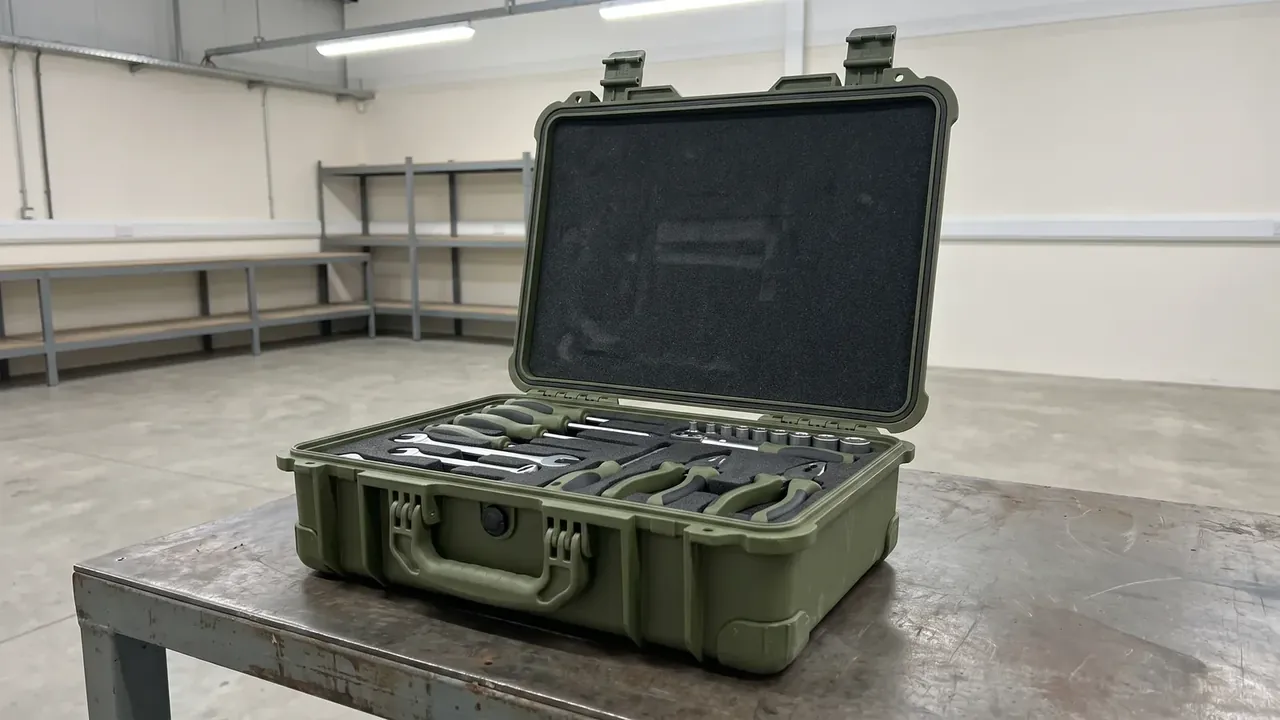
Sealing is judged on spray, not immersion alone. IP67 means dust-tight plus 1 m of water for 30 min and excludes jetting, while a pressure washer corresponds to IPX5 and IPX6, with 6.3 mm and 12.5 mm nozzles at 2.5 m to 3 m. A shell marked IP67 is not thereby proof against a lance.
Coolant is the second line of attack. Glycol creeps into a pocket, does not evaporate, and stays in the EVA cells. A TPE gasket at Shore A 50–60 with 25%–30% compression loses rebound once swollen, and the second closure no longer seats. Pockets are built without blind bottoms and carry a 2 mm drainage channel.
Oil is wiped, not washed: a rinse pushes the film deeper into the pockets. Clean below 40 ℃ and leave the lid open 30 min.
5. Moving From the Bay to the Lift
Travel for an Electric Vehicle Repair Tool Case runs about 30 m, and the trouble sits in the thresholds. A 25 kg load over a 100 mm step has to be lifted to 350 mm, which doubles the lumbar moment; four φ50 castors bring the push force down to 15 N.
Latches handle anti-opening. With lid inertia at three times its weight, a 25 kg case stopping in 0.2 s sees nearly 375 N, so holding force is set above 200 N and split across two latches.
Carrying and pushing are separate duties for an Electric Vehicle Repair Tool Case. Under 30 m, push; over 30 m, load the van. The base carries four wheel bosses, and once wheels are fitted the wall at each boss gains 1.5 mm.
The case parks 500 mm outside the lift column on a floor that falls at 1%, so wash water runs off and the feet stay dry.
Related Reading
- Socket and wrench tool case shell for auto repair
- Industrial auto repair plastic latch briefcase
- Industrial waterproof and oil-resistant tool case
JUNZHIJIA
Related Products
- 8 Series — Gun Cases; Military Equipment Cases; Camera Equipment Cases; Drone Cases; Watch Cases; Knife Cases; First Aid Cases; Electronics Equipment Cases
- WL8-2812 PP Gun Case — model WL8-2812
- All protective cases and toolboxes: 7 series, 158 models