

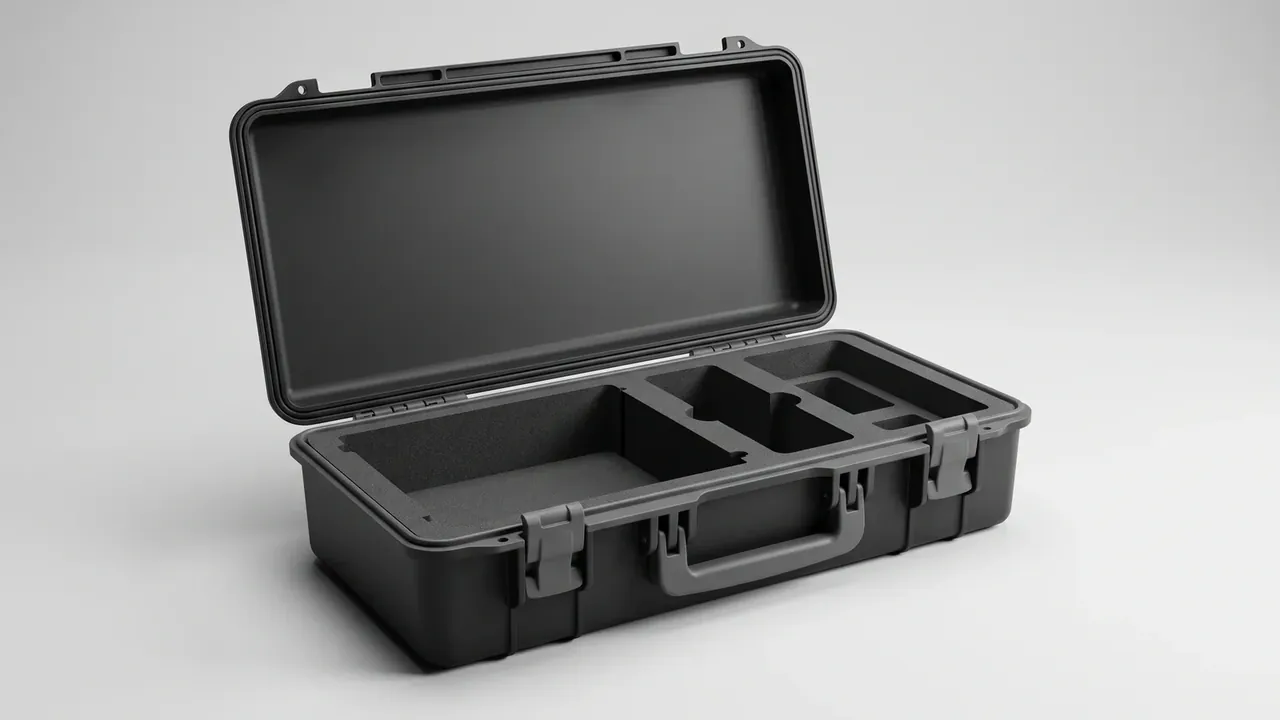
Quick answer: On a route that starts at -20 C in a cold truck and ends at 55 C beside an unshaded cabinet, an Electronic Equipment Case is judged by three quantities you can measure in the yard: lid deflection under load, gasket recovery time, and latch retention under side load.
Table of contents
- The Failure Order Inside a Cold Truck
- Three Measurements You Can Take On Site
- Turning Equipment Weight Into Wall and Latch Count
- Loading and Stacking Decide Your Rework Rate
- FAQ
1. The Failure Order Inside a Cold Truck
At six in the morning a 12 kg field logger goes into a truck at -20 C, travels three hours over 40 km of broken gravel, then sits beside an unshaded cabinet where the skin reaches 55 C by mid afternoon. One round trip across a 75 C spread exposes every weakness of an unsuitable Electronic Equipment Case.
The order of failure is almost fixed: soft first, loose second, sagging last. The gasket loses elasticity in the cold, leaving a gap nobody sees. Latches then fight each other on gravel, polishing bright marks into the hooks and rattling even when closed. Finally the lid creeps down until it touches the harness.
None of the three appears at the lid. They surface later as bit errors, reboots or drift. Site inspection should run in reverse: lid first, gasket second, latches last.
| Failure point | Trigger | Signal visible on site |
|---|---|---|
| Gasket | Six hours at -20 C, then opened | Crease does not recover in 10 s, 0.2 mm feeler enters lid line |
| Latches | Three hours of gravel, about 1.5 g lateral | Bright wear on hooks, gap remains after closing |
| Lid | Three-high stack, 40 kg on top | Centre sags over 3 mm, presses on harness |
2. Three Measurements You Can Take On Site
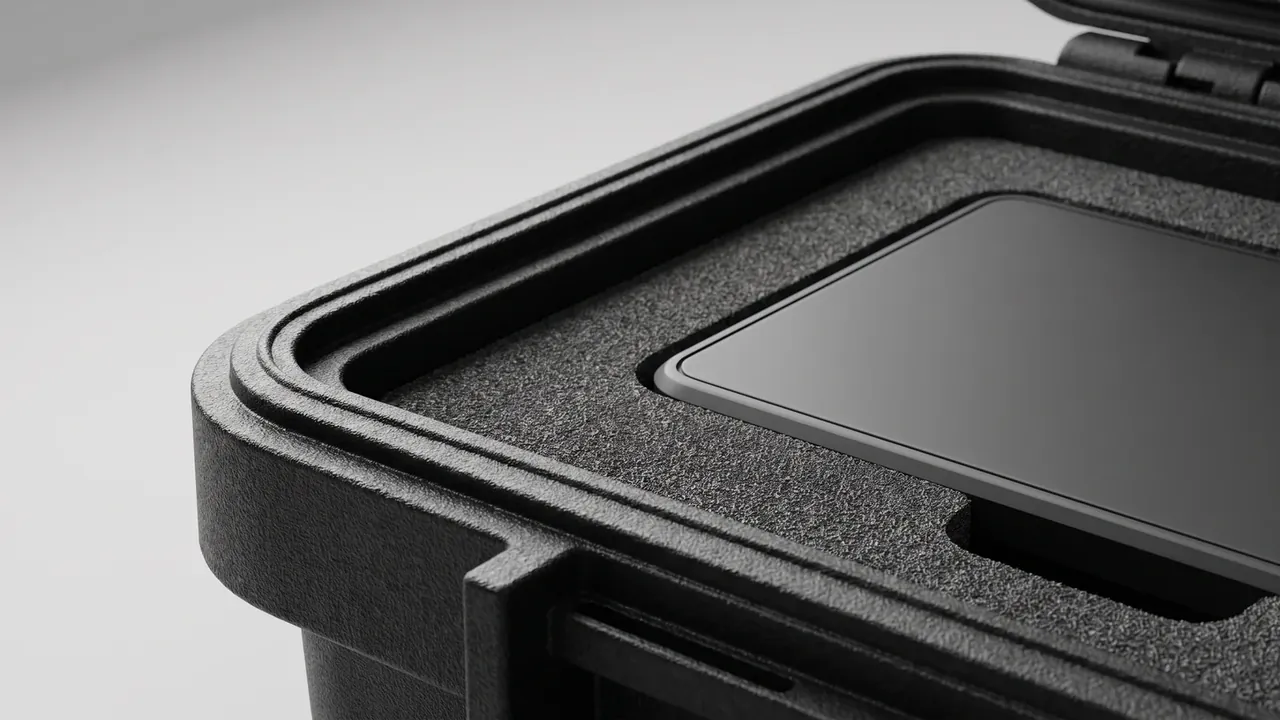
Test lid stiffness with the sandbag. Latch the case, drop the bag on the centre of the lid, bridge a straight edge across the diagonal and read the gap. A 4 mm wall gives 2 mm to 3 mm of deflection; a 3 mm wall reads 6 mm or more, and the lid then meets your hardware instead of the side walls.
Test the gasket by recovery. Trap a sheet of paper between lid and rim, then pull. Resistance should be even around the perimeter; a side that feels suddenly slippery is your future water path.
Test latches with a sideways push. Lay the case flat, close both, push the lid sideways with your palm. Movement above 1 mm means the hook does not engage deep enough and vibration walks it open.
Order of judgement
- Lid deflection above 5 mm: change wall thickness, do not fix it with more foam
- Paper pulls out with no resistance: change compound, silicone over plain rubber
- Sideways latch movement above 1 mm: thicker catch or two-point engagement
- All three pass but the case weighs over 9 kg: move to a thinner ribbed shell
3. Turning Equipment Weight Into Wall and Latch Count
Wall thickness follows from payload, stack height and transport mode. The table is a starting band to correct with measurements.
| Equipment weight | Suggested wall | Latches | Foam thickness | Handling |
|---|---|---|---|---|
| Under 8 kg | 3.5 mm | 2 | 20 mm | One person, short road trips |
| 12 kg to 25 kg | 4.5 mm | 2 to 3 | 25 mm | Two people, under 500 km |
| 30 kg to 45 kg | 6.0 mm | 4 | 40 mm | Forklift or two-plus, incl. rail |
The real criterion is the ratio of wall to payload: 8 kg on 3.5 mm is about 0.44, while 45 kg on 6.0 mm falls to 0.13. A falling ratio tells you the large sizes carry load through ribs and latch count, not through extra plastic.
If a supplier quotes wall thickness but not rib height and latch depth, the rating on that Electronic Equipment Case is not verifiable. Ribbed mouldings run about forty percent stiffer in bending at the same nominal wall.
4. Loading and Stacking Decide Your Rework Rate
The same case laid flat and stood on edge do not share a life span. Lying flat with the lid up, weight runs down the walls into the truck bed and the lid carries almost nothing. Stood on edge, the whole load sits on latches and hinge, the thinnest plastic on the product.
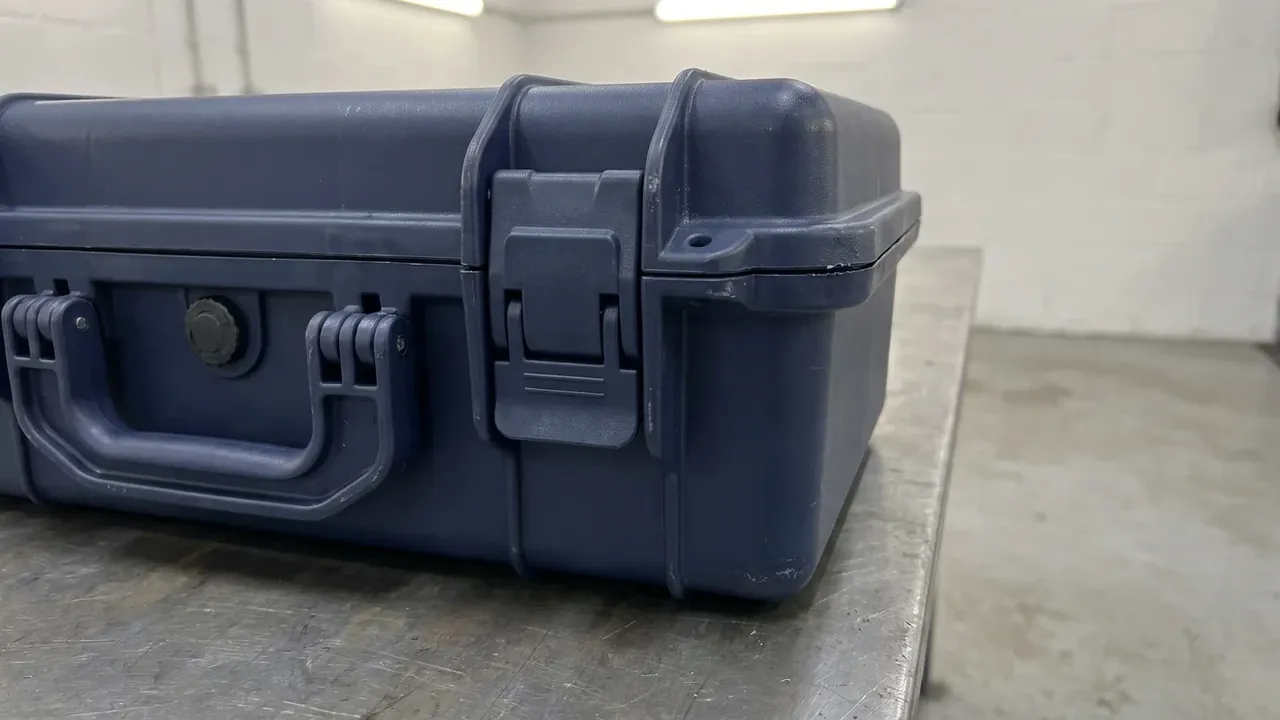
Stack height has to match the shell. A ribbed lid takes three high, the middle unit carrying about 80 kg. A flat lid creeps at the second layer, and that creep never fully recovers.
Transport mode decides the valve. Road freight has small pressure swings, so a plain breather is enough. Air freight changes pressure fast, and without a differential valve the gasket is drawn inward in flight.
Ask for evidence of a three-high side-stack held for 72 hours; a supplier without that record has probably never run it on that Electronic Equipment Case.
Conclusion
Across a 75 C spread and 40 km of gravel, an Electronic Equipment Case is judged by lid deflection, gasket recovery and latch movement, all measurable with a sandbag, a card and a hand. Convert payload into wall and latch count by ratio, then ask for side-stack records, not a datasheet. The rework rate follows the numbers you took in the yard, on that Electronic Equipment Case.
This article discusses only the container (case body) side of specifications and design intent, and does not cover any handling, loading or use of the contents.
Related Reading
- Shielding, grounding and heat paths in an electronic equipment case
- Field testing and data logging use of an electronic equipment case
- A general selection framework for equipment cases
Related Products
- 8 Series — Gun Cases; Military Equipment Cases; Camera Equipment Cases; Drone Cases; Watch Cases; Knife Cases; First Aid Cases; Electronics Equipment Cases
- WL8-2812 PP Gun Case — model WL8-2812
- All protective cases and toolboxes: 7 series, 158 models